Charlotte Square: Edinburgh's Georgian Masterpiece in the New Town
Charlotte Square sits at the west end of George Street as the architectural crown of Edinburgh's first New Town. Designed by Robert Adam in 1791 and completed in 1820, the square is a free, publicly accessible streetscape and a key part of the city's UNESCO World Heritage Site.
Quick Facts
- Location
- West end of George Street, New Town, Edinburgh EH2
- Getting There
- West end of George Street, New Town, Edinburgh EH2
- Time Needed
- 20–40 minutes to walk and observe; longer if visiting the Georgian House at No. 7
- Cost
- Free to view as a public streetscape; central gardens are private and normally closed to the public
- Best for
- Architecture enthusiasts, Georgian history, New Town walking routes, photography
- Official website
- ewh.org.uk/charlotte-square
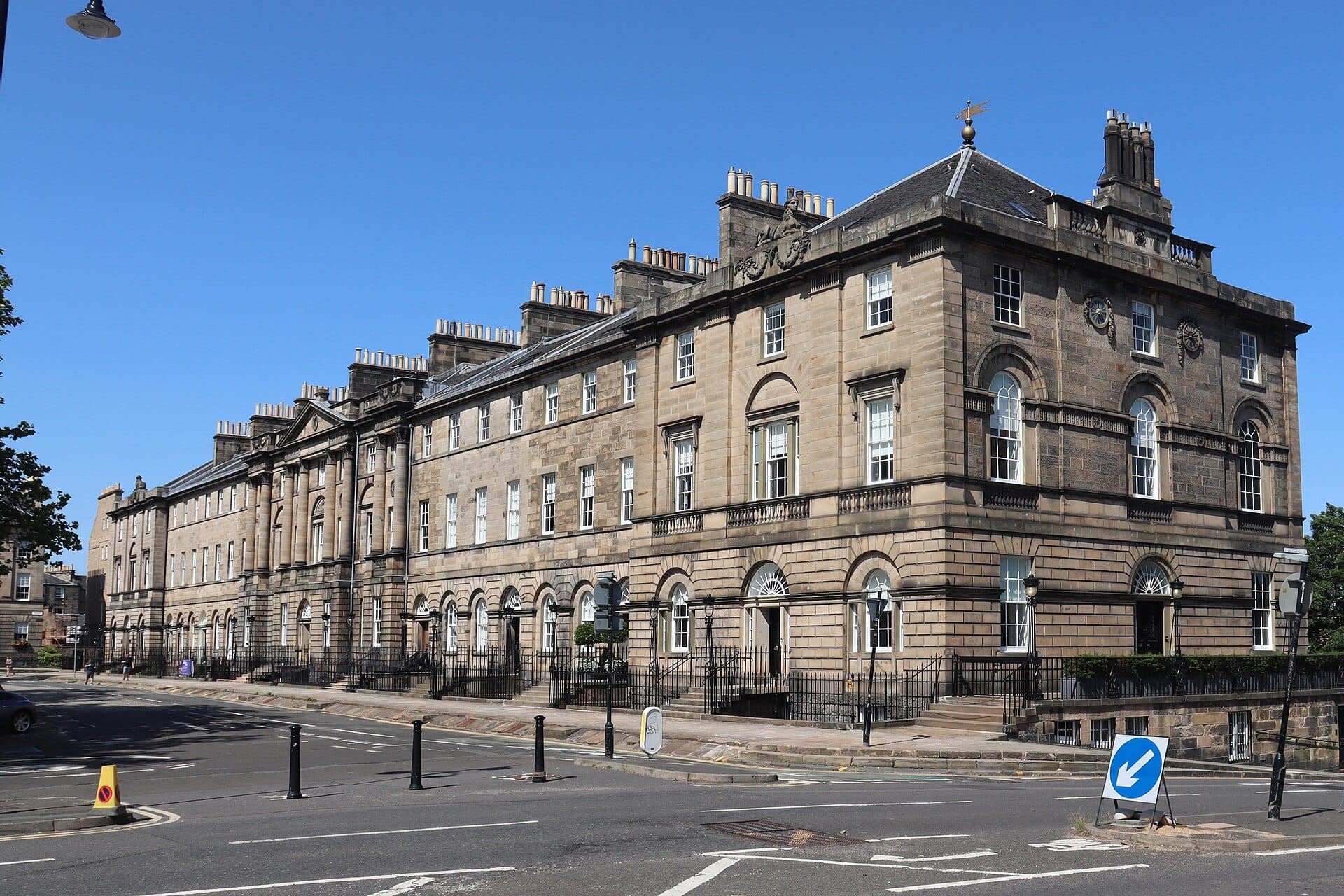
What Charlotte Square Actually Is
Charlotte Square is a formal Georgian garden square in Edinburgh's New Town, positioned at the west end of George Street. It forms the western terminus of the grid that defines the first phase of New Town planning, and it is the most architecturally coherent of the city's Georgian squares. The perimeter is lined with stone townhouses designed as unified palace-fronted terraces, the kind of integrated civic vision that was unusual for its era and remains impressive today.
The square is not an attraction in the ticketed sense. There is no entrance gate, no visitor centre, and no admission fee. What you are visiting is a place of architectural record — a streetscape so well preserved that it requires almost no explanation. You walk around it, look up at the facades, and understand immediately what Georgian Edinburgh set out to achieve.
The central garden is private, managed by residents, and is not generally accessible to the public. It has been open during special events, including Edinburgh's Doors Open Day and, historically, as the venue of the Edinburgh International Book Festival until that event relocated around 2019 to 2020. On an ordinary visit, you view the garden through its iron railings from the surrounding pavement.
ℹ️ Good to know
The Georgian House at No. 7 Charlotte Square is a separate National Trust for Scotland property with its own opening hours and admission charges. It offers interior access to a restored Georgian townhouse and is the most detailed way to understand how the square's residents once lived. Check the National Trust for Scotland website for current details before visiting.
The Architecture: Robert Adam and the New Town Vision
The story of Charlotte Square's design begins with a name change. James Craig's original 1766 plan for Edinburgh's New Town called the western square St. George's Square, but this was renamed Charlotte Square before construction was complete, partly to honour Queen Charlotte, consort of King George III. The renaming reflects how the square was conceived from the start as a civic statement rather than just a residential development.
In 1791, the town council commissioned Robert Adam to design the townhouses lining the square. Adam brought a key idea to the project: rather than designing individual house facades, he treated each terrace as a single palace front, with a central pediment, rusticated ground floors, and consistent window proportions running the full length. The result is a unified visual mass that reads as one grand building rather than a row of separate properties. This approach, borrowed from English Baroque precedents but applied with Georgian restraint, is what elevates Charlotte Square above the other New Town squares.
Adam died in 1792, the year after his designs were commissioned, and he did not live to see the project realised. Construction continued under other hands, and the square was not fully completed until 1820, making it the last section of Edinburgh's first New Town to be finished. The north side, where the Georgian House sits, is considered the most faithful realisation of Adam's original intentions.
Tickets & tours
Live prices and dates from our booking partner. If you book, we may earn a commission at no extra cost to you.
West Highland Lochs, mountains and castles tour from Edinburgh
From 61 €Instant confirmationFree cancellationLoch Ness, Glen Coe and the Highlands tour from Edinburgh
From 66 €Instant confirmationFree cancellationDay Trip to Holy Island, Alnwick Castle and Northumbria from Edinburgh
From 60 €Instant confirmationFree cancellationLoch Ness Explorer Day Trip from Edinburgh
From 60 €Instant confirmationFree cancellation
How the Square Feels at Different Times of Day
Early morning, before 8am, Charlotte Square belongs to dog walkers circling the garden railings and the occasional runner cutting through from the West End. The stone facades catch the low northern light well, especially on clear days, and this is when the colour of Edinburgh's sandstone registers most clearly, a warm honey-gold when the sun is at a low angle, a cooler grey when the sky closes over. Traffic is light, and the proportions of the square are easier to appreciate when the surrounding streets are quieter.
By mid-morning the square picks up office workers, as a number of professional services firms and public bodies have addresses here. The area has a quiet, purposeful energy rather than the tourist-heavy atmosphere found a few minutes east along the Royal Mile. This is genuinely useful to know: Charlotte Square sits within the New Town but feels more residential and professional than the main visitor corridors, which makes it an easier place to stop and look without navigating a crowd.
Late afternoon light, particularly in spring and autumn, is the most photogenic window. The west-facing garden side receives direct sun from roughly 3pm onward, and the iron railings and central planting cast long shadows across the paving. In winter, the square empties out quickly after dark and can feel quiet to the point of solitude, which has its own appeal for anyone who wants to experience the New Town without the summer tourist rhythm.
Historical Context: Part of the UNESCO World Heritage Site
Charlotte Square is one component of Edinburgh's Old and New Towns, designated a UNESCO World Heritage Site in 1995. The designation recognises the contrast between the medieval organic pattern of the Old Town and the rational planned grid of the New Town, and Charlotte Square sits at the apex of the New Town's first phase. Understanding the square properly means understanding the ambition behind the New Town project as a whole: Edinburgh in the 1760s was attempting to build a modern city alongside its medieval core, and the result became one of the most studied examples of 18th-century urban planning in Europe. For a broader grounding in that story, the Georgian House at No. 7 provides context that the exterior alone cannot.
The square also carries a layer of political and cultural memory. It has served as a residential address for figures associated with Scottish public life, and It has served for decades as the home of the Edinburgh International Book Festival, which occupied the central gardens every August and turned the square into a temporary literary village until the festival moved in 2019.
Walking the Square: A Practical Approach
Most visitors approach Charlotte Square from the east, walking west along George Street from the main shopping and café area of the New Town. The walk from Princes Street takes around ten minutes on foot. Charlotte Street and Young Street also connect north from Queen Street if you are approaching from that direction.
The most useful circuit is a simple clockwise walk around the square's perimeter, which takes about fifteen minutes at an unhurried pace. The north side offers the clearest view of Adam's intended palace-front composition. Pause in front of the Georgian House (No. 7) and look left and right along the full terrace to see how the composition works as a single unit. The south side is slightly less uniform but still coherent. The west side, facing West Register House (formerly St George's Church) (now a venue), closes the square with a different architectural character, as the church replaced an earlier design.
Photography works best from the middle of the square's access roads, where you can frame a full terrace without foreground obstructions. A wide-angle lens or a phone in standard mode is fine for capturing the full north facade. For detail shots of the doorway ironwork, cornices, and window glazing bars, get close and look for the repetition that makes the design coherent.
💡 Local tip
Wear comfortable shoes with grip. The paving around the square includes older cobbled sections that can be slippery when wet, which is a realistic possibility in Edinburgh at any time of year. A light waterproof layer is practical for any New Town walking route.
Fitting Charlotte Square Into a Wider New Town Itinerary
Charlotte Square works best as part of a longer walk through the New Town rather than a standalone destination. A logical sequence from here is to walk east along George Street, calling in at the Scottish National Portrait Gallery on Queen Street, then continue down to Princes Street and Princes Street Gardens before heading up the Mound toward the Old Town. This route covers the main architectural spine of the first New Town without requiring any transport.
If your interest runs toward Georgian social history, consider pairing the square with the Georgian House visit and then heading north to Stockbridge for a feel of how the residential New Town bleeds into a more relaxed neighbourhood character. The transition from the formal grid to the looser streets of Stockbridge takes less than ten minutes on foot and gives a useful sense of the New Town's edges.
Who Should Skip This
Charlotte Square requires an interest in architecture or Georgian history to feel worthwhile on its own terms. Visitors looking for interactive experiences, interior access, or a story told with museum-style interpretation will find the square itself underwhelming. It is, fundamentally, a row of stone buildings around a locked garden. The payoff is entirely visual and historical, and it is a quiet, reading-between-the-lines kind of payoff.
Families with young children may find little to hold attention here beyond the walk through. The gardens are not accessible, there is no play space, and the square does not have the drama of, say, a castle on a volcanic rock. It rewards patience and prior knowledge more than it rewards spontaneous discovery.
Insider Tips
- The best single viewpoint for photography is from the pavement directly in front of No. 7 on the north side, looking east along the full terrace. The unified palace-front composition becomes immediately clear from this angle.
- If you visit during Edinburgh's Doors Open Day in September, some buildings around the square occasionally open to the public. Check the Doors Open Day Edinburgh programme each year for current participants, as it changes annually.
- West Register House (formerly St George's Church) on the west side of the square is architecturally different from Adam's terraces and is worth a look from outside. West Register House (formerly St George's Church) on the west side of the square is architecturally different from Adam's terraces and is worth a look from outside.
- The plaques mounted on some of the townhouse facades record former residents and occupants. Reading them as you walk is a low-key way to build a picture of the square's social history without needing a guidebook.
- Early Sunday mornings in spring and autumn offer the quietest and most atmospheric experience of the square. Traffic is near zero, the light is often good, and the scale of the architecture registers in a way it cannot when buses and delivery vehicles are moving through.
Who Is Charlotte Square For?
- Architecture and design enthusiasts interested in 18th-century Georgian urbanism
- Photographers looking for well-preserved Georgian streetscapes with good natural light
- Walkers building a comprehensive New Town itinerary on foot
- Visitors to the Georgian House at No. 7 who want to understand the exterior context first
- Travellers who appreciate urban history and want to move at their own pace without a guided structure
Nearby Attractions
Other things to see while in New Town:
- Calton Hill
Rising 103 metres above central Edinburgh, Calton Hill is a free, 24-hour public park packed with monuments, volcanic geology, and some of the most complete city panoramas in Scotland. It takes under 20 minutes to reach from Princes Street on foot, and the views repay every step.
- Edinburgh Christmas Market
Spread across East and West Princes Street Gardens and George Street, Edinburgh's Christmas runs from mid-November to early January each year. Entry is free, the backdrop is Edinburgh Castle, and the atmosphere shifts dramatically depending on when you arrive.
- Edinburgh Gin Distillery
Opened on 6 December 2024, the Edinburgh Gin Distillery at The Arches on East Market Street is the brand home of one of Scotland's most recognised craft gins. Set inside dramatic stone vaulted arches beneath historic railway arches near Waverley, it offers tastings, tours, and a retail experience rooted in the city's growing reputation for artisan spirits.
- Georgian House
Designed by Robert Adam and completed in 1796, The Georgian House at 7 Charlotte Square is one of Edinburgh's most precisely restored historic interiors. Managed by the National Trust for Scotland, it offers a floor-by-floor portrait of upper-class life at the height of the New Town's golden age.
Planning a trip? Discover personalized activities with the Nomado app.