Royal Observatory Edinburgh: Stargazing, History, and Views from Blackford Hill
Perched on Blackford Hill about two miles south of the city centre, the Royal Observatory Edinburgh is a working astronomical research institution with a visitor centre open to the public through guided events, stargazing sessions, and lectures. Its twin copper domes, completed in 1896, frame some of the finest views across Edinburgh, and the hill itself is worth the trip even on a cloudy night.
Quick Facts
- Location
- Blackford Hill, Edinburgh EH9 3HJ (south of the city centre)
- Getting There
- Lothian Buses to Observatory Road or King's Buildings; ample on-site parking (postcode EH9 3HJ)
- Time Needed
- 1.5 to 3 hours depending on event type
- Cost
- Varies by event; check the official Visitor Centre site for current GBP pricing
- Best for
- Astronomy enthusiasts, families, photographers, and anyone wanting a quiet hilltop escape
- Official website
- visit.roe.ac.uk
What Royal Observatory Edinburgh Actually Is
The Royal Observatory Edinburgh is not a museum in the conventional sense. It is an active research institution, home to the Institute for Astronomy at the University of Edinburgh and several UK Astronomy Technology Centre teams. Scientists working here contribute to telescope design and cosmological research. Public access runs through a dedicated Visitor Centre and a programme of ticketed events, which means your experience on any given day depends heavily on what is scheduled.
That context matters for planning. Unlike a standard attraction with fixed daily hours, the observatory opens its doors to the public in a more deliberate, curated way: evening stargazing sessions, daytime tours, public lectures, and occasional school holiday events. The upside is that what you get when you visit tends to be genuinely informative and led by people who work in astronomy rather than actors in period costume.
⚠️ What to skip
Do not turn up unannounced expecting walk-in access. Public events require advance booking through the Visitor Centre website. Check visit.roe.ac.uk for the current programme before making the trip.
The Building: Victorian Ambition in Copper and Stone
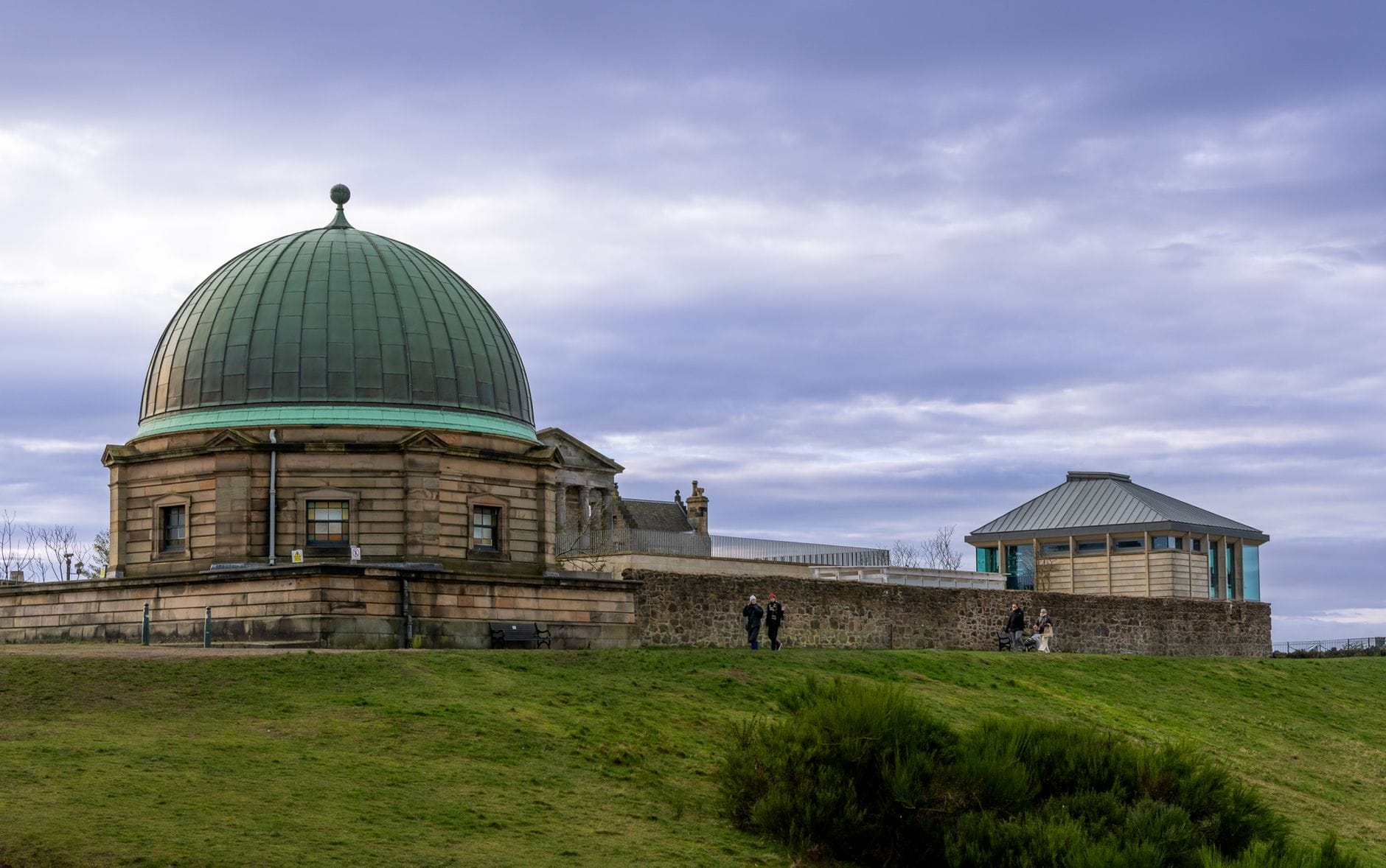
The complex on Blackford Hill was constructed between 1894 and 1896, and the observatory building was completed in 1896.[3] It includes laboratories, offices, a library, and two rotatable domes clad in copper, each housing telescopes. The copper has weathered to the familiar green-grey patina you see in photographs, and the domes sit at 146 metres above sea level,[4] giving the whole structure a commanding presence against the southern Edinburgh skyline.
Architecturally, this is a serious piece of late-Victorian institutional design: solid, purposeful, and built to last. The proportions are confident without being showy. Up close, the scale of the domes becomes clear in a way that photographs do not convey. Standing beneath one, looking up at the mechanism that allows the entire structure to rotate, it is easy to understand why this was considered one of the most technically advanced observatories in Britain when it opened.
The observatory's lineage is older than its current building. The Royal Observatory's history in Edinburgh traces back to 1776, when the foundation stone was laid for the original observatory on Calton Hill, closer to the city centre.[1] The move to Blackford Hill at the end of the nineteenth century, completed in 1896,[3] was driven by the need for darker, cleaner skies and better seeing conditions, away from the growing gas and coal haze of the Victorian city.
If you are interested in the earlier Calton Hill site, it is now operated as the City Observatory by Collective Gallery. The two sites tell complementary chapters of Edinburgh's astronomical story. You can read more about that hilltop in our guide to Calton Hill.
Tickets & tours
Live prices and dates from our booking partner. If you book, we may earn a commission at no extra cost to you.
Edinburgh Royal Mile Self-Guided Audio Tour
From 5 €Instant confirmationFree cancellationPrivate guided walking tour of Edinburgh
From 225 €Instant confirmationFree cancellationSecrets of the Royal Mile walking tour of Edinburgh
From 23 €Instant confirmationFree cancellationRoyal Mile Walking Tour with Edinburgh Castle Entry Tickets
From 55 €Instant confirmationFree cancellation
The View from Blackford Hill
The observatory sits near the summit of Blackford Hill, and the view north across Edinburgh is genuinely arresting. On a clear day you can pick out Arthur's Seat, the Castle, the Pentland Hills to the south-west, and on the sharpest winter days, the Firth of Forth and the hills of Fife beyond. The observatory buildings frame the foreground in a way that rewards photographers: copper domes against a wide city panorama.
The quality of the view changes dramatically with the time of day. Early morning, before cloud cover builds, tends to produce the crispest sightlines. At dusk in autumn and winter, the city lights begin to appear below as the sky deepens, and this is roughly when evening stargazing events start, which is not a coincidence. The combination of the observatory silhouette and the lit-up city below makes for some of the more distinctive images you can take in Edinburgh without a significant hike.
For comparison with other elevated vantage points across the city, the guide to the best views in Edinburgh covers the full range of options from sea level to hilltop.
💡 Local tip
The path up Blackford Hill from the Agassiz Rock car park on Charterhall Road takes around 10 to 15 minutes on foot. Wear shoes with grip: the gravel paths can be slippery after rain, which in Edinburgh means most of the year.
What Happens During a Public Visit
The Visitor Centre programme typically includes evening stargazing events using the observatory's telescopes, daytime tours of the building and domes, and public astronomy talks. Some events are designed with families in mind; others are pitched at adults with a serious interest in the science. The Visitor Centre page lists events by date, and booking in advance is essential since capacity is limited by the size of the viewing areas inside the domes.
During a dome tour, you stand inside the rotating structure and, on clear nights, observe through a telescope operated by staff. The experience of watching the dome track slowly across the sky while you wait for a planet or star cluster to centre itself in the eyepiece is one of those small, genuine moments that sticks with you. It is unhurried in a way that feels unusual for a public attraction.
Daytime visits tend to focus on the history of the institution, the instruments on display, and sometimes the active research taking place on site. The smell inside the older parts of the building is exactly what you would expect from a 130-year-old scientific institution: wood, old paper, a faint trace of machine oil from the dome mechanisms. It is an environment that makes the history feel immediate rather than curated.
Ticket prices are published in GBP per event on the official site and change depending on the programme. Some community and educational events are free. There is no blanket daily admission price to compare against other Edinburgh attractions, which makes direct cost comparisons misleading.
Getting There and Practical Logistics
The observatory is at Blackford Hill, Edinburgh EH9 3HJ, around 2–3 miles south of Princes Street. From Edinburgh Waverley, Lothian Buses serve the area toward King's Buildings and Observatory Road; check the Lothian Buses website or app for current route numbers and frequency, as these can change seasonally. The journey by bus from the city centre takes around 20 to 25 minutes. A taxi or rideshare from the centre is a practical option for evening events when bus frequency drops.
On-site parking is available, which is useful if you are driving from outside the city or arriving with children or mobility equipment. GPS navigation to EH9 3HJ is reliable. For visitors with mobility requirements, the site has road access and parking, but specific information about step-free access to interior areas is not fully documented in publicly available sources. Contact the observatory directly at +44 (0)131 668 8100 before visiting if this is a consideration.
The Southside and Newington area around the observatory is also worth exploring before or after your visit. It sits close to the Southside and Newington neighbourhood, which has good independent cafes and restaurants along Clerk Street and Newington Road, useful for meals around an evening event.
Honest Assessment: Who This Is For and Who Might Leave Disappointed
The Royal Observatory Edinburgh rewards visitors who come with some curiosity about astronomy or Victorian scientific history. If you are hoping for an interactive science centre in the mould of Dynamic Earth or a free-roam museum experience, this is not that. The event-based format means your visit will be shaped significantly by what is on and who is leading it.
For families looking for a more structured, walk-in science experience, Dynamic Earth near Holyrood may be a better fit for younger children. The observatory's evening events work well for older children who are genuinely interested in looking through telescopes, but they may feel slow for very young visitors.
Weather is a real variable for stargazing events. Edinburgh's skies are frequently overcast, and while the observatory does its best to run events regardless, a cloudy night means no telescope viewing. The building tour and talks still go ahead, but visitors should go in knowing this is a genuine possibility, particularly between October and February. Summer evenings, while clearer, have the opposite problem: it does not get fully dark until after 10pm in June and July, which limits what you can see even through a good telescope.
ℹ️ Good to know
The best window for stargazing events is typically September through March, when darkness falls early and the winter sky offers bright planets and prominent constellations. Book several weeks ahead for weekend sessions during this period.
If you are building an itinerary around the Southside area, the walk across the Meadows to the north is a pleasant way to connect the observatory neighbourhood with the Old Town on foot.
Insider Tips
- Book stargazing events as soon as they appear on the calendar. Weekend sessions in autumn and winter sell out weeks in advance, especially those timed around significant astronomical events like meteor showers or planetary oppositions.
- The path around the north side of Blackford Hill gives an unobstructed view of the observatory domes against the Edinburgh skyline. This is one of the better angles for photography and is accessible without booking any event.
- If you are attending an evening event, dress significantly warmer than the forecast suggests. You will be standing outside at 146 metres in what can be a sharp easterly wind, often for extended periods waiting for telescope access.
- The on-site car park fills quickly for popular evening events. Arriving 20 to 25 minutes early is worthwhile, both for parking and to settle in before the session begins inside the dome.
- The observatory runs specialist events for astrophotographers on occasion. These are listed separately on the Visitor Centre events page and are worth checking if photography is your primary interest.
Who Is Royal Observatory Edinburgh For?
- Astronomy and physics enthusiasts looking for a working research environment rather than a replica exhibit
- Couples wanting an unusual and genuinely memorable evening out in Edinburgh
- Photographers after a distinctive Edinburgh skyline composition with Victorian architecture in the foreground
- Families with older children (roughly 8 and up) who have a specific interest in space or telescopes
- Visitors interested in the history of Scottish science and Victorian institutional architecture
Nearby Attractions
Other things to see while in Southside & Newington:
- Summerhall
Housed in the former Royal (Dick) School of Veterinary Studies site, Summerhall is Edinburgh's most atmospheric arts complex. From year-round gallery shows and independent cinema to its legendary role as a Fringe hub, the building repays exploration at any time of year.
- Surgeons' Hall Museums
Housed in a Category A listed building designed by William Henry Playfair, Surgeons' Hall Museums holds one of the world's finest collections of medical and surgical history. Open since 1832, it is not for the squeamish, but it rewards curious visitors with genuine insight into five centuries of anatomy, medicine, and the human body.
- The Meadows
The Meadows is an 11.1-hectare public park in Edinburgh's Southside, free to enter and open around the clock. Once a medieval loch that supplied Old Town with water, today it serves as a social anchor for students, families, and anyone seeking open space just minutes from the city centre.
Planning a trip? Discover personalized activities with the Nomado app.