Surgeons' Hall Museums: Edinburgh's Most Unexpectedly Gripping Museum
Housed in a Category A listed building designed by William Henry Playfair, Surgeons' Hall Museums holds one of the world's finest collections of medical and surgical history. Open since 1832, it is not for the squeamish, but it rewards curious visitors with genuine insight into five centuries of anatomy, medicine, and the human body.
Quick Facts
- Location
- Nicolson Street, Edinburgh EH8 9DW (Southside)
- Getting There
- 10-minute walk from Edinburgh Waverley station; multiple buses on Nicolson Street
- Time Needed
- 1.5 to 2.5 hours
- Cost
- Around £10 for adults; concessions available. Check official site for current prices.
- Best for
- History lovers, medical students, true crime enthusiasts, architecture admirers
- Official website
- museum.rcsed.ac.uk
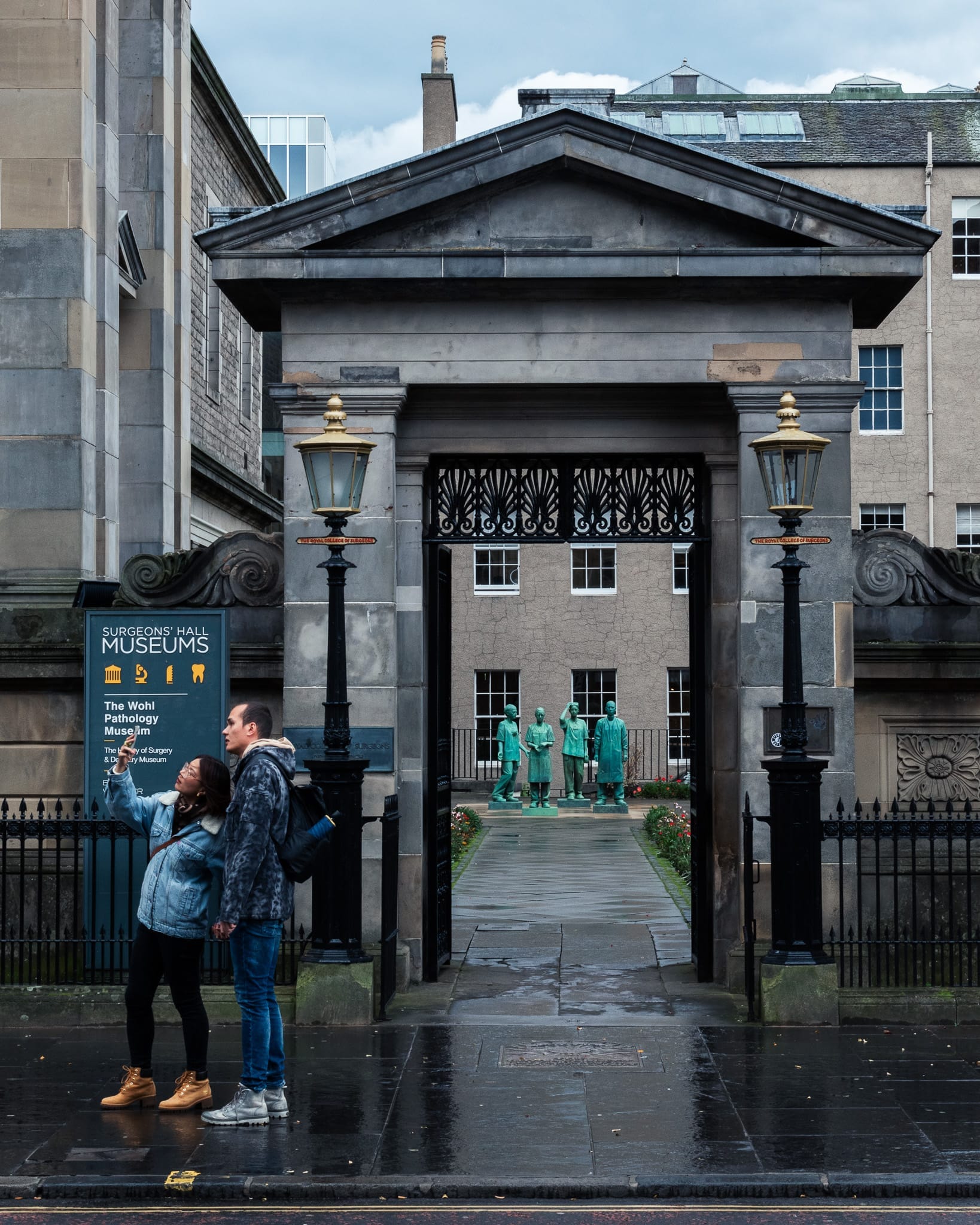
What Is Surgeons' Hall Museums?
Surgeons' Hall Museums sit inside the headquarters of the Royal College of Surgeons of Edinburgh, a professional body granted its Seal of Cause in 1505, making it one of the oldest surgical colleges in the world. The collections themselves began accumulating in 1699, when the College formally called for donations of 'natural and artificial curiosities.' The building you enter today, a Greek Revival temple on Nicolson Street, was designed by William Henry Playfair and completed in 1832, the same year the museums first opened to the public. That continuous public access makes this Scotland's oldest museum still operating in its original location.
The museum spans three main collections: the Wohl Pathology Museum, the History of Surgery Museum, and the Dental Collection. Each occupies its own distinct space inside the building, and together they chart the development of medicine from barber-surgeons working without anaesthetic to the precision instruments of modern operating theatres. This is a serious scholarly institution, not a funhouse of medical oddities, though some of what you see will stay with you.
ℹ️ Good to know
The museum is open daily 10:00–17:00, with last entry at 16:30. Seasonal variations (for example around Christmas and New Year) may apply, so check the official website before visiting: museum.rcsed.ac.uk
The Building Itself: Playfair's Greek Revival Masterpiece
Before you set foot inside, stop on Nicolson Street and look at the facade. William Henry Playfair, the architect responsible for much of Edinburgh's neoclassical identity, gave the Royal College a building that reads as a statement of civic authority. The broad portico, with its Ionic columns and restrained stonework, signals that what happens inside matters. It is a Category A listed building, the highest level of architectural protection in Scotland, which means it has been judged to be of special architectural or historic interest.
The building occupies a confident position on a stretch of Nicolson Street that serves as a corridor between the Old Town's southern edge and the University of Edinburgh campus. Edinburgh has more Playfair buildings than almost any other architect, including the Scottish National Gallery on the Mound, so visitors with an architectural interest will recognise the same assured classical hand at work here.
Tickets & tours
Live prices and dates from our booking partner. If you book, we may earn a commission at no extra cost to you.
National Museum of Scotland In-App Audio Guided Tour
From 9 €Instant confirmationPrivate Glasgow West End tour
From 87 €Instant confirmationFree cancellationWest Highland Lochs, mountains and castles tour from Edinburgh
From 61 €Instant confirmationFree cancellationLoch Ness, Glen Coe and the Highlands tour from Edinburgh
From 66 €Instant confirmationFree cancellation
Inside the Collections: What You Will Actually See
The Wohl Pathology Museum is the room that catches most visitors off guard. It occupies a long Victorian gallery lined with tiered display cases holding thousands of preserved anatomical specimens in glass jars. Many date back to the 19th century. The smell is faint but clinical, a mix of old wood and something chemical just at the edge of perception. The light inside is controlled and slightly cool, which gives the room a stillness that feels appropriate. You walk between cases cataloguing disease, injury, and anatomical variation with a directness that modern museums rarely allow themselves.
The History of Surgery Museum takes a more narrative approach, moving through centuries of surgical development using instruments, paintings, and written records. There are scalpels, saws, and amputation sets from eras when speed was the only anaesthetic. There are also connections to figures that Edinburgh medicine produced in disproportionate numbers: Joseph Lister, who pioneered antiseptic surgery, and James Young Simpson, who introduced chloroform as an anaesthetic, are among those referenced in the collections.
The Dental Collection is smaller but genuinely interesting to anyone who has not thought carefully about the history of dentistry. Pre-anaesthetic tooth extraction, the evolution of denture materials, and the long overlap between barber and surgeon make for an unexpectedly compelling narrative thread.
⚠️ What to skip
The Wohl Pathology Museum contains real human specimens and graphic anatomical displays. Parents should consider carefully before bringing children under 12. The museum is straightforward about this content; it is not gratuitous, but it is unflinching.
The Burke and Hare Connection
No honest account of Edinburgh medical history omits Burke and Hare. In 1828, William Burke and William Hare murdered 16 people and sold the bodies to the anatomist Robert Knox, who used them for dissection classes. The case shocked the city and led directly to the Anatomy Act of 1832, which legalised the use of unclaimed bodies for medical study and ended the commercial incentive for body-snatching. The museum addresses this period directly, including an exhibit involving a cast of Burke's skull and a pocketbook reputedly made from his skin after his execution.
This history places Surgeons' Hall firmly within Edinburgh's darker narrative, a thread that runs from the medical school through Greyfriars Kirkyard and the underground vaults. For visitors drawn to this side of the city, the museum is one of the most substantive stops rather than just a macabre footnote.
Visiting by Time of Day: How the Experience Changes
The museum opens at 10:00 and is quietest in the first hour. The pathology gallery in particular is worth experiencing with few other people present. The silence and the rows of specimens create an atmosphere that evaporates once tour groups arrive, typically from mid-morning onwards. If you are visiting during the Edinburgh Festival Fringe in August, even specialist museums see higher footfall, so an early arrival matters more then.
By early afternoon the museum has a steadier flow of visitors, including university students from the adjacent campus. The history gallery handles groups well because it is linear and spacious, but the pathology room can feel crowded when more than twenty people are inside. Late afternoon, from around 15:30 to closing, offers another quieter window. Last entry is at 16:30. For context on planning a broader day in this part of the city, see the guide to Edinburgh's best museums.
Getting There and Practical Notes
The museum is at Nicolson Street, Edinburgh EH8 9DW. From Edinburgh Waverley station it is a straightforward 10-minute walk south along Nicolson Street. Multiple bus routes serve Nicolson Street directly. The area is flat and well-paved between the station and the museum, making it manageable for most mobility levels, though specific accessibility queries should be directed to the museum at museum@rcsed.ac.uk or +44 (0)131 527 1711.
The Southside location means it pairs naturally with other nearby attractions. The National Museum of Scotland is a short walk away on Chambers Street, and the Greyfriars Kirkyard is within ten minutes on foot. Together these make a coherent half-day or full-day route through the southern edge of the Old Town.
Admission is around £10 for adults, with concessions available, but prices should be confirmed on the official website before your visit as they are subject to change. The museum shop stocks medically themed books and gifts that lean toward the scholarly end of the souvenir spectrum.
Photography and What to Bring
Visitor photography is not permitted in the public galleries for personal use, but check with staff on the day regarding flash photography near specimens. The pathology gallery, with its tiered Victorian cases and controlled lighting, photographs well in the quieter morning hours when you can compose without other visitors in frame. A phone camera is sufficient; the interior light levels are manageable without specialist equipment.
There is no specific dress code. The building is fully indoors and climate-controlled, so wet-weather layers can be left at the cloakroom if available. Comfortable walking shoes are all that is needed. Allow at least 90 minutes if you want to read the interpretive panels; some visitors who engage seriously with the history of surgery collection spend closer to two and a half hours.
Who Should Skip This Museum
Surgeons' Hall is genuinely not for everyone. If preserved human specimens cause you distress, or if you have a strong aversion to graphic medical content, the pathology collection will be uncomfortable rather than educational. The museum does not sanitise its material. Visitors expecting interactive family-friendly displays or the broad cultural sweep of a national museum will also find this too narrow in focus. That narrowness is exactly what makes it valuable to the right visitor, but it is worth being honest about the fit.
Families with young children may find the National Museum of Scotland a better starting point. It covers Scottish history, science, and culture across multiple floors with hands-on sections and wider appeal.
Insider Tips
- Arrive at 10:00 when the museum opens. The Wohl Pathology Museum has a genuinely different atmosphere with fewer visitors present, and the rows of Victorian specimen cases are more affecting in near-silence.
- The Burke and Hare exhibit is not always prominently signposted at the entrance. Ask at reception if you are specifically looking for it, as it sits within the History of Surgery Museum section.
- The building's exterior is worth a few minutes before you go in. The Nicolson Street facade is one of Playfair's most complete surviving street frontages in the city, and it is often photographed without the context of what it houses.
- If you have an Art Fund card, check whether it applies for reduced admission before you pay full price at the desk.
- Combine the visit with a late-afternoon walk through the Meadows, Edinburgh's large park immediately to the south. The contrast between the enclosed intensity of the museum and the open air makes for a natural decompression after two hours with the collections.
Who Is Surgeons' Hall Museums For?
- History and medical history enthusiasts who want depth over breadth
- Fans of true crime and Edinburgh's darker historical narratives
- Architecture lovers interested in Playfair's neoclassical work
- University students and academics with an interest in the history of science
- Repeat Edinburgh visitors who have covered the major landmarks and want something more specialist
Nearby Attractions
Other things to see while in Southside & Newington:
- Royal Observatory Edinburgh
Perched on Blackford Hill about two miles south of the city centre, the Royal Observatory Edinburgh is a working astronomical research institution with a visitor centre open to the public through guided events, stargazing sessions, and lectures. Its twin copper domes, completed in 1896, frame some of the finest views across Edinburgh, and the hill itself is worth the trip even on a cloudy night.
- Summerhall
Housed in the former Royal (Dick) School of Veterinary Studies site, Summerhall is Edinburgh's most atmospheric arts complex. From year-round gallery shows and independent cinema to its legendary role as a Fringe hub, the building repays exploration at any time of year.
- The Meadows
The Meadows is an 11.1-hectare public park in Edinburgh's Southside, free to enter and open around the clock. Once a medieval loch that supplied Old Town with water, today it serves as a social anchor for students, families, and anyone seeking open space just minutes from the city centre.
Planning a trip? Discover personalized activities with the Nomado app.