Cramond Beach & Island: Edinburgh's Tidal Island Escape
A short bus or drive from the city centre, Cramond Beach leads to one of Edinburgh's most unusual free attractions: a tidal island in the Firth of Forth, reachable only during a narrow low-tide window. Sandy shores, wartime concrete pylons, and quiet woodland paths make this a world away from the Royal Mile.
Quick Facts
- Location
- Cramond, Edinburgh EH4 6QU
- Getting There
- Local Lothian Buses services from the city centre; approx. 30–40 min journey
- Time Needed
- 2–4 hours (including island crossing)
- Cost
- Free — no tickets or admission required
- Best for
- Walkers, families, photography, history enthusiasts
- Official website
- cramondheritage.org.uk
What Is Cramond Beach and Why Does It Deserve Your Time?
Cramond Beach sits at the mouth of the River Almond on the southern shore of the Firth of Forth, about 5 miles northwest of Edinburgh's Old Town. It is a broad, gently shelving sandy beach flanked by a promenade, with a row of white-painted cottages at the village end that would look more at home in a seaside town than a national capital. The beach is open at all times and costs nothing to visit.
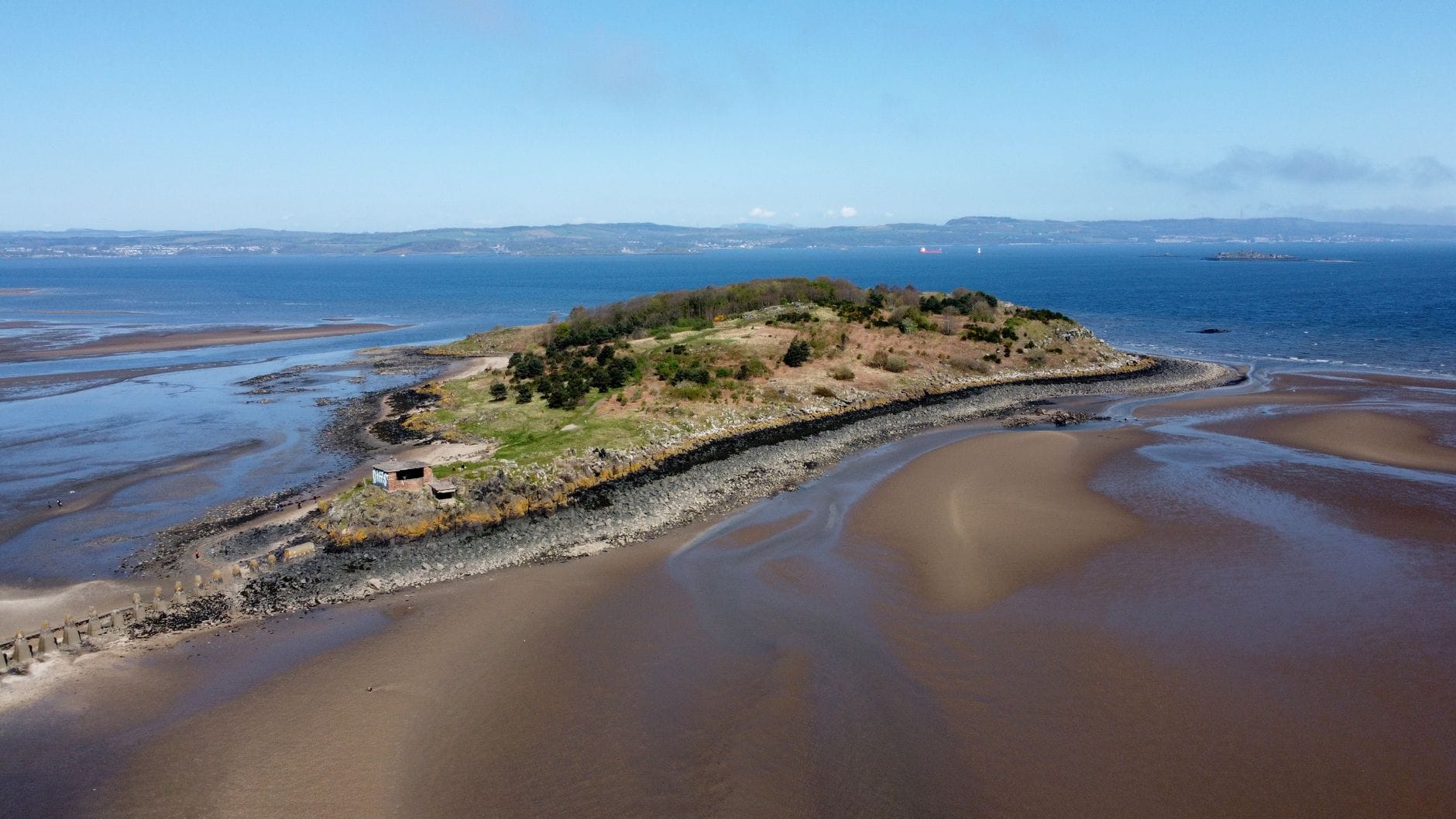
The real draw, however, lies about 1 km offshore: Cramond Island, a tidal island of roughly 19 acres that can only be reached on foot during a roughly 4-hour window around low tide. When the tide is out, a stony causeway emerges, flanked by a row of angular concrete pylons — the remnants of a Second World War anti-submarine boom barrier. Walking out between them, with the Forth stretching ahead and the city skyline invisible behind you, the experience is genuinely unlike anything else within easy reach of Edinburgh.
⚠️ What to skip
Tide times are not predictable by memory or intuition. Before crossing to Cramond Island, check the noticeboard at the south end of the causeway, or text 'CRAMOND' to the local tide information service. The causeway floods quickly and people have been stranded. This is not a risk worth taking casually.
The Causeway Walk: Wartime Relics and Open Water
The causeway stretches close to 1 km from the mainland shore to the island. The surface underfoot is uneven, a mix of compacted gravel and exposed rock, and it requires reasonable footwear. Wellies or sturdy waterproof boots are the practical choice, particularly after rain, when the crossing and the island's earth paths become muddier than they look from a distance.
The concrete pylons lining the causeway are among the most atmospheric wartime features in the Edinburgh area. During the Second World War, steel anti-submarine nets were strung between them to protect the Royal Navy's anchorage in the Forth. The nets are long gone, but the pylons remain, salt-stained and barnacled, leaning slightly with decades of tidal pressure. At low tide, you can walk right up to their bases and see the iron fittings still embedded in the concrete.
On a clear day, the crossing offers uninterrupted views across the Forth to Fife. Inchcolm Island, with its medieval priory, sits further out to the northeast. Closer in, the water around the causeway supports oystercatchers, curlews, and in winter, large flocks of wading birds working the exposed mudflats. Bring binoculars if you have them.
Tickets & tours
Live prices and dates from our booking partner. If you book, we may earn a commission at no extra cost to you.
West Highland Lochs, mountains and castles tour from Edinburgh
From 61 €Instant confirmationFree cancellationLoch Ness, Glen Coe and the Highlands tour from Edinburgh
From 66 €Instant confirmationFree cancellationDay Trip to Holy Island, Alnwick Castle and Northumbria from Edinburgh
From 60 €Instant confirmationFree cancellationLoch Ness Explorer Day Trip from Edinburgh
From 60 €Instant confirmationFree cancellation
Exploring the Island: Ruins, Paths, and Silence
The island is about 0.3 miles long and is covered by rough grass, scrubby woodland, and several derelict buildings from its wartime garrison use. There are no facilities on the island — no toilets, no cafe, no shelter that you can actually use. That absence is part of the appeal. On weekdays, especially outside summer, the island feels genuinely remote.
The paths on the island are earth tracks that can be slippery when wet. The terrain is not wheelchair accessible, and the causeway itself presents a significant barrier for anyone with limited mobility. The western and northern edges of the island give the best views back toward the Forth Road Bridge and the hills of Fife. The ruins of a wartime observation post sit near the island's higher ground and are worth seeking out.
The island's recorded history stretches back to at least the 12th century, when it was owned by the Bishop of Dunkeld. More recently, it was used as a military installation during both World Wars. In the decades since, it has been left largely to return to nature, and the combination of crumbling concrete and encroaching vegetation gives it an atmosphere that photographers tend to find compelling.
💡 Local tip
Give yourself at least 45 minutes on the island before turning back. The tide waits for no one — if you arrived at the start of the low-tide window, monitor your time carefully. Most visitors underestimate how quickly the crossing disappears.
Cramond Village and the Beach Promenade
Even without the island crossing, Cramond is worth the trip. The village has a character that feels genuinely separate from the rest of Edinburgh: a cluster of 17th and 18th-century whitewashed houses around a small harbour at the mouth of the River Almond, a historic church, and the Cramond Inn, a pub with outdoor seating that is justifiably popular on warm afternoons.
The promenade runs west from the village along the foreshore, offering a flat, surfaced walking route with open views across the Forth. Dog walkers use it at all hours, and at weekends it carries a steady flow of families with pushchairs and cyclists. Early mornings are notably quieter, and on misty days the Forth takes on a moody, grey quality that makes the view feel far more dramatic than any guidebook photograph suggests.
If you have extra time, the River Almond walkway extends inland from Cramond, following the river through woodland toward Cramond Brig. This connects loosely to the broader Water of Leith Walkway network of riverside paths that thread through Edinburgh's western suburbs — a good option if you want to extend the day's walking without retracing your steps.
When to Visit and How the Experience Changes
The experience at Cramond shifts considerably depending on season and time of day. In summer (June to August), the beach draws families and sunbathers, the car park fills up by mid-morning on weekends, and the causeway crossing becomes a procession. The island itself absorbs the crowds better than you might expect, but it loses some of its atmosphere when busy. Weekday mornings in summer are a reasonable compromise.
Spring and autumn offer arguably the best conditions. Temperatures are mild enough for the walk, the light on the Forth can be extraordinary in the late afternoon, and the crowds are a fraction of the summer peak. Winter visits require warm layers and waterproof outerwear — the sea wind at the causeway has nothing between it and Scandinavia — but the bird life is richer, the beaches are empty, and the island feels closest to its abandoned, post-war character.
The key variable is always the tide, not the season. Check tide times in advance, and plan your journey so you arrive with the window open rather than chasing a closing one. For broader context on planning a visit to Edinburgh's outdoor attractions, the best time to visit Edinburgh guide covers seasonal trade-offs across the city.
Getting to Cramond from Edinburgh City Centre
By bus, regular Lothian Buses services run from the city centre to Cramond, with a journey time of approximately 30 to 40 minutes depending on traffic. The bus drops you within a short walk of the beach. No booking is required and the fare is a standard Lothian Buses single or day ticket.
By car, take the A90 toward Barnton, then follow the B9085 to Cramond. A free public car park is available near the beach. On sunny summer weekends this car park fills early, and parking in the village's residential streets is limited and frustrating — the bus is a genuinely better option on those days.
If you are building a longer day in the northwest of the city, Cramond pairs well with the Royal Botanic Garden, which lies on the route back into town. The contrast between manicured glasshouses and windswept tidal island makes for an unusually varied half-day.
Photography at Cramond
The concrete pylons are the signature image, and they photograph best in golden-hour light — either early morning or the hour before sunset, when the low angle picks out their texture and casts long shadows across the causeway surface. At high tide, when the causeway is submerged, the pylons emerge from the water like a minimalist sculpture installation and can be photographed from the beach itself.
The white cottages of Cramond village reflect well in the harbour water at high tide. The woodland along the River Almond turns well in autumn and is sheltered from wind, making it a reliable location when conditions on the foreshore are too harsh. Wide-angle lenses work best on the open beach; a short telephoto is useful for compressing the line of pylons against the island background.
Who Might Not Enjoy This
Visitors with limited mobility will find the island inaccessible and the causeway challenging. The beach and promenade are flat and surfaced, but the island's paths are rough earth tracks that become slippery mud in wet weather. Anyone expecting a curated visitor attraction — interpretation boards, a cafe, managed paths, indoor options if it rains — will be disappointed. Cramond Island offers almost no infrastructure. That is a feature for some and a dealbreaker for others.
Travellers who want dramatic Edinburgh views from a managed site with a clear payoff would be better served by Arthur's Seat or Calton Hill. Both are closer to the centre, fully accessible by foot, and require no tide planning.
Insider Tips
- Text 'CRAMOND' to the local tide information service before you leave the city — do not rely on a general tide app, as crossing times depend on local conditions rather than simple high/low tide predictions.
- The Cramond Inn is a good option for lunch or a post-walk drink, but it fills up fast on weekend afternoons. Arriving before 12:30 or after 2:30 avoids the worst of the lunch crush.
- If you time your island visit for the first half of the low-tide window (going over as soon as the causeway is passable), you get more time on the island and a more relaxed return crossing.
- The island's northern shore, facing toward Fife, is almost never busy even when the island itself has visitors. Walk around the western edge to find it.
- On overcast days, the wartime ruins photograph without harsh shadows and the Forth takes on a slate-grey quality that actually enhances the atmospheric, post-war feel of the place — don't rule out a visit just because the sky isn't blue.
Who Is Cramond Beach & Island For?
- Walkers and hikers looking for an unusual, tide-dependent adventure close to a major city
- History enthusiasts interested in Second World War coastal defences and medieval island ownership
- Photographers seeking textured industrial-meets-natural subjects on the Firth of Forth
- Families with older children who can handle uneven terrain and a time-pressured causeway crossing
- Edinburgh visitors who want a half-day of genuine outdoor calm without driving into the Highlands
Nearby Attractions
Combine your visit with:
- Colinton Tunnel
The Colinton Tunnel is a 137-metre Victorian railway tunnel on the Water of Leith Walkway, transformed into Scotland's largest heritage mural. Inspired by Robert Louis Stevenson's poem 'From a Railway Carriage', it's free to visit, fully accessible, and open around the clock.
- Craigmillar Castle
Craigmillar Castle is a remarkably complete medieval ruin sitting on a low hill 3 miles southeast of Edinburgh's centre. Once a retreat for Mary, Queen of Scots, it rewards visitors with genuine history, sweeping city views, and crowds that are a fraction of Edinburgh Castle's.
- Edinburgh Zoo
Set across 82 acres of wooded hillside in western Edinburgh, Edinburgh Zoo is Scotland's largest wildlife attraction and home to over 2,500 animals. It holds a remarkable place in zoo history as the first zoo in the world to successfully house and breed penguins, and it remains the only UK zoo incorporated by royal charter.
- Forth Bridge
The Forth Bridge is one of the most recognisable structures in Scotland, a Victorian-era cantilever railway bridge spanning the Firth of Forth near South Queensferry. Inscribed as a UNESCO World Heritage Site in 2015, it remains an active railway crossing and a landmark that rewards a dedicated half-day trip from Edinburgh.
Planning a trip? Discover personalized activities with the Nomado app.