Plaza de Santa Ana: Madrid's Literary Square and Social Heart
Plaza de Santa Ana is a handsome 19th-century square in central Madrid, framed by historic theatres, traditional tabernas, and terrace bars. Free to enter at any hour, it rewards visitors who understand its rhythms: quiet and photogenic in the morning, sociable and animated by evening.
Quick Facts
- Location
- Plaza de Santa Ana, 28012 Madrid (Cortes barrio, Centro district, near Sol)
- Getting There
- Sol (Lines 1, 2, 3) or Antón Martín (Line 1)
- Time Needed
- 30–60 minutes for the square itself; longer if dining or bar-hopping
- Cost
- Free to enter. Food and drinks at surrounding bars vary widely.
- Best for
- Evening atmosphere, terrace drinks, literary and architectural interest
What Is Plaza de Santa Ana?
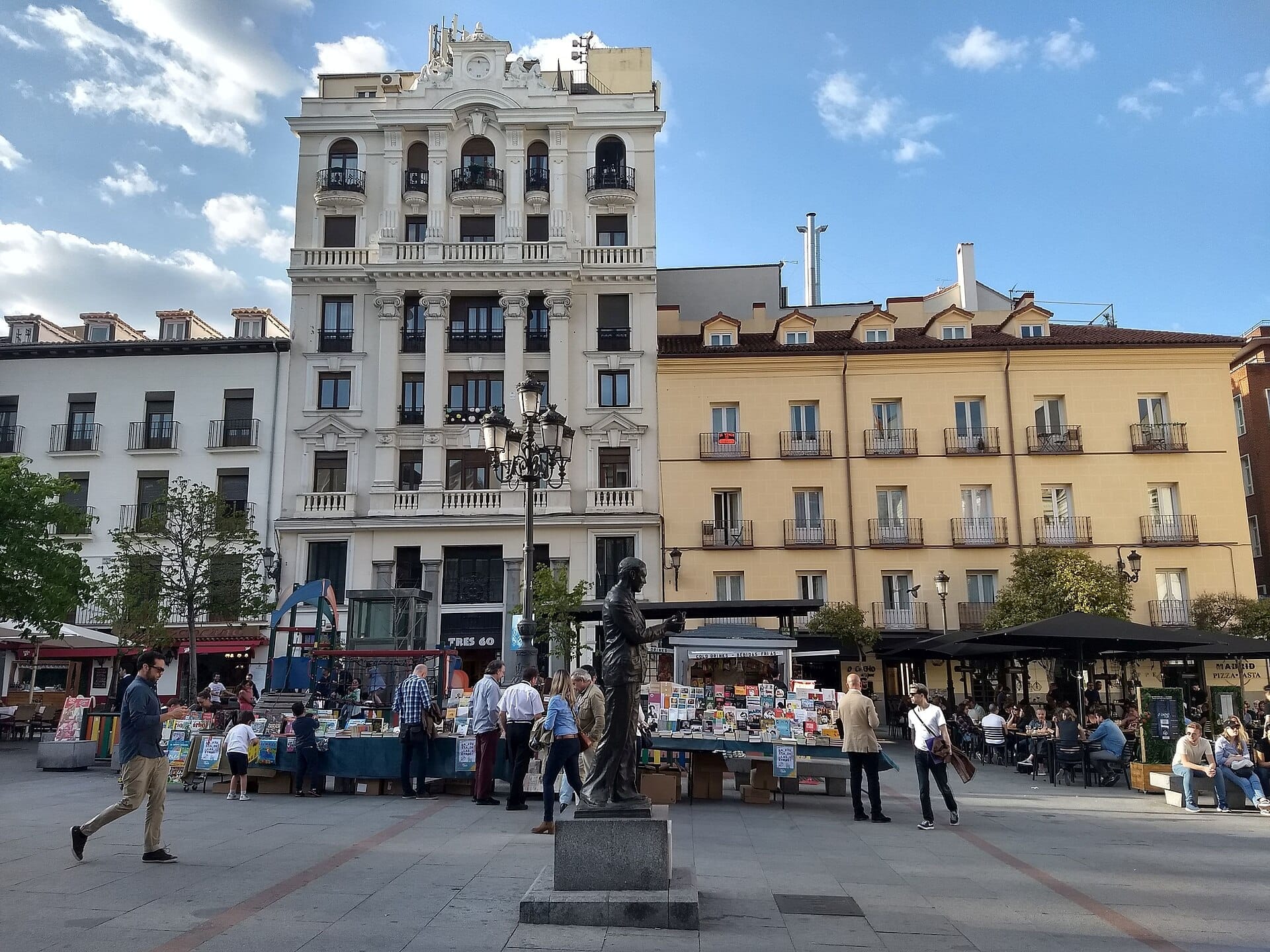
Plaza de Santa Ana is one of central Madrid's most storied public squares, set in the zone known as the Barrio de las Letras (Literary Quarter) in the historic Centro district. Laid out in the early 19th century under the brief reign of Joseph Bonaparte, who cleared the Santa Ana convent that had occupied the site, the square took its present form gradually, reaching something close to its current state by around 1880. It is rectangular, open, and relatively generous in scale for this part of the city, with a long central pedestrian strip lined with benches and stone paving.
Two buildings frame it with particular authority: the Teatro Español on the eastern end, one of Madrid's oldest active theatres with a history stretching back to the late 16th century, and the ME Madrid hotel on the northern side, occupying the historic Gran Hotel Reina Victoria building. Between them, the square's ground level is occupied by a concentration of traditional tabernas, contemporary bars, and terrace seating that makes it one of the more reliable places in central Madrid to sit outside with a drink at almost any hour.
💡 Local tip
If you want the square at its most photogenic and least crowded, arrive before 9am. The warm Madrid light falls across the Teatro Español's facade and the paving is nearly empty. By 11am, terrace chairs begin to fill.
The Square Through the Day
Morning on Plaza de Santa Ana is genuinely peaceful. Pigeons move across the stone, a few residents cut through on their way to work, and the bars are just beginning to set out their chairs. The air at this elevation (Madrid sits at 667 metres above sea level) has a clarity in the early hours that disappears once heat builds in summer. This is the window for unhurried photography: the Teatro Español's neoclassical facade, the statue of the playwright Pedro Calderón de la Barca at the square's western end, and the decorative tile panels on the façade of the Cervecería Alemana are all worth framing without people in the shot.
By mid-morning, the square shifts into a comfortable idle. Solo travellers with laptops appear, older residents occupy the central benches, and the first tourists arrive. The Cervecería Alemana, a traditional German-style beer hall at the square's southern side that has been serving here since 1904, opens for coffee. It is one of the bars most frequently cited in connection with Ernest Hemingway, who spent considerable time in Madrid during the 1920s and 1930s and reportedly frequented the place. Whether or not that story is embellished, the interior, with its dark wood, marble-topped bar, and old tiles, looks as though it has not been substantially altered in decades.
From around 6pm onward, the square transforms into something closer to a social focal point. The terrace bars fill with a mixed crowd: office workers finishing their day, groups of friends meeting before dinner, and visitors who have spent the afternoon at the museums along the Paseo del Prado and are now ready to unwind. By 9pm on a warm evening, every chair on the terraces is occupied, the sound of conversation carries across the stone, and the square operates at a sustained pitch of activity that continues well past midnight on weekends.
⚠️ What to skip
Weekends between 10pm and 2am can be very loud around the square's perimeter bars. If you are staying nearby, check hotel reviews carefully. If you are visiting, this is precisely when the atmosphere peaks.
Tickets & tours
Hand-picked options from our booking partner. Prices are indicative; availability and final rates are confirmed when you complete your booking.
Puy du Fou Espana and Sueno de Toledo with transfer from Madrid
From 55 €Instant confirmationFree cancellationGymkhana bike tour at the Retiro Park of Madrid
From 35 €Instant confirmationFree cancellationAquopolis Villanueva de la Canada tickets
From 14 €Instant confirmationFlexible time Real Madrid: Bernabeu Stadium & Museum Entry
From 42 €Instant confirmation
The Literary Quarter Context
The Barrio de las Letras, the neighbourhood surrounding Plaza de Santa Ana, takes its name from the extraordinary concentration of writers who lived and worked here during Spain's Golden Age, roughly the late 16th and early 17th centuries. Miguel de Cervantes, author of Don Quixote, lived and died on Calle de Cervantes, one block from the square. Lope de Vega, the prolific playwright who may have written over 400 surviving plays, lived on Calle de Lope de Vega. Their houses stood within a few hundred metres of each other, in a neighbourhood that also housed the corrales de comedias, the open-air theatre courtyards where Spanish Golden Age drama was performed.
The Teatro Español, which closes the eastern end of the square, is the direct institutional descendant of this theatre tradition. Its current building dates primarily from the 18th and 19th centuries and has been rebuilt after fires, but it stands on a site that has hosted theatre continuously since the late 1500s. The city of Madrid still owns and operates it today as a publicly funded theatre. Performances are listed on the theatre's own website and tickets can be purchased directly. If you have an interest in Spanish-language theatre and your visit coincides with a production, this is a legitimate reason to plan an evening around the square.
The broader neighbourhood rewards slow walking. Calle de las Huertas, which runs parallel to the square, is lined with bars and has embedded brass literary quotations set into the pavement. For a fuller picture of Madrid's cultural geography, the Madrid architecture guide places the Barrio de las Letras within the city's wider urban development.
What to See and Do Around the Square
The square itself is compact enough that a single circuit takes under ten minutes. Start near the Calderón de la Barca statue: this seated bronze figure of the 17th-century playwright was installed in 1880 and stands toward the square's western side. The statue's plinth carries relief panels depicting scenes from his works. Move along the southern edge to take in the Cervecería Alemana facade, with its distinctive tile panels and period lettering. Continue to the Teatro Español, where the playbill boards will tell you what is currently in production. The northern side is dominated by the ME Madrid hotel, which has a rooftop bar accessible to non-guests that offers elevated views across the surrounding rooflines toward the Gran Vía.
If you want to sit down, the square offers choices at distinctly different price points. The traditional tabernas along the southern and western edges tend to be the most reasonably priced, with a caña (small draught beer) typically costing less than two euros at the bar. The hotel rooftop and some of the more design-oriented bars charge considerably more. The crowds at each place reflect this: locals and longer-stay visitors gravitate to the traditional spots, while newer arrivals often end up at the higher-profile venues.
The surrounding streets connect naturally to other parts of the city worth exploring. Walking west for five minutes takes you to Puerta del Sol and then on to Plaza Mayor. Walking southeast along Calle de Atocha leads toward the museums of the Paseo del Prado, including the Museo del Prado and the Museo Reina Sofía.
Getting Here and Getting Around
Plaza de Santa Ana sits in one of the most walkable parts of central Madrid. From Puerta del Sol, it is about a five-minute walk heading southeast along Calle del Príncipe. The nearest metro stations are Sol (Lines 1, 2, and 3), a short walk north, and Antón Martín (Line 1), roughly the same distance to the south. Neither metro stop is directly adjacent to the square, but both are close enough that the walk is straightforward and passes through interesting streets.
The square is on relatively flat ground and the pedestrian strip in the centre is level stone paving, generally accessible for those with mobility considerations, though the surrounding streets have varying kerb heights. Madrid's public transport network, the EMT bus system, also runs routes through nearby streets including Calle de Atocha and Paseo del Prado.
If you are planning a wider day in the centre, the guide to getting around Madrid covers metro, bus, and walking strategies in detail.
Weather, Seasons, and When to Visit
As an open-air public square, the experience at Plaza de Santa Ana is directly shaped by Madrid's climate. In summer (June through August), daytime temperatures frequently exceed 35°C, and the stone paving reflects heat intensely. Terrace seating that feels pleasant at 8pm can be oppressive at 3pm. If you visit in summer, aim for early morning or after 7pm. The square remains lively on warm summer nights until well past midnight.
Spring (April and May) and autumn (September and October) are the most comfortable seasons for lingering outdoors. Temperatures are moderate, the terraces are busy but not overwhelmed, and the light in late afternoon is particularly good for photography of the square's facades. Winter evenings can be cold at Madrid's altitude, but the tabernas keep their interiors warm and the square rarely feels entirely empty.
ℹ️ Good to know
Madrid's spring and autumn are considered the optimal visiting windows for outdoor sightseeing. Plaza de Santa Ana is at its most enjoyable in the evenings of these seasons, when the temperature is comfortable and the terraces are full without being chaotic.
Is It Worth Your Time?
Plaza de Santa Ana is not a spectacular architectural set piece in the way that Plaza Mayor is, and it contains no single landmark that would justify a dedicated visit on its own. What it offers instead is a reliable, well-located stopping point with genuine historical layering, a concentration of good traditional bars, and an evening atmosphere that reflects how a significant part of Madrid's population actually spends its time.
Visitors who respond well to the square tend to be those interested in the literary and theatrical history of the city, those looking for a sociable base for an evening without committing to a single venue, and those who appreciate the kind of European urban square that functions as a shared living room rather than a tourist attraction. Visitors seeking grand monuments or a quiet retreat from city noise will find it less compelling, particularly on weekend evenings when the surrounding bars are at full volume.
Insider Tips
- The Cervecería Alemana is busiest in the evening. If you want to sit inside at the old marble-topped bar and absorb the historic atmosphere without a crowd, go on a weekday afternoon around 4pm.
- The ME Madrid hotel's rooftop bar (The Roof) is open to non-guests and offers some of the better elevated views over this part of the city. It is not cheap, but one drink buys you the vantage point without a ticket.
- The pavement on Calle de las Huertas, one block south, has literary quotations in brass set directly into the stone. Most visitors walk past them without noticing. Look down as you walk.
- If the Teatro Español has a production you are interested in, buy tickets in advance online. The theatre's prices are publicly subsidised and considerably lower than comparable venues in northern European cities.
- For the best morning light on the Teatro Español facade, position yourself at the Calderón statue end of the square and shoot east. The direct light falls on the facade roughly between 9am and 11am in spring and autumn.
Who Is Plaza de Santa Ana For?
- Travellers exploring the Barrio de las Letras and Golden Age literary heritage
- Those looking for an authentic evening terrace experience away from the most tourist-saturated squares
- Visitors building an evening itinerary around the area's traditional tabernas
- Anyone using the Paseo del Prado museums as their base for the day who wants a sociable endpoint within walking distance
- Architecture and urban history enthusiasts interested in Madrid's 19th-century civic development
Nearby Attractions
Other things to see while in Retiro:
- CaixaForum Madrid
CaixaForum Madrid is a striking cultural centre on Paseo del Prado, housed in a converted early-20th-century power station redesigned by Herzog & de Meuron. Alongside rotating international exhibitions, it features a celebrated vertical garden by botanist Patrick Blanc and sits within walking distance of the city's three great art museums.
- Estanque Grande del Retiro
The Estanque Grande del Retiro is a vast artificial lake at the center of Parque del Retiro, created in the 17th century for royal festivities and now open to everyone for free. Rent a rowboat, watch street performers, or simply sit on the surrounding promenade as the Alfonso XII monument reflects in the water.
- Museo Nacional del Prado
The Museo Nacional del Prado holds one of the most important collections of European art in the world, with around 7,000–8,000 paintings spanning five centuries of Western painting. Located on the Paseo del Prado in the Retiro district, it is the cultural centerpiece of Madrid and the reason many visitors come to the city at all.
- Museo Nacional Centro de Arte Reina Sofía
The Museo Nacional Centro de Arte Reina Sofía is Spain's national museum of 20th-century art, housed in a converted 18th-century hospital near Atocha station. Its permanent collection includes Picasso's Guernica and major works by Dalí and Miró, making it one of the most significant modern art institutions in Europe.