Place de la Concorde: Paris's Most Storied Square
At 8.64 hectares, Place de la Concorde is the largest square in Paris, stretching between the Champs-Élysées and the Tuileries Gardens. Free and open around the clock, it anchors more than two centuries of French history around a 3,300-year-old Egyptian obelisk.
Quick Facts
- Location
- 8th arrondissement, between Champs-Élysées and Tuileries Gardens, 75008 Paris
- Getting There
- Métro Concorde (Lines 1, 8, 12)
- Time Needed
- 30–60 minutes on foot; longer if combining with nearby attractions
- Cost
- Free — open public square, no admission
- Best for
- History lovers, photographers, and anyone walking the Champs-Élysées corridor
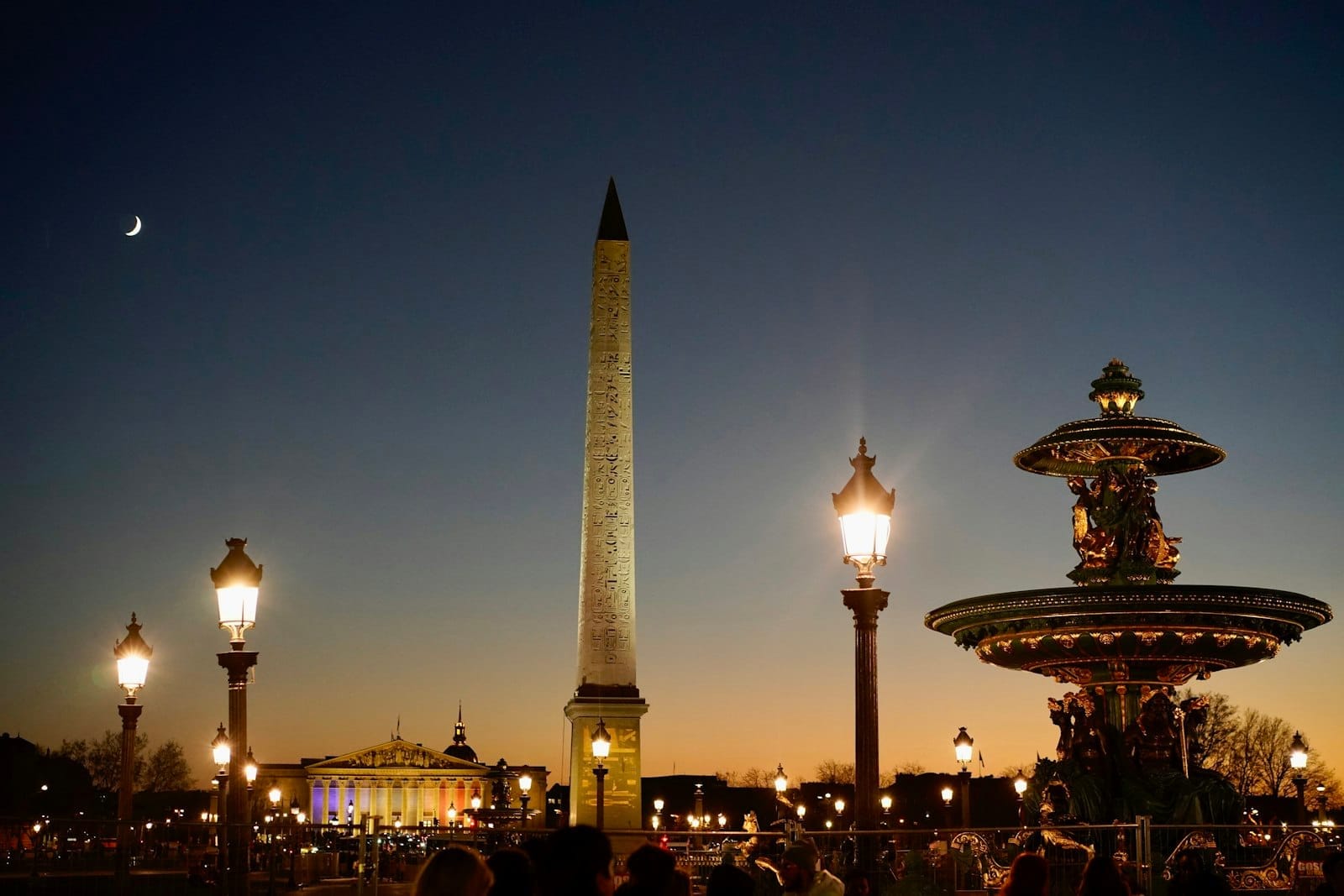
What Place de la Concorde Actually Is
Place de la Concorde is one of the largest public squares in Paris, covering roughly 8.6 hectares at the eastern end of the Champs-Élysées. It sits at an intersection of some of the city's most dramatic sightlines: look west and the Arc de Triomphe fills the horizon; turn east and the Tuileries arch frames the Louvre in the distance; face south across the Seine and the Assemblée Nationale sits perfectly centered. Few places in Paris reward simply standing still quite as much.
The square is not a garden, a market, or a museum. It is an open urban plaza made of stone and asphalt, with the Luxor Obelisk at its center, two monumental fountains to its north and south, and eight allegorical statues ringing the perimeter. That openness is both its greatest quality and its main limitation: in strong sun or cold wind, there is little shelter. Come prepared.
💡 Local tip
The best time to appreciate the square's scale and symmetry is early morning, before the traffic thickens and tour groups arrive. On summer mornings around 7–8 AM, you can stand at the obelisk base almost undisturbed and take in all four cardinal axes.
A History Written in Blood and Stone
The square was designed in 1755 by royal architect Ange-Jacques Gabriel at the request of King Louis XV, initially named Place Louis XV. It was one of the first purpose-built royal squares in Europe designed with open vistas rather than enclosed colonnades, a deliberate choice that made it feel less like a courtyard and more like a stage set for the city itself.
During the French Revolution it became Place de la Révolution, and the stage metaphor became grimly literal. Between 1793 and 1795, the guillotine stood here. King Louis XVI was executed on 21 January 1793; Marie Antoinette followed on 16 October of the same year. Over the course of the Terror, over 1,100 people were executed here, with another 133 trampled to death. The cobblestones absorbed an extraordinary amount of history in a very short time.
In 1795, as the revolutionary period wound down, the square was renamed Place de la Concorde (Place of Harmony) in a deliberate act of national reconciliation. The name stuck. The current design, including the obelisk, the fountains, and the eight city statues, was completed between 1836 and 1840 under architect Jacques-Ignace Hittorff, giving the square the form visitors see today.
Tickets & tours
Hand-picked options from our booking partner. Prices are indicative; availability and final rates are confirmed when you complete your booking.
Paris Essential dinner cruise at 6.15pm
From 99 €Instant confirmationFree cancellationEiffel Tower reserved elevator entrance to 2nd floor with walking tour and Seine cruise
From 94 €Instant confirmationFree cancellationBest of Paris city tour with Eiffel Tower lunch and Seine cruise
From 144 €Instant confirmationFree cancellationBike tour of Versailles Palace with skip-the-line tickets
From 109 €Instant confirmationFree cancellation
The Luxor Obelisk: 3,300 Years in One Landmark
The centerpiece of the square is a yellow granite obelisk standing 23 metres tall, including its base, and weighing over 250 tonnes. It is approximately 3,300 years old, originally one of two obelisks that stood at the entrance to the Luxor Temple in Egypt. Covered in hieroglyphics recording the reign of the pharaoh Ramesses II, it was gifted to France by Muhammad Ali, Wali of Egypt, and raised in the square on 25 October 1836 before an enormous crowd.
The engineering feat required to transport and erect it was remarkable for the era, and the square's pedestal is engraved with diagrams explaining exactly how it was done. Look closely at the base: those are not decorative carvings but actual technical schematics. In 1998, the French government added a gold-leafed pyramidal cap to the obelisk's top, replacing the original tip that was believed stolen in the 6th century BC. On a sunny afternoon, the gilded apex catches the light in a way that makes it easy to understand why the obelisk commanded such reverence across three millennia.
ℹ️ Good to know
The second obelisk originally paired with this one remains at Luxor Temple in Egypt. The French government formally agreed to waive any future claim to it in 1981.
The Fountains, the Statues, and What Else to Look At
Flanking the obelisk are two monumental fountains designed by Hittorff between 1836 and 1840: the Fontaine Maritime, oriented toward the Seine, and the Fontaine Fluviale, oriented toward the Rue Royale. Both are decorated with bronze sculptures of tritons, nereids, and dolphins by celebrated sculptors including James Pradier and Jean-Pierre Cortot. When the fountains are running on a calm day, the sound of water is one of the few things that softens the relentless noise of traffic. They are illuminated at night, making them among the most photogenic subjects in the square after dark.
Around the perimeter, eight seated stone figures represent major French cities: Brest, Rouen, Lyon, Marseille, Bordeaux, Nantes, Lille, and Strasbourg. They were installed in 1838 and are often overlooked by visitors who head straight for the obelisk. The arrangement is not random: viewed from above, the statues form a rough geographic map of France, with northern cities positioned to the north and southern ones to the south. On the northern edge of the square sit the Hôtel de Crillon and the Hôtel de la Marine, both 18th-century neoclassical buildings designed by Gabriel. The Pont Alexandre III is a short walk south along the Seine if you want to continue in that direction.
How the Square Changes Through the Day
Early morning is categorically the best time to visit. By 7 AM in spring and summer, the light is soft and angled, casting long shadows from the obelisk. The traffic is light enough that you can hear the fountains, and the scale of the square registers properly rather than being swallowed by the chaos of midday circulation. Photographers will find this the only window when the fountains can be captured without cars in the frame.
By 10 AM the square fills quickly, especially in summer, when tour coaches deposit groups at the Tuileries end and the Champs-Élysées crowds spill over. Midday in July or August can be genuinely unpleasant: the stone reflects heat, there is almost no shade, and the traffic creates a wall of exhaust and noise. This is one of the few Paris landmarks that is meaningfully worse at peak times rather than just busier.
After sunset, the fountains are lit and the obelisk's gold tip glows against a dark blue sky. The traffic thins on weekday evenings, and the square takes on a more cinematic quality. New Year's Eve sees enormous crowds gathering here, as it sits on the direct axis of the fireworks display traditionally centered on the Arc de Triomphe.
⚠️ What to skip
The square is surrounded by eight lanes of active traffic. Crossing on foot requires using designated pedestrian crossings and paying close attention — drivers do not always yield. Keep children close and avoid stepping into the road to frame photographs.
Practical Walkthrough: How to See It Well
Most visitors arrive from the Métro Concorde station (Lines 1, 8, 12) or walk west from the Jardin des Tuileries. From the Tuileries end, the obelisk appears centered in a long axis framed by chestnut trees, one of the most satisfying urban compositions in the city. Walk to the obelisk base and read the pedestal engravings before looking up — understanding what the diagrams show makes the scale of the 19th-century engineering effort tangible.
From the obelisk, do a slow 360-degree turn and identify each landmark on each axis: the Arc de Triomphe to the west, the Tuileries colonnade to the east, the Madeleine church at the far end of Rue Royale to the north, and the Assemblée Nationale to the south across Pont de la Concorde. This orientation exercise is what separates visitors who merely pass through from those who understand what the square was designed to demonstrate: that Paris itself is a composed, deliberate work of urban planning.
The square connects naturally to longer itineraries along the grand axis. Heading east, the Louvre Museum is a 15-minute walk through the Tuileries. Heading west, you are already on the Champs-Élysées. The Musée de l'Orangerie, home to Monet's panoramic Water Lilies paintings, sits at the southwest corner of the Tuileries — one of the most overlooked major museums in Paris, and a logical extension of any Concorde visit.
For photography, the north-facing fountain photographed with the Madeleine church in the background at golden hour produces one of the square's most atmospheric shots. The obelisk from directly below, looking straight up at the gold cap, works well with a wide-angle lens. Avoid shooting from street level with the traffic in frame unless you specifically want to document the square as it currently functions.
Who Should Skip It (and Who Will Love It)
Place de la Concorde is not a comfortable people-watching destination. There are no cafés on the square itself, no market stalls, and almost no seating. If you are looking for somewhere to sit, relax, and watch Paris happen around you, the adjacent Tuileries Gardens serve that purpose far better. The square is, at its core, a monument to be read and understood rather than lingered in.
Visitors primarily interested in shopping, food, or indoor culture will find little reason to spend more than 20 minutes here. Those who process cities through their architecture, their political history, or their urban logic will find it genuinely riveting. The history alone, from royal plaza to guillotine site to monument of reconciliation, compressed into a single square that has not fundamentally changed in 200 years, is extraordinary.
ℹ️ Good to know
A major redesign is being rolled out across the square in 2026. Led by architect Philippe Prost (winning project announced in March 2025), the project will reduce car traffic lanes, plant around 130 new trees, add large lawns and pedestrian areas, and restore the flowered ditches. The square's monuments will remain in place, but construction access may affect visits.
Insider Tips
- Stand directly at the base of the obelisk and study the engraved pedestal diagrams. They are technical illustrations showing the pulleys, ropes, and counterweights used to erect the 250-tonne column in 1836 — one of the most underappreciated details in the entire square.
- The Hôtel de la Marine on the north side of the square opened to the public as a museum in 2021 after a full restoration. Its grand 18th-century interiors, which served as the Navy Ministry for over 200 years, are remarkable and far less visited than the square itself.
- For the cleanest photographs of the fountains, arrive just after sunrise on a weekday. The low-angle light catches the bronze sculptures, the traffic is minimal, and the wind is usually calm enough that the water falls straight.
- If you visit at night, stand south of the obelisk and look north up Rue Royale: the illuminated Madeleine church frames the view perfectly, and this axis looks almost nothing like it does during the day.
- The square is scheduled for a major pedestrianization redesign underway since 2026. If you want to see it in its current form — traffic and all — now is the time.
Who Is Place de la Concorde For?
- History and architecture enthusiasts who want to understand Paris as a planned urban project
- Photographers working on Paris's grand axis at golden hour or after dark
- First-time visitors connecting the Champs-Élysées with the Tuileries and Louvre on foot
- Travelers interested in the French Revolution who want to stand at one of its most significant sites
- Anyone combining a visit with the nearby Musée de l'Orangerie or Musée Jacquemart-André
Nearby Attractions
Other things to see while in Champs-Élysées & Trocadéro:
- Arc de Triomphe
Standing 49.5 metres above Place Charles de Gaulle, the Arc de Triomphe de l'Étoile anchors the grandest axis in Paris. Its rooftop terrace delivers one of the city's great panoramas, while the base houses the Tomb of the Unknown Soldier — a living memorial renewed by flame every evening.
- Champs-Élysées
Stretching 1.91 km from Place de la Concorde to the Arc de Triomphe, the Avenue des Champs-Élysées is at once Paris's grandest promenade and its most debated street. Here is what to expect, when to go, and how to make the most of it.
- Crazy Horse Paris
Crazy Horse Paris has staged its distinctive blend of dance, light, and visual design on Avenue George V since 1951. The current show, 'Totally Crazy!', runs approximately 90 minutes and draws a mix of curious first-timers and loyal returning guests who appreciate its position between cabaret tradition and contemporary performance art.
- Grand Palais
Built for the 1900 Universal Exhibition and freshly reopened after a landmark renovation, the Grand Palais is one of the most spectacular public buildings in Europe. Its iron-and-glass nave stretches 240 metres and shelters world-class art exhibitions, cultural events, and the Palais de la Découverte science museum beneath a single soaring roof.