Piccadilly Circus: London's Neon Heart Explained
Piccadilly Circus is a road junction, public space, and accidental landmark all at once. Created in 1819 and framed by blazing digital screens, it sits at the crossroads of London's theatre district, shopping strips, and nightlife. Free to visit any hour of the day or night, it rewards those who understand what they are actually looking at.
Quick Facts
- Location
- Piccadilly Circus, London W1D 7ET, City of Westminster
- Getting There
- Piccadilly Circus Underground Station (Bakerloo and Piccadilly lines), directly beneath the junction
- Time Needed
- 20–45 minutes to absorb the square; allow longer if exploring the surrounding streets
- Cost
- Free — it is a public space with no admission charge
- Best for
- First-time visitors, evening atmosphere, West End exploration, photography
- Official website
- www.visitlondon.com/things-to-do/place/77552-piccadilly-circus
What Piccadilly Circus Actually Is
Piccadilly Circus is not a circus in the entertainment sense. In older British urban planning, a circus simply meant a circular junction where several streets converge. This one, created in 1819 as part of John Nash's ambitious redesign of London, was built to link the newly constructed Regent Street with the older road of Piccadilly. Today, six streets feed into it: Piccadilly, Regent Street, Shaftesbury Avenue, Haymarket, Coventry Street, and Glasshouse Street. The result is less a square and more a controlled collision of some of London's most commercially important corridors.
Its fame rests on two things: the illuminated advertising screens that have blazed here since early illuminated advertisements appeared here in the early 1900s, and the Shaftesbury Memorial Fountain, erected in 1893 at the centre of the junction to commemorate the Victorian philanthropist Lord Shaftesbury. The winged bronze figure at the top is almost universally called Eros, but that identification is wrong. The statue represents Anteros, the Greek god of selfless love, chosen specifically as a tribute to Shaftesbury's charitable legacy. Knowing that small detail changes how you look at the thing.
ℹ️ Good to know
The junction is accessible 24 hours a day, 7 days a week. There is no admission charge of any kind.
The Screens and the Skyline
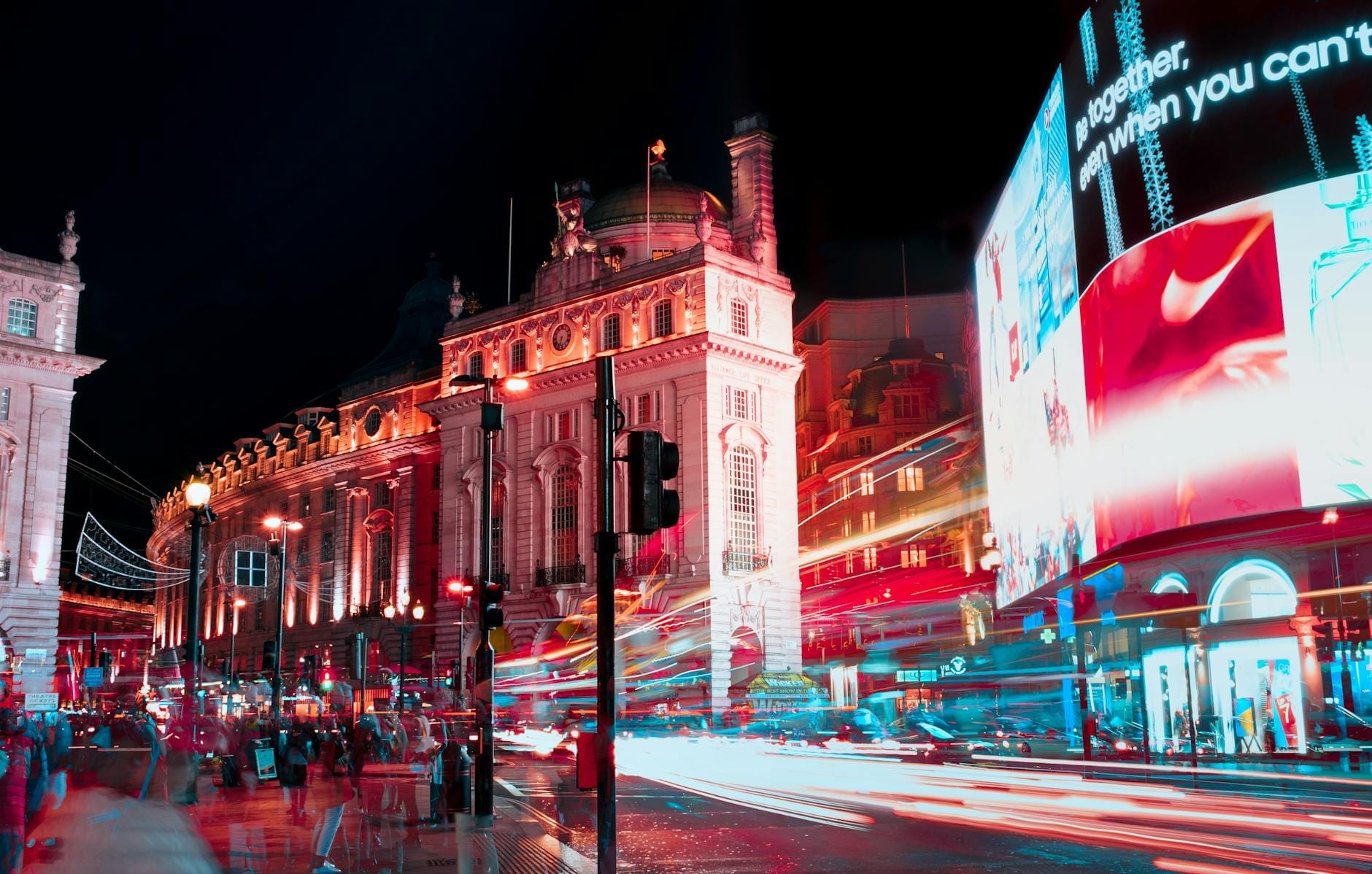
The illuminated advertising displays are the defining visual feature of Piccadilly Circus. What once began with single-colour electric signs has evolved into a set of large-format LED screens covering the curved facade of the building on the north side of the junction, facing the fountain. They run continuously, cycling through advertisements and occasionally special broadcasts. During major national events, the screens have been used for commemorative messaging, which gives the site a civic dimension that pure commercial advertising cannot.
From a photography standpoint, the screens create a particular challenge: they are bright enough to blow out detail in daytime shots and in full darkness they can overwhelm a frame with colour. The most useful window is the period roughly 30 to 45 minutes after sunset, when the ambient light of the sky still balances against the screens. In summer this falls around 9:30 to 10 pm; in winter it arrives closer to 5:30 pm. Wide-angle lenses work best positioned from the south side of the junction, with the fountain included in the foreground to give the image scale and context.
The surrounding architecture deserves more attention than it typically receives. The curved building to the north, Criterion Buildings, dates from the 1870s and its ground floor houses the Criterion restaurant with a Byzantine-tiled interior. The proportions of the junction were disrupted by 20th-century road widening and are now further complicated by the sheer volume of foot traffic, but traces of Nash's original vision survive if you look at Regent Street as it exits northward, still holding its sweeping curve.
Tickets & tours
Hand-picked options from our booking partner. Prices are indicative; availability and final rates are confirmed when you complete your booking.
Self-guided Discovery Walk in London's Piccadilly Circus and Whitehall
From 24 €Instant confirmationFree cancellationTickets for Moulin Rouge the Musical at the Piccadilly Theatre
From 0 €Instant confirmationTickets for Come Alive, the greatest showman circus spectacular London
From 98 €Instant confirmationSoho Instagram a self-guided walking tour to top photo spots
From 6 €Instant confirmationFree cancellation
How the Experience Changes by Time of Day
Piccadilly Circus in the morning, before 9 am, is a noticeably different place. Delivery vehicles use the junction, workers move through without stopping, and the screens feel incongruously loud against the relative quiet. This is the only time you can stand near the Shaftesbury Memorial Fountain without being jostled, read the inscriptions at its base, and look at the bronze panels properly. The fountain itself sits on a stepped stone base that doubles as an informal seating area and gathering point; in the mornings it is largely empty.
By midday the junction operates at full commercial intensity. Visitors queue for photographs at the fountain steps while workers from the surrounding offices cross at pace. The sounds are layered: traffic from multiple directions, the persistent hum of double-decker buses, conversations in dozens of languages, and the occasional busker positioned on a nearby corner. The smell of food from takeaways along Coventry Street mixes with diesel. It is not unpleasant, but it is dense. People who struggle with large, loud crowds will find midday here uncomfortable.
Evening, particularly from around 7 pm on weekends, is the circuit at its most theatrical. The screens dominate, the West End theatres draw pre-show crowds along Shaftesbury Avenue and Haymarket, and the pavements along Coventry Street fill with people heading toward Leicester Square. The energy is high and the light is extraordinary, but movement is slow. If you are trying to get somewhere efficiently at this time, the Underground is a better option than trying to walk through the junction.
Historical and Urban Context
The junction became significantly more complex in 1885 when Shaftesbury Avenue was cut through the dense streets north of Piccadilly to relieve congestion and connect the junction to the growing entertainment district further east. This transformed Piccadilly Circus from a primarily residential and commercial crossroads into the gateway to London's theatre world. By the early 20th century it was being described, perhaps with some exaggeration, as the centre of the world, a phrase that reflects the self-confidence of imperial London rather than geography.
Today the junction sits at the intersection of two of the West End's main shopping and entertainment axes. Regent Street runs north toward Oxford Circus and south toward St James's. Shaftesbury Avenue runs northeast through the heart of Theatreland. The broader West End is walkable in most directions from here: Covent Garden is roughly ten minutes east on foot, while Trafalgar Square is about eight minutes south via Haymarket.
The Underground station beneath the junction opened in 1906 and is one of the most heavily used stations in the network. Its tiled corridors and curved platforms retain the feel of early 20th-century infrastructure. The station is listed as having limited accessibility due to its original design, which includes deep-level lifts and no step-free access between street and platform. Travellers with mobility requirements should check current Transport for London accessibility guidance before relying on this station.
Practical Walkthrough: Getting There and Moving Around
The simplest approach is the Piccadilly Circus Underground Station, served by the Bakerloo and Piccadilly lines. The Piccadilly line connects directly from Heathrow Airport; the journey from Heathrow to Piccadilly Circus takes roughly 50 to 60 minutes with a pay-as-you-go Oyster or contactless fare. Exits from the station place you at different points around the junction. The northern exits lead directly toward Regent Street; the southern exits bring you out closest to the fountain and the advertising screens.
Buses serve the junction from multiple directions, including night routes that continue through the early hours. If you are approaching on foot from Oxford Street, the walk south along Regent Street takes around eight minutes and passes some of London's most recognised retail facades. Those coming from the South Bank can walk across the Westminster end and up through St James's in around 20 minutes, which is a more interesting route than it sounds.
💡 Local tip
Arrive on foot from Regent Street rather than exiting the Underground. The view of the circus as the street opens out in front of you gives a better sense of the scale and relationship between the screens, the fountain, and the surrounding architecture.
The pavements around the junction are wide enough to handle the volume of foot traffic on most days, but during major events in the West End or on busy summer weekends, movement near the fountain becomes stop-start. Pickpocketing is a known risk in any very crowded central London location, so standard precautions apply: keep bags closed and in front of you, particularly when pausing for photographs.
Worth Knowing: Is It Worth Your Time?
Piccadilly Circus rewards visitors who treat it as a starting point rather than a destination. On its own, a visit consists of standing at a busy junction, looking at commercial screens, and photographing a fountain. There is nothing wrong with any of that, and for a first visit to London it carries genuine emotional weight as a recognisable landmark. But if you arrive expecting a curated experience, a museum, or a park, you will leave underwhelmed.
The real value is positional. From Piccadilly Circus you can walk to Soho in under five minutes, reach the National Gallery in eight minutes, or turn north up Regent Street toward Carnaby Street in four. It is the most efficient orientation point in the West End. On a first day in London it functions as the axis around which a half-day itinerary can be built, not as the itinerary itself.
Those who will not enjoy this: anyone seeking quiet, calm, or green space will find nothing here. On a hot summer afternoon the junction can feel oppressive, particularly when it is crowded and the traffic noise rises. Visitors with sensory sensitivities should plan their visit for early morning. Families with small children should be aware that the pavement space near the fountain is very limited during peak hours and pushchairs become difficult to manoeuvre.
⚠️ What to skip
The Piccadilly Circus Underground station does not currently offer step-free access between street level and the platforms. Check the Transport for London website for the most current accessibility status before your visit if this affects your journey planning.
Insider Tips
- The Shaftesbury Memorial Fountain base has four bronze panels depicting scenes from Lord Shaftesbury's philanthropic work. At peak visiting times they are obscured by crowds sitting on the steps; arrive before 9 am to see them unobstructed.
- For the classic wide-angle photograph of the screens and fountain together, cross to the south side of the junction near the top of Haymarket. This is the only vantage point where you can include the fountain in the foreground and capture most of the screen facade in the background.
- The Criterion restaurant on the west side of the junction has a Victorian interior with gilded mosaic ceilings that most visitors walk past completely unaware. The bar area does not require a reservation and gives you a legitimate reason to step off the pavement and see one of London's more unusual Victorian interiors.
- If you are visiting in the evening before a theatre performance, Shaftesbury Avenue is faster to navigate on foot than it appears on a map. Give yourself slightly more time than your mapping app suggests during the 7 to 8 pm period when pre-show crowds are at their peak.
- The advertising screens are occasionally switched off for maintenance, typically in the early hours of weekday mornings. If your visit is specifically timed around photographing the screens, a brief check of recent visitor reports online before you go is worth doing.
Who Is Piccadilly Circus For?
- First-time visitors to London wanting to orient themselves in the West End
- Evening visitors building an itinerary around the theatre district or Soho dining
- Photographers seeking the contrast of Victorian architecture and contemporary advertising
- Travellers using the junction as a walking hub to connect multiple nearby attractions
- Anyone wanting to understand how London's Victorian street planning has shaped its modern commercial geography
Nearby Attractions
Other things to see while in West End:
- British Library
The British Library holds over 170 million items spanning thousands of years of human thought, from the Magna Carta to Beatles lyrics. Entry to the building and permanent collection galleries is free, making it one of the most rewarding stops in central London for curious travellers.
- British Museum
The British Museum holds one of the world's great collections of human history and culture, spanning two million years across more than 60 free galleries. Entry to the permanent collection is free, but knowing how to navigate the scale of it makes the difference between a rewarding visit and an overwhelming one.
- Carnaby Street
Carnaby Street is the pedestrianised shopping district in Soho that defined the look of 1960s London and continues to draw fashion lovers, food hunters, and curious walkers today. Free to explore and five minutes from Oxford Circus, it rewards those who slow down and wander its connecting lanes.
- Coal Drops Yard
Coal Drops Yard is a redeveloped Victorian industrial estate in King's Cross, now home to independent retailers, restaurants, and bars set beneath strikingly restored brick vaults. The public outdoor spaces are free to enter and a short walk from King's Cross St Pancras station.