Palais Royal: Paris's Most Underrated Royal Garden
A former cardinal's palace turned public garden, the Palais Royal offers free entry to one of Paris's most architecturally rich outdoor spaces. Shaded arcades, independent boutiques, and the striped Buren columns make it far more than a shortcut between the Louvre and the Opéra.
Quick Facts
- Location
- Place du Palais-Royal, 75001 Paris (1st arrondissement), opposite the Louvre
- Getting There
- Palais Royal-Musée du Louvre (Métro lines 1 & 7), a 2-minute walk
- Time Needed
- 45 minutes to 1.5 hours
- Cost
- Free (gardens and courtyards)
- Best for
- Architecture lovers, slow walkers, photography, quiet mornings
- Official website
- www.domaine-palais-royal.fr/en
What the Palais Royal Actually Is
The Palais Royal stands in the 1st arrondissement, directly north of the Louvre Museum, yet most first-time visitors walk straight past it. It is not a museum with a ticket queue: it is a palace compound with colonnaded arcades and a formal garden that has been, at different moments in its long history, a cardinal's private residence, a revolutionary agora, and a gambling den. Today it houses the French Ministry of Culture, the Conseil d'État, and the Constitutional Council. Those institutions are closed to visitors, but the garden and arcades are free and open daily.
💡 Local tip
Enter from the Place du Palais-Royal, directly opposite the Louvre's Richelieu Wing. The archway opens into the Cour d'Honneur, where you'll find the Buren columns. Keep walking north through a second archway to reach the garden itself.
Three Centuries of Turbulent History
The palace was built between 1633 and 1639 for Cardinal Richelieu, who commissioned architect Jacques Lemercier for the project. On Richelieu's death in 1642 it passed to the Crown, and Louis XIII's widow Anne of Austria moved in with the young Louis XIV, giving the palace its current name before the court relocated to Versailles.
The most consequential chapter came under the Orléans branch of the Bourbon family in the late 18th century. Philippe Égalité, desperate for income, constructed the three arcaded wings that still frame the garden today, lining them with shops, cafés, and theatres. The arcades quickly became an autonomous zone exempt from police jurisdiction, drawing gamblers, pamphleteers, and political radicals. On July 12, 1789, journalist Camille Desmoulins stood here and delivered the speech that helped ignite the French Revolution two days later.
The palace's revolutionary period ended under Napoleon, who closed the gambling establishments. It passed through further royal hands, survived the Commune of 1871, and eventually settled into its current institutional role. For a deeper look at the social and political world the palace once anchored, the Musée Carnavalet in Le Marais holds an outstanding permanent collection covering exactly that era, and entry is free.
Tickets & tours
Hand-picked options from our booking partner. Prices are indicative; availability and final rates are confirmed when you complete your booking.
Palais Royal and the Covered Galleries: walking audio tour
From 9 €Instant confirmationWalking tour of the Covered Passages in the Palais Royal neighborhood
From 11 €Instant confirmationWorld War II in Paris private walking tour
From 26 €Instant confirmationFree cancellationSemi-private Louvre tour with Mona Lisa and Royal Palace
From 94 €Instant confirmationFree cancellation
The Buren Columns: Controversy That Became Iconic
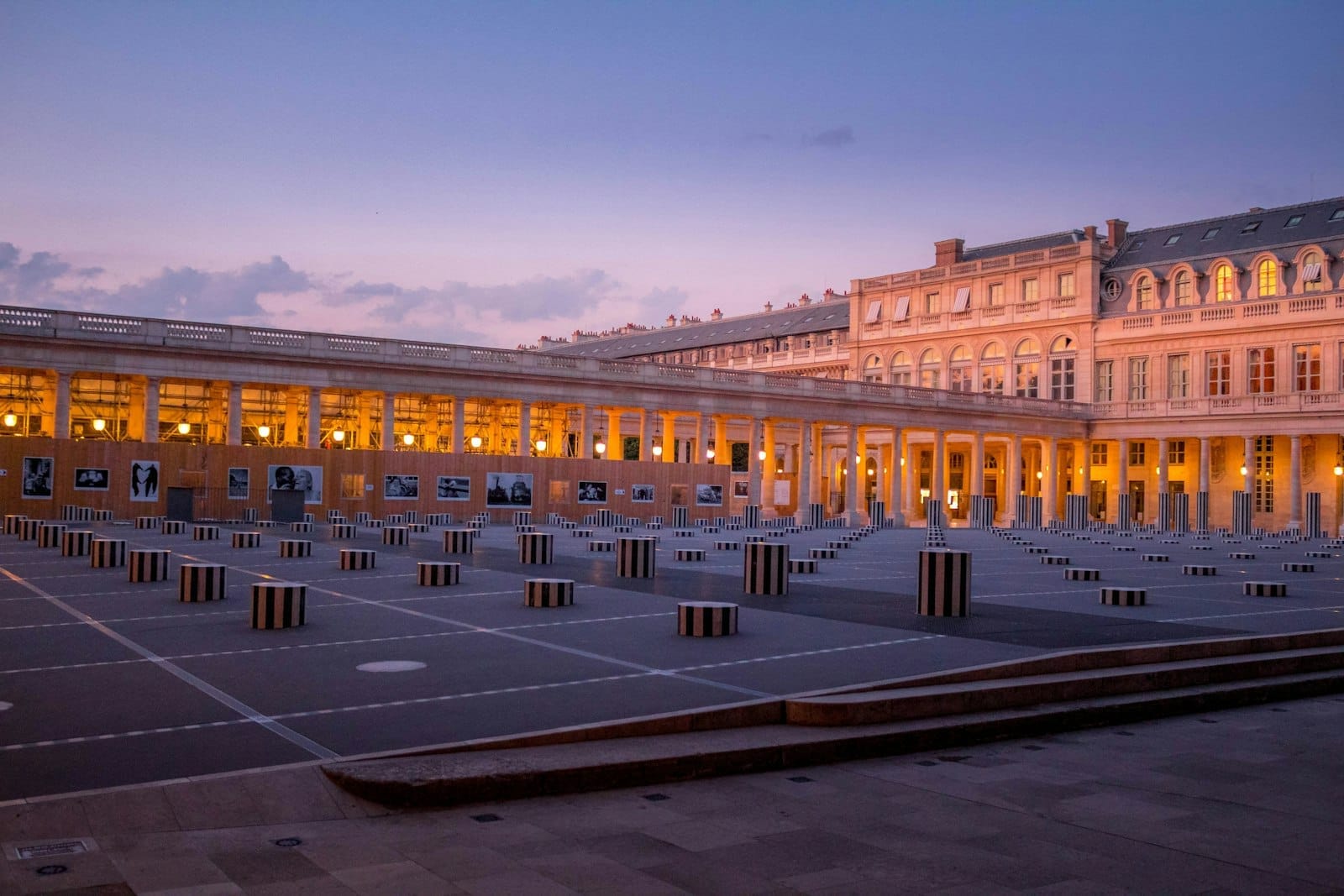
The first thing you see after passing through the main gate is the Cour d'Honneur, a wide ceremonial courtyard filled with 260 black-and-white striped columns of varying heights. These are Les Deux Plateaux, a public art installation by French conceptual artist Daniel Buren, commissioned in 1985. The columns range from roughly 25 cm to over 3 metres; water channels run between them, and children invariably treat the shorter stumps as stepping stones.
The installation provoked genuine outrage when it was proposed: politicians, artists, and architects petitioned against it. Today it is one of the most photographed spots in Paris, particularly in early morning when low-angle light catches the striped surfaces and the courtyard is largely empty. On overcast days the contrast flattens and the columns lose much of their graphic punch.
💡 Local tip
For the best Buren column photographs, arrive before 9am in summer when sunlight enters the courtyard at a low angle from the east. By 11am the courtyard fills with school groups and the light becomes flat overhead.
The Garden and Arcades: What to Expect
Beyond the Cour d'Honneur lies the main garden: a long rectangular space of clipped hedges, gravel paths, and a central fountain, divided by two rows of linden trees. Three sides are bounded by the continuous Orléans-era arcades, giving the whole space an enclosed, cloister-like quality that muffles street noise. On warm afternoons, office workers from the Ministry of Culture bring their lunches here. On cool mornings, it is one of the genuinely quiet places in central Paris.
The arcades themselves are worth a slow circuit. Unlike Paris's covered passages, the Palais Royal arcades are open to the sky at courtyard level. The shops beneath the colonnades lean toward the antique and the specialist: military medals, vintage jewellery, art books, designer clothing. Several restaurants here have been operating for generations. Prices throughout the arcades reflect the postcode.
If the Palais Royal arcades spark interest in Paris's broader covered passage tradition, the covered passages of Paris make a natural follow-on visit. The best examples, including the Galerie Vivienne and Passage des Panoramas, are a 15-minute walk northeast.
How the Experience Changes Through the Day
At 7am the garden opens and for the first hour it belongs to joggers and dog walkers. The gravel is freshly raked, the fountain runs steadily, and the only sounds are birds. This is the Palais Royal most tourists never see: a pocket of stillness in the 1st arrondissement.
By 10am the arcades begin to come to life and tour groups filter through the Buren columns. Midday to 3pm is the busiest period in summer. The garden absorbs crowds reasonably well because of its elongated shape, and the far north end near the Théâtre du Palais-Royal almost always stays quieter than the main entrance.
Evening is the most underrated window. In summer the garden stays open until 10:30pm, and the hour before dusk brings warm light on pale stone facades, restaurant tables spilling into the arcades, and far fewer tourists than midday. In winter, closing time shifts to 8:30pm, but the lit boutiques make the arcades worth a cold-weather detour.
ℹ️ Good to know
Gardens open daily 7am to 10:30 pm (April to October) and 7am to 8:30 pm (November to March). The palace interiors, housing the Ministry of Culture, Conseil d'État, and Constitutional Council, are not open to the public.
Practical Details for Your Visit
Getting here is straightforward. Palais Royal-Musée du Louvre station, served by Métro lines 1 and 7, puts you at the south entrance in under two minutes on foot. Line 1 runs east toward the Marais and west toward the Champs-Élysées; Line 7 connects north to the Opéra area. If you are already at the Louvre, the Palais Royal is a four-minute walk through the Cour Napoléon.
The garden terrain is mostly compacted gravel, which is manageable for most visitors but can be slow for wheelchairs. The main paths through the garden are level and wide. Cobblestones in the Cour d'Honneur and parts of the arcades may present more difficulty. For visitors planning a broader morning in the area, the Jardin des Tuileries is a 10-minute walk west along Rue de Rivoli and offers a different, more expansive version of the formal French garden tradition.
There are no bag checks, no timed entry, and no ticket. Restrooms are available within the arcades near the garden entrance. Cafés and restaurants in the arcades are full-service and tend toward the expensive side; there are no food stalls inside, so bring provisions if you plan to picnic.
The Palais Royal sits at the northern edge of Paris's 1st arrondissement, a short walk from the Louvre Museum to the south and the Place de la Concorde axis to the west. It fits naturally into a first-day itinerary covering central Paris, and the free entry makes it a no-commitment addition to any route between the Louvre and the Opéra. For a structured overview of how to sequence these sights, the Paris 3-day itinerary covers this corridor in detail.
Who May Want to Skip It
The Palais Royal rewards those who walk slowly and notice architectural detail. Visitors after sweeping views or interactive experiences will find it underwhelming. The palace itself is closed to the public: if you want royal apartments, Versailles or Fontainebleau are what you need. The garden is also not well suited to younger children: there is no play equipment, the Buren columns entertain for about ten minutes, and the arcade shops offer little for anyone under twelve.
If you are working from a tight list of major sights and have limited time in Paris, the Palais Royal is worth about an hour. The Paris first-timers guide helps prioritize sights when time is genuinely short.
Insider Tips
- The north end of the garden, near the Théâtre du Palais-Royal, stays quieter throughout the day than the Buren columns end. Walk the full length before settling on a bench.
- Restaurant Le Grand Véfour, inside the north arcade, has operated since 1784 and retains its original Empire-era interior. Even if you do not eat there, look through the windows at the painted glass panels.
- The west arcade (Galerie de Montpensier) is quieter than the east arcade (Galerie de Valois) and better for browsing specialist shops without café foot traffic.
- On Saturday mornings, antique medal and military decoration dealers in the arcades are at their most active, drawing collectors from across France.
- The Métro station below has its own art: Jean-Michel Othoniel's glass-bead canopies above the exits, installed for the station's centenary in 2000.
Who Is Palais Royal For?
- Architecture enthusiasts drawn to the 17th-century arcades and the contrast between classical design and Buren's postmodern columns
- Photographers seeking geometric subjects in central Paris, especially at low-light morning hours
- Slow travelers who want to sit in a formal French garden without paying admission
- Budget-conscious visitors: free entry, no queues, easily combined with nearby no-cost sights
- Antique and specialist shoppers: military decorations, vintage jewellery, and specialist art books in the arcades
Nearby Attractions
Other things to see while in Champs-Élysées & Trocadéro:
- Arc de Triomphe
Standing 49.5 metres above Place Charles de Gaulle, the Arc de Triomphe de l'Étoile anchors the grandest axis in Paris. Its rooftop terrace delivers one of the city's great panoramas, while the base houses the Tomb of the Unknown Soldier — a living memorial renewed by flame every evening.
- Champs-Élysées
Stretching 1.91 km from Place de la Concorde to the Arc de Triomphe, the Avenue des Champs-Élysées is at once Paris's grandest promenade and its most debated street. Here is what to expect, when to go, and how to make the most of it.
- Crazy Horse Paris
Crazy Horse Paris has staged its distinctive blend of dance, light, and visual design on Avenue George V since 1951. The current show, 'Totally Crazy!', runs approximately 90 minutes and draws a mix of curious first-timers and loyal returning guests who appreciate its position between cabaret tradition and contemporary performance art.
- Grand Palais
Built for the 1900 Universal Exhibition and freshly reopened after a landmark renovation, the Grand Palais is one of the most spectacular public buildings in Europe. Its iron-and-glass nave stretches 240 metres and shelters world-class art exhibitions, cultural events, and the Palais de la Découverte science museum beneath a single soaring roof.