Covered Passages of Paris (Passages Couverts): The Complete Visitor's Guide
Paris's covered passages are 19th-century glass-roofed arcades that once revolutionized urban retail — and today offer one of the city's most atmospheric, free, and rain-proof walks. About 21 survive today, with around 20 others demolished historically, concentrated in the 1st and 2nd arrondissements near the Grands Boulevards and Palais Royal, each with its own character, shops, and stories.
Quick Facts
- Location
- Primarily 1st & 2nd arrondissements, Paris (clusters near Grands Boulevards and Palais Royal)
- Getting There
- Grands Boulevards (lines 8, 9), Bourse (line 3), Palais Royal–Musée du Louvre (lines 1, 7)
- Time Needed
- 1.5–3 hours for a self-guided circuit of the main passages; half a day to explore them all at leisure
- Cost
- Free entry to all passages; individual shops and cafes charge separately
- Best for
- Architecture lovers, rainy-day explorers, vintage shoppers, history enthusiasts, and slow walkers
What Are the Covered Passages?
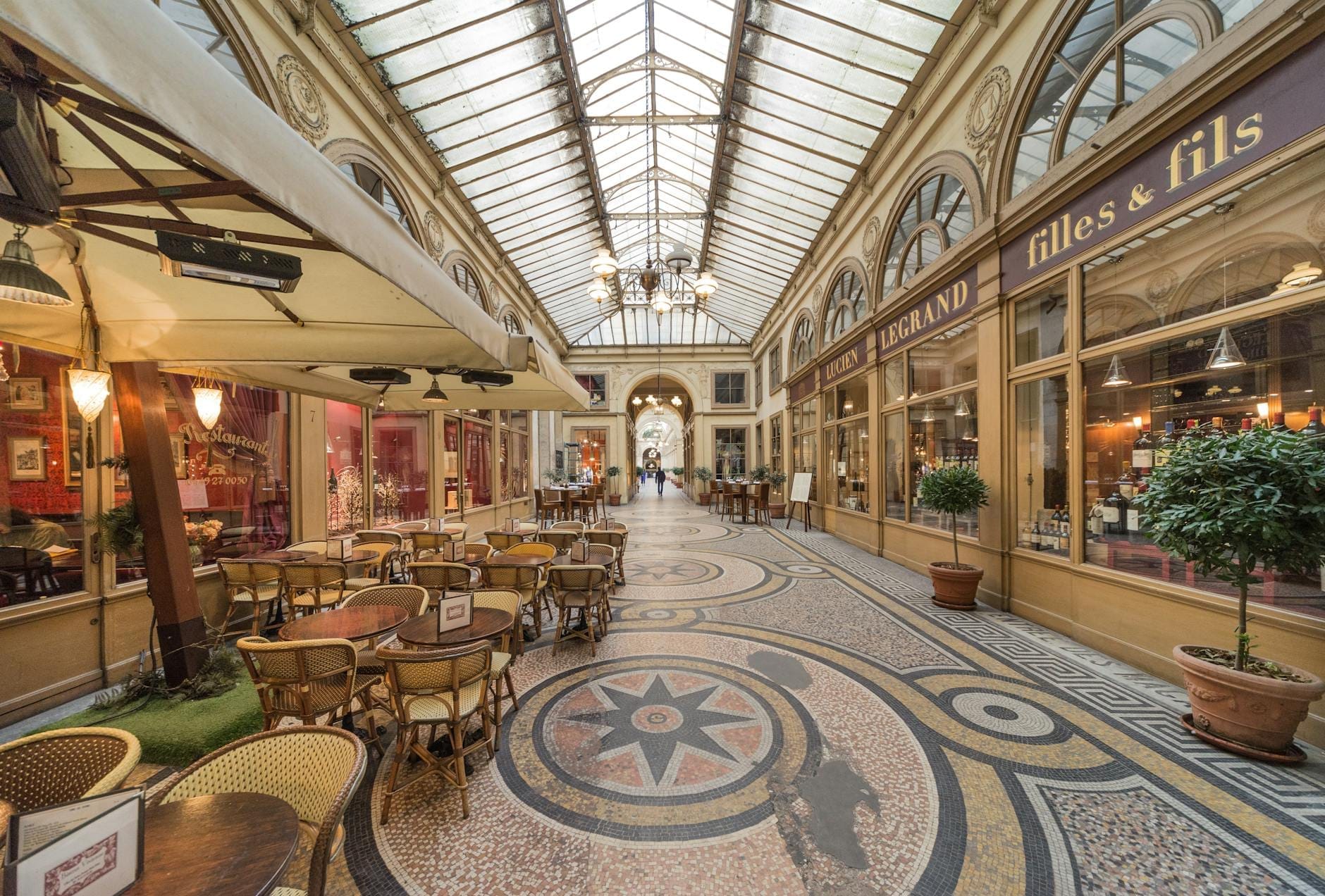
The passages couverts de Paris are pedestrian shopping arcades roofed in iron and glass, built between 1798 and the mid-19th century, with the earliest opening in 1798. At their peak, Paris had around 150 of these sheltered lanes threading through its city blocks. Today roughly 21 survive, and they represent one of the most distinctive pieces of urban architecture in Europe: forerunners of the modern shopping mall, but dressed in mahogany vitrines, painted ceilings, mosaic floors, and gaslight-era ironwork.
They were built to solve a practical problem. Before Baron Haussmann redesigned Paris in the 1850s and 1860s, the city's streets were narrow, unpaved, and dominated by horse-drawn traffic. The passages gave Parisians a sheltered route between streets, protected from mud, rain, and carriage wheels. Merchants quickly discovered that captive foot traffic translated to sales, and a construction boom followed. By the 1830s, the passages were the city's most fashionable retail destinations.
Most surviving passages cluster in two geographic zones: the 2nd arrondissement around the Grands Boulevards and Opéra district, and the 1st arrondissement around Palais Royal. Walking between them takes under ten minutes, making it easy to combine four or five passages into a single morning circuit.
💡 Local tip
Most passages are open Monday to Saturday during business hours. Sunday hours are inconsistent, and some arcades close entirely. If you are planning your visit around specific shops, check in advance. The Passage des Panoramas is among the most reliably open, with access from 6am to midnight including Sundays and public holidays.
The Grands Boulevards Cluster: Four Passages in a Row
The most rewarding self-guided walk links four passages just north of the Seine, all within a short stretch of the 2nd and 9th arrondissements. Start at Passage des Panoramas, then cross the boulevard into Passage Jouffroy, cross again into Passage Verdeau, and loop back. This chain takes about 90 minutes at a relaxed pace, with plenty of reasons to stop.
Passage des Panoramas: Among the Oldest Survivors
Passage des Panoramas, opened in 1799, is the second-oldest covered walkway in Paris still in use, after Passage du Caire (1798). Its entrance on Boulevard Montmartre at number 11 is easy to miss — a plain arch that opens into a labyrinth of interconnected galleries. Inside, the light shifts immediately. Street noise drops. The paving stones are original, worn smooth in the center by two centuries of foot traffic.
The passage built its early reputation on the panoramic rotundas at its northern end — large cylindrical rooms where painted scenes of foreign cities were displayed for paying visitors, an 1800s equivalent of virtual travel. The rotundas are long gone, but the passage retains its layered atmosphere: philatelist shops with stamp collections in the windows, atmospheric bistros serving steak frites, a wine bar, and engravers whose trade signs look unchanged since the Second Empire.
At midday on a weekday, the passage fills with office workers from the surrounding arrondissements, drawn by the lunch counters. In the late afternoon it quiets down considerably. Early morning, before 9am, is when the space feels most authentically itself: shutters still closed on many shops, the smell of fresh bread drifting from a nearby boulangerie, and a handful of locals passing through as a shortcut.
Passage Jouffroy and Passage Verdeau
Cross Boulevard Montmartre and you enter Passage Jouffroy, which opened in 1847 and was the first covered passage to be heated by the ground — a significant luxury at the time. Its polished geometric tile floor, ornate plasterwork, and the presence of a 19th-century clock mounted on the wall give it a slightly grander feel than its neighbor. The Librairie du Passage near the southern end stocks antiquarian and new books with the kind of organized chaos that invites browsing.
Passage Verdeau, just beyond, is quieter and attracts fewer visitors. That lower footfall is part of its appeal. Antique dealers dominate here, with stalls of vintage postcards, old cameras, prints, and second-hand books. The ceiling here is lower and the light more diffuse, making it feel closer to a cabinet of curiosities than a shopping arcade. Vendors are generally open to conversation, and prices are negotiable on smaller items.
Tickets & tours
Hand-picked options from our booking partner. Prices are indicative; availability and final rates are confirmed when you complete your booking.
Guided walking tour of the Covered Passages of Paris
From 125 €Instant confirmationFree cancellationPrivate tour of the Opera Garnier and the Covered Passages
From 187 €Instant confirmationFree cancellationWalking tour of the Covered Passages in the Palais Royal neighborhood
From 11 €Instant confirmationPrivate walking tour of covered passages
From 56 €Instant confirmation
The Palais Royal Cluster: Elegance and Discretion
A fifteen-minute walk south and west brings you to a second cluster of passages, more polished in character and set within the elegant 1st arrondissement. These arcades attracted a wealthier clientele from their opening and have maintained a more refined atmosphere.
Galerie Vivienne
Galerie Vivienne, built in 1823, is one of the most beautiful covered passages in Paris. Its mosaic floor is the first thing you notice: geometric patterns in terracotta, black, and cream that extend the full length of the gallery. The Neoclassical stucco reliefs on the upper walls feature goddesses, eagles, and trailing vines. At the rotunda midpoint, a glass dome channels diffused daylight down onto the floor in a shifting oval of light that changes throughout the day.
The tenants lean toward design, fashion, and fine wine. Jean-Paul Gaultier once maintained his flagship boutique here, lending the gallery a fashion-world cachet that still lingers. The bookshop near the Rue de la Banque entrance carries a well-curated selection. In the late afternoon, when angled sunlight hits the ironwork and the mosaic floor simultaneously, the gallery is at its most photogenic.
💡 Local tip
Photography tip: For Galerie Vivienne's mosaic floors, shoot from low angle near the rotunda between 3pm and 5pm on sunny days when the dome casts the strongest light. A wide-angle lens or a phone camera in portrait mode with the floor in the foreground captures the depth best.
Galerie Véro-Dodat
Opened in 1826, Galerie Véro-Dodat is a theatrical passage with distinctive architectural features. Its painted ceilings are divided into trompe-l'oeil panels. Black-and-white linoleum tiles alternate the length of the floor. The mahogany-fronted shop fittings are among the best-preserved in any passage, and the entire space is lit by globe lamps on brass fittings that were originally gas-powered.
Tenants here include antique dealers specializing in musical instruments, restorers, and a few fashion ateliers. The gallery connects Rue de l'Arbre-Sec with Rue Jean-Jacques-Rousseau, both within easy walking distance of the Louvre. It receives fewer visitors than Galerie Vivienne, which means you can often have long stretches of it to yourself, a rarity in central Paris.
The Lesser-Known Passages: Off the Main Circuit
Passage du Grand Cerf, in the 2nd arrondissement near Rue Saint-Denis, has a notably high glass ceiling. The ironwork is particularly fine here, painted pale green, and the light inside is exceptional on bright days. It has been attractively restored and houses a mix of design studios, jewellers, and craft workshops, attracting a younger clientele than the Grands Boulevards passages.
Passage du Caire, opened in 1798, is the oldest arcade in Paris and, at around 360 metres, the longest, narrowest, and the only passage currently occupied by wholesale textile, trim, and ready-to-wear businesses. Its Egyptian-revival facade at the entrance references the Napoleonic campaign in Egypt, which dominated French public imagination at the time of its construction. Inside, however, romance gives way to commerce: the passage is almost entirely given over to the wholesale textile and fashion trade centered on the nearby Sentier district. It is worth entering for the facade alone, but do not expect the curated boutique atmosphere of Galerie Vivienne.
For context on shopping in the wider area, the Galeries Lafayette Haussmann is a ten-minute walk north and represents the opposite end of the retail spectrum: a grand department store where the covered passages' intimate scale gives way to something much larger and louder.
⚠️ What to skip
Passage des Princes (Boulevard des Italiens) is currently closed due to demolition and renovation works, and Passage Ben Aïad is considered possibly permanently closed. Do not include either in your itinerary.
When to Visit and What to Expect
The passages are at their most compelling in conditions that make outdoor sightseeing uncomfortable. On a grey November morning or during a summer afternoon downpour, stepping from the street into a glass-roofed arcade is one of Paris's most satisfying transitions. The covered roof keeps rain out entirely, the enclosed space holds warmth in winter, and the absence of vehicle traffic makes conversation easy.
Weekday mornings between 9am and 11am offer the least crowded experience. Weekend afternoons can become congested, particularly in Galerie Vivienne and Passage des Panoramas. If you are visiting in July or August, be aware that some individual shops close for summer holidays, reducing the number of open boutiques noticeably. Spring and autumn are ideal: milder temperatures, fewer tour groups, and full trading hours across most tenants.
The passages work well as a standalone half-day or as part of a broader Palais Royal and Opéra neighbourhood walk. Combining them with a visit to the Palais Garnier makes geographic sense: the opera house is five minutes from the Grands Boulevards passage cluster, and its own architecture rewards the same unhurried attention.
Practical Details and Accessibility
Entry to all passages is free. The passages are not museums and have no ticketed areas. Shops operate independently, with their own pricing and hours. Most passages are open Monday to Saturday during business hours, with Passage des Panoramas accessible from 6am to midnight daily including public holidays. Verify individual shop hours before making a special trip for a specific retailer.
Accessibility is a genuine limitation. These are historic structures with original flooring, narrow widths in some sections, and no infrastructure for wheelchair users. Steps appear at entrances to several passages and at internal level changes. The uneven paving stones in older sections can be difficult for travellers with mobility issues. Galerie Vivienne is the most navigable of the main passages in terms of floor level, but even there access is not fully wheelchair-compatible.
Getting there by metro is straightforward. For the Grands Boulevards cluster (Passage des Panoramas, Jouffroy, Verdeau): exit at Grands Boulevards on lines 8 or 9. For the Palais Royal cluster (Galerie Vivienne, Véro-Dodat): exit at Palais Royal–Musée du Louvre on lines 1 and 7, or Bourse on line 3. The full circuit is walkable without using the metro at all. See the Paris transport guide for metro fare and ticket options.
Who Should Skip This
Travellers looking for blockbuster sights with a clear payoff — the kind of experience where you arrive, see a famous object, and leave with a photograph — will likely find the passages underwhelming. There is no single centrepiece. The pleasure is cumulative and slow: the details in the ironwork, the smell of old paper from an antiquarian bookseller, the particular quality of light through aged glass. If that sounds more like work than enjoyment, this is probably not a priority for a short trip.
Similarly, travellers primarily interested in contemporary shopping should look elsewhere. The passages carry niche, specialist, and vintage inventory. For mainstream retail, the department stores around Opéra and the Grands Boulevards or the boutiques of Le Marais will be more satisfying.
Insider Tips
- The four connected galleries of Passage des Panoramas — Galerie Feydeau, Galerie Montmartre, Galerie Saint-Marc, and Galerie des Variétés — are all technically part of the same complex. Exploring the branching corridors reveals older sections that most visitors walk past.
- Galerie Colbert, directly adjacent to Galerie Vivienne and connected to it, is managed by the Institut National d'Histoire de l'Art and contains a free exhibition space. It is less crowded than Vivienne despite being just steps away.
- The mosaic floor of Galerie Vivienne extends fully to both exits. Most visitors enter from Rue de la Banque and turn back at the rotunda, missing the second half of the floor pattern near the Rue des Petits-Champs exit.
- For the best atmospheric photographs in Passage des Panoramas, visit on a quiet weekday morning before 9am when the shopkeepers are preparing their displays and the paving stones catch the early diffused light from the glass roof.
- Passage du Grand Cerf's entrance on Rue Saint-Denis is easy to miss. Look for the tall iron gate, just north of Rue Greneta. Verify current opening hours before visiting.
Who Is Covered Passages of Paris For?
- Architecture and design enthusiasts who appreciate ornate 19th-century ironwork, mosaic floors, and glass vaulting
- Vintage and antique shoppers hunting for postcards, prints, stamps, old cameras, and second-hand books
- Rainy-day visitors who want an atmospheric alternative to outdoor sightseeing
- Slow travellers who prefer exploring at an unhurried pace over a structured itinerary
- Photographers looking for interior architectural shots away from the crowds of major monuments
Nearby Attractions
Other things to see while in Opéra & Grands Boulevards:
- Galeries Lafayette Haussmann
Galeries Lafayette Haussmann is a highly visited retail destination, but its 43-metre Art Nouveau glass dome and free rooftop terrace with panoramic Paris views make it worth a detour for non-shoppers too. Set at Boulevard Haussmann, with the landmark dome built in 1912, it spans three interconnected buildings across 70,000 square metres in the 9th arrondissement.
- Le Grand Rex
Opened in 1932 and listed as a French historical monument, Le Grand Rex is Europe's largest cinema with 2,702 seats and an extraordinary Art Deco interior. Beyond regular screenings, the Rex Studios backstage tour takes you behind the projection booths, onto rooftop terraces, and into an interactive special-effects finale that surprises adults and delights children alike.
- Musée de la Vie Romantique
Set in painter Ary Scheffer's 1830 townhouse at the foot of Montmartre, the Musée de la Vie Romantique immerses visitors in the world of Chopin, George Sand, and the Romantic movement. Admission to the permanent collection is free, the rose-lined courtyard garden invites lingering, and the whole experience feels nothing like a conventional museum.
- Musée Jacquemart-André
Hidden in plain sight on Boulevard Haussmann, the Musée Jacquemart-André is a 19th-century private mansion that doubles as one of Paris's finest art museums. Its collection of Italian Renaissance masterpieces, Flemish paintings, and period furnishings survives exactly as its original owners intended.