Palais Garnier: Inside Paris's Most Spectacular Opera House
The Palais Garnier is the most ornate building Napoleon III's Paris ever produced: a 19th-century monument of marble, bronze, and velvet that doubles as one of the city's most rewarding self-guided tours. Whether you come to see a ballet or simply to wander, the building itself is the performance.
Quick Facts
- Location
- Place de l'Opéra, 75009 Paris (corner of Rue Scribe and Rue Auber for visits)
- Getting There
- Opéra (lines 3, 7, 8); also Chaussée d'Antin – La Fayette (lines 7, 9) and Auber (RER A)
- Time Needed
- 1.5 to 2 hours for a self-guided tour; longer if attending a performance
- Cost
- Self-guided tour: €26 (non-EEA adults), €15 (EEA/France adults), €21 (non-EEA ages 13–25), €10 (EEA ages 13–25), free (under 12). Multimedia tablet add-on: €6.50
- Best for
- Architecture lovers, opera and ballet fans, history enthusiasts, first-time Paris visitors
- Official website
- www.operadeparis.fr/en/visits/palais-garnier
What Is the Palais Garnier?
The Palais Garnier, officially the Opéra national de Paris – Palais Garnier, is a 1,979-place opera house completed in 1875 and listed as a historical monument since 1923. It stands on the Place de l'Opéra in Paris's 9th arrondissement as the architectural centrepiece of Baron Haussmann's grand redesign of the city. Today it serves as the primary home of the Paris Opera Ballet, while the larger Opéra Bastille hosts most of the city's large-scale operatic productions.
The building was designed by Charles Garnier, a 35-year-old relatively unknown architect who won the commission in 1861 in open competition, beating out 170 rivals including the established names of the day. Construction began immediately but was delayed repeatedly: an underground lake was discovered beneath the site, requiring months of pumping and reinforced concrete foundations, and the Franco-Prussian War of 1870 halted work entirely for two years. The building finally opened on 5 January 1875, fourteen years after the first spade went into the ground.
ℹ️ Good to know
The auditorium may be closed during rehearsals. On days when it is inaccessible, ticket prices are reduced. Check operadeparis.fr before your visit to confirm auditorium access.
The Grand Staircase: Theatre Before the Theatre
Nothing prepares you for the Grand Staircase. You pass through the security checks on Rue Scribe, collect your ticket, and then step into a space that makes the entry halls of most palaces look understated. The staircase is made from white Algerian marble with balustrades of red and green marble, rising in a double flight beneath a barrel-vaulted ceiling decorated with painted medallions. Garnier designed it explicitly as a stage: 19th-century opera-goers were as interested in seeing each other as in hearing the music, and the staircase gave them the perfect runway.
Arrive just after opening (10am) and you will have these stairs largely to yourself. By 11:30am, tour groups and independent visitors fill the landings, and the noise level rises considerably. If photography is your priority, the early slot is worth the effort. The light filtering through the upper windows is warm and diffuse in the morning, harsher in the early afternoon. The staircase is also one of the few areas where tripods are generally tolerated during non-performance hours, though it is worth confirming at the desk.
Tickets & tours
Hand-picked options from our booking partner. Prices are indicative; availability and final rates are confirmed when you complete your booking.
World War II in Paris private walking tour
From 26 €Instant confirmationFree cancellationGuided walking tour of the Covered Passages of Paris
From 125 €Instant confirmationFree cancellationPrivate tour of the Opera Garnier and the Covered Passages
From 187 €Instant confirmationFree cancellationWalking tour of the Covered Passages in the Palais Royal neighborhood
From 11 €Instant confirmation
The Auditorium and Chagall's Ceiling
The auditorium is what most visitors come to see, and it rarely disappoints. Five tiers of red-velvet boxes rise around the horseshoe-shaped hall, trimmed in gold leaf, each box framed by gilded caryatids and lit by crystal chandeliers. The atmosphere is hushed in a way that feels performative, as if the room itself is holding its breath. The capacity is just under 2,000 seats, but the horseshoe layout makes the space feel intimate despite its scale.
Look up. The ceiling you see today is not the original. In 1964, André Malraux, then France's Minister of Cultural Affairs, commissioned Marc Chagall to paint a new one. Chagall covered the original ceiling with a stretched canvas 220 square metres in size, depicting fourteen scenes drawn from operas and ballets, with figures from works by Mozart, Wagner, Berlioz, Rameau, and Stravinsky floating across panels of emerald, violet, blue, and gold. The contrast with Garnier's gilded neo-Baroque interior is deliberate and strange and, once you've seen it, unforgettable.
The auditorium is only accessible when rehearsals are not scheduled. On performance days it closes to daytime visitors in the afternoon, typically from around 1pm onwards. If seeing the auditorium is essential to your visit, book a morning entry and confirm access at the ticket desk.
The Grand Foyer and Salon du Glacier
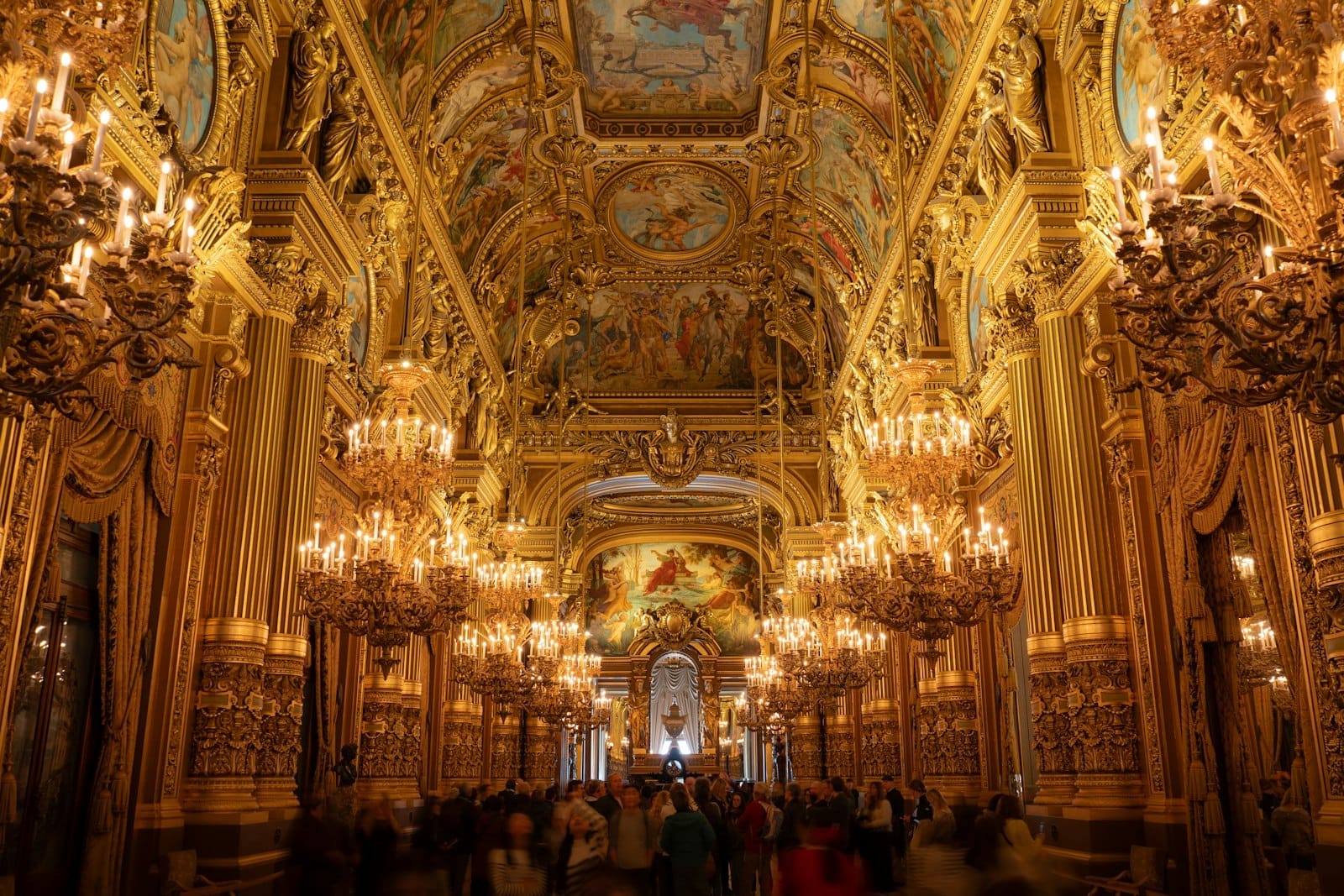
Beyond the staircase, the Grand Foyer runs the full width of the building at 54 metres long. Its ceiling is covered with allegorical paintings, the floor is inlaid marble, and the mirrors along the walls multiply the chandelier light into something close to dazzling. It was modelled on the Hall of Mirrors at Versailles, though Garnier's version is, if anything, more densely ornamented. At intermission during performances, this is where the crowd spills out with champagne glasses; during daytime visits, it is quieter and you can take it in without jostling.
The adjacent Salon du Glacier, originally used as a refreshment room during performances, retains its Second Empire ceiling paintings and elaborate plasterwork. It opens onto the loggia facing the Place de l'Opéra. Step out onto the terrace and you get one of the cleaner views of Haussmann's Paris: the wide boulevards radiating outward, the uniform stone façades, and the distant shimmer of the city. For a full appreciation of how the building fits its urban context, the Opéra and Grands Boulevards neighborhood rewards a 20-minute walk after your visit.
The Library-Museum
Included with the standard visit ticket is access to the Paris Opera Library-Museum, housed within the building itself. The permanent collection covers the history of the Paris Opera from its founding in 1669: original set models, costume sketches, performance photographs, musical scores, and a rotating selection of items connected to productions across three and a half centuries. It is a small museum, but the quality of the objects is high and the context it provides for understanding the building's significance is genuine.
Temporary exhibitions are mounted here regularly. From October 2025 to February 2026, the library-museum is hosting an exhibition marking the 150th anniversary of the Palais Garnier. Note that the temporary exhibition spaces and the library-museum have limited accessibility for visitors with reduced mobility.
Attending a Performance
Visiting the building as a tourist and attending a performance are two very different experiences. The Paris Opera Ballet, one of the oldest and most prestigious ballet companies in the world, performs its most important productions here. Ballet programmes at Garnier tend to favour the classical repertoire, while opera productions migrate between the two houses depending on scale. Tickets range from under €20 for upper balcony seats to well over €200 for premium boxes. For programming details and booking, the official site is the only reliable source. If you are planning a Paris trip around a performance, the best time to visit Paris guide covers the cultural season in detail.
Dress code for performances is smart to formal, though the Palais Garnier does not enforce strict black-tie rules as it once did. What you will notice is that the Parisian audience dresses with care, and arriving underdressed is a minor social miscalculation rather than a punishable offence. Evening performances begin between 7:30pm and 8pm; check your ticket for the precise curtain time.
💡 Local tip
Book daytime visit tickets online in advance, especially in August and during school holidays. Walk-up entry is possible at the desk (open from 10am daily), but popular time slots sell out. The desk at Rue Scribe is the one for visits; the box office for performance tickets is on the Place de l'Opéra side.
Practical Walkthrough: What to Expect on Arrival
Visitors enter via the corner of Rue Scribe and Rue Auber, not through the main façade on the Place de l'Opéra. Expect airport-style security: bags are scanned and you walk through a portal. Suitcases and large travel bags are not permitted inside under the Vigipirate security plan; there is no cloakroom during visiting hours, so plan accordingly. A luggage storage service exists nearby if you are visiting directly from a hotel or the train.
The self-guided visit is open every day from 10am to 5pm (last entry 4:15pm), with possible seasonal variations. The ticket desk on-site opens at 11am. A multimedia tablet audio guide is available as an add-on for €6.50 and provides roughly one hour of content as you move through the building. It covers the architecture, mythology, and stories that the wall plaques do not, and is worth the supplement if you are visiting without a guided tour.
The building is covered by the Paris Museum Pass, which allows entry without purchasing a separate ticket. If you are planning to visit multiple museums and major sites in a few days, checking whether the Paris Museum Pass is worth it for your itinerary is a sensible step before you buy individual tickets.
⚠️ What to skip
The auditorium and some upper areas may be closed on performance days, often from early afternoon. Reduced-price tickets apply when access is limited, but if seeing the full building is important, a weekday morning visit outside the main performance season is the safest bet.
Who Might Want to Skip It
The Palais Garnier is genuinely one of the most impressive interiors in Paris, but it is not for everyone. Visitors with limited mobility should know that the temporary exhibition areas and the library-museum are not fully accessible. The visit involves significant stair climbing; there is no lift to all levels. Travellers who find ornate, gilded spaces overwhelming rather than impressive will get less from it than those who enjoy historical architecture. And if you visit on a day when the auditorium is closed, the experience, while still beautiful, loses its centrepiece.
Budget travellers should weigh the €25 entry (for non-EEA adults) against other options: the exterior and the Place de l'Opéra can be observed freely, and the nearby Galeries Lafayette Haussmann rooftop offers a free and striking view of the Garnier dome from above. For those drawn more to the history of Parisian performance culture, the Musée Carnavalet covers the city's theatrical heritage in a free permanent collection.
Insider Tips
- Enter at exactly 10am on a weekday to have the Grand Staircase almost entirely to yourself. Tour groups rarely arrive before 10:30am, giving you a 20–30 minute window of relative quiet.
- The exterior dome and rooftop sculptures are best photographed from the rooftop terrace of Galeries Lafayette Haussmann, a short walk east along Boulevard Haussmann. It is free to access and the perspective from above shows details of the gilded Apollo figure and the green copper dome that you cannot see from street level.
- The Phantom of the Opera is set at Garnier, and the underground lake that inspired Gaston Leroux's 1910 novel is real. It still exists beneath the building today, used to maintain stable foundation pressure and as a water reservoir for the Paris fire brigade.
- If you want guided-tour depth without the group format, rent the multimedia tablet (€6.50 supplement). It includes augmented-reality overlays that reveal inaccessible areas including the Foyer de la Danse and the costume depository.
- Performance tickets for upper-tier seats (4th and 5th balcony) are the most atmospheric way to experience Garnier as a working theatre. Sightlines are steep but the acoustics are excellent, and the view of the auditorium from above is unlike anything in the daytime visit.
Who Is Palais Garnier For?
- Architecture enthusiasts drawn to Second Empire ornament and Haussmann-era Paris
- First-time visitors to Paris who want an interior that rewards close attention
- Ballet and opera-goers looking to experience one of Europe's great historic performance spaces
- Photographers with an eye for symmetry, gilded detail, and dramatic staircases
- History travellers interested in 19th-century Paris, Napoleon III's urban vision, and French cultural institutions
Nearby Attractions
Other things to see while in Opéra & Grands Boulevards:
- Covered Passages of Paris
Paris's covered passages are 19th-century glass-roofed arcades that once revolutionized urban retail — and today offer one of the city's most atmospheric, free, and rain-proof walks. About 21 survive today, with around 20 others demolished historically, concentrated in the 1st and 2nd arrondissements near the Grands Boulevards and Palais Royal, each with its own character, shops, and stories.
- Galeries Lafayette Haussmann
Galeries Lafayette Haussmann is a highly visited retail destination, but its 43-metre Art Nouveau glass dome and free rooftop terrace with panoramic Paris views make it worth a detour for non-shoppers too. Set at Boulevard Haussmann, with the landmark dome built in 1912, it spans three interconnected buildings across 70,000 square metres in the 9th arrondissement.
- Le Grand Rex
Opened in 1932 and listed as a French historical monument, Le Grand Rex is Europe's largest cinema with 2,702 seats and an extraordinary Art Deco interior. Beyond regular screenings, the Rex Studios backstage tour takes you behind the projection booths, onto rooftop terraces, and into an interactive special-effects finale that surprises adults and delights children alike.
- Musée de la Vie Romantique
Set in painter Ary Scheffer's 1830 townhouse at the foot of Montmartre, the Musée de la Vie Romantique immerses visitors in the world of Chopin, George Sand, and the Romantic movement. Admission to the permanent collection is free, the rose-lined courtyard garden invites lingering, and the whole experience feels nothing like a conventional museum.