Palace of Culture and Science: Warsaw's Tallest Controversy
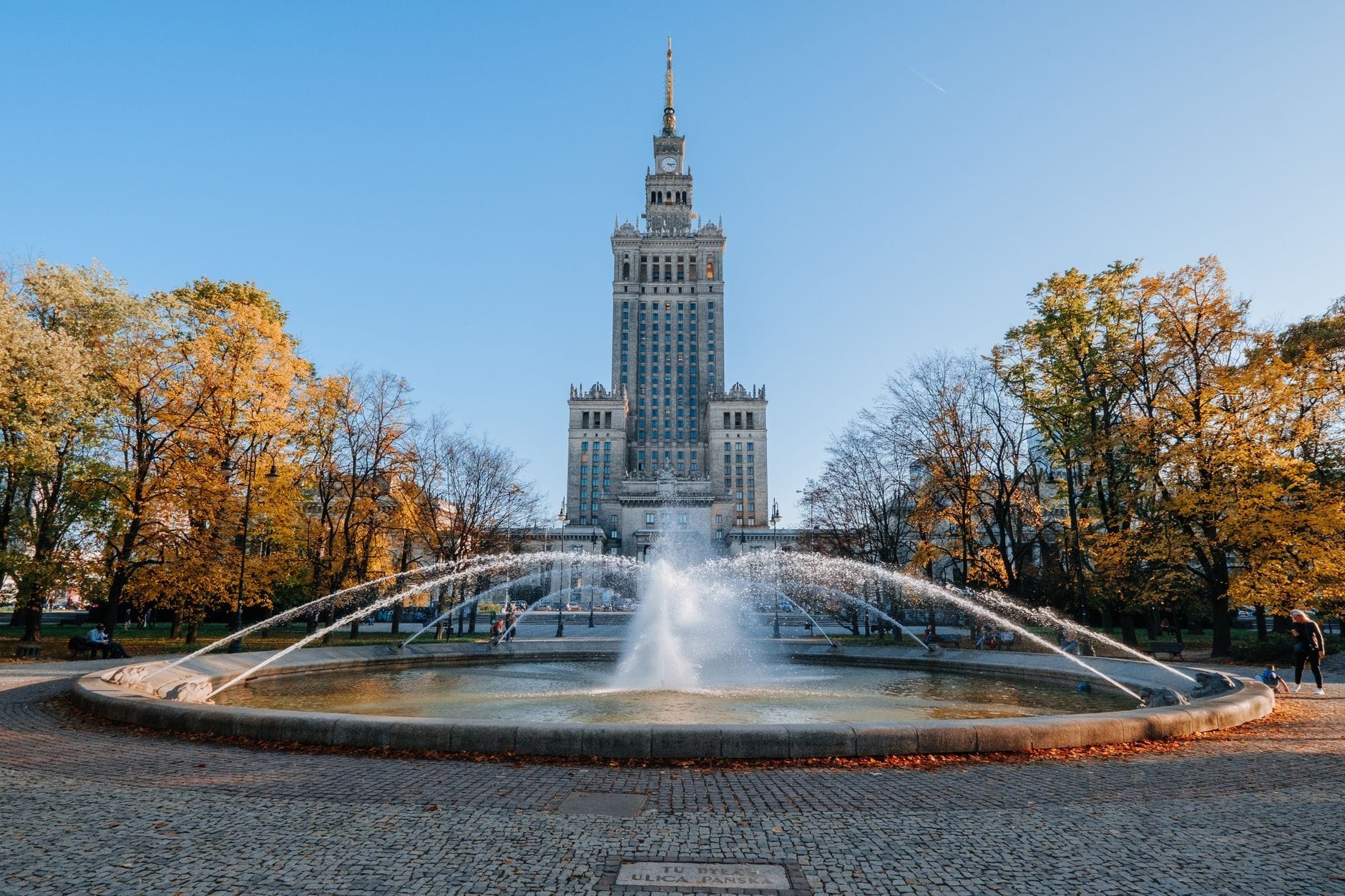
The Palace of Culture and Science (Pałac Kultury i Nauki) is Warsaw's most recognizable and most debated structure. A Soviet-era skyscraper gifted by Stalin, it dominates the city skyline at 230.68 metres and houses everything from a cinema to a viewing terrace with panoramic views across the Polish capital. Whether you love it or find it unsettling, it is impossible to ignore.
Quick Facts
- Location
- Plac Defilad 1, City Centre, Warsaw
- Getting There
- Metro Centrum (~4 min walk) or Świętokrzyska (~5 min walk); trams and buses on Marszałkowska and Aleje Jerozolimskie
- Time Needed
- 1–2 hours for the exterior and viewing terrace; longer if exploring interior venues
- Cost
- Viewing terrace approx. 20–26 PLN per person; confirm current price at pkin.pl
- Best for
- City panoramas, Cold War architecture enthusiasts, photographers, first-time Warsaw visitors
- Official website
- pkin.pl/en/home
What Is the Palace of Culture and Science?
The Palace of Culture and Science, known in Polish as Pałac Kultury i Nauki (PKiN), stands 230.68 metres tall at the heart of Warsaw's city centre. With 42 floors and approximately 3,288 rooms, it was the largest building in Poland when it was completed on 22 July 1955, and it remains one of the most architecturally distinctive structures in Central Europe. Its address, Plac Defilad 1, puts it at the literal centre of Warsaw's urban grid.
Construction began on 2 May 1952, a gift from the Soviet Union to the Polish people — a fact that makes the building politically charged to this day. The architect was Lev Rudnev, and the style draws directly from Stalinist classicism, sometimes called Socialist Realist architecture. The building's stone facades are decorated with socialist realist motifs: workers, scientists, writers, and farmers rendered in relief above doorways and along cornices. Up close, the level of craft in that stonework is genuinely impressive, regardless of what you think of the ideology behind it.
ℹ️ Good to know
The viewing terrace (Warsaw 360°) is open daily 10:00–20:00. Tickets cost approximately 20 PLN, but prices change; confirm at pkin.pl before visiting.
The Architecture: Stalinist Skyscraper Up Close
From across Plac Defilad, the palace looks like a wedding cake: broad at the base, tapering in stepped tiers toward a spire topped by a large clock. The four clock dials, each 6 metres in diameter, are among the largest clock faces in Europe. On a clear night, lit from within, they glow over the city centre like something from a science fiction film.
The base of the building contains cinemas, theatres, a congress hall, university faculties, offices, and exhibition spaces. Walking around the exterior perimeter takes about ten minutes, and the scale only becomes fully apparent when you are standing directly beneath one of the main entrance porticos. The columns are enormous, and the reliefs above the doors are larger than most rooms in an average apartment.
PKiN fits within a pattern of Soviet 'Seven Sisters' skyscrapers built across the Eastern Bloc in the early 1950s, sharing proportional similarities with buildings in Moscow, Riga, and Bucharest. For visitors interested in this architectural tradition, the Communist-era Warsaw guide provides broader context for how the city's postwar urban planning shaped its current form.
Tickets & tours
Hand-picked options from our booking partner. Prices are indicative; availability and final rates are confirmed when you complete your booking.
Palace of Culture and Science skip-the-line ticket and tour in Polish
From 19 €Instant confirmationFree cancellationEscape Tour self-guided, interactive city challenge in Warsaw
From 30 €Instant confirmationEscape Tour self-guided, interactive city challenge in Warsaw
From 30 €Instant confirmationPalace of Culture and Science skip-the-line ticket and tour in English
From 34 €Instant confirmationFree cancellation
The Warsaw 360° Viewing Terrace: What to Expect
The observation deck sits on the 30th floor and is marketed under the name Warsaw 360°. Lifts reach it quickly; the elevator ride itself takes only seconds but deposits you into a space where the full scale of Warsaw's flat geography becomes clear. On a clear day, the view extends across the city in every direction: westward toward Wola's glass office towers, eastward over the Vistula River to the Praga district, southward toward Mokotów, and northward along the green corridor that runs up toward Żoliborz.
The terrace is enclosed by glass, which means you are protected from wind but also means photography requires some care. Reflections and glare are a consistent problem during midday. Photographers get the cleanest results early in the morning or in the hour before closing, when the light is softer and the crowds thin out. The city looks particularly striking at dusk, when Warsaw's mix of Soviet-era blocks, glass-and-steel towers, and distant church spires is compressed into a single panorama.
💡 Local tip
For photography: press your lens gently against the glass to eliminate reflections. Arrive 30–45 minutes before closing for the best light and fewest visitors. On overcast days, the terrace remains worthwhile — cloud cover softens the light and adds atmosphere to the flat urban sprawl below.
One honest note: if you have already visited a modern observation deck elsewhere in Europe or Asia, the viewing experience here will feel modest by comparison. The glass enclosure is not the most technically sophisticated, and the terrace itself is relatively compact. The value here is less in the viewing technology and more in what you are looking at: a city that was almost completely destroyed in World War Two and rebuilt from the ground up, with PKiN at its centre.
How the Atmosphere Changes Through the Day
Plac Defilad, the wide square surrounding the palace, operates at different rhythms depending on the time. In the early morning, the square is quiet. Pigeons gather near the main entrance. The scale of the building is easiest to feel at this hour because there is almost no human activity to distract from it. The stone facade is cool and grey in morning light, and the clock ticks audibly from street level.
By midday on a weekend, the square becomes a transit point: people crossing between the central train station (Warszawa Centralna, nearby to the west), the tram stops on Marszałkowska, and the surrounding commercial district.
The surrounding city centre neighbourhood offers far more than just PKiN. Nowy Świat street is a short walk southeast, and the Saxon Garden lies to the northeast, providing a quiet contrast to the architectural weight of the palace.
Inside the Building: What Else Is Here
PKiN is not simply a monument to observe from outside. It functions as a working complex. The Congress Hall (Sala Kongresowa) inside has hosted concerts ranging from classical performances to major international rock and pop acts. The Kinoteka cinema, located in the basement level, shows mainstream and independent films. Various museums, cultural institutions, and commercial offices occupy floors throughout the structure.
Most visitors focus on the observation deck and the exterior, but it is worth walking through the grand entrance halls even if you do not visit any specific institution. The interiors are a continuation of the exterior's aesthetic: high ceilings, heavy stone floors, Soviet-era light fittings, and oversized doors. There is something almost theatrical about the proportions, as if the space was designed to make individual humans feel small by comparison.
If the Cold War architectural dimension of your visit interests you, consider pairing it with the Living Under Communism Museum, which provides detailed social context for what daily life looked like in this era.
Practical Details: Getting There, Getting In
PKiN is one of the easiest major attractions in Warsaw to reach. Metro Centrum is nearby, and Świętokrzyska station is also a short walk away; trams and buses run along Marszałkowska and Aleje Jerozolimskie, both close to the building. Warsaw Centralna, the main intercity train station, is adjacent.
On-site parking is available and monitored around the clock, including Sundays and public holidays, which is useful if you are driving into the city centre. The viewing terrace is reached by lift, making it physically accessible for visitors who cannot use stairs. Visitors with specific accessibility requirements should contact PKiN directly via the official website to confirm current facilities before visiting.
⚠️ What to skip
The square around PKiN can be disorienting for first-time visitors because the streets around it are wide and the pedestrian crossings are spaced far apart. Allow a few extra minutes if you are navigating from Centralna station with luggage.
For a broader orientation of the city centre before or after your visit, the Warsaw walking tour guide maps a practical route through Śródmieście that includes PKiN alongside several other key landmarks.
Who Should Think Twice Before Visiting
If you have very limited time in Warsaw and your priority is the reconstructed Old Town, the Royal Castle, or the city's WWII history sites, the viewing terrace at PKiN may not be the most rewarding use of an afternoon. The panoramic view is best appreciated once you already have some sense of Warsaw's geography, not as a first stop. Visitors primarily interested in Polish history rather than Soviet architecture may find the building's context frustrating rather than interesting.
Travellers with limited time are better served by prioritising the Warsaw Uprising Museum or POLIN Museum of the History of Polish Jews — both are considerably more informative as standalone experiences.
Insider Tips
- Buy your viewing terrace tickets online via pkin.pl in advance, especially during summer weekends and public holidays.
- The clock dials are best seen from street level on the north and south sides of the building, where the angle is cleanest.
- The Kinoteka cinema in the basement is a genuine working cinema, not a tourist attraction.
- If you are visiting in winter, the upper floors of the observation terrace can feel noticeably colder than ground level even inside the glass enclosure. A layer over your regular jacket is worth having.
- For the widest possible view of PKiN itself, walk to Plac Konstytucji, south on Marszałkowska. From that plaza, looking north, the building’s silhouette is visible without much foreground obstruction.
Who Is Palace of Culture and Science For?
- First-time visitors to Warsaw wanting a quick city orientation from above
- Architecture and urban history enthusiasts interested in Cold War-era design
- Photographers working on dusk or night cityscape compositions
- Travellers connecting through Warszawa Centralna with a few hours to spare
- Anyone curious about how Poles have related to, repurposed, and reinterpreted a Soviet-era monument over time
Nearby Attractions
Other things to see while in City Centre (Śródmieście):
- Fryderyk Chopin Museum
Housed inside the 17th-century Ostrogski Palace near Warsaw's Royal Route, the Fryderyk Chopin Museum holds one of the world's richest collections of Chopin memorabilia. Closed for full renovation throughout 2026; reopening is planned for 2027 — plan post-renovation visits and confirm dates on the official site.
- Grand Theatre – National Opera
The Grand Theatre – National Opera (Teatr Wielki – Opera Narodowa) is one of the largest opera houses in Europe, anchoring Theatre Square in central Warsaw with a neoclassical facade that survived war and rebuilding. Whether you attend a full opera, a ballet, or simply walk across the square to take in the architecture, this institution rewards both serious culture-seekers and curious first-time visitors.
- Hala Koszyki Food Hall
Built in 1909 and reborn in 2016, Hala Koszyki is a restored Art Nouveau market hall in central Warsaw where locals actually eat, drink, and shop. Free to enter, open daily until 1am, and genuinely good.
- Holy Cross Church (Kościół Świętego Krzyża)
One of Warsaw's most historically charged sites, Holy Cross Church on Krakowskie Przedmieście holds the preserved heart of Frédéric Chopin in a nave pillar. A Minor Basilica with a Baroque facade, 17th-century origins, and free entry, it rewards visitors who take the time to look closely.