POLIN Museum of the History of Polish Jews: What to Know Before You Visit
POLIN Museum of the History of Polish Jews stands on the former Warsaw Ghetto site in the Muranów district, presenting 1,000 years of Polish Jewish history across the Core Exhibition’s four thousand square meters of immersive, architecturally striking galleries. It is one of the most ambitious and emotionally resonant history museums in Europe, not just a Holocaust memorial but a full chronicle of a civilization.
Quick Facts
- Location
- Mordechaja Anielewicza 6, Muranów district, Warsaw (former Warsaw Ghetto site)
- Getting There
- Ratusz Arsenał metro station (Line 1), approx. 10-min walk; Muranów tram/bus stop, approx. 5-min walk
- Time Needed
- 3–5 hours for the Core Exhibition; allow a full day if attending temporary exhibitions
- Cost
- Paid admission in PLN; discounted and free tickets available — check official ticketing page for current prices
- Best for
- History enthusiasts, Jewish heritage travelers, architecture lovers, school and university groups
- Official website
- polin.pl/en
What POLIN Museum Actually Is
The full official name is Muzeum Historii Żydów Polskich POLIN — POLIN Museum of the History of Polish Jews. The word POLIN is both a transliteration of the Hebrew word for Poland and an acronym meaning 'Here shall you rest,' a phrase from a medieval legend about Jewish migrants arriving in Polish lands. That layering of meaning is intentional and gives you a sense of the intellectual care the institution brings to everything it does.
This is not a Holocaust museum, though the Holocaust is unflinchingly covered. The Core Exhibition traces a thousand years of Jewish life in Poland — medieval trade routes, Renaissance-era autonomous Jewish communities, the Enlightenment, modernity, the catastrophe of World War II, and the post-war decades. The frame is life and continuity, not only destruction. That distinction matters for how you experience it.
Opened to the public on 19 April 2013, with the Core Exhibition fully launching on 28 October 2014, POLIN sits directly across from the Monument to the Ghetto Heroes. The date of the building's opening was chosen deliberately: it marks the 70th anniversary of the Warsaw Ghetto Uprising. Everything about this museum, down to its calendar, carries weight.
The Building: Architecture Worth Examining Before You Go In
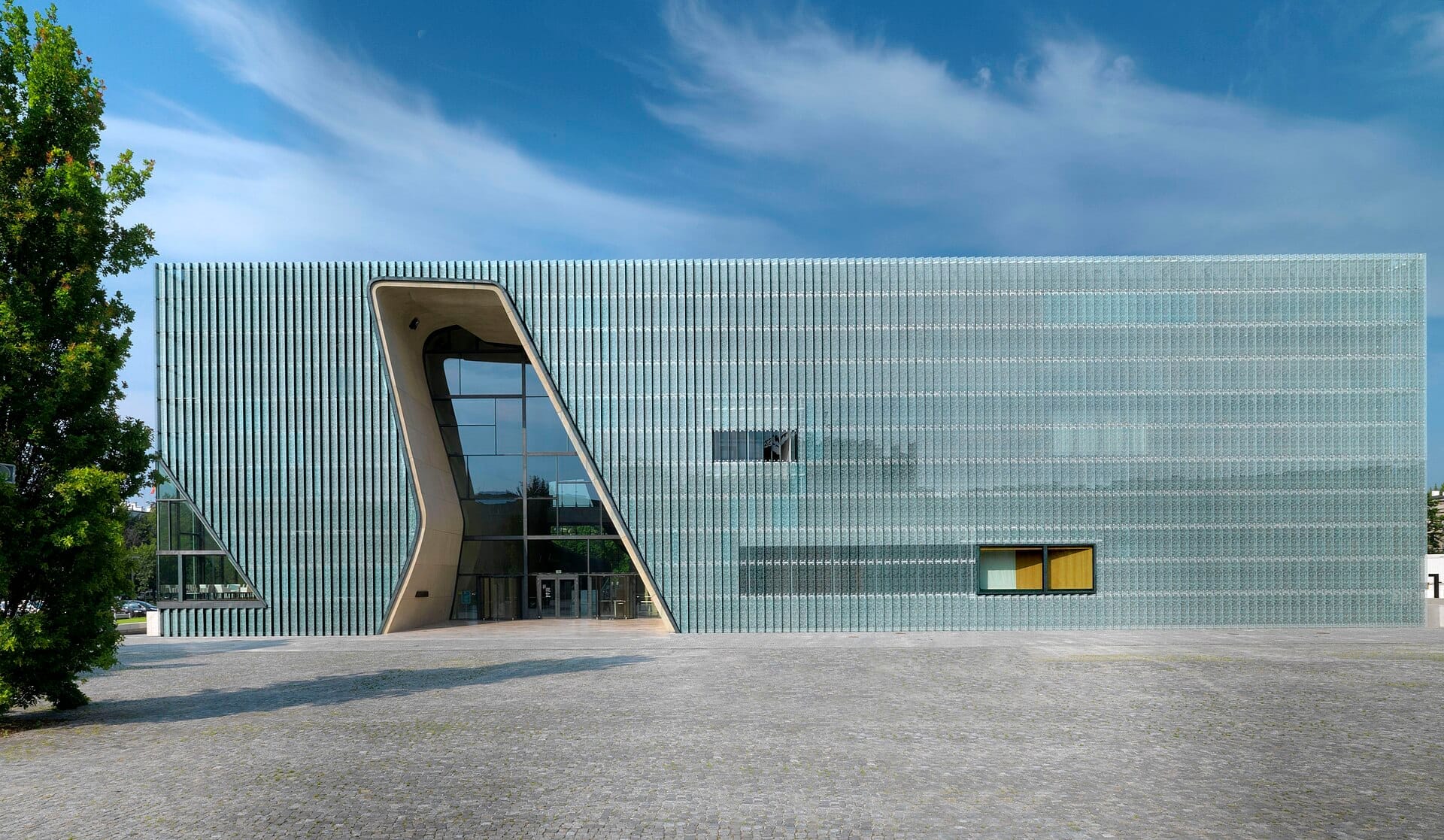
The building was designed by Finnish architects Lahdelma and Mahlamäki, who won an international competition. From the outside it presents as a large, copper-and-glass rectangular block rising from the green lawn of the Muranów quarter. It is not a flashy building. It is deliberate and restrained, and that restraint is part of the statement.
The defining architectural feature is a dramatic crack or fissure running through the center of the building, visible in the lobby. It has been interpreted as representing the parting of the Red Sea, a wound, a divide between past and present. Whichever reading you bring, standing inside the atrium looking up at that curved, rippling interior surface is one of the more striking architectural moments in Warsaw. It earns its place on any list of significant contemporary Polish buildings.
💡 Local tip
Arrive 10–15 minutes early on busy weekend mornings. Bag check is required for large bags, and the queue for the cloakroom can slow your entry into the exhibition.
Tickets & tours
Hand-picked options from our booking partner. Prices are indicative; availability and final rates are confirmed when you complete your booking.
Palace of Culture and Science skip-the-line ticket and tour in Polish
From 19 €Instant confirmationFree cancellationMuseum of John Paul II and Primate Wyszyński entrance ticket
From 8 €Instant confirmationPub crawl in Warsaw
From 28 €Instant confirmationFree cancellationWarsaw Museum of Modern Art entrance ticket
From 8 €Instant confirmation
The Core Exhibition: Eight Galleries, One Thousand Years
The Core Exhibition covers roughly 4,000 square meters across eight galleries, arranged chronologically from the first traces of Jewish presence in Polish lands through to the communist period and the beginnings of post-war renewal. The production quality is exceptional. Reconstructed environments, layered soundscapes, interactive digital displays, and original artifacts are combined in a way that avoids the clinical flatness of traditional vitrines-and-panels museum design.
The most breathtaking single set piece is the reconstructed ceiling of a wooden synagogue from Gwoździec, a village in what is now western Ukraine. The original synagogue was destroyed during World War II. A team of historians, artists, and craftspeople spent years recreating the painted ceiling, which rises above you in one of the central gallery spaces. The colors are vivid — deep blues, golds, animals, and inscriptions spiraling across the dome. It stops most visitors in their tracks.
The Holocaust gallery is positioned in the second half of the exhibition, after you have spent considerable time in the world that was destroyed. That sequencing is deliberate and effective. By the time you reach the wartime galleries, you have already met the community, understood its structures, its humor, its arguments. The loss registers differently than if you had entered with destruction as the opening frame.
Plan a minimum of three hours for the Core Exhibition if you intend to read seriously. Five hours is not unusual for visitors who engage with the interactive stations and documentary footage. The museum also runs temporary exhibitions alongside the Core Exhibition, which may require separate tickets.
Visiting by Time of Day: How the Experience Shifts
Weekday mornings, particularly Wednesday and Thursday before noon, are the quietest times. School groups tend to arrive mid-morning and fill certain gallery sections with organized noise. If you prefer a slower, more contemplative pace through the Holocaust and postwar galleries, arriving at opening time on a weekday and moving quickly through the earlier galleries before groups arrive is a practical strategy.
Saturday evenings until 20:00 are a genuinely good option that many visitors overlook. The museum stays open two hours later than on other days, the crowds thin considerably after 17:00, and the building's interior lighting takes on a different quality. The cafe and public spaces feel calmer. For visitors doing a full Warsaw itinerary, a Saturday late afternoon entry allows the rest of the day to be used elsewhere.
⚠️ What to skip
The museum is closed every Tuesday. This catches many visitors off-guard, particularly those working from a Monday–Saturday travel schedule. Verify your visit day before making other plans around it.
The Muranów district surrounding the museum is worth at least a short walk before or after your visit. The area sits on the site of the former Warsaw Ghetto, and the landscape of low apartment blocks and open spaces carries a quiet, layered significance that amplifies what you see inside. The broader Muranów Jewish Quarter has several other sites of historical importance within a short radius.
Getting There and Practical Navigation
The most straightforward public transport option is Metro Line 1 to Ratusz Arsenał station, which puts you about a ten-minute walk north through the Muranów streets. Several bus and tram lines stop at the Muranów stop, roughly five minutes on foot from the museum entrance. Taxis and ride-hailing apps such as Bolt and Uber serve the area without difficulty.
The museum address is Mordechaja Anielewicza 6, 00-157 Warsaw. The street is named after Mordecai Anielewicz, the commander of the Warsaw Ghetto Uprising. Note that spelling the street name correctly matters when using navigation apps, as variations in the transliteration can send you to the wrong location.
Tickets can be purchased in advance through the official ticketing page at bilety.polin.pl, which is strongly recommended for weekend visits and during school holiday periods. Pricing is in PLN and includes standard adult, reduced, family, and occasional free-entry options; check the live price list before visiting as these change. The Warsaw Jewish Heritage guide provides useful broader context for planning a full visit to the area.
The building is a modern, purpose-built facility with step-free access, lifts, and dedicated visitor services. For specific accessibility requirements, the museum's official website carries detailed visitor information and a contact option for advance queries.
What to Bring and How to Photograph
Photography without flash is permitted in the Core Exhibition, though some temporary exhibitions have their own rules posted at entry. The reconstructed synagogue ceiling is one of the most photographed spaces; it photographs well but benefits from a wide angle lens or the panoramic mode on a phone camera, given the scale of the dome.
Wear comfortable shoes. The exhibition route involves significant walking across multiple levels, and the floor surfaces include stone and polished concrete. There is a cafe inside the building where you can pause, and a museum shop with a serious selection of books on Polish Jewish history, which is worth time if that subject interests you.
ℹ️ Good to know
Audio guides are available in multiple languages and add meaningful context to the galleries, particularly for visitors less familiar with Polish history. Budget an extra 30–45 minutes if you use one.
Who Should Reconsider This Visit
POLIN is not a light afternoon option. The emotional weight of the Holocaust galleries is real, and the exhibition is dense with text, film, and layered historical argument. Visitors looking for a quick cultural tick or a photogenic backdrop will find this museum demanding in ways they may not expect. That is not a flaw; it is the institution doing its job.
Families with children under around eight may find the content difficult to manage, though the museum does offer educational programming for younger audiences on specific days. The Holocaust sections are particularly graphic in their documentary content. Parents should review the official visitor information before bringing young children.
If you are building a broader Warsaw history itinerary, POLIN pairs well with the Warsaw Uprising Museum and the Pawiak Prison Museum, though visiting both on the same day is genuinely exhausting. Space them out if you can.
Insider Tips
- The museum offers free admission on one day per week or month depending on the season; check the current schedule on the official website before buying tickets, as it changes.
- The museum café on the ground floor is a practical and calm spot to decompress after the Core Exhibition. It is not heavily advertised but the food is decent and the space is quiet on weekday afternoons.
- The permanent exhibition has a recommended route but you are not required to follow it. Starting with the final gallery and working backwards gives a completely different emotional arc — some historians and educators recommend this approach for visitors already familiar with the Holocaust context.
- The museum shop carries one of Warsaw's best curated selections of books on Polish Jewish history, Yiddish literature in translation, and prewar Warsaw photography. Budget time for it if this subject interests you.
- The Monument to the Ghetto Heroes directly in front of the museum is the official memorial unveiled in 1948 and is worth pausing at before entering. The monument faces the direction of the Treblinka extermination camp, a detail most visitors walk past without knowing.
Who Is POLIN Museum of the History of Polish Jews For?
- History and humanities travelers who want serious, well-produced engagement with a major European history
- Jewish heritage visitors tracing family or community roots in Poland
- Architecture enthusiasts interested in contemporary European museum design
- University students and educators looking for a rigorous, internationally recognized institution
- Travelers revisiting Warsaw who have seen the major tourist sites and want something more demanding
Nearby Attractions
Other things to see while in Muranów & the Jewish Quarter:
- Monument to the Ghetto Heroes
Standing on the rubble of the former Warsaw Ghetto, the Monument to the Ghetto Heroes is one of the most historically significant memorials in Europe. Unveiled in 1948, it commemorates Jewish fighters who rose up against Nazi extermination in April 1943. Entry is free and the square is open at all hours.
- Nożyk Synagogue
Built between 1898 and 1902, the Nożyk Synagogue is the only pre-war synagogue in Warsaw to have survived the Nazi occupation. Still an active house of prayer, it stands as the most tangible architectural link to a Jewish community that once numbered over 300,000 people in this city.
- Pawiak Prison Museum
Built in the 1830s and transformed into the largest political prison in Nazi-occupied Poland, Pawiak held around 100,000 prisoners during WWII, of whom tens of thousands were executed or deported. The museum, opened in 1965 on the surviving site, is a quiet, serious memorial that demands patience and emotional readiness. It is not a comfortable visit, and it is not supposed to be.