Nożyk Synagogue: Warsaw's Last Standing Pre-War Synagogue
Built between 1898 and 1902, the Nożyk Synagogue is the only pre-war synagogue in Warsaw to have survived the Nazi occupation. Still an active house of prayer, it stands as the most tangible architectural link to a Jewish community that once numbered over 300,000 people in this city.
Quick Facts
- Location
- Twarda 6, Śródmieście district, central Warsaw
- Getting There
- Rondo ONZ metro (5-min walk) or Świętokrzyska metro (7-min walk)
- Time Needed
- 45–90 minutes
- Cost
- Around 20 PLN entrance fee (cash on arrival)
- Best for
- Jewish heritage seekers, history travelers, architecture enthusiasts
- Official website
- warszawa.jewish.org.pl/en/community/religion
Why This Synagogue Matters
Warsaw was once one of the great centers of Jewish life in Europe. Before World War II, roughly a third of the city's population was Jewish, concentrated in neighborhoods that no longer exist as they were. The Nożyk Synagogue, at Twarda 6, is the single pre-war synagogue in Warsaw that survived the Nazi occupation in a state that allowed postwar restoration. Every other synagogue in the city was destroyed. That fact alone makes this building extraordinary, not as a tourist attraction, but as a piece of living history that continues to function exactly as it was built to do.
Visiting the Nożyk Synagogue is not like visiting a museum exhibit or a memorialized ruin. This is an active Orthodox congregation with daily and Sabbath services. It sits at the quiet end of a courtyard set back from Twarda Street, partially shielded from the surrounding city by taller modern buildings. To understand the full context of Warsaw's Jewish heritage, consider pairing this visit with the POLIN Museum of the History of Polish Jews, which provides the narrative depth that the synagogue's walls alone cannot offer.
⚠️ What to skip
The synagogue is an active place of worship. Tourist visiting hours are not consistently published and change around Jewish holidays. Confirm current hours directly with the Jewish Religious Community of Warsaw before your visit. Men are required to cover their heads inside — a kippah is typically available at the entrance.
History: Built by Two People, Survived by Accident
The synagogue was funded and built by Załman and Rywka Nożyk, a merchant couple who purchased the land in 1893. Construction began in spring 1898 and the building was consecrated in May 1902. The Nożyks stipulated that the synagogue be maintained as an Orthodox house of prayer, a condition that still shapes its character today.
Its survival through the war was not the result of careful protection. The Nazis used the building as a stable and storage depot, which paradoxically meant the structure was maintained rather than demolished outright. The surrounding Jewish district was largely destroyed during and after the Warsaw Ghetto Uprising of 1943. When the war ended, the synagogue stood amid rubble.
For decades after the war, the building fell into disrepair. A restoration project running from 1977 to 1983 brought it back to usable condition, and it reopened as a functioning synagogue in 1983. That restoration work is what visitors see today: a building that blends original Neo-Romanesque fabric with post-war reconstruction, imperfect in places but deeply meaningful in its completeness.
Tickets & tours
Hand-picked options from our booking partner. Prices are indicative; availability and final rates are confirmed when you complete your booking.
Museum of John Paul II and Primate Wyszyński entrance ticket
From 8 €Instant confirmationPub crawl in Warsaw
From 28 €Instant confirmationFree cancellationWarsaw Museum of Modern Art entrance ticket
From 8 €Instant confirmationSafe and Convenient Luggage Storage in Warsaw Old Town
From 6 €Instant confirmationFree cancellation
Architecture: Neo-Romanesque in a Courtyard Setting
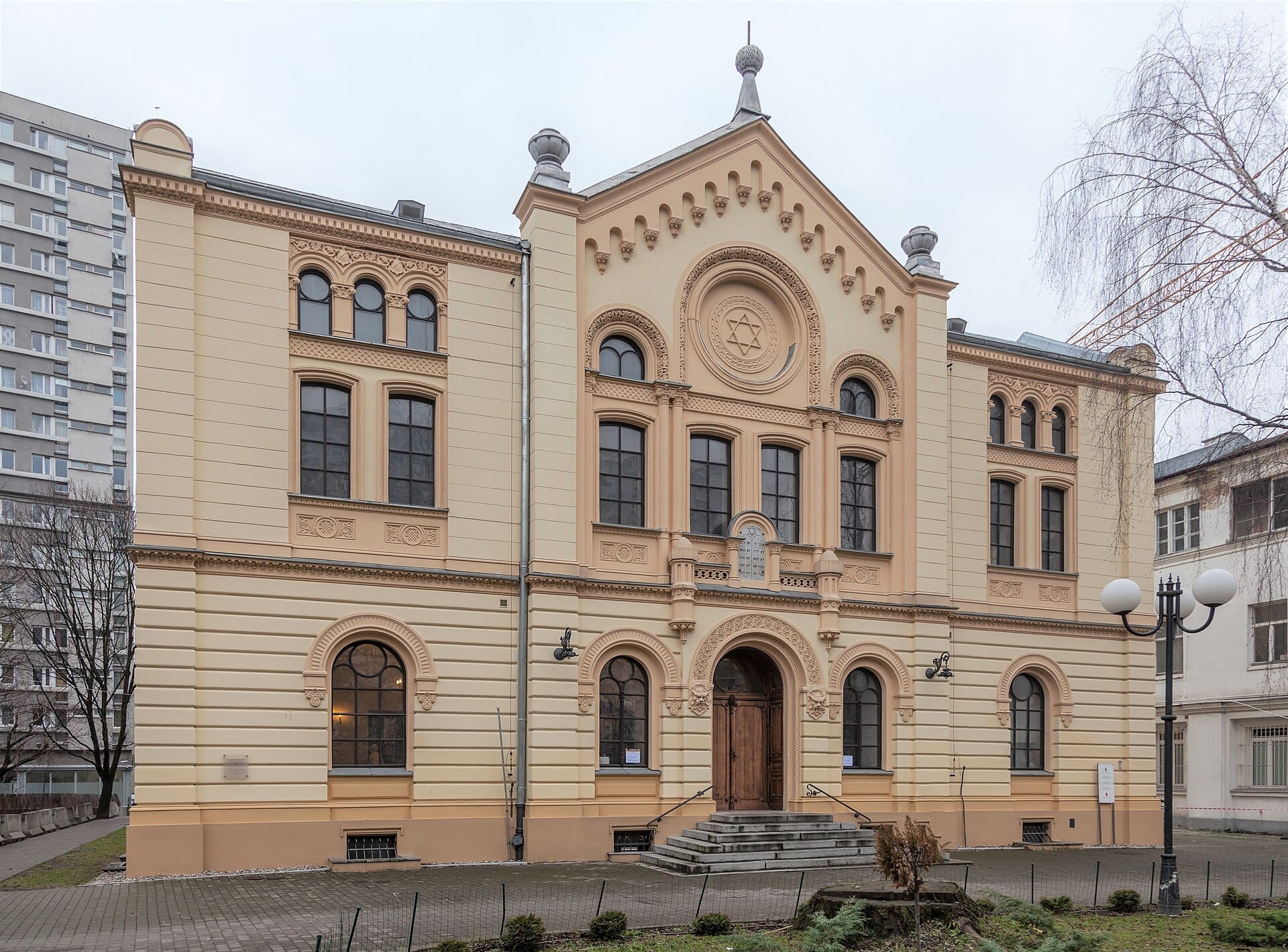
The Nożyk Synagogue is built in a Neo-Romanesque style, originally designed to seat several hundred worshippers. The exterior is relatively modest from Twarda Street: you pass through a gate, cross a courtyard, and the facade reveals itself gradually. The entrance arch, the rounded windows, and the pale masonry give it a solemnity that feels different from the glass-and-steel towers that now surround it.
Inside, the main hall draws the eye upward to a domed ceiling decorated with Stars of David. The bimah (the raised platform from which the Torah is read) stands centrally positioned, as is traditional in Orthodox synagogues. Light filters in through arched windows, and the overall effect is intimate rather than grand. The women's gallery runs along the upper level. Even on a weekday morning with no service in progress, the interior has an atmosphere of active use: prayer books on benches, ritual objects in place, the smell of old wood and candle wax.
💡 Local tip
Photography inside the synagogue may be restricted during services or certain religious periods. If in doubt, ask staff at the entrance. Outside in the courtyard, photography is generally unrestricted.
What to Expect When You Arrive
Entry is controlled. There is a security gate at the courtyard entrance where bags are checked before you proceed to the synagogue building itself. This is standard practice and should not come as a surprise. The process is straightforward and the staff are accustomed to international visitors. A small cash donation is typically requested from tourists on-site to help support the building's upkeep; confirm the current arrangement on arrival as it may change.
The courtyard between the gate and the synagogue door gives you a moment to take in the setting before entering. The building is slightly sunken relative to the current street level, a consequence of Warsaw's postwar reconstruction which raised ground levels across much of the city. This detail, easy to overlook, is a physical trace of how thoroughly the neighborhood was remade.
Inside, the visit is self-guided. There are usually some informational panels in English covering the building's history and the Nożyk family. The space is small enough that you can take in the main hall in a few minutes, but those who sit quietly for a while tend to notice more: the proportions of the bimah, the quality of light at different hours, the worn texture of the pews.
Timing Your Visit
Weekday mornings outside major Jewish holidays are the most reliably accessible times for tourist visits. During Shabbat (Friday sundown to Saturday nightfall) and Jewish high holidays including Rosh Hashanah and Yom Kippur, the synagogue is in active religious use and access for tourists is either restricted or closed entirely. Plan around the Jewish calendar if your visit coincides with a holiday period.
The light inside the main hall is best in the morning when it comes in from the east-facing windows. Afternoon visits are quieter in terms of street noise from outside, but the interior light is flatter. There is no time of year where the synagogue is dramatically different in appearance, though winter visits bring a particular stillness to the courtyard that suits the gravity of the site.
ℹ️ Good to know
The synagogue is not a large-scale attraction and does not handle crowds the way museums do. It is well-suited to solo visitors or small groups. Large tour groups visiting simultaneously can feel intrusive given the scale of the interior and the active religious nature of the space.
Getting There and the Surrounding Neighborhood
The synagogue is located on Twarda Street in central Warsaw, near the area historically associated with the Jewish community. From Rondo ONZ metro station on Line 2, it is roughly a five-minute walk. From Świętokrzyska on the same line, allow about seven minutes. Trams on Emilii Plater stop bring you within a short walk as well. From central Warsaw's main pedestrian spine, it is approximately a 25-minute walk along Marszałkowska.
The surrounding blocks are a mix of postwar housing blocks, office buildings, and a few prewar fragments. The area does not look like a historic Jewish district in any conventional sense. That visual absence is itself historically significant: the neighborhood was almost entirely demolished. To read the landscape properly, it helps to have visited the POLIN Museum first. From Twarda Street, the monument to the Ghetto Heroes is about a 15-minute walk north through Muranów, and the Pawiak Prison Museum is within the same general area.
If you are building a full day around Warsaw's Jewish heritage sites, the guide on Warsaw's Jewish heritage provides a logical sequence for combining Nożyk Synagogue with the POLIN Museum, the Monument to the Ghetto Heroes, and Pawiak in a single itinerary without significant backtracking.
Who Should Visit and Who Might Skip It
The Nożyk Synagogue rewards visitors who come with some prior knowledge of Warsaw's Jewish history or who are willing to engage with what the building represents rather than what it visually delivers. The interior is beautiful but not spectacular in the way of a grand cathedral or palace. Its significance is historical and emotional, not primarily aesthetic.
Travelers looking for a visually dramatic or interactive experience may find the visit brief and quiet in a way that feels anticlimactic without context. Children can visit but may struggle to find engagement unless the history has been introduced beforehand. For visitors focused entirely on architecture, the building is interesting but not the most elaborate Neo-Romanesque example in the city.
For those with a serious interest in Warsaw's wartime history more broadly, the Warsaw WW2 history guide places the synagogue within the wider context of the city's destruction and reconstruction, alongside sites like the Warsaw Uprising Museum.
Insider Tips
- Confirm visiting hours directly with the Jewish Religious Community of Warsaw (warszawa.jewish.org.pl) before you go, especially if your visit falls near a Jewish holiday. The calendar changes the access situation more than any other factor.
- Bring cash. The approximately 20 PLN entrance fee is collected on-site and card payment is not reliably available. There is an ATM at Rondo ONZ station a few minutes away.
- The courtyard between the security gate and the synagogue door is worth pausing in. The slight drop in ground level around the building's foundations hints at how much the surrounding city was rebuilt from rubble upward.
- Men without a head covering can expect to find a kippah available at the entrance, but bringing your own is a small courtesy if you have one.
- If you are visiting on a weekday morning outside holiday periods, you may encounter a minyan (prayer quorum) in the main hall. In that case, wait quietly near the entrance until prayers conclude before moving through the space.
Who Is Nożyk Synagogue For?
- Travelers tracing Warsaw's Jewish history and cultural heritage
- Architecture enthusiasts interested in Neo-Romanesque religious buildings
- Visitors seeking active, living heritage rather than purely memorialized sites
- Those building a full Jewish heritage itinerary combining Nożyk, POLIN Museum, and Muranów
- Thoughtful solo travelers who appreciate quiet, historically significant spaces
Nearby Attractions
Other things to see while in Muranów & the Jewish Quarter:
- Monument to the Ghetto Heroes
Standing on the rubble of the former Warsaw Ghetto, the Monument to the Ghetto Heroes is one of the most historically significant memorials in Europe. Unveiled in 1948, it commemorates Jewish fighters who rose up against Nazi extermination in April 1943. Entry is free and the square is open at all hours.
- Pawiak Prison Museum
Built in the 1830s and transformed into the largest political prison in Nazi-occupied Poland, Pawiak held around 100,000 prisoners during WWII, of whom tens of thousands were executed or deported. The museum, opened in 1965 on the surviving site, is a quiet, serious memorial that demands patience and emotional readiness. It is not a comfortable visit, and it is not supposed to be.
- POLIN Museum of the History of Polish Jews
POLIN Museum of the History of Polish Jews stands on the former Warsaw Ghetto site in the Muranów district, presenting 1,000 years of Polish Jewish history across the Core Exhibition’s four thousand square meters of immersive, architecturally striking galleries. It is one of the most ambitious and emotionally resonant history museums in Europe, not just a Holocaust memorial but a full chronicle of a civilization.