Fryderyk Chopin Museum: Warsaw's Definitive Tribute to a Musical Giant
Housed inside the 17th-century Ostrogski Palace near Warsaw's Royal Route, the Fryderyk Chopin Museum holds one of the world's richest collections of Chopin memorabilia. Closed for full renovation throughout 2026; reopening is planned for 2027 — plan post-renovation visits and confirm dates on the official site.
Quick Facts
- Location
- ul. Okólnik 1, 00-368 Warszawa (City Centre)
- Getting There
- Nowy Świat-Uniwersytet metro (~5 min walk); Centrum Nauki Kopernik metro (~10 min walk)
- Time Needed
- Around 1.5 hours
- Cost
- Ticket prices to be confirmed on reopening; check official website before visiting
- Best for
- Music lovers, cultural travelers, history enthusiasts, architecture admirers
- Official website
- muzeum.nifc.pl/en
What the Fryderyk Chopin Museum Is, and Why It Matters
The Fryderyk Chopin Museum (Polish: Muzeum Fryderyka Chopina) is the official institution dedicated to the life, work, and legacy of Poland's most celebrated composer. It holds one of the world's richest collections of Chopin-related objects: original manuscripts, letters written in his elegant hand, portraits painted during his lifetime, instruments he played, and personal effects that bring his biography into sharp relief. For anyone genuinely interested in Chopin beyond the concert hall, this museum is not a supplementary stop. It is the primary source.
The collection is managed by the National Fryderyk Chopin Institute, which also organizes the International Chopin Piano Competition held in Warsaw every five years. The museum, therefore, sits at the center of a living cultural ecosystem, not simply as a repository of old objects but as an active point of reference for musicians, scholars, and curious visitors from across the world.
⚠️ What to skip
Important for 2026 travelers: The Fryderyk Chopin Museum is closed for full renovation throughout 2026, with reopening planned for 2027. Plan your visit for 2027 or later, and confirm the reopening date on the official website before booking travel around this attraction.
The Building: Ostrogski Palace and Its Layered History
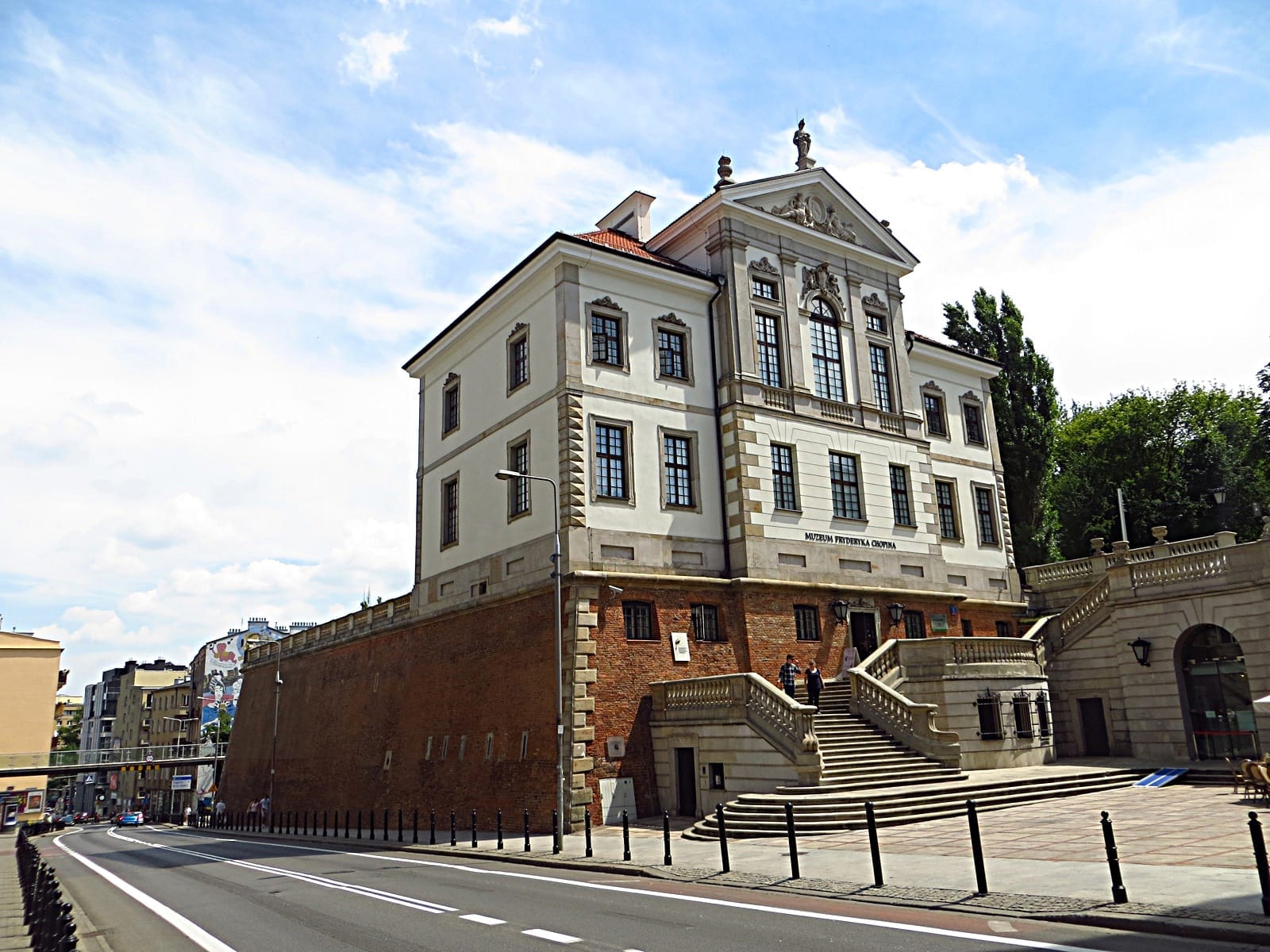
The museum's home is Ostrogski Palace, a Baroque structure whose origins trace back to the 17th century. The palace sits on a terrace above street level near the Vistula escarpment, giving it an unusually commanding presence along the stretch of Warsaw's Royal Route where noble residences once lined the road south from the Old Town. Before you cross the threshold, take a moment to look at the building from the courtyard below: the elevated position, the symmetry of the facade, and the compact scale all read as aristocratic restraint rather than royal extravagance.
Like so much of Warsaw, the palace did not survive the Second World War intact. It was heavily damaged during the Warsaw Uprising of 1944, when systematic German destruction left most of the city in ruins. The reconstruction completed in 1954 restored the exterior to its Baroque form, but the interior was adapted over the decades as the museum's collection and ambitions grew. The current exhibition layout, introduced in 2010, transformed the space into a multimedia experience that uses sound, light, and archive recordings to animate the collection.
For broader context on Warsaw's wartime destruction and reconstruction, the Warsaw WW2 history guide covers the full arc from the 1939 siege to the city's postwar rebuilding.
Tickets & tours
Hand-picked options from our booking partner. Prices are indicative; availability and final rates are confirmed when you complete your booking.
Tickets for Chopin concerts at Warsaw Fryderyk Concert Hall
From 22 €Instant confirmationChopin Concert in Warsaw Old Town with complimentary drink
From 13 €Instant confirmationFree cancellationEntrance tickets to a Chopin piano recital inside the Archdiocese Museum Warsaw
From 14 €Instant confirmationFree cancellationChopin Piano Concert in the Old Town of Warsaw
From 16 €Instant confirmationFree cancellation
Inside the Exhibition: What You Actually See
The permanent exhibition is organized thematically and chronologically across multiple floors, tracing Chopin's life from his childhood in the Mazovian countryside through his Paris years and up to his death in 1849. The design philosophy is immersive rather than didactic: rather than rows of glass cases with minimal labels, the rooms layer ambient recordings of his compositions over displays of manuscripts, letters, and objects. You can hear a nocturne playing softly while reading a letter Chopin wrote to his family in Poland from Paris, which gives the documents an emotional weight that a silent archive room rarely achieves.
Among the highlights of the collection are original manuscripts in Chopin's handwriting, a rare early portrait, a Pleyel grand piano associated with his later years, and a cast of his left hand made shortly after his death. These objects are small in scale but extraordinary in proximity. You stand within arm's reach of the physical record of a creative life. There are also listening booths where visitors can sit with headphones and move through recordings of specific compositions tied to the period on display, which rewards a slower pace.
The exhibition is designed for visitors who want to linger, not rush through. Families with young children who have no prior interest in classical music may find the pace slow, but older children who study piano often engage deeply with the instrument displays and manuscript facsimiles. For anyone with a serious interest in 19th-century Romantic music or European cultural history, two hours passes quickly.
Location, Surroundings, and How to Get There
The museum sits at ul. Okólnik 1, just off the southern end of Krakowskie Przedmieście, Warsaw's principal ceremonial boulevard. The immediate neighborhood is quieter than the main Royal Route: there are fewer tourist-facing cafes and more institutional buildings associated with the University of Warsaw. The contrast between the narrow street leading to the palace and the broad, tree-lined Krakowskie Przedmieście is part of the appeal; the museum occupies a slightly withdrawn position that suits its character.
The closest metro station is Nowy Świat-Uniwersytet on Line 2 (the east-west line), approximately a five-minute walk away. The Centrum Nauki Kopernik station, also on Line 2, is about ten minutes on foot. Multiple tram lines and bus routes run along Nowy Świat and Aleje Jerozolimskie nearby. If you are walking from the Old Town Market Square, the museum is roughly a 15-minute walk south along the Royal Route, passing Krakowskie Przedmieście with its churches, monuments, and outdoor cafes en route.
The museum building is accessible to visitors with reduced mobility, with lifts serving all levels. If you require wheelchair assistance or specific accommodations, the museum advises contacting them in advance by phone or email so staff can prepare accordingly.
Timing Your Visit: When to Go and What to Expect
Weekday mornings, particularly Tuesday through Thursday, see the lightest foot traffic. The museum tends to draw a quieter, more focused crowd than Warsaw's larger institutions: you are unlikely to encounter tour groups moving in tight formation through the rooms. Weekends attract more visitors, especially in the afternoon, and the listening booths can fill up. Given the contemplative nature of the exhibition, arriving early gives you a better chance of spending unhurried time with the most significant objects.
Photography inside the museum has historically been permitted in most areas without flash, though specific rules should be confirmed at the door. The palace rooms themselves, particularly the upper floors with views toward the escarpment, provide reasonable natural light for interior shots. Avoid visiting on a tight schedule: the experience of moving slowly through the rooms, following recordings and reading letters, is genuinely different from rushing through to tick a box.
If your interest in Chopin extends beyond the museum, Warsaw offers several other touchpoints. The Chopin Monument in Łazienki Park hosts free outdoor piano recitals on Sunday afternoons throughout the warmer months, and the Chopin in Warsaw guide maps out all the sites connected to his life in the city.
Honest Assessment: Is It Worth Your Time?
For visitors with genuine interest in Chopin or 19th-century European cultural history, the museum justifies its place on any Warsaw itinerary. The quality of the collection is exceptional, and the 2010 exhibition design has aged better than many contemporary museum makeovers: it uses technology to deepen rather than distract. The building itself carries historical weight, and the neighborhood setting rewards a short walk before or after.
For travelers without a particular interest in classical music, the museum may feel slow. It is not the kind of place where spectacle substitutes for engagement. If you are allocating limited time and Chopin does not already mean something to you, the museum may be less rewarding than Warsaw's more immersive historical institutions.
Travelers who find themselves uncertain about how to structure time in Warsaw's centre can consult the guide to things to do in Warsaw for a broader view of how the Chopin Museum fits into a multi-day itinerary.
ℹ️ Good to know
The museum is closed throughout 2026 for renovation. Confirm the reopening schedule at muzeum.nifc.pl/en before planning your visit.
Insider Tips
- The museum is closed throughout 2026 for renovation; treat the tips below as guidance for planning a post-reopening visit in 2027 or later.
- Use the listening booths once the museum reopens. They are one of the museum's most underused features: visitors often walk past them, but sitting with headphones and following a composition tied to the manuscript in front of you is a genuinely different experience from background ambient sound.
- The palace's elevated terrace is easy to overlook. After your visit, circle the exterior and take in the view of the garden below; it gives the building's Baroque logic a spatial clarity that the interior rooms do not always convey.
- Combine the museum with a walk along Krakowskie Przedmieście rather than treating it as a standalone stop. The Royal Route's churches, courtyards, and street-level details extend naturally from the museum's 19th-century frame of reference.
- If you are visiting Warsaw during the International Chopin Piano Competition (held every five years, next in 2030), the museum and surrounding cultural venues host satellite events that are free or low-cost and attract serious pianists and audiences from around the world.
- Check the National Fryderyk Chopin Institute website before visiting: the Institute organizes regular concerts and lectures that can complement a post-renovation museum visit for a fuller experience of the institution's programming.
Who Is Fryderyk Chopin Museum For?
- Classical music enthusiasts and amateur pianists who want to engage with Chopin's manuscripts and instruments at close range
- Cultural history travelers interested in 19th-century Poland and European Romanticism
- Architecture admirers curious about Baroque Warsaw and the postwar reconstruction of its historic palaces
- Travelers on a focused Warsaw itinerary who want a quieter counterpoint to the city's larger, more crowded institutions
- Students and researchers with an interest in Chopin's correspondence and compositional process
Nearby Attractions
Other things to see while in City Centre (Śródmieście):
- Grand Theatre – National Opera
The Grand Theatre – National Opera (Teatr Wielki – Opera Narodowa) is one of the largest opera houses in Europe, anchoring Theatre Square in central Warsaw with a neoclassical facade that survived war and rebuilding. Whether you attend a full opera, a ballet, or simply walk across the square to take in the architecture, this institution rewards both serious culture-seekers and curious first-time visitors.
- Hala Koszyki Food Hall
Built in 1909 and reborn in 2016, Hala Koszyki is a restored Art Nouveau market hall in central Warsaw where locals actually eat, drink, and shop. Free to enter, open daily until 1am, and genuinely good.
- Holy Cross Church (Kościół Świętego Krzyża)
One of Warsaw's most historically charged sites, Holy Cross Church on Krakowskie Przedmieście holds the preserved heart of Frédéric Chopin in a nave pillar. A Minor Basilica with a Baroque facade, 17th-century origins, and free entry, it rewards visitors who take the time to look closely.
- Living Under Communism Museum (Czar PRL)
Housed in a Stalinist-era building at Plac Konstytucji, the Museum of Life Under Communism (Muzeum Życia w PRL) reconstructs what it felt like to live in Poland between 1944 and 1989. Think cramped apartments, propaganda posters, and Fiat 126p interiors rather than political theory. It is a small, idiosyncratic museum that rewards curious visitors with a surprisingly emotional window into a vanished world.