Old Town Market Square (Rynek Starego Miasta): Warsaw's Rebuilt Heart
The Old Town Market Square is the centrepiece of Warsaw's reconstructed medieval core, a UNESCO World Heritage Site that rose from near-total wartime destruction. Entry is free, the square is open around the clock, and the surrounding townhouses date back in form to the 17th century. Whether you visit at sunrise or under evening lanterns, this is Warsaw's most layered public space.
Quick Facts
- Location
- Rynek Starego Miasta, 00-272 Warsaw, Old Town district
- Getting There
- Bus stop Stare Miasto or Miodowa; no metro station directly in Old Town — walk from Ratusz Arsenał (M1 line) takes about 15 min
- Time Needed
- 30 min to browse the square; 2–3 hours to include the Museum of Warsaw, cafes, and surrounding lanes
- Cost
- Free entry to the square at all times. Optional guided tours from approx. US$9 per person
- Best for
- History lovers, architecture enthusiasts, first-time Warsaw visitors, evening strollers
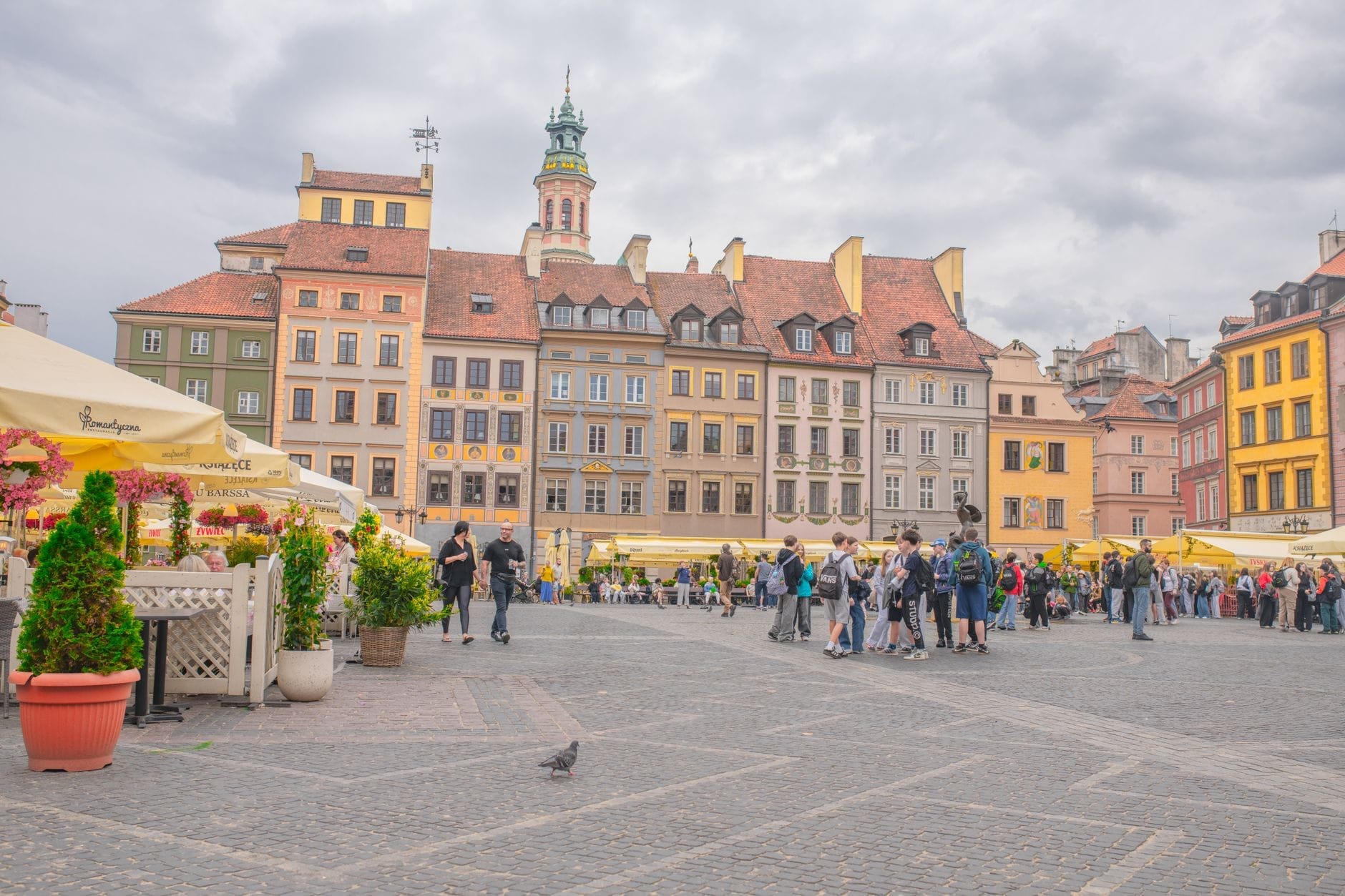
What Is the Old Town Market Square?
Rynek Starego Miasta, or the Old Town Market Square, is Warsaw's original urban core. Dating in its layout to the late 13th century, the square functioned as the commercial and civic heart of the city until the close of the 18th century, when the city's centre of gravity shifted southward. Merchants traded here, public announcements were made here, and the surrounding townhouses belonged to some of Warsaw's wealthiest families. Today it remains the symbolic heart of Warsaw's Old Town, even if its day-to-day rhythm is now shaped by tourism rather than commerce.
What makes the square remarkable is not merely its appearance but what it represents. In August and September 1944, following the collapse of the Warsaw Uprising, German forces systematically demolished virtually every structure in the Old Town, including the entire market square. What stands today was rebuilt between the late 1940s and 1950s using a combination of historical records, 18th-century paintings by Bernardo Bellotto (known as Canaletto), surviving architectural fragments, and the collective memory of Warsaw's residents. The reconstruction was so precise that UNESCO designated Warsaw's Old Town a World Heritage Site in 1980, recognising the reconstruction itself as an act of outstanding universal value.
ℹ️ Good to know
The square is traditionally described as having four sides named after notable Warsaw citizens: Barss, Dekert, Kołłątaj, and Zakrzewski. Each side has a slightly different architectural character, worth noticing as you walk the perimeter.
The Architecture: A Careful Illusion
Standing in the middle of the square, surrounded by four- and five-storey burgher townhouses painted in ochre, terracotta, mint green, and cream, it is easy to forget that every facade was reconstructed within living memory. The buildings follow the style of the 17th-century originals, with steeply pitched roofs, decorative attic parapets, and ornate painted polychrome details on some facades. Look closely and you'll notice differences between individual buildings: some have reliefs depicting merchants or mythological figures, others carry stone cartouches or wrought-iron details that distinguish each house's reconstructed identity.
At the centre of the square stands the Mermaid Fountain, a bronze sculpture of the Warsaw mermaid (Syrena) that has become the city's symbol. The original sculpture by Konstanty Hegel dates to 1855, but the figure in the square today is a post‑war copy based on his design that was relocated and restored after the war. She faces east, sword raised, shield forward. It is one of the most photographed spots in Poland, which means at peak tourist season, between June and August, getting a clean shot without other visitors requires arriving before 8 a.m. or waiting until dusk.
The Museum of Warsaw occupies a row of reconstructed townhouses on the Dekert side of the square and holds one of the more underrated collections in the city, including Bellotto's original paintings that guided much of the postwar reconstruction. If you want to understand what the square actually looked like before 1939, and what it took to rebuild it, the museum provides essential context. It connects well with a broader museum itinerary across Warsaw.
Tickets & tours
Hand-picked options from our booking partner. Prices are indicative; availability and final rates are confirmed when you complete your booking.
Safe and Convenient Luggage Storage in Warsaw Old Town
From 6 €Instant confirmationFree cancellationInteractive spy-themed city game with host-guide in Warsaw Old Town
From 90 €Instant confirmationFree cancellationWarsaw old town audio-guided walking tour
From 11 €Instant confirmationWarsaw old town panorama cruise
From 11 €Instant confirmationFree cancellation
How the Square Changes by Time of Day
Early morning, before 9 a.m., the square belongs to a small number of people: delivery workers stocking the restaurants, a few joggers cutting through from the Barbican side, and the occasional photographer positioned at ground level to catch the low light bouncing off the coloured facades. The cobblestones are damp and dark at this hour, the ornate streetlamps still lit. It is genuinely quiet, and the scale of the square, which measures roughly 73 by 90 metres, becomes apparent when it is not filled with tables and people.
By mid-morning, restaurant staff begin setting out terrace furniture. By noon in summer, the outdoor seating across the square is largely full, the smell of grilled food drifts across from multiple directions, and street musicians take positions. The atmosphere is convivial but undeniably tourist-facing. Prices at the square's restaurants and cafes reflect the location, typically running higher than equivalent spots a few blocks away in the surrounding Old Town lanes.
Evening is the most atmospheric time. When the lanterns come on after dusk, the warm light against the coloured facades creates something closer to the pre-war photographs than the daytime crowds allow. Locals do walk through here in the evenings, especially on weekends. During Christmas season, the square hosts a market with lights strung between the buildings, and the effect is theatrical in a way that earns the detour.
💡 Local tip
For photography, aim for the 30 minutes before and after sunset in summer. The facades face multiple directions, so the light quality shifts dramatically around the square's four sides throughout the day.
Getting There and Moving Through the Old Town
The Old Town has no metro station directly serving it, which surprises many first-time visitors. The closest metro stop is Ratusz Arsenał on the M1 line, approximately a 10-15 minute walk depending on your pace. From there, head north along Miodowa and turn up through the Old Town gates. Alternatively, several bus lines stop closer to the walls. The most common pedestrian approach, and the most dramatic, is to enter via Castle Square and walk north along Świętojańska Street past the Cathedral, arriving into the market square from the south.
From the north, the Warsaw Barbican provides a second entry point, connecting the Old Town to the New Town district beyond. Walking between the Barbican and the market square takes about five minutes along Nowomiejska Street. If you are combining the Old Town with a broader walk along Krakowskie Przedmieście, plan for at least half a day.
The square and surrounding streets are fully pedestrianised. Cobblestone surfaces are relatively smooth by old-town standards, but they are uneven in places, particularly on the narrower side streets. Wheelchair users can generally navigate the main square, though the older surrounding buildings vary significantly in terms of step-free access. It is worth checking specific venues in advance.
Seasonal Considerations and When to Visit
Summer, particularly July and August, brings the highest foot traffic. The square becomes genuinely crowded at midday, outdoor restaurant tables fill quickly, and the narrow approach streets can feel congested. If you are visiting during this period, arriving before 9 a.m. or after 7 p.m. makes the experience considerably more comfortable. Warsaw's summers are warm enough to sit outside comfortably, and the longer daylight hours mean evening light stays useful for photography until well past 8 p.m. For a broader look at the city in this season, see our guide to Warsaw in summer.
Late autumn and winter change the square's character entirely. The tourist volume drops sharply after October. By December, the Christmas market brings atmospheric lighting and the smell of mulled wine (grzaniec) across the square, drawing a mix of locals and visitors. Snow on the cobblestones and coloured facades makes for some of the most striking images of the city. The winter visit guide covers what to expect across the city during colder months.
Spring, particularly May and early June, is arguably the most balanced time: reasonable warmth, fewer crowds than summer, and the outdoor terraces open for business. Rain is possible at any time of year, and the cobblestones become slippery when wet, so footwear with grip is practical regardless of season.
Honest Assessment: Is the Hype Deserved?
The Old Town Market Square is not a secret, and it does not pretend to be. It is Warsaw's most visited public space, and at peak hours in summer, it shows. The restaurants around the perimeter charge premium prices for average food in some cases, and the souvenir shops cater firmly to the tourist trade. Anyone expecting an authentic slice of everyday Warsaw life will need to look at neighbourhoods further from the centre.
That said, the square earns its place on every first-time visitor's itinerary for reasons that go beyond surface aesthetics. The story of its destruction and reconstruction is one of the most significant urban stories of 20th-century Europe. Walking across these cobblestones with that context in mind, knowing that the buildings around you were rebuilt meticulously from paintings and memory, gives the space a weight that purely intact historic squares do not carry in the same way.
Visitors primarily interested in Warsaw's wartime history should treat the square as an entry point rather than a destination in itself. Pairing it with the Royal Castle to the south and the broader WW2 history trail across Warsaw creates a far more complete picture of what the city went through and what it chose to rebuild.
⚠️ What to skip
Visitors with mobility difficulties should be aware that while the main square surface is manageable, the surrounding Old Town lanes are narrow and cobbled with less uniform surfaces. Restaurants frequently have steps at their entrances; check individual venues before visiting.
Insider Tips
- Cross the square to the Dekert side and look for the entrance to the Museum of Warsaw. The collection of Bellotto's 18th-century paintings, which were used as blueprints for postwar reconstruction, is one of the most compelling exhibits in the city and is often overlooked in favour of larger institutions.
- If you want to eat on the square without paying tourist prices, look one or two streets back from the perimeter. Restaurants on Wąski Dunaj and Szeroki Dunaj, the narrow lanes running off the square's corners, typically offer similar atmosphere at noticeably lower prices.
- The four sides of the square are named after historical Warsaw figures: the Barss, Dekert, Kołłątaj, and Zakrzewski sides. Walking each side separately and reading the facade details slows you down in a useful way and reveals the individuality of each reconstructed house.
- During winter evenings, particularly around Christmas, the square is lit with warm overhead lights strung between the buildings. This is one of the few moments when the space feels equally shared between locals and tourists rather than dominated by summer visitor traffic.
- Rynek Starego Miasta is fully open and free at 6 a.m. The silence at that hour, combined with the early light on the east-facing facades, is something the midday version of the square cannot offer. If you are an early riser, this is worth setting an alarm for.
Who Is Old Town Market Square (Rynek Starego Miasta) For?
- First-time visitors to Warsaw wanting a geographical and historical anchor point for the city
- Architecture enthusiasts interested in postwar reconstruction and the Bellotto painting connection
- Travellers visiting during the Christmas season for the market and evening lighting
- Families with children who benefit from open space, street performers, and the Mermaid Fountain as a visual focal point
- Photographers working in early morning or evening light
Nearby Attractions
Other things to see while in Old Town (Stare Miasto):
- Field Cathedral of the Polish Army
The Field Cathedral of the Polish Army (Katedra Polowa Wojska Polskiego) stands on Długa Street just north of the Old Town, opposite the Warsaw Uprising Monument. It is simultaneously a functioning place of worship, the official church of the Polish military, and a layered historical document stretching from a 17th-century wooden chapel to a Katyn memorial added decades after the Second World War.
- Krakowskie Przedmieście
Krakowskie Przedmieście is Warsaw's most storied street, a just-over-1km boulevard connecting Castle Square to Nowy Świat along the historic Royal Route. Lined with baroque churches, neoclassical palaces, statues of Poland's greatest figures, and pavement cafés, it is the spine of the city's public life and the best single walk for understanding Warsaw's history and character.
- Krasiński Palace & Garden
Krasiński Palace, also known as the Palace of the Commonwealth, is a late 17th-century Baroque masterpiece designed by Tylman van Gameren. After decades as a closed National Library repository, it reopened to the public in May 2024 with free admission. Behind the palace, the 11.8-hectare Krasiński Garden offers a welcome green escape just north of the Old Town.
- Little Insurgent Monument
Standing roughly 1.5 metres tall against Warsaw's ancient red brick city walls, the Little Insurgent Monument is a bronze statue of a child soldier that carries the weight of an entire generation. Free to visit at any hour, it is one of the most emotionally affecting stops in the Old Town.