Little Insurgent Monument: Warsaw's Most Quietly Powerful Memorial
Standing roughly 1.5 metres tall against Warsaw's ancient red brick city walls, the Little Insurgent Monument is a bronze statue of a child soldier that carries the weight of an entire generation. Free to visit at any hour, it is one of the most emotionally affecting stops in the Old Town.
Quick Facts
- Location
- Podwale Street, by the Old Town city walls, near Wąski Dunaj, Warsaw
- Getting There
- Bus/tram stops Stare Miasto or Plac Zamkowy; 5-min walk from Castle Square
- Time Needed
- 15–30 minutes at the statue; combine with an Old Town walk
- Cost
- Free — open-air public monument, no tickets required
- Best for
- History lovers, those tracing WWII Warsaw, reflective solo travellers
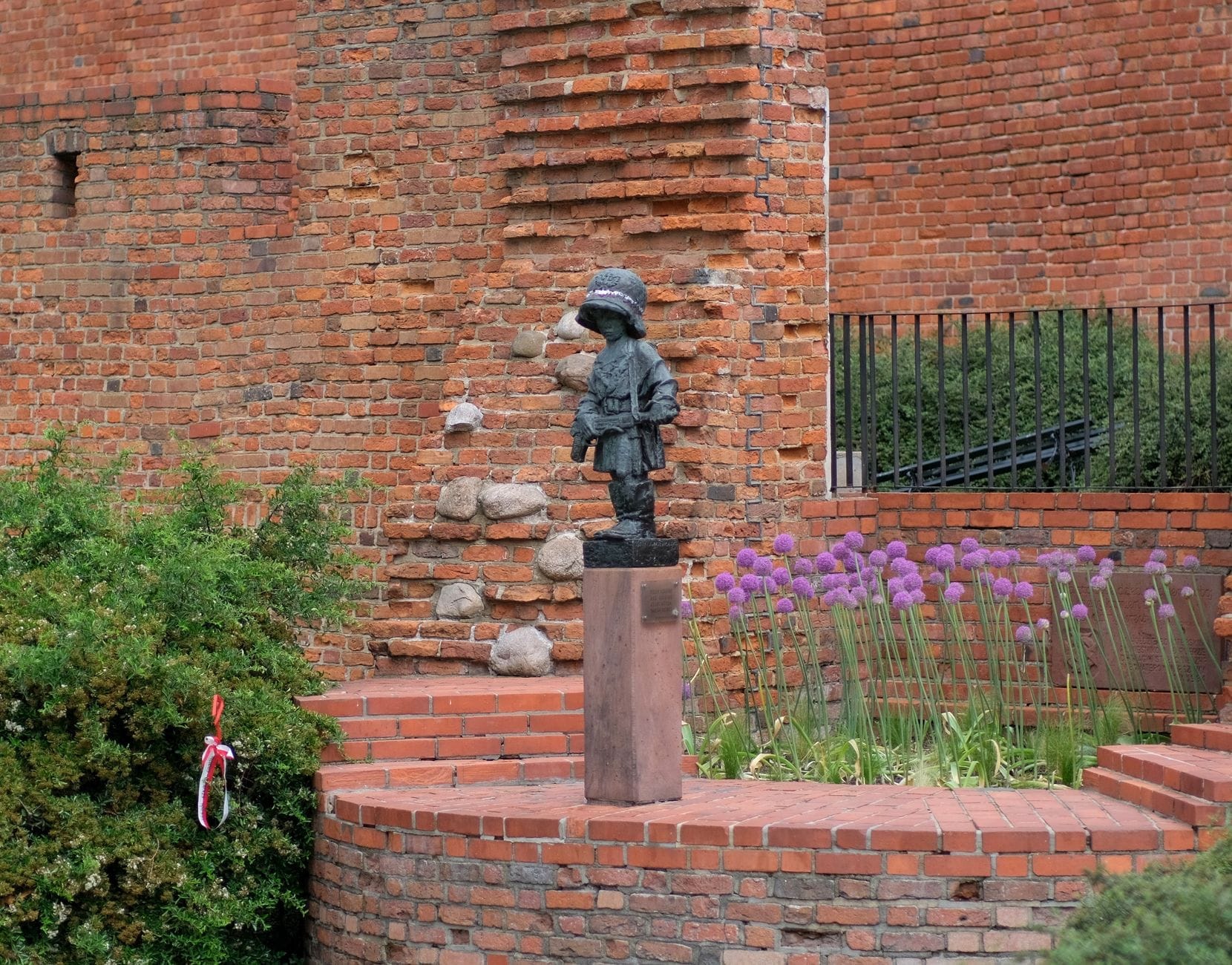
What You're Looking At and Why It Matters
The Little Insurgent Monument, known in Polish as Pomnik Małego Powstańca, stands against the outer defensive wall of Warsaw's Old Town on Podwale Street. It is a small bronze figure: a boy in an oversized helmet, a submachine gun slung at his side, wearing a military coat several sizes too large. The proportions are deliberate. The figure reads immediately as a child. That recognition, the gap between the weapon in his hands and the smallness of his frame, is what stops most visitors mid-stride.
The monument commemorates the thousands of children and teenagers who participated in the Warsaw Uprising of August and September 1944, when the Polish Home Army (Armia Krajowa) rose against the Nazi German occupation. Many of these young participants served as couriers, messengers, and medics, carrying orders and supplies through sewers and ruins while under fire. Some were very young teenagers. A significant number did not survive.
ℹ️ Good to know
Behind the statue is a plaque bearing words from 'Warszawskie Dzieci' (Varsovian Children), a wartime song that became an anthem of the Uprising. Reading it adds substantial context to what the figure represents.
The Story Behind the Bronze
The statue was sculpted by Jerzy Jarnuszkiewicz in 1946, barely a year after the war ended, when Warsaw was still largely rubble. It took nearly four decades for the work to find its permanent home. The monument was officially unveiled on 1 October 1983. That detail is not incidental. The person who unveiled the memorial had lived the experience it depicts.
Funding for the monument was raised entirely by Polish scouts, a fact that gives the project a grassroots quality unusual for public memorials. There was no state commission, no official budget line. It was built by people who chose to build it, many of whom had personal connections to the events being remembered.
The statue is positioned against the tall red-brick city walls that were painstakingly reconstructed after the war, walls that are themselves a monument to Warsaw's postwar act of collective rebuilding. For context on what the city looked like before and after, the Warsaw Uprising Museum in the Wola district provides the most comprehensive account of the 1944 events and is worth combining with this visit if the subject draws you in.
Tickets & tours
Hand-picked options from our booking partner. Prices are indicative; availability and final rates are confirmed when you complete your booking.
Museum of John Paul II and Primate Wyszyński entrance ticket
From 8 €Instant confirmationPub crawl in Warsaw
From 28 €Instant confirmationFree cancellationWarsaw Museum of Modern Art entrance ticket
From 8 €Instant confirmationSafe and Convenient Luggage Storage in Warsaw Old Town
From 6 €Instant confirmationFree cancellation
How the Visit Feels at Different Times of Day
In early morning, before the tour groups reach the Old Town, the spot on Podwale Street is quiet enough that you can hear pigeons on the wall above. The red brick catches low light well, and the bronze figure takes on a warmer tone than it does under the flat midday sun. At this hour, a handful of local residents pass by on the cobblestones, occasionally pausing, occasionally not. The monument is familiar to them in the way that only very old grief becomes familiar.
By mid-morning, particularly in summer, the area fills with guided walking tours. Guides stop here for three to five minutes, deliver their summary in Polish, English, German, or Italian, and move on toward the Barbican. The visit is brief for those groups. If you want time to read the plaque in full and sit with the image, come before 9am or after 6pm.
Evening is arguably the best time to visit. The tourist foot traffic thins, the city walls glow amber under street lighting, and the smallness of the figure becomes more pronounced against the darkened brick. Flowers and small items are sometimes left at the base, particularly around 1 August, the anniversary of the Uprising's outbreak. If you are visiting Warsaw in late July or early August, the atmosphere around this statue and across the Old Town intensifies noticeably.
💡 Local tip
Visit on or around 1 August if possible. At 5pm on that date, Warsaw observes a city-wide minute of silence marking the Uprising's start. Sirens sound across the city and traffic stops. Standing at this monument at that moment is an experience unlike any other the city offers.
Getting There and Walking the Area
The monument sits on Podwale Street, the road that runs along the base of the Old Town's outer defensive walls. From Castle Square (Plac Zamkowy), walk northwest along the wall for roughly five minutes and you will find the statue set into a niche in the brickwork. Coming from the Old Town Market Square, exit via Wąski Dunaj lane toward the wall and turn right onto Podwale. The walk takes about three minutes.
The surrounding terrain is cobbled and uneven in places, typical of Warsaw's Old Town. Visitors using wheelchairs or pushchairs should note there are no dedicated accessibility ramps or smooth paths immediately around the statue's position against the wall, and the historic street surface can be difficult to navigate.
The monument makes natural sense as part of a longer walk that takes in the Barbican a few steps further along the wall, the Old Town Market Square, and the Royal Castle. All are within a ten-minute walk of each other, and the concentration of historical weight in this small area is remarkable.
Photography Notes
The statue is set against a tall section of red brick wall, which makes for a naturally dramatic backdrop. The figure faces outward toward the street, so shooting from street level and slightly below emphasizes the contrast between the child's size and the scale of the wall. Morning light from the east catches the bronze cleanly. Afternoon light from the west can create strong shadows that work well for black-and-white photography.
The monument is small enough that a phone camera captures it adequately. The challenge is framing: if you step back far enough to include the full wall, the statue becomes tiny. If you move close, the helmet and coat details resolve clearly. Both framings tell different stories about what the memorial means, and both are worth taking.
⚠️ What to skip
Avoid staging photos that use the statue as a prop or place items on the figure itself. The monument is a war memorial and is treated as such by local visitors. Respectful distance from other people photographing is the understood norm.
Who Will Connect With This and Who Might Not
For travellers with a serious interest in the Second World War, Polish history, or the ethics of memory and commemoration, the Little Insurgent Monument is one of the most concentrated and affecting points in Warsaw. It communicates something that a museum exhibit sometimes cannot: scale. The smallness of the figure beside the wall says more than a paragraph of text.
Travellers visiting Warsaw primarily for its food, nightlife, or contemporary culture may find the monument worth a five-minute detour from the Old Town route but are unlikely to plan their afternoon around it. Those with a deeper appetite for the WWII context should also consider the POLIN Museum of the History of Polish Jews and the Pawiak Prison Museum, both of which provide structured historical context that the outdoor statue alone cannot offer.
Visitors travelling with young children should know that the monument prompts questions. The image of a child holding a weapon is stark, and curious children will ask what it means. Whether that is the right moment for those conversations depends entirely on the family. The monument itself is not graphic, but its subject matter is not light.
Insider Tips
- Come on 1 August, the anniversary of the Warsaw Uprising. The city-wide siren at 5pm, audible from this spot, transforms a quiet street memorial into something that resonates across the entire city.
- Look carefully at the helmet the figure wears: it is far too large for the head beneath it, a detail Jarnuszkiewicz built into the design to make the child's age unmistakable at a glance.
- The plaque behind the statue carries lyrics from 'Warszawskie Dzieci', a song still sung at commemorative events. Reading it before visiting the Warsaw Uprising Museum will give the museum's audio-visual materials added emotional weight.
- Combine this stop with the nearby Barbican and city wall walk. Few tourists walk the full length of Podwale Street, so the further you go from Castle Square, the quieter it becomes.
- Small mementos, flowers, and candles are sometimes placed at the statue's base by visitors and scouts. If you wish to leave something, a small flower or a lit candle is appropriate. Objects placed on the statue itself are generally removed.
Who Is Little Insurgent Monument For?
- Travellers tracing the history of the Warsaw Uprising and WWII Poland
- Visitors on a walking tour of the Old Town who want moments of depth between landmarks
- Photography enthusiasts interested in memorial architecture and documentary subjects
- Families ready to discuss difficult history with older children and teenagers
- Anyone seeking a quiet, non-commercial moment in a part of Warsaw that can feel crowded
Nearby Attractions
Other things to see while in Old Town (Stare Miasto):
- Field Cathedral of the Polish Army
The Field Cathedral of the Polish Army (Katedra Polowa Wojska Polskiego) stands on Długa Street just north of the Old Town, opposite the Warsaw Uprising Monument. It is simultaneously a functioning place of worship, the official church of the Polish military, and a layered historical document stretching from a 17th-century wooden chapel to a Katyn memorial added decades after the Second World War.
- Krakowskie Przedmieście
Krakowskie Przedmieście is Warsaw's most storied street, a just-over-1km boulevard connecting Castle Square to Nowy Świat along the historic Royal Route. Lined with baroque churches, neoclassical palaces, statues of Poland's greatest figures, and pavement cafés, it is the spine of the city's public life and the best single walk for understanding Warsaw's history and character.
- Krasiński Palace & Garden
Krasiński Palace, also known as the Palace of the Commonwealth, is a late 17th-century Baroque masterpiece designed by Tylman van Gameren. After decades as a closed National Library repository, it reopened to the public in May 2024 with free admission. Behind the palace, the 11.8-hectare Krasiński Garden offers a welcome green escape just north of the Old Town.
- Museum of Warsaw
Spread across a row of reconstructed tenement houses on the UNESCO-listed Old Town Market Square, the Museum of Warsaw (Muzeum Warszawy) traces the capital's history from medieval origins to the present day. It is a serious, carefully curated institution that rewards visitors who want context, not just sightseeing.