Warsaw Barbican: A Reconstructed Renaissance Gate at the Old Town Edge
Built in 1548 by Italian architect Jan Baptist of Venice, the Warsaw Barbican is one of the best-preserved Renaissance fortifications in Poland. Standing at the northern edge of Old Town, it marks the boundary between the city's historic core and the New Town district, and offers a small but rewarding museum inside its thick semicircular walls.
Quick Facts
- Location
- North wall of Old Town, approx. 200m from the Market Square, Warsaw
- Getting There
- Bus and tram lines to Stare Miasto stops; nearest metro is Ratusz Arsenal (M1) about 10 minutes away; Old Town is best reached on foot from the city centre
- Time Needed
- 30 minutes for the museum; 10 minutes to walk through and photograph
- Cost
- 12 PLN standard / 8 PLN reduced (ISIC accepted); exterior is free to view year-round
- Best for
- History enthusiasts, architecture lovers, Old Town walkers
- Official website
- barbakan.muzeumwarszawy.pl/
What the Warsaw Barbican Actually Is
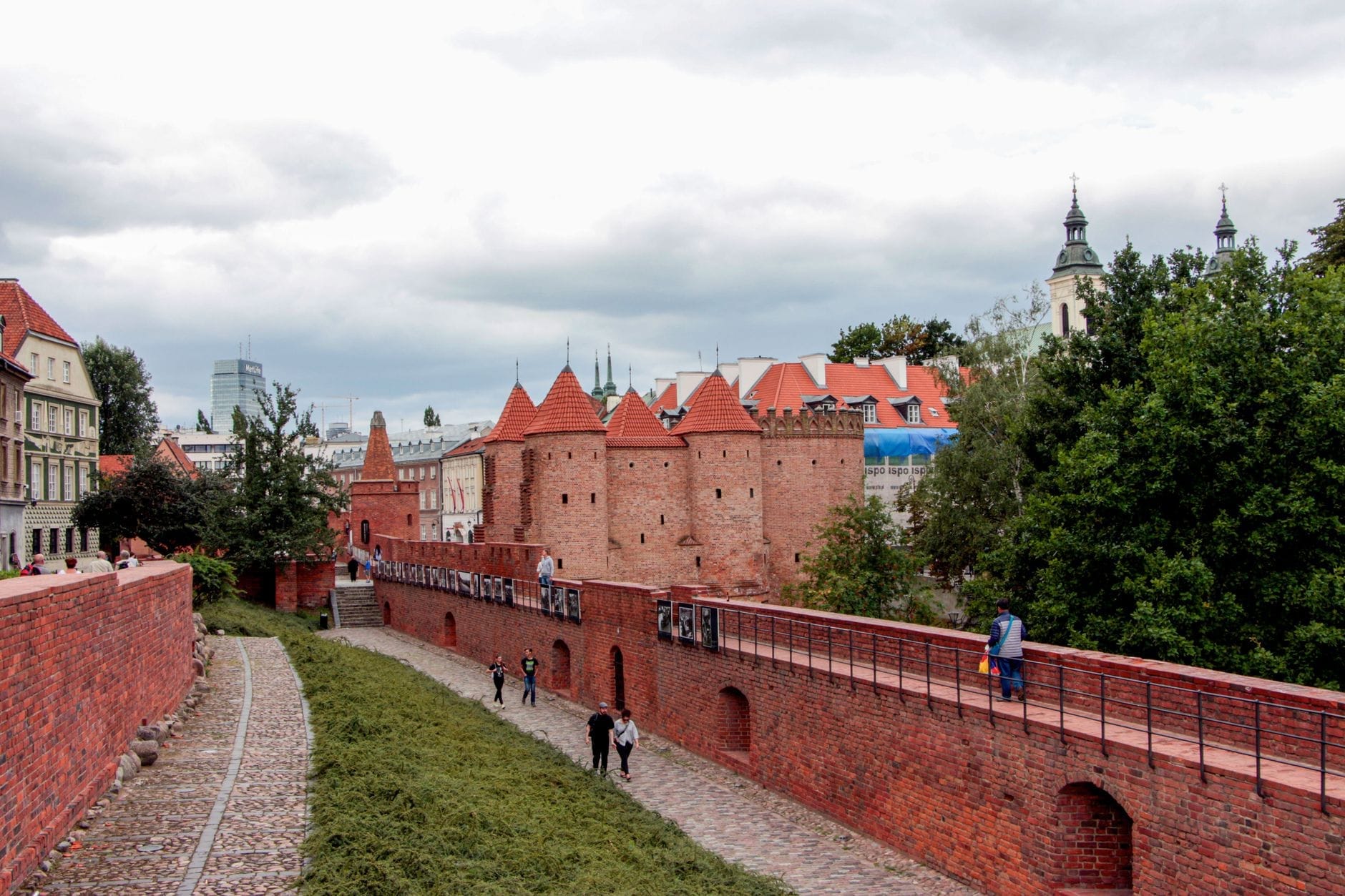
The Warsaw Barbican, known in Polish as Barbakan Warszawski, is a semicircular fortified outpost that once guarded the main northern entrance into the medieval city. Erected in 1548 and designed by the Italian architect Jan Baptist of Venice, it is a well-preserved example of Renaissance military architecture in Poland. The structure is roughly 14 metres wide and 15 metres tall, built from brick in three levels, with archer slits and cannon embrasures that give it a distinctly serious purpose beyond its current role as a tourist landmark.
What makes the Barbican unusual, beyond its age, is how much of it is original in spirit if not entirely in material. Like much of Warsaw's Old Town, the Barbican was heavily damaged in World War II and subsequently reconstructed as part of the postwar effort to restore the historic city centre. That reconstruction was recognized by UNESCO, which added Warsaw's Old Town to its World Heritage List in 1980. The Barbican sits within this UNESCO-listed zone, which adds context to what you're looking at: a faithful reconstruction built on historical records and surviving fragments, not a ruin frozen in time.
ℹ️ Good to know
The museum inside operates Wednesday and Saturday, 13:00–17:00, from May 21 to September 30 only. Outside of those months, you can walk through the gate passage for free, but there's no interior access.
The Experience: What You'll Actually See and Feel
Approaching from the Old Town Market Square, you walk north along ul. Nowomiejska, a pedestrian lane flanked by colourful townhouse facades and souvenir stalls. The Barbican comes into view abruptly at the end of the street, its dark brick mass cutting across the lane like a wall that forgot it was supposed to end. There's a satisfying scale shift here: the buildings drop away and the fortification rises up, and for a moment it reads as genuinely medieval even in a city that was rebuilt from scratch.
The gate passage itself is narrow and slightly dim, with the cool smell of old brick that is impossible to fake. Even in summer, when the surrounding streets are warm and loud with tourists, the passage through the Barbican feels different: the sounds compress and change, footsteps echo off the curved interior walls, and the temperature drops a degree or two. It takes about thirty seconds to walk through, but it's thirty seconds that communicate more about historical fortification logic than most exhibits can.
On the north side of the gate, you cross an old moat channel (now dry and paved) and arrive in the New Town area. The contrast is useful: the Old Town behind you is compact, rebuilt, polished; the New Town in front is somewhat more lived-in and less photographed. Many visitors don't notice they've crossed a meaningful urban boundary.
Tickets & tours
Hand-picked options from our booking partner. Prices are indicative; availability and final rates are confirmed when you complete your booking.
Pub crawl in Warsaw
From 28 €Instant confirmationFree cancellationWarsaw Museum of Modern Art entrance ticket
From 8 €Instant confirmationSafe and Convenient Luggage Storage in Warsaw Old Town
From 6 €Instant confirmationFree cancellationInteractive spy-themed city game with host-guide in Warsaw Old Town
From 90 €Instant confirmationFree cancellation
Inside the Museum: Three Levels of Fortification History
When the museum is open, the interior of the Barbican reveals how the three-level structure was designed to function. The lowest level contains the gate passage itself. The upper levels, accessible by steep narrow stairs, show the firing positions, the wall-walk, and views over both the Old Town and New Town. These upper levels are compact and the ceilings are low in places, which adds to the sense of being inside a working military structure rather than a display space.
The exhibits cover the history of Warsaw's medieval city walls, the role of the Barbican in the city's defensive system, and the reconstruction effort after 1945. The display is modest in scale but reasonably informative for visitors with an interest in military architecture or urban history. Do not arrive expecting anything like the depth of the nearby Royal Castle or POLIN Museum; this is a focused, site-specific exhibition in a small space.
⚠️ What to skip
The Barbican museum has no lift and the upper-level stairways are steep and narrow. It is not suitable for visitors with reduced mobility, and it's a tight fit with pushchairs or prams.
If fortification history is a particular interest, the Barbican pairs well with a visit to the Royal Castle, which sits at the southern edge of the Old Town and covers Warsaw's political and dynastic history in considerably more depth.
How the Experience Changes by Time of Day
The area around the Barbican is at its most crowded between 11:00 and 16:00 on weekends and in July and August. During these hours, the gate passage can feel genuinely congested, with tour groups moving slowly through and photographers stopping in the middle of the arch. If you want to photograph the Barbican without people filling the frame, arrive before 10:00 in summer or after 17:00 when the day-trip crowds begin thinning.
Early morning visits have a particular quality. The Barbican's brick turns a warm ochre colour in direct morning light, and the surrounding lanes are quiet enough that you can hear birds rather than crowd noise. The souvenir stalls that line Nowomiejska are often just setting up, and the café terraces nearby haven't yet filled. If you're staying in the Old Town or can arrive early, this is the most atmospheric window.
In winter, the museum is closed but the gate itself remains open for passage. The Barbican in snow or frost has a starkness that is actually more historically legible than the summer version: stripped of flower boxes and tourist stalls, the fortification reads more clearly as a serious structure rather than a scenic backdrop.
Getting There and Fitting It Into Your Route
The Barbican sits at the northern tip of the Old Town, making it a natural endpoint or starting point for any walk through Warsaw's historic core. The logical route from the south begins at Sigismund's Column and the Royal Castle, moves north through the Old Town Market Square, then continues up Nowomiejska to the Barbican. From there, you can cross into the New Town or loop back through the old city walls that partially survive along the eastern perimeter of the Old Town.
The nearest metro station is Ratusz Arsenal on M1, about 10 minutes' walk north through the Old Town. Most visitors still approach on foot from the city centre, a walk of roughly 20-25 minutes from the main shopping streets. Bus lines serve the Stare Miasto area; check the ZTM Warsaw route planner for current stops and numbers, as these can change. Taxis and ride-hailing apps can drop you at the edge of the pedestrian zone. Most visitors approach on foot from the city centre, a walk of roughly 20-25 minutes from the main shopping streets. Bus lines serve the Stare Miasto area; check the ZTM Warsaw route planner for current stops and numbers, as these can change. Taxis and ride-hailing apps can drop you at the edge of the pedestrian zone.
The Barbican is also close to St. John's Archcathedral and the northern end of Krakowskie Przedmieście, Warsaw's historic royal route. Combining all three into a half-day itinerary is straightforward on foot.
Photography and Practical Notes
The Barbican is one of the most photographed structures in Warsaw, and the challenge for photographers is finding a composition that doesn't look identical to every other shot. The standard view is from Nowomiejska looking north at the gate arch. A more interesting angle is from the moat side, looking south back through the arch with the Old Town rooflines behind it, which gives the image more depth and a sense of the gate's function. The wall-walk on the eastern side of the Old Town, if you explore it, offers an elevated view of the Barbican's exterior curve.
The gate area is well lit by daylight and doesn't require specialist equipment to photograph well. The interior passage, however, is dim enough that a wide aperture or higher ISO helps if you want sharp images without flash. Flash photography inside the museum section may be restricted; check on arrival.
💡 Local tip
Walk the surviving section of the Old Town city walls on the eastern side of the Old Town. They run along the inside of the reconstructed fortification perimeter and offer a less-visited perspective on how the Barbican connected to the broader defensive system.
Insider Tips
- The north-facing side of the Barbican, overlooking the old moat, is quieter than the south-facing entrance even during peak tourist hours. Spend a few minutes here to read the structure's form without the crowd pressure.
- If you visit in May or September (the beginning and end of the museum season), you'll find shorter queues and cooler temperatures than the July-August peak.
- The stretch of reconstructed city walls on the eastern perimeter of the Old Town is free to walk and almost always uncrowded. It provides direct visual context for how the Barbican functioned as a forward outpost in front of the main wall.
- Street artists and portrait painters set up in the Barbican passage and along the adjacent walls throughout summer. This is a long-standing local tradition and the quality varies considerably; it's worth a few minutes to browse even if you don't intend to buy.
- If the museum interior is your primary goal, confirm it's open before making a special trip. The May-to-September season is fixed, but individual days or hours can vary, and the official Muzeum Warszawy website is the most reliable source for current information.
Who Is Warsaw Barbican For?
- First-time visitors to Warsaw completing an Old Town walking circuit
- Architecture and military history enthusiasts interested in Renaissance fortification design
- Photographers looking for the clearest expression of Warsaw's medieval urban form
- Travellers following Warsaw's UNESCO World Heritage reconstruction story
- Anyone connecting the Old Town to the New Town on foot and wanting context for the boundary between the two
Nearby Attractions
Other things to see while in Old Town (Stare Miasto):
- Field Cathedral of the Polish Army
The Field Cathedral of the Polish Army (Katedra Polowa Wojska Polskiego) stands on Długa Street just north of the Old Town, opposite the Warsaw Uprising Monument. It is simultaneously a functioning place of worship, the official church of the Polish military, and a layered historical document stretching from a 17th-century wooden chapel to a Katyn memorial added decades after the Second World War.
- Krakowskie Przedmieście
Krakowskie Przedmieście is Warsaw's most storied street, a just-over-1km boulevard connecting Castle Square to Nowy Świat along the historic Royal Route. Lined with baroque churches, neoclassical palaces, statues of Poland's greatest figures, and pavement cafés, it is the spine of the city's public life and the best single walk for understanding Warsaw's history and character.
- Krasiński Palace & Garden
Krasiński Palace, also known as the Palace of the Commonwealth, is a late 17th-century Baroque masterpiece designed by Tylman van Gameren. After decades as a closed National Library repository, it reopened to the public in May 2024 with free admission. Behind the palace, the 11.8-hectare Krasiński Garden offers a welcome green escape just north of the Old Town.
- Little Insurgent Monument
Standing roughly 1.5 metres tall against Warsaw's ancient red brick city walls, the Little Insurgent Monument is a bronze statue of a child soldier that carries the weight of an entire generation. Free to visit at any hour, it is one of the most emotionally affecting stops in the Old Town.