Krakowskie Przedmieście: Warsaw's Grand Royal Boulevard
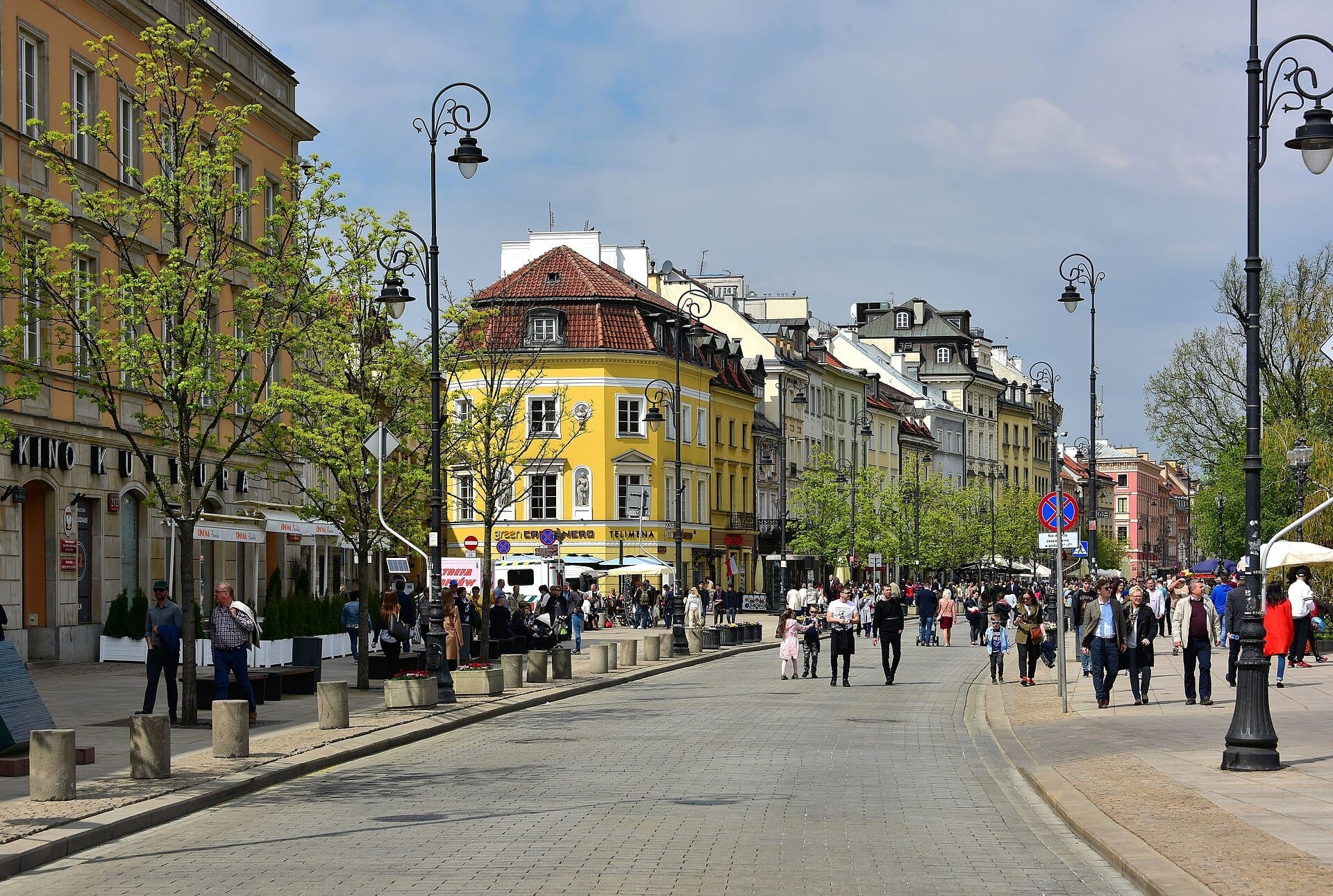
Krakowskie Przedmieście is Warsaw's most storied street, a just-over-1km boulevard connecting Castle Square to Nowy Świat along the historic Royal Route. Lined with baroque churches, neoclassical palaces, statues of Poland's greatest figures, and pavement cafés, it is the spine of the city's public life and the best single walk for understanding Warsaw's history and character.
Quick Facts
- Location
- Krakowskie Przedmieście, 00-071 Warsaw (Śródmieście district), running between Castle Square and its junction with Nowy Świat
- Getting There
- Metro M2: Nowy Świat–Uniwersytet (approx. 7-minute walk); multiple bus and tram lines along Śródmieście
- Time Needed
- 45–90 minutes for the boulevard itself; half a day if entering churches, palaces, or museums
- Cost
- Free to walk; individual sites (Royal Castle, churches, museums) charge separately
- Best for
- History lovers, architecture enthusiasts, first-time visitors to Warsaw, evening strollers
What Krakowskie Przedmieście Actually Is
Krakowskie Przedmieście is not a square, not a park, and not a museum. It is a working urban street that also happens to be one of Central Europe's most architecturally dense thoroughfares. Just over 1 kilometre long, it runs from Castle Square at the northern edge of Warsaw's Old Town down to the junction with Nowy Świat, where the street's character softens into something more commercial. Along the way it passes baroque church facades, neoclassical palace courtyards, important monuments, university gates, hotel terraces, and pavement cafés that fill with students and office workers at all hours.
This is the opening section of the Royal Route, the ceremonial road that Polish kings used for processions from the Royal Castle southward toward their summer residence. That royal heritage gives the street its architectural ambition: nothing built here was built small. You will find the same effect in other European capitals, but Warsaw's version has a particular weight to it because so much of what you see was reconstructed after near-total wartime destruction, a fact that gives even a routine afternoon stroll an undercurrent of historical significance. For broader context on how Warsaw rebuilt itself, the Warsaw WWII history guide is worth reading before you arrive.
The History Behind the Streetscape
Development along this corridor began as far back as the 14th century, when the area outside the Kraków Gate started accumulating religious and civic buildings. A Bernardine church was founded here in 1454, and by the 17th century the street had become Warsaw's most prestigious address, attracting aristocratic palaces, religious orders, and the institutions of a capital city growing in confidence and ambition.
The street's name translates literally as the 'Kraków Suburb,' reflecting its historical origin as the suburban extension leading toward Kraków, then Poland's royal capital. As Warsaw grew, the suburb became the city's ceremonial core, lined with the residences of magnate families whose names still appear on building facades.
After Warsaw's systematic destruction during World War II, Krakowskie Przedmieście was among the areas prioritized for reconstruction in the late 1940s and 1950s. The effort was meticulous: architects worked from historical photographs, paintings, and pre-war surveys to restore facades to something close to their 18th and 19th century appearance. The result is a street that reads as historic but is largely a post-war construction, a distinction worth keeping in mind. The Royal Castle at the northern end tells that same story in greater detail.
Tickets & tours
Hand-picked options from our booking partner. Prices are indicative; availability and final rates are confirmed when you complete your booking.
Museum of John Paul II and Primate Wyszyński entrance ticket
From 8 €Instant confirmationPub crawl in Warsaw
From 28 €Instant confirmationFree cancellationWarsaw Museum of Modern Art entrance ticket
From 8 €Instant confirmationSafe and Convenient Luggage Storage in Warsaw Old Town
From 6 €Instant confirmationFree cancellation
Walking the Street: What You Will See
Starting from Castle Square at the northern end, the first landmark you encounter is the imposing facade of St. Anne's Church, one of Warsaw's oldest, with a viewing terrace accessible from a separate entrance that offers rooftop views over the square and castle. The exterior is late-baroque; the interior is richly decorated and worth a few minutes even for non-religious visitors.
Moving south, the street opens up into a sequence of palaces, many now occupied by government offices, embassies, or the University of Warsaw. The main university gate, a neoclassical arch flanked by iron railings, is one of the street's most photographed features. Just inside, the University of Warsaw Library Garden offers a green pause that most visitors walking the boulevard miss entirely.
The Chopin monument in the small square at the university end of the street marks the place where the composer once lived. It is a simple but affecting piece of urban furniture: a seated bronze figure at street level, not elevated on a grand plinth, which makes it feel more personal than monumental. Chopin is everywhere in this part of Warsaw; the street sits in the radius of several sites connected to his life in the city.
Further south, the Presidential Palace presents one of the street's grandest frontages: a long neoclassical colonnade set back slightly from the pavement behind a low fence. The palace is the official workplace of the Polish president and is not open for public tours, but its facade and the equestrian statue of Prince Józef Poniatowski in the forecourt are accessible from the pavement.
The Holy Cross Church, closer to the Nowy Świat end, is architecturally significant and culturally resonant: an urn containing Frédéric Chopin's heart is interred in one of the nave pillars, in accordance with his dying wish to have his heart returned to Poland. The church is open to visitors outside of service times and admission is free.
💡 Local tip
If you are walking the full length of Krakowskie Przedmieście, budget time to step inside at least two or three of the churches. They are free to enter (outside services), take only a few minutes each, and contain details — frescoes, crypts, memorial plaques — that the street-level view completely misses.
How the Street Changes Through the Day
Early mornings on Krakowskie Przedmieście are genuinely calm. The wide pavement belongs mostly to joggers and people walking to work, and the light falling at an angle across the palace facades reveals textures that disappear once the day brightens. The smell in the early hours is bakery-adjacent: coffee from cafés opening their shutters, fresh pastries from nearby side streets.
By mid-morning the tourist foot traffic builds steadily, and by midday the street is at its most crowded, particularly around Castle Square and the section in front of the Presidential Palace. This is when photography becomes more demanding: every bench has someone on it, and the pavement is rarely clear. If you want photographs of the architecture with minimal people in frame, arrive before 9:00 in summer or on a weekday morning in shoulder season.
Evenings have their own character. The church facades are lit from below after dark, casting warm light against the stone. The cafés spread tables outside in warm months, and the pedestrian sections fill with a mix of locals and visitors in a way that feels less transactional than the daytime crowds. Summer evenings in particular see the street used as a linear promenade, with people moving slowly between the castle end and Nowy Świat and stopping at outdoor seating along the way.
ℹ️ Good to know
In winter, Krakowskie Przedmieście is considerably quieter and the pace slower. The facades look different under grey sky or dusted with snow. Some outdoor café seating disappears, but the street is never empty, and the lower tourist volumes make it easier to appreciate individual buildings without the summer scrum.
Practical Information for Visitors
The street itself is free to walk at any hour. There is no ticket, no gate, and no closing time. Individual attractions along the route set their own hours and prices: the Royal Castle charges for entry to most of its exhibitions, the churches are generally free but may be closed during services, and any museum you enter along or near the street will have a separate fee.
The nearest metro station is Nowy Świat–Uniwersytet on the M2 line, roughly a 7-minute walk from the midpoint of the street. Multiple bus lines stop along nearby parallel routes. If you are staying in the city centre, the street is walkable from most hotels without needing public transport at all. For help planning connections across the city, the getting around Warsaw guide covers all transport options clearly.
The pavement is wide and largely level, making it accessible for wheelchair users and those with strollers along the main boulevard. Steps at individual church entrances and palace courtyards vary: some have ramp access, others do not. If access at specific sites is a priority, it is worth checking directly with those institutions before visiting.
Comfortable walking shoes are the only real packing requirement. The stone and brick surfaces can be uneven in places, particularly near Castle Square. There is no meaningful dress code for walking the street, though if you plan to enter churches you should have shoulders and knees covered, or carry a layer for that purpose.
Photography and What You Might Miss
The obvious shots on Krakowskie Przedmieście are the long perspective down the boulevard toward the castle, the Chopin plaque on the building where he lived, and the colonnade of the Presidential Palace. Most visitor photographs focus on these. What tends to be overlooked is the detail: decorative ironwork on gates, carved stone above doorways, the ceramic street numbers on older buildings, and the narrow passages between palaces that occasionally open into courtyard gardens.
The best light for facade photography is morning, when the sun catches the east-facing fronts. By afternoon the street is largely in shade on the upper floors, which can flatten the images. For the church interiors, natural light through the windows is usually sufficient, and flash is not appropriate or necessary.
💡 Local tip
Look up. Many of the cornices, pediments, and decorative sculptural details on the upper floors of buildings along Krakowskie Przedmieście are invisible from normal walking posture. Step back to the opposite pavement and scan the roofline: the architectural density up there is often more interesting than what is at eye level.
Honest Assessment: Is It Worth Your Time?
For a first visit to Warsaw, Krakowskie Przedmieście is close to non-negotiable. It is where the city's history is most legibly arranged in space, and walking its length in one direction takes under 20 minutes at a steady pace, so the time cost is low. It also connects naturally to the Old Town at one end and to Nowy Świat at the other, meaning it slots into any walking itinerary without detour.
That said, visitors expecting a pedestrianized mall-style experience will find the reality more complex: Krakowskie Przedmieście carries vehicle traffic, and while the pavements are wide, the street is not car-free. The midday summer crowds around the Castle Square end can feel dense, and some of the souvenir vendors near that end are predictably targeted at package tourism rather than local character.
People who will get the most from this street are those who slow down enough to read the memorial plaques, step inside the churches, and take the side passages into the courtyards. Visitors who prefer indoor, curated experiences with clear narrative structure may find the boulevard format less satisfying than a single focused museum.
Insider Tips
- The side entrance to St. Anne's Church (on the right when facing the facade from Castle Square) leads to a bell tower and viewing terrace that gives one of the best low-altitude views over the Old Town rooftops. It is not prominently signed and most visitors walking past miss it entirely.
- The section of pavement in front of the Presidential Palace is a popular meeting point for small political demonstrations, which occur unpredictably. These are generally peaceful and add authentic local texture to the walk, but if you are photographing the palace facade during one, the timing can be frustrating.
- Most visitors walk the street south from Castle Square toward Nowy Świat, which means the crowds thin noticeably once you pass the university gate. Walking the reverse direction in the morning puts the castle at the end of your walk rather than the beginning, which can feel more rewarding visually as the Royal Castle and Sigismund's Column emerge ahead of you.
- The cafés with outdoor seating on Krakowskie Przedmieście are atmospheric but priced at tourist-area rates. For the same coffee at half the cost, turn into any of the side streets running parallel and you will find student-oriented cafés serving the university crowd within a 2-minute walk.
- Chopin's heart is interred in the second pillar on the left as you enter the Holy Cross Church from the main entrance. There is a small plaque marking the spot that is easy to walk past without noticing. The church is generally quiet enough inside that you can stand there for a moment without feeling rushed.
Who Is Krakowskie Przedmieście For?
- First-time visitors to Warsaw wanting a single walk that captures the city's historical arc
- Architecture enthusiasts interested in baroque and neoclassical urban design
- Chopin devotees tracing the composer's Warsaw connections
- Evening strollers and pavement café visitors in summer months
- Families with older children who can engage with monuments, churches, and street-level history at a comfortable pace
Nearby Attractions
Other things to see while in Old Town (Stare Miasto):
- Field Cathedral of the Polish Army
The Field Cathedral of the Polish Army (Katedra Polowa Wojska Polskiego) stands on Długa Street just north of the Old Town, opposite the Warsaw Uprising Monument. It is simultaneously a functioning place of worship, the official church of the Polish military, and a layered historical document stretching from a 17th-century wooden chapel to a Katyn memorial added decades after the Second World War.
- Krasiński Palace & Garden
Krasiński Palace, also known as the Palace of the Commonwealth, is a late 17th-century Baroque masterpiece designed by Tylman van Gameren. After decades as a closed National Library repository, it reopened to the public in May 2024 with free admission. Behind the palace, the 11.8-hectare Krasiński Garden offers a welcome green escape just north of the Old Town.
- Little Insurgent Monument
Standing roughly 1.5 metres tall against Warsaw's ancient red brick city walls, the Little Insurgent Monument is a bronze statue of a child soldier that carries the weight of an entire generation. Free to visit at any hour, it is one of the most emotionally affecting stops in the Old Town.
- Museum of Warsaw
Spread across a row of reconstructed tenement houses on the UNESCO-listed Old Town Market Square, the Museum of Warsaw (Muzeum Warszawy) traces the capital's history from medieval origins to the present day. It is a serious, carefully curated institution that rewards visitors who want context, not just sightseeing.