Presidential Palace Warsaw (Pałac Prezydencki): What to Know Before You Visit
The Presidential Palace on Krakowskie Przedmieście is the official seat of Poland's head of state and the largest palace in Warsaw. The interior is closed to casual visitors, but the neoclassical facade, the ceremonial guards, and the surrounding Royal Route make for a rewarding short stop.
Quick Facts
- Location
- Krakowskie Przedmieście 46/48, Śródmieście, Warsaw
- Getting There
- Nowy Świat–Uniwersytet metro station (Line M2), approx. 9-minute walk
- Time Needed
- 15–30 minutes for exterior; approx. 60 minutes for a pre-arranged group tour
- Cost
- Free to view exterior; group tours (by prior appointment) are generally not available to casual visitors and may be limited to special occasions
- Best for
- History enthusiasts, architecture lovers, Royal Route walkers
- Official website
- www.president.pl
What Is the Presidential Palace?
The Presidential Palace — known in Polish as Pałac Prezydencki — occupies one of the most prominent addresses in the Polish capital: Krakowskie Przedmieście 46/48, directly on the Royal Route. It is the official seat and working residence of the President of the Republic of Poland, and has held that function since 1995. As such, it is a living piece of political infrastructure rather than a conventional tourist attraction.
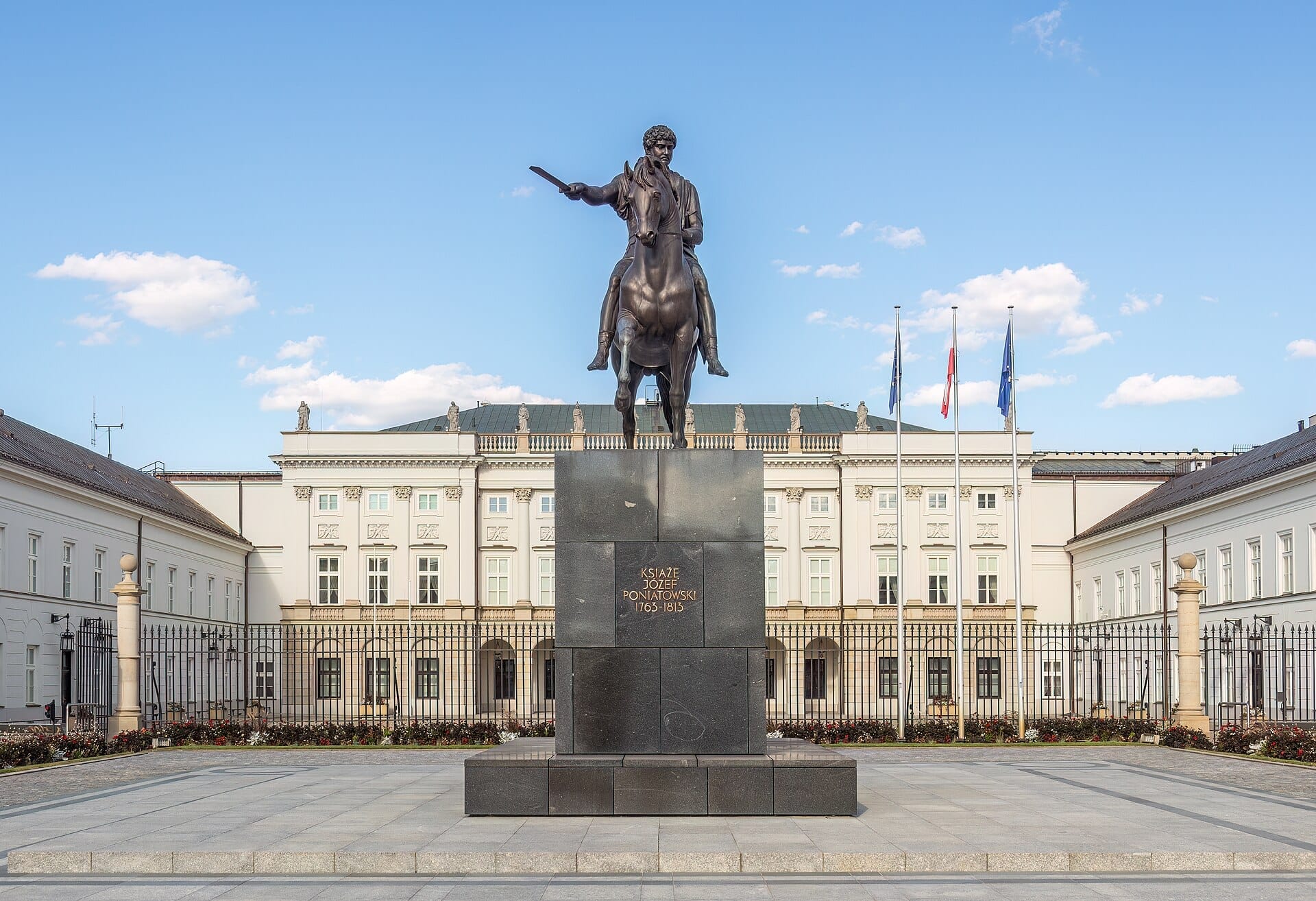
Widely regarded as one of the largest palaces in Warsaw, the building presents a composed neoclassical face to the street: a four-storey main body flanked by two lower wings, all rendered in pale stucco with a colonnaded portico at the centre. The overall effect is formal and deliberately authoritative, designed to project continuity and institutional weight.
Most visitors encounter it as part of a Royal Route walk rather than as a standalone destination, and that is probably the right framing. Access to the interior is restricted. What you get is an exterior, a ceremonial context, and a very dense layer of history packed into a single facade.
A Brief History: From Koniecpolski Palace to Presidential Seat
Construction began in the 1640s, and the building was completed between 1643 and 1645 as the Koniecpolski Palace, named after the powerful noble family that commissioned it. Over the following three centuries it changed hands repeatedly, each new owner reshaping the interiors and, on occasion, the facade, to reflect shifting political fortunes and evolving architectural tastes.
One of the more remarkable facts about the building is what did not happen to it during World War II. While roughly 85 percent of Warsaw was destroyed, the palace survived almost intact, largely because it was commandeered as the headquarters of the German Army's Warsaw garrison. That preservation by occupation is a particular kind of irony that runs through a lot of Warsaw's surviving prewar architecture.
The postwar decades brought different occupants and different uses, before the building was formally designated the official presidential seat in 1995 following Poland's return to democracy. To understand why that moment mattered, it helps to read more about Warsaw's political and architectural history in the broader context of the city's communist-era transformation.
Tickets & tours
Hand-picked options from our booking partner. Prices are indicative; availability and final rates are confirmed when you complete your booking.
Pub crawl in Warsaw
From 28 €Instant confirmationFree cancellationWarsaw Museum of Modern Art entrance ticket
From 8 €Instant confirmationSafe and Convenient Luggage Storage in Warsaw Old Town
From 6 €Instant confirmationFree cancellationInteractive spy-themed city game with host-guide in Warsaw Old Town
From 90 €Instant confirmationFree cancellation
What You Can Actually See and Do
⚠️ What to skip
The Presidential Palace is not open for casual walk-in visits. The interior is generally accessible only on special occasions or open days, and any group visits require prior arrangements with the Chancellery. Do not plan a spontaneous interior visit.
From the street, you can observe the full neoclassical facade at close range. The colonnaded portico is impressive at street level, and the proportions of the building become clearer when you step back toward the opposite side of Krakowskie Przedmieście. The ceremonial guards stationed at the entrance gate change at regular intervals, and that exchange draws a small crowd at most hours of the day.
In front of the palace, a bronze equestrian statue of Prince Józef Poniatowski commands the forecourt. Cast in the early 19th century by the Danish sculptor Bertel Thorvaldsen, it is one of Warsaw's most recognizable equestrian monuments and a natural focal point for photographs.
Occasional open days are announced through official channels, typically tied to national holidays or cultural events. On those days, public access may extend into parts of the courtyard or grounds. However, the schedule for open days is not predictable, so it is worth checking the presidential chancellery website closer to your travel dates if interior access matters to you.
💡 Local tip
Group visits (free of charge, for organized groups) must be booked in advance through the Chancellery of the President. If you are traveling with a larger group or school party, this is genuinely worth arranging — the interior is reportedly furnished with significant historical pieces and state reception rooms not otherwise viewable.
How the Experience Changes by Time of Day
Early morning is the cleanest time to photograph the facade. The light falls across the front of the building from the east, the street has not yet filled with tour groups, and the formal geometry of the portico reads clearly against the sky. By mid-morning, the tour group rhythm that defines Krakowskie Przedmieście sets in, and the pavement in front of the palace becomes noticeably more crowded.
In the early afternoon, particularly on weekdays, you may observe official vehicles entering and leaving the gate, which adds a layer of real-time political life to what might otherwise feel like a static heritage stop. The guards at the gate maintain their positions regardless of weather, which in winter means watching ceremonial duty performed in full uniform through snow and wind — a genuinely striking sight.
Evening visits are less rewarding. The palace is not dramatically illuminated compared to some of Warsaw's other landmarks, and the formal purpose of the building means there is no evening program or atmosphere to sustain. Dusk is acceptable for a quick look, but not worth a dedicated return trip.
The Broader Royal Route Context
The Presidential Palace sits at roughly the midpoint of Krakowskie Przedmieście, the upper stretch of Warsaw's Royal Route. To its north, within a few minutes' walk, are St. Anne's Church and the entry to the Old Town. To its south, the boulevard continues past the Holy Cross Church and the University of Warsaw campus toward Nowy Świat.
The palace is best understood as one node in a walkable sequence rather than as a standalone stop. A walking tour of Warsaw's Royal Route is the most logical way to include it, allowing you to absorb the architectural transitions from Gothic and Baroque (in the Old Town) through neoclassical (the palace) to 19th-century eclectic (the university district) in a single two-hour loop.
The surrounding streetscape is also notable for the density of plaques, monuments, and historical markers. Almost every building on Krakowskie Przedmieście carries some layer of significance, and walking slowly with that awareness makes the whole stretch feel different from a casual tourist thoroughfare.
Practical Details for Your Visit
Getting here is straightforward. The Nowy Świat–Uniwersytet station on Metro Line M2 is approximately a 10-minute walk south along Krakowskie Przedmieście. The palace is also reachable on foot from the Old Town in under 10 minutes, making it easy to include in a morning or afternoon on foot. Multiple tram and bus lines stop along the Royal Route corridor as well.
The exterior area around the palace is wheelchair accessible. The pavement on Krakowskie Przedmieście is level and maintained, and there are no steps required to view the facade and the Poniatowski statue. If you are planning a group interior visit and have specific accessibility requirements, contact the Chancellery in advance.
Photography of the exterior is unrestricted. The guard posts and the gate are photographed constantly by visitors and the guards are accustomed to it, but common courtesy applies: do not obstruct the gate, do not cross the security perimeter, and be aware that this is an active government facility rather than a museum.
ℹ️ Good to know
Security presence around the palace is permanent and visible. Bag checks or temporary access restrictions can occur when the President is in residence or during official state events. If the surrounding area seems unusually secured, check local news — it likely means an official function is underway.
Honest Assessment: Is It Worth Your Time?
If you are visiting Warsaw for the first time and following the Royal Route on foot, the Presidential Palace is a natural stop that adds roughly 15 minutes and no entry cost. The architectural quality is genuine, the historical context is substantial, and the equestrian statue of Poniatowski is worth pausing for.
If, however, you are expecting a palace museum experience with furnished interiors, guided audio tours, and a gift shop, you will be disappointed. This is not Versailles or Schönbrunn. It is a working government building that happens to be very old and very significant. The experience is fundamentally an exterior one.
Visitors whose primary interest is palace interiors should direct that energy toward the Royal Castle or toward Wilanów Palace, both of which offer fully developed museum experiences with original furnishings and regular public access.
Insider Tips
- Arrive before 09:00 on a clear morning for the best photographs of the facade with clean light and minimal crowds on the pavement.
- The guard change in front of the palace gate occurs periodically during the day and can be interesting to observe if you happen to be nearby, especially if you are interested in ceremonial military tradition.
- Check the presidential chancellery website before visiting if interior access matters to you — occasional open days linked to national holidays can open parts of the grounds without requiring a group booking.
- The bronze equestrian statue of Prince Józef Poniatowski in the forecourt was created by Bertel Thorvaldsen, one of the most celebrated sculptors of the early 19th century, making it a work of genuine art-historical interest beyond its political symbolism.
- If you are walking the full Royal Route, combine this stop with St. Anne's viewpoint terrace a few minutes north — the elevated view back over the palace and Krakowskie Przedmieście gives a useful sense of the street's monumental scale.
Who Is Presidential Palace For?
- First-time Warsaw visitors completing a Royal Route walk who want architectural and historical context without a separate entry ticket
- History enthusiasts interested in Polish political history, particularly the interwar period and post-1989 democratic transition
- Architecture lovers drawn to Warsaw's neoclassical building stock and how it survived or was rebuilt after wartime destruction
- Photographers working early morning shoots along Krakowskie Przedmieście
- Organized groups who can arrange a free interior visit in advance and want access to active state reception rooms
Nearby Attractions
Other things to see while in City Centre (Śródmieście):
- Fryderyk Chopin Museum
Housed inside the 17th-century Ostrogski Palace near Warsaw's Royal Route, the Fryderyk Chopin Museum holds one of the world's richest collections of Chopin memorabilia. Closed for full renovation throughout 2026; reopening is planned for 2027 — plan post-renovation visits and confirm dates on the official site.
- Grand Theatre – National Opera
The Grand Theatre – National Opera (Teatr Wielki – Opera Narodowa) is one of the largest opera houses in Europe, anchoring Theatre Square in central Warsaw with a neoclassical facade that survived war and rebuilding. Whether you attend a full opera, a ballet, or simply walk across the square to take in the architecture, this institution rewards both serious culture-seekers and curious first-time visitors.
- Hala Koszyki Food Hall
Built in 1909 and reborn in 2016, Hala Koszyki is a restored Art Nouveau market hall in central Warsaw where locals actually eat, drink, and shop. Free to enter, open daily until 1am, and genuinely good.
- Holy Cross Church (Kościół Świętego Krzyża)
One of Warsaw's most historically charged sites, Holy Cross Church on Krakowskie Przedmieście holds the preserved heart of Frédéric Chopin in a nave pillar. A Minor Basilica with a Baroque facade, 17th-century origins, and free entry, it rewards visitors who take the time to look closely.