Holy Cross Church (Kościół Świętego Krzyża): Where Chopin's Heart Rests
One of Warsaw's most historically charged sites, Holy Cross Church on Krakowskie Przedmieście holds the preserved heart of Frédéric Chopin in a nave pillar. A Minor Basilica with a Baroque facade, 17th-century origins, and free entry, it rewards visitors who take the time to look closely.
Quick Facts
- Location
- Krakowskie Przedmieście 3, Warsaw city centre
- Getting There
- Metro: Nowy Świat – Uniwersytet (~250 m); Bus stop: Uniwersytet
- Time Needed
- 30–60 minutes
- Cost
- Free (no entrance fee)
- Best for
- History lovers, Chopin fans, architecture enthusiasts
- Official website
- http://www.swkrzyz.pl
What Holy Cross Church Actually Is
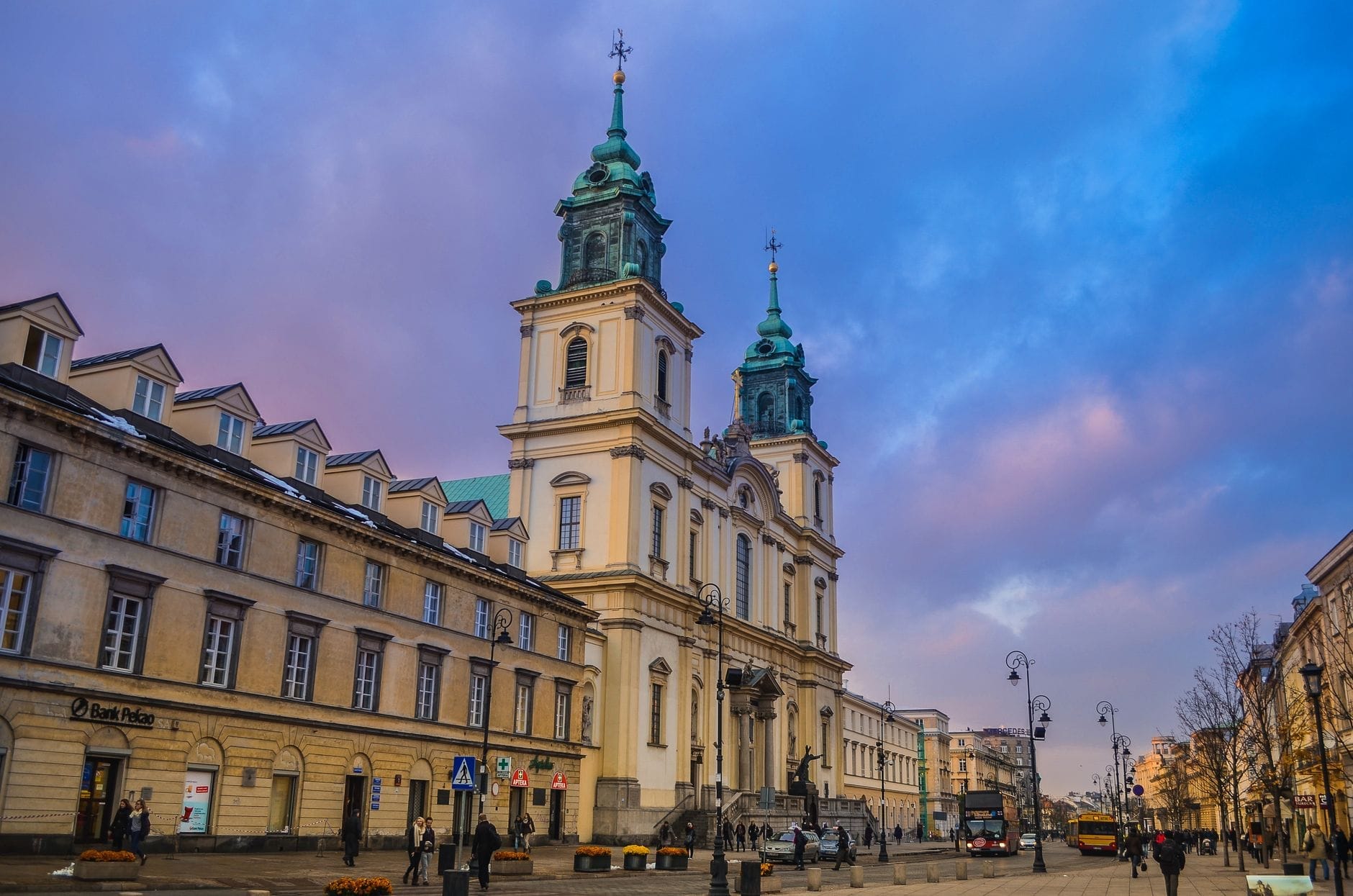
Holy Cross Church (Kościół Świętego Krzyża) stands on Krakowskie Przedmieście, Warsaw's grandest ceremonial boulevard, directly opposite the main gates of Warsaw University. Its twin-towered Baroque facade has anchored this stretch of the Royal Route for nearly three centuries, and the building carries one of the most intimate relics in European cultural history: the preserved heart of Frédéric Chopin.
Elevated to the status of Minor Basilica by Pope John Paul II on 21 January 2002, the church is both an active Roman Catholic parish and a site of genuine historic weight. Entry is free, the interior is open daily as a place of worship, and the visit itself takes no more than an hour even at a slow pace. Yet the experience is dense with detail that rewards anyone who walks in knowing what they are looking at.
A History Built on Rubble and Reconstruction
A church has occupied this site since at least 1525, but the original structure did not survive the Swedish invasions of the mid-17th century, a period Poles call the Deluge. The present Baroque building was constructed between 1679 and 1696, making it a product of Warsaw's post-Deluge recovery. The two flanking towers, which give the facade its recognizable silhouette, were added later, between approximately 1725 and 1737.
The Second World War came close to erasing it entirely. The church suffered heavy damage during the 1944 Warsaw Uprising and the subsequent German destruction of the city. Reconstruction was a slow process, not completed until 1953, and several interior elements date from that postwar period rather than the original 17th-century construction. This layering of eras is part of what makes the building interesting: it is simultaneously Baroque, war-scarred, and rebuilt.
ℹ️ Good to know
The church is an active parish. Visiting during or immediately after a Mass service means the nave will be crowded and certain areas may be inaccessible. Weekday mornings between services are the quietest time to explore the interior.
Tickets & tours
Hand-picked options from our booking partner. Prices are indicative; availability and final rates are confirmed when you complete your booking.
Museum of John Paul II and Primate Wyszyński entrance ticket
From 8 €Instant confirmationPub crawl in Warsaw
From 28 €Instant confirmationFree cancellationWarsaw Museum of Modern Art entrance ticket
From 8 €Instant confirmationSafe and Convenient Luggage Storage in Warsaw Old Town
From 6 €Instant confirmationFree cancellation
Chopin's Heart: The Detail That Changes the Visit
Frédéric Chopin died in Paris on 17 October 1849. Before his death, he reportedly requested that his heart be returned to Poland. His sister Ludwika fulfilled this wish, smuggling the heart out of France. It arrived in Warsaw and was entrusted to Holy Cross Church, where it has remained, preserved in cognac inside a crystal urn, sealed within a pillar on the left side of the nave.
The pillar itself is marked by a plaque and a small carved inscription. It is not a large monument, which surprises many visitors expecting something more theatrical. The restraint is, in its way, appropriate. You are standing within arm's reach of one of the most carefully preserved pieces of a composer who reshaped European piano music. The column is cold, smooth, and utterly ordinary-looking from three meters away. Step closer and read the Latin inscription, and the weight of the place becomes very real.
For context on Chopin's deep connection to Warsaw, the Fryderyk Chopin Museum on nearby Okolnik Street holds the most comprehensive collection of his manuscripts, instruments, and personal effects in the world. The two sites complement each other well on the same afternoon — though the museum is closed for renovation throughout 2026, so confirm reopening dates before planning a joint visit.
Inside the Church: What You Will See
The facade presents two towers in pale stone, with a broad central portal framed by columns and topped by a pediment carrying figurative sculpture. The proportions are restrained for Baroque work, closer to the dignified than the theatrical. Step through the main doors and the interior opens into a single wide nave with side chapels lining both walls.
The ceiling frescoes are among the most significant elements of the interior decoration. They were damaged during the war and painstakingly restored during the 1950s reconstruction, and they retain real visual power: deep blues and ochres across a vaulted expanse that draws the eye upward from the moment you enter. The high altar at the far end is gilded and vertical, framed by twisted columns, and lit in a way that makes it glow even on overcast days when the nave itself is relatively dim.
Side chapels contain altarpieces, carved wooden confessionals, and various memorial tablets. The atmosphere is typical of a working Central European Catholic church: candlelit, slightly cool even in summer, and with a persistent faint smell of incense. The stone floor amplifies every footstep, so the space is never fully silent unless you visit very early in the morning.
💡 Local tip
Photography is generally permitted inside, but use judgment: avoid flash near altars and never photograph during services. The Chopin pillar on the left nave wall is the most-photographed object inside; early morning light from the high windows falls across it most favorably.
The Setting: Krakowskie Przedmieście and the Walk Around It
Holy Cross Church sits at the southern end of the most walkable stretch in Warsaw. To its north along Krakowskie Przedmieście you will find the Presidential Palace and the St. Anne's Church, which has a viewpoint tower worth climbing. To the south, the street transitions into Nowy Świat, lined with cafes and bookshops. The church is naturally embedded in a longer walk rather than being a standalone destination.
The Copernicus Monument stands directly in front of the church on the pavement, which means the two are inevitably photographed together. The monument is a 19th-century neoclassical bronze by Bertel Thorvaldsen, depicting the astronomer holding an armillary sphere. It was removed and hidden by the Polish resistance during the German occupation to prevent its destruction or repurposing, then restored to its plinth after the war.
The street directly outside is wide and relatively quiet for central Warsaw. In warm months, the pavement outside the university gates fills with students between lectures, giving the whole stretch a low-key academic energy that contrasts with the more tourist-oriented atmosphere further north toward the Old Town.
Practical Details and How to Visit
The church is located at Krakowskie Przedmieście 3, in the Śródmieście district of central Warsaw. The nearest metro station is Nowy Świat – Uniwersytet on Line 2, approximately 250 meters away on foot. Bus stop Uniwersytet serves multiple routes along the Royal Route corridor. If you use the Veturilo city bike scheme, there is a docking station nearby.
Entrance is free of charge. The church crypts are not open to the public. There is no formal ticketing, no audio guide system in place, and no gift shop inside. The visit is entirely self-guided. For current Mass times and any changes to visiting hours, check the parish website at swkrzyz.pl directly, as these are governed by the liturgical calendar and can shift around major feast days.
⚠️ What to skip
Accessibility note: The main entrance requires climbing several steps, and the church is not barrier-free. Visitors with mobility limitations should be aware that there is no ramped or level access to the primary entrance.
If you are building a half-day itinerary around this area, a walking tour of central Warsaw would naturally incorporate Holy Cross Church alongside the university, the Saxon Garden, and Nowy Świat. It sits at roughly the midpoint of the Royal Route between the Old Town and Łazienki Park.
Who This Is Not For
Travelers with no interest in religious architecture or Polish cultural history are unlikely to find much here beyond a quick look at the facade. The interior, while genuinely beautiful, is not on the scale of Krakow's Wawel Cathedral or Warsaw's own Royal Castle in terms of sheer spectacle. If you are working through a short visit and have to choose, the Chopin Museum nearby offers a more immersive and curated experience of Chopin's legacy specifically.
Families with young children may find the mandatory quiet and restricted photography protocol during services frustrating if their timing does not allow for an off-peak visit. The church also lacks any interactive or explanatory displays in English, so first-time visitors unfamiliar with the Chopin connection or the building's history may find it difficult to understand what they are looking at without prior reading.
Insider Tips
- The Chopin pillar is on the left side of the nave as you walk in from the main entrance. Look for the stone tablet set into the column at roughly chest height. It is easy to walk past if you do not know to look for it.
- Weekday mornings between roughly 9am and 11am tend to be the quietest visiting window. Weekend afternoons draw both tour groups and local worshippers, making the nave crowded and the atmosphere less conducive to quiet observation.
- The view of the church facade from the far side of Krakowskie Przedmieście, framing the Copernicus Monument in the foreground, is the most effective photo composition. Cross to the university side of the street and shoot with a standard lens.
- Mass is celebrated multiple times daily. If you arrive during a service, wait outside or in the rear of the nave. Services typically last around 30–40 minutes, and the church becomes considerably calmer immediately afterward.
- The church sits directly on the route between Nowy Świat–Uniwersytet metro station and the Old Town. Combining it with a walk north toward the Royal Castle makes geographic and logistical sense, adding minimal time to an already planned route.
Who Is Holy Cross Church (Kościół Świętego Krzyża) For?
- Chopin enthusiasts making a pilgrimage to the composer's most intimate Warsaw connection
- Travelers interested in Polish Baroque architecture and postwar reconstruction history
- Visitors walking the Royal Route who want to understand the buildings they are passing
- Those combining the visit with the Fryderyk Chopin Museum on the same afternoon
- Anyone looking for a quiet, free interior space in the middle of a long day on foot
Nearby Attractions
Other things to see while in City Centre (Śródmieście):
- Fryderyk Chopin Museum
Housed inside the 17th-century Ostrogski Palace near Warsaw's Royal Route, the Fryderyk Chopin Museum holds one of the world's richest collections of Chopin memorabilia. Closed for full renovation throughout 2026; reopening is planned for 2027 — plan post-renovation visits and confirm dates on the official site.
- Grand Theatre – National Opera
The Grand Theatre – National Opera (Teatr Wielki – Opera Narodowa) is one of the largest opera houses in Europe, anchoring Theatre Square in central Warsaw with a neoclassical facade that survived war and rebuilding. Whether you attend a full opera, a ballet, or simply walk across the square to take in the architecture, this institution rewards both serious culture-seekers and curious first-time visitors.
- Hala Koszyki Food Hall
Built in 1909 and reborn in 2016, Hala Koszyki is a restored Art Nouveau market hall in central Warsaw where locals actually eat, drink, and shop. Free to enter, open daily until 1am, and genuinely good.
- Living Under Communism Museum (Czar PRL)
Housed in a Stalinist-era building at Plac Konstytucji, the Museum of Life Under Communism (Muzeum Życia w PRL) reconstructs what it felt like to live in Poland between 1944 and 1989. Think cramped apartments, propaganda posters, and Fiat 126p interiors rather than political theory. It is a small, idiosyncratic museum that rewards curious visitors with a surprisingly emotional window into a vanished world.