Living Under Communism Museum (Czar PRL): Warsaw's Most Personal Cold War Experience
Housed in a Stalinist-era building at Plac Konstytucji, the Museum of Life Under Communism (Muzeum Życia w PRL) reconstructs what it felt like to live in Poland between 1944 and 1989. Think cramped apartments, propaganda posters, and Fiat 126p interiors rather than political theory. It is a small, idiosyncratic museum that rewards curious visitors with a surprisingly emotional window into a vanished world.
Quick Facts
- Location
- Piękna 28/34, Plac Konstytucji, City Centre, Warsaw
- Getting There
- Politechnika metro station (M1 line, ~700 m); tram and bus stops at Plac Konstytucji
- Time Needed
- 1–2 hours
- Cost
- 32 PLN regular / 22 PLN reduced / free for children 0–5; retro Walkman audioguide 10 PLN extra
- Best for
- History lovers, Cold War buffs, Polish diaspora, families with older children
- Official website
- http://mzprl.pl
What the Museum Actually Is (And Is Not)
The Museum of Life Under Communism, known locally as Muzeum Życia w PRL or Czar PRL, is not a grand national institution with soaring exhibition halls. It is a compact, hands-on collection tucked onto the first floor of a Stalinist residential block, and that incongruity is part of the point. The building itself, on the north-eastern corner of Plac Konstytucji, was constructed in the Socialist Realist style of the early 1950s, when Polish architects were ordered to produce architecture that projected the optimism and power of the new communist order. Walking through its heavy doorway already puts you in the right frame of mind.
The museum focuses exclusively on everyday civilian life during the Polish People's Republic, the PRL, which existed roughly from 1944 to 1989. You will not find much here about political purges or high-level party intrigue. Instead, the collection asks a quieter question: what did ordinary people eat, wear, watch on television, and keep in their medicine cabinets? The result is closer to a curated time-capsule apartment than a conventional museum, and for many visitors that intimacy is exactly what makes it land.
ℹ️ Good to know
The museum is on the first floor and has no elevator. It is explicitly noted as not wheelchair accessible. If mobility is a concern, confirm current access arrangements before visiting.
The Building and Its Neighbourhood
Plac Konstytucji is one of Warsaw's most architecturally coherent Socialist Realist spaces. Laid out in the early 1950s, the square was designed as a ceremonial plaza surrounded by monumental residential and commercial blocks with colonnaded ground floors, carved stone reliefs, and inscriptions praising the working class. Today a KFC occupies one of those colonnaded units and a contemporary coffee bar another, which tells you something about the distance Poland has travelled since 1989. The Museum of Life Under Communism sits in this same complex, which means the exterior context is free and impossible to miss.
The museum is roughly 1.2 kilometres south of the Palace of Culture and Science, walkable in about 15 minutes along Marszałkowska Street. That walk itself is an education: you pass the transition from Socialist Realist apartment blocks to 1970s concrete panel housing to post-1989 glass towers. If you have time, combine the museum visit with a broader walk along this corridor to understand how Warsaw's architecture layers its ideological history.
Tickets & tours
Hand-picked options from our booking partner. Prices are indicative; availability and final rates are confirmed when you complete your booking.
Museum of John Paul II and Primate Wyszyński entrance ticket
From 8 €Instant confirmationPub crawl in Warsaw
From 28 €Instant confirmationFree cancellationWarsaw Museum of Modern Art entrance ticket
From 8 €Instant confirmationSafe and Convenient Luggage Storage in Warsaw Old Town
From 6 €Instant confirmationFree cancellation
Inside the Exhibition: Rooms, Objects, and Atmosphere
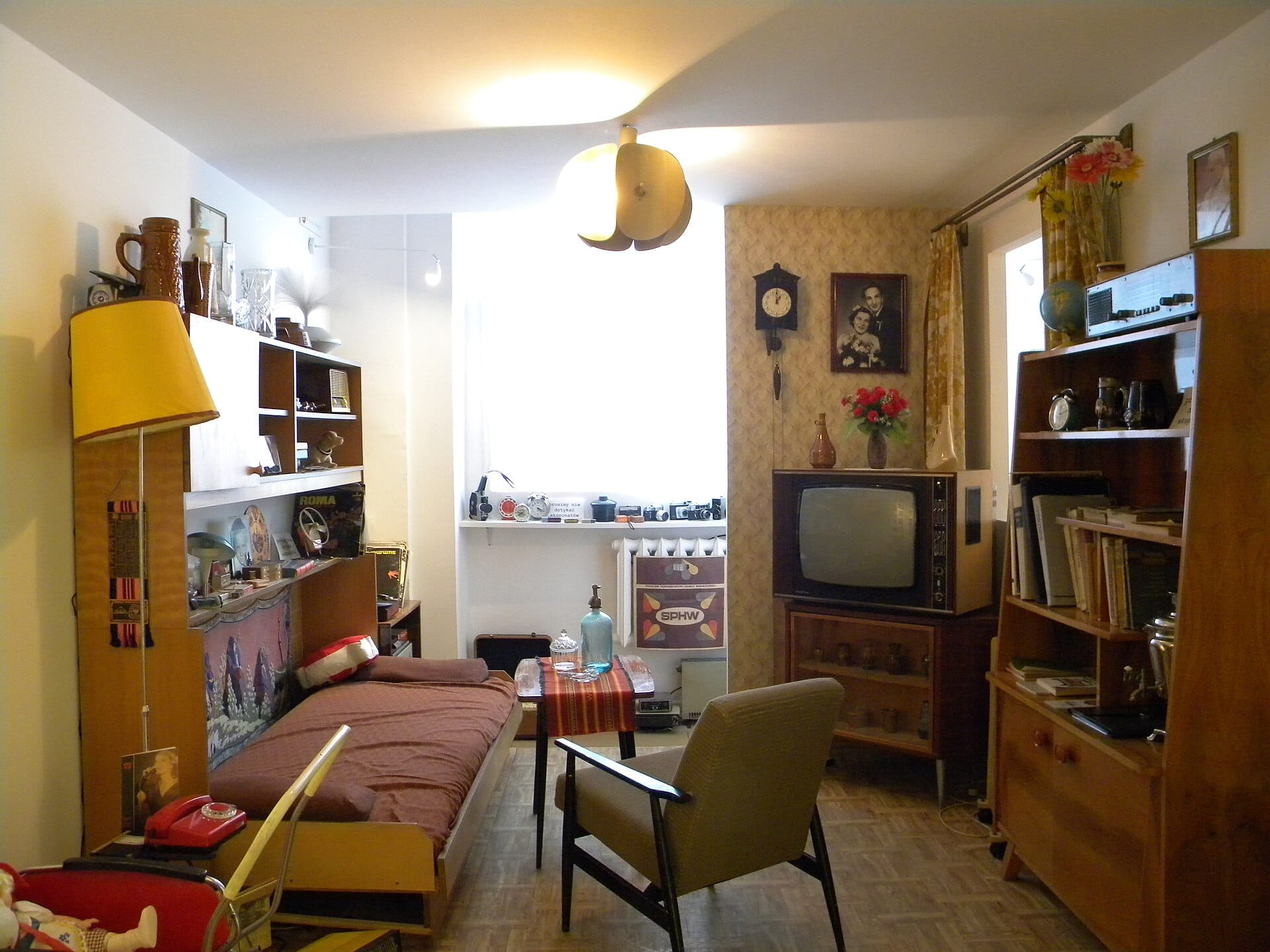
The exhibition is arranged to evoke the rooms of a typical Polish apartment from various decades of the PRL period. You move through spaces that recall a living room, a kitchen, a children's bedroom, and a bathroom, each stocked with period-correct objects sourced from private donations and flea markets. The smell of old plastics, worn upholstery, and decades-old packaging is subtle but real. Many visitors, especially those with Polish family connections, report a jolt of recognition the moment they step in.
Objects range from the mundane to the absurd: Pollena soap in its original orange wrapper, a Grundig-era radio set, an Orbis travel agency calendar from the 1970s, a stack of Przekrój magazines, and the ubiquitous Fiat 126p (the Maluch, or Little One), the small car that became the most potent symbol of PRL consumer aspiration. There are also propaganda posters, May Day parade banners, and shelves of food packaging that illustrate the real scarcity of consumer goods. Exhibition labels are in Polish and English, which makes the space accessible to international visitors without requiring a guide.
For an additional 10 PLN you can hire a retro Walkman audioguide, which leans into the nostalgia with deliberate charm. The Walkman itself is part of the exhibit. A mobile app alternative is also available. Neither is essential, but the Walkman is worth the extra cost for the tactile experience alone.
When to Visit and What to Expect at Different Times
The museum keeps straightforward hours: Monday through Thursday and weekends from 10:00 to 18:00, and Friday from 12:00 to 20:00. Last entry is 30 minutes before closing. Note that Christmas Eve (24 December, open until 14:00) and New Year's Eve (31 December, open until 16:00) have shortened hours, so plan accordingly if you are visiting Warsaw during the holiday season.
Weekday mornings are the quietest windows. The space is small, and on a busy Saturday afternoon the rooms can feel genuinely cramped when multiple groups are moving through simultaneously. Friday evenings benefit from the extended closing time and a slightly older, more reflective crowd. If you visit mid-morning on a Tuesday or Wednesday, you may have entire rooms to yourself, which makes it considerably easier to linger over objects and read the labels at your own pace.
💡 Local tip
Weekday mornings before noon offer the most relaxed experience. The museum is small enough that a Saturday afternoon with two tour groups inside will feel noticeably crowded.
Historical Context: What the PRL Was
The Polish People's Republic (Polska Rzeczpospolita Ludowa) was the communist state that governed Poland from 1944, when Soviet forces pushed Nazi Germany out of the country, until 1989, when partially free elections brought Solidarity to power. That 45-year span encompassed Stalinist terror in the late 1940s and early 1950s, a brief thaw under Gomułka, the relative optimism of Gierek's 1970s credit-fuelled building boom, the extraordinary social movement of Solidarity in the early 1980s, the imposition of martial law in December 1981, and the final unravelling of the system by the end of the decade.
What the Museum of Life Under Communism captures is not that political arc but the texture of daily life running underneath it. Poles were queuing for meat while Solidarity was being born. They were watching state television drama series while martial law curfews kept them indoors. Understanding this parallel track, between official history and lived experience, is what makes the museum a useful companion to weightier sites like the Warsaw Uprising Museum or the POLIN Museum of the History of Polish Jews. Those institutions explain what happened. This one explains what it felt like on a Tuesday morning.
The museum opened in its current Piękna Street location in 2014, having previously operated in the Praga district on the eastern bank of the Vistula in connection with retro city tours. The move to a Stalinist-era building at Plac Konstytucji was a considered choice, not a coincidence. For more on the architectural and ideological heritage of communist-era Warsaw, the communist Warsaw guide covers the major sites in the broader city context.
Practical Walkthrough: Getting There and Getting the Most Out of It
The nearest metro stop is Politechnika on the M1 (north-south) line, about 700 metres from the museum entrance. From Politechnika, walk north along Marszałkowska, turn right onto Piękna, and the building is on your left. Multiple tram and bus routes stop directly at Plac Konstytucji, making it easy to reach from most parts of the city centre. If you are coming from the Old Town or the Royal Castle area, the walk south along Krakowskie Przedmieście and Nowy Świat to Piękna takes around 20 minutes and passes through some of Warsaw's most interesting streetscapes.
Admission is 32 PLN at regular price, 22 PLN reduced (for students, seniors, and other qualifying groups), and free for children aged five and under. Group rates of 17 or 20 PLN per person apply depending on group type. All prices are in Polish złoty. There are no timed entry slots, so you can turn up directly, but arriving close to last entry (30 minutes before closing) will feel rushed given the amount to read.
Photography is generally permitted throughout the exhibition. The low-light conditions in some rooms mean a phone with decent low-light capability will produce better results than a compact camera with flash. The retro objects photograph particularly well in the warmer light of the apartment-style rooms. If you are specifically interested in the propaganda poster collection, position yourself early in the visit before groups move through and block wall access.
⚠️ What to skip
The museum has no elevator and is reached by stairs. Visitors with mobility limitations should be aware it is not wheelchair accessible. The staircase is typical of 1950s residential construction: solid but steep.
Honest Assessment: Is It Worth Your Time?
For visitors with a genuine interest in Central European history and social life, this museum delivers far more than its modest size and ticket price suggest. It fills a gap that most Warsaw institutions leave open: they explain politics and war, but not the quieter rhythms of life under an authoritarian system. The collection is carefully assembled, the bilingual labels are informative, and the building itself adds a layer of meaning that a purpose-built modern space could not replicate.
That said, visitors who prefer large-scale, high-production museum experiences may find it underwhelming. The space is genuinely compact, the lighting is deliberately atmospheric rather than bright, and the exhibition does not use much interactive technology beyond the audioguide. If you are choosing between this and the Warsaw Uprising Museum on a tight schedule, the Uprising Museum offers a more dramatically staged narrative. The Museum of Life Under Communism works best as a complement to that kind of visit, not a substitute.
Visitors who will get the least from it: those with no background interest in Polish or Soviet-bloc history, very young children, and anyone expecting an English-language guided tour (individual guided tours in English are not a standard feature; the audioguide and bilingual labels are the primary English-language support).
Insider Tips
- The Walkman audioguide is worth the extra 10 PLN not just for the content but because walking through a communist-era apartment listening to a cassette player is exactly the kind of layered experience the museum is built around.
- After your visit, walk the full perimeter of Plac Konstytucji to take in the carved stone reliefs above the colonnaded ground floors. They depict workers, soldiers, and farmers in classic Socialist Realist style and are among the best-preserved examples of this art form in Warsaw.
- Friday evening opening until 20:00 makes this a practical stop before dinner in the nearby Śródmieście restaurant district, avoiding the weekend crowds entirely.
- Many of the objects were donated by Warsaw families clearing out relatives' flats after 1989. If you speak to staff, they often have context about specific items that goes well beyond the labels.
- Combine the visit with a walk north along Marszałkowska to the Palace of Culture and Science. The 15-minute walk passes through successive layers of Warsaw's architectural history and makes the museum's context considerably richer.
Who Is Living Under Communism Museum (Czar PRL) For?
- Travellers interested in Cold War social history and everyday life behind the Iron Curtain
- Polish diaspora visitors and their families tracing personal or family connections to the PRL era
- History students and researchers looking for material culture context beyond political narratives
- Visitors who have already covered the major WWII sites and want to understand what came after
- Architecture and urban history enthusiasts who want to experience a Stalinist residential block from the inside
Nearby Attractions
Other things to see while in City Centre (Śródmieście):
- Fryderyk Chopin Museum
Housed inside the 17th-century Ostrogski Palace near Warsaw's Royal Route, the Fryderyk Chopin Museum holds one of the world's richest collections of Chopin memorabilia. Closed for full renovation throughout 2026; reopening is planned for 2027 — plan post-renovation visits and confirm dates on the official site.
- Grand Theatre – National Opera
The Grand Theatre – National Opera (Teatr Wielki – Opera Narodowa) is one of the largest opera houses in Europe, anchoring Theatre Square in central Warsaw with a neoclassical facade that survived war and rebuilding. Whether you attend a full opera, a ballet, or simply walk across the square to take in the architecture, this institution rewards both serious culture-seekers and curious first-time visitors.
- Hala Koszyki Food Hall
Built in 1909 and reborn in 2016, Hala Koszyki is a restored Art Nouveau market hall in central Warsaw where locals actually eat, drink, and shop. Free to enter, open daily until 1am, and genuinely good.
- Holy Cross Church (Kościół Świętego Krzyża)
One of Warsaw's most historically charged sites, Holy Cross Church on Krakowskie Przedmieście holds the preserved heart of Frédéric Chopin in a nave pillar. A Minor Basilica with a Baroque facade, 17th-century origins, and free entry, it rewards visitors who take the time to look closely.