Communist Warsaw: A Guide to Soviet-Era Architecture & History
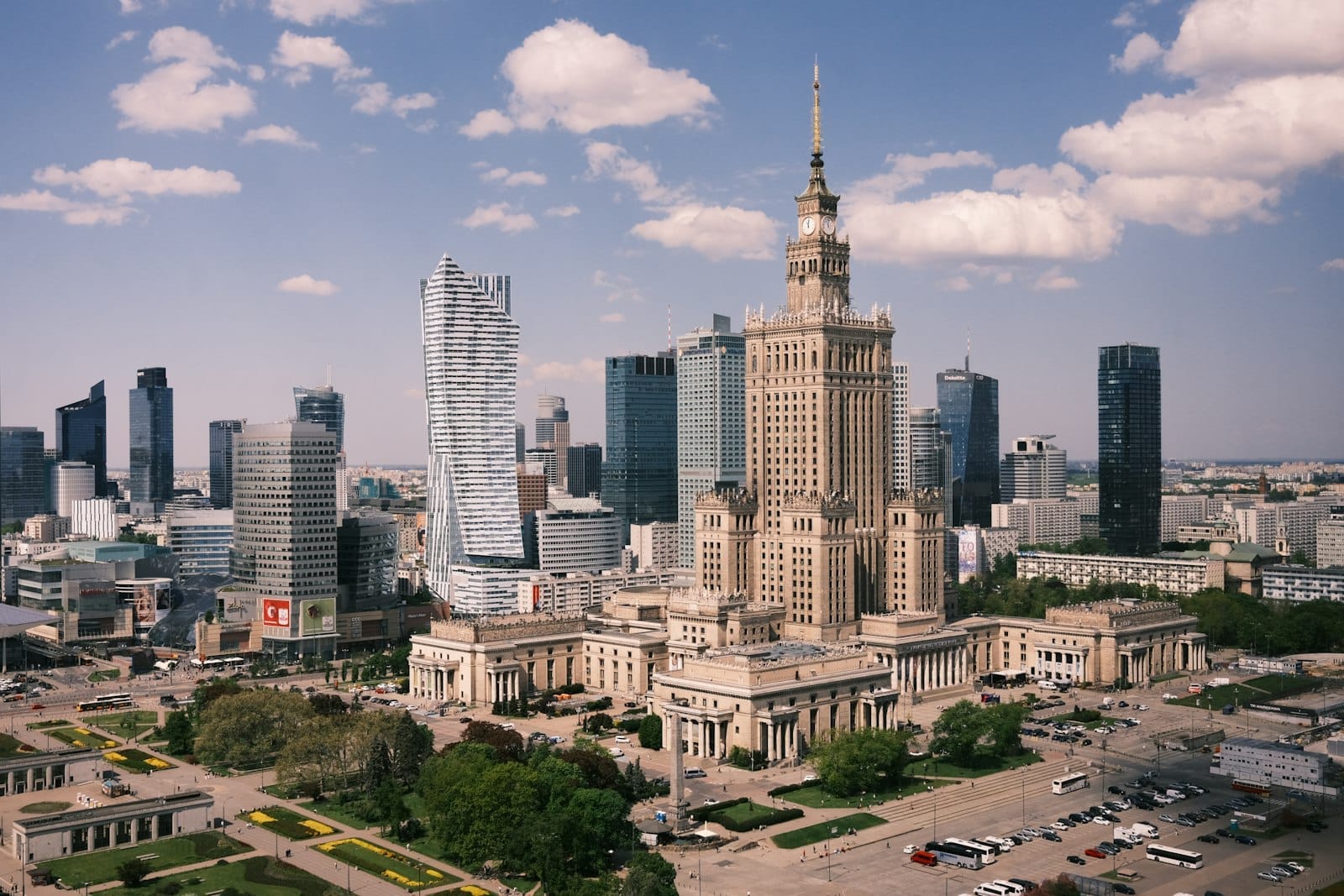
Warsaw preserves one of Central Europe's most complete collections of Stalinist and socialist realist architecture. This guide covers the key landmarks, the history behind them, practical visiting tips, and the common myths that distort what communist-era Warsaw actually looks like.
Plan and book this trip
Tools from our partner Travelpayouts help you compare flights and hotels. If you book through them, we may earn a commission at no extra cost to you.
Flights
Hotels map
TL;DR
- The Palace of Culture and Science (PKiN), completed in 1955, is the defining symbol of Soviet influence in Warsaw and still functions as a mixed-use cultural complex with a paid observation deck on the 30th floor.
- The Marszałkowska Housing District (MDM) and Plac Konstytucji are Warsaw's major socialist realist urban ensemble, built in the early 1950s with colonnades, worker reliefs, and monumental facades.
- Communist-era Warsaw was never purely grey concrete: planners deliberately blended Polish national motifs into socialist realist design, and the Old Town reconstruction also happened under communist rule.
- Warsaw's Soviet Military Cemetery holds the graves of about 21,000 Red Army soldiers, a sobering and often overlooked site outside the usual tourist circuit.
- For broader historical context, the Warsaw WWII history guide explains how wartime destruction set the stage for everything the communists built afterward.
Why Warsaw Is One of Europe's Best Cities for Soviet-Era Architecture
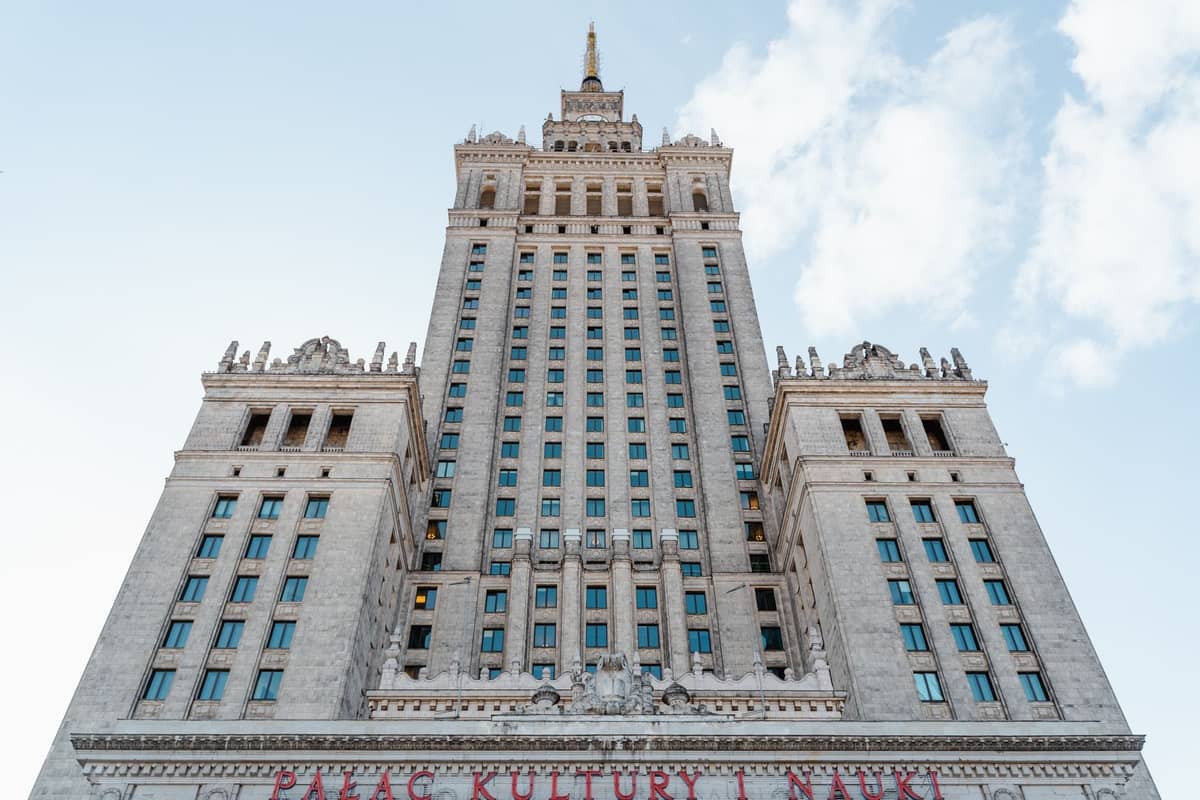
Warsaw occupies a unique position among European capitals: it was heavily destroyed during World War II, then rebuilt under communist rule between 1945 and 1989. That timeline means the city received a full dose of Stalinist socialist realism in the early 1950s, followed by the more utilitarian prefab panel blocks (known in Polish as 'bloki') of the 1960s through 1980s. No other capital in the region had to rebuild so much, so fast, under such tight ideological constraints.
The result is a city where an enormous Stalinist palace shares the skyline with 21st-century glass towers, where socialist realist apartment blocks stand metres from baroque churches. That visual tension is not an accident or a failure of planning: it is the compressed architectural biography of a city that was erased and reinvented within living memory. Understanding what was built, why, and by whom turns an ordinary city walk into something considerably more interesting.
ℹ️ Good to know
Poland was under Soviet-aligned communist rule from 1944 to 1989, governed by the Polish United Workers' Party (PZPR). The architecture of that era reflects distinct phases: Stalinist socialist realism until around 1956, then a shift toward functionalism and prefabricated construction after Stalin's death and Khrushchev's denunciation of architectural excess.
The Palace of Culture and Science: Warsaw's Most Contested Landmark
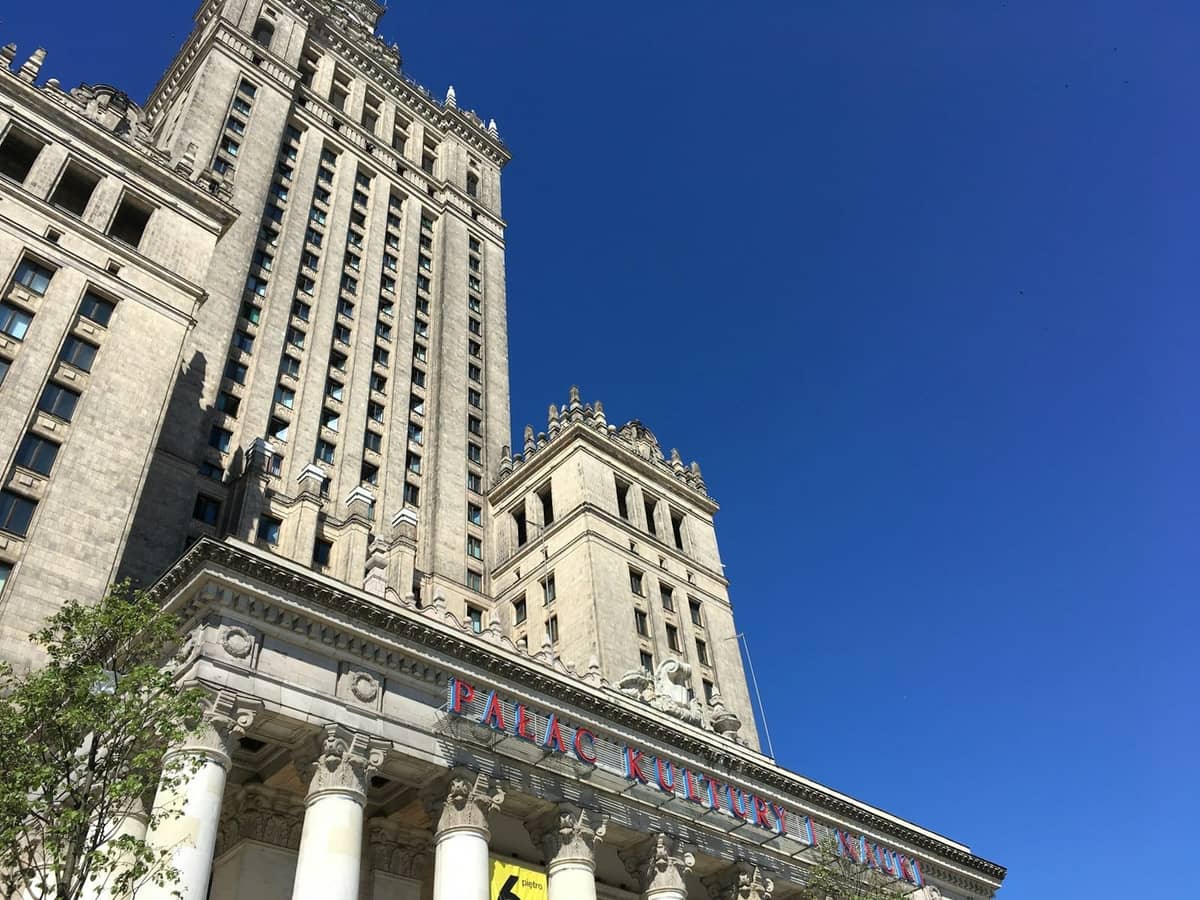
The Palace of Culture and Science (Pałac Kultury i Nauki, or PKiN) is the starting point for any serious exploration of communist Warsaw. Completed in 1955, it was presented as a 'gift' from the Soviet Union to the Polish people, originally named the Joseph Stalin Palace of Culture and Science. The name was quietly dropped after Stalin's death and Khrushchev's 1956 speech denouncing the cult of personality.
Soviet architect Lev Rudnev designed it in Stalinist socialist classicism, a style directly inspired by Moscow's famous 'Seven Sisters' skyscrapers. At 237 metres, it remains the second-tallest building in Poland, with around 3,288 rooms spread across 123,084 square metres. It is not simply an office block: the building houses cinemas, theatres, museums, the Polish Academy of Sciences, university faculties, cafes, and a popular observation deck on the 30th floor. Calling it a monument to Soviet power is accurate, but incomplete. It functions as a genuine civic institution.
- Observation Deck (30th Floor) Paid entry, widely considered the best panoramic viewpoint over central Warsaw. Winter visits offer sharper visibility and dramatic night views when illuminated office towers surround the palace. Check pkin.pl for current ticket prices and hours before visiting.
- Congress Hall A 3,000-seat auditorium that hosted party congresses and now holds concerts and major events. You can sometimes enter during cultural events.
- Museum of Technology One of several cultural institutions housed inside the palace, with permanent and temporary exhibitions. Entrance fees apply.
- Ground-Level Arcade The base of the building contains shops, cafes, and the PKiN cinema complex. Free to walk through at street level — a good way to appreciate the scale without paying for the observation deck.
💡 Local tip
PKiN is located at Plac Defilad 1 in central Warsaw, served by nearby metro stations Centrum and Świętokrzyska, plus numerous tram and bus lines. The surrounding Plac Defilad (Parade Square) was originally designed for mass political demonstrations and is worth viewing from a distance to appreciate the full scale of the building and its deliberate urban dominance.
MDM and Plac Konstytucji: Socialist Realism at Street Level
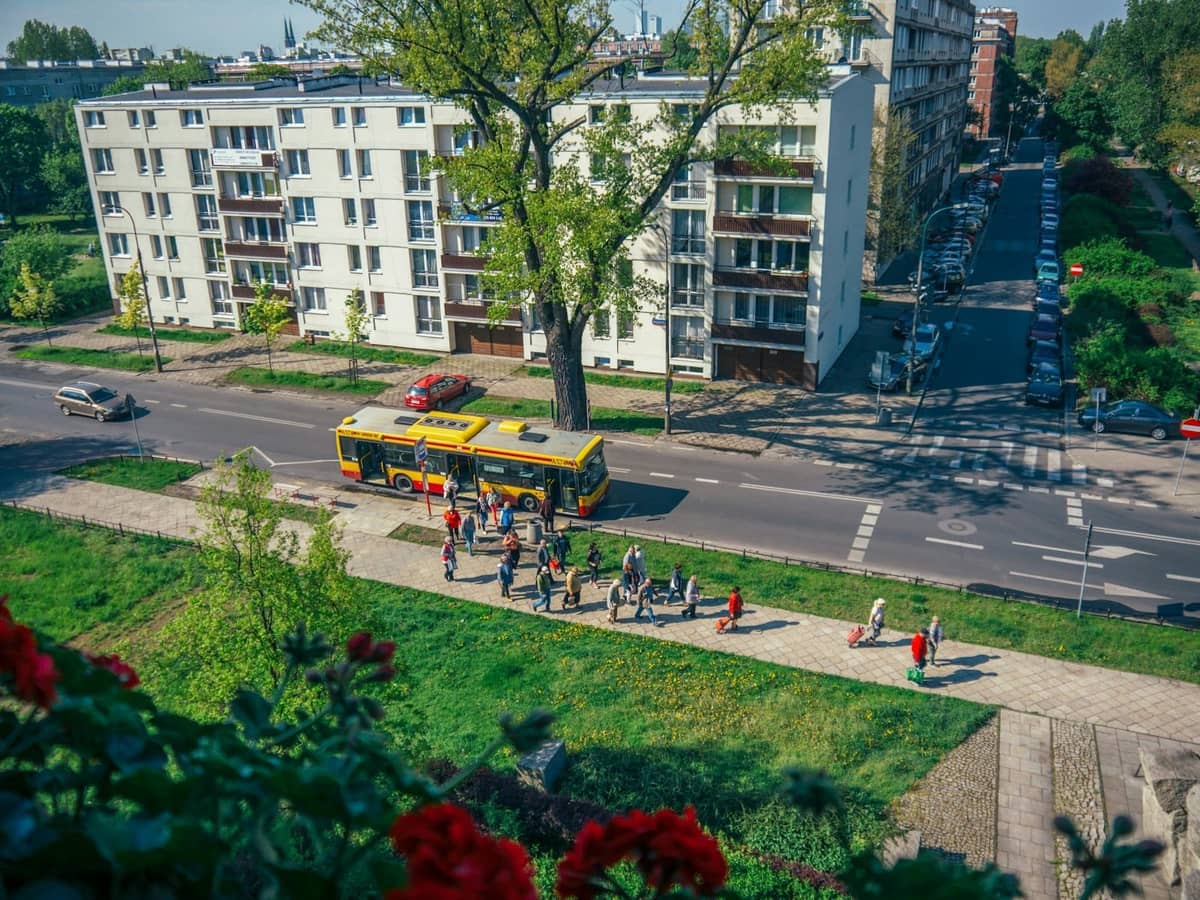
While PKiN dominates the skyline, the Marszałkowska Housing District (MDM) shows what Stalinist urban planning looked like when applied to everyday residential life. Built in the early 1950s and completed around 1953, the MDM complex was designed as a showpiece for socialist living: broad boulevards, symmetrical facades decorated with bas-reliefs of smiling workers and farmers, colonnaded ground floors, and generous apartment sizes by Polish standards at the time. The message was explicit: communism provides for its workers better than capitalism ever could.
Plac Konstytucji, the central square of the MDM, is the best single spot to absorb the ensemble. The proportions are grand without being oppressive, and the reliefs are detailed enough to reward close inspection. A few cafes now occupy the colonnaded ground floors, which makes for a strange but enjoyable contrast: drinking a flat white under a bas-relief of a steel worker. The square is a short walk from PKiN and rarely crowded with tourists, which makes it a more contemplative experience than the palace.
✨ Pro tip
The MDM district is best explored in the morning on a weekday, when residents are going about daily routines. The residential blocks are still lived in, which means you are walking through a functioning neighbourhood, not a museum. Treat it accordingly: keep noise down and avoid photographing people through windows.
Former Communist Party Buildings and Official Architecture
Beyond the headline landmarks, central Warsaw has a layer of official communist-era buildings that most visitors walk past without recognising. The former headquarters of the Polish United Workers' Party (KC PZPR) and various planning commission buildings along Marszałkowska and Aleje Jerozolimskie represent the more restrained bureaucratic version of socialist realism: imposing, heavy-fronted, and clearly designed to project authority rather than inspire affection.
One important correction to the standard narrative: the ideological directive for communist architecture in Poland was 'national in form, socialist in content.' This meant architects were required to incorporate Polish historical motifs into their designs. Look closely at MDM facades and you will find references to Renaissance Polish decoration alongside the socialist worker imagery. Even the reconstruction of the Old Town happened under communist rule, finished by 1953, and was driven partly by nationalist sentiment the regime needed to co-opt. The communists rebuilt the medieval streetscape while simultaneously constructing the MDM a few blocks away — an ideological balancing act that shaped Warsaw's current urban character.
The Soviet Military Cemetery and Red Army Memorials
Warsaw's Soviet Military Cemetery on Żwirki i Wigury Street holds the graves of about 21,000 Soviet soldiers who died during the operations to capture Warsaw from Nazi Germany in January 1945. It is a large, formally landscaped site with rows of identical military markers. Visiting it generates a genuinely complex response: these were soldiers who fought against fascism and whose deaths contributed to Warsaw's liberation, yet the Soviet army that entered Warsaw also imposed four decades of political domination. The cemetery does not resolve that tension, but it makes it concrete and specific.
The site receives far fewer visitors than Warsaw's other war memorials and is rarely featured in standard tourist itineraries. If you are spending more than two days exploring the city's wartime and postwar history, it deserves inclusion. It is located near Warsaw Chopin Airport, so it can logically be combined with a departure day or a visit to the Mokotów district.
The Museum of Life Under Communism and Other Dedicated Sites
For visitors who want context beyond architecture, Warsaw has dedicated museum spaces covering the communist period. The Museum of Life Under Communism documents everyday life during the Polish People's Republic era: consumer shortages, propaganda, secret police surveillance, and the small resistances of daily life. It is a more intimate and domestic perspective than the grand architecture of PKiN, and the two experiences complement each other well.
The broader historical arc of resistance to communist rule runs through several other Warsaw institutions. The Warsaw Uprising Museum covers the 1944 uprising against Nazi occupation, but understanding why the Soviet army halted on the Vistula's east bank while the city burned is central to understanding postwar Polish-Soviet relations and everything that followed. This is not peripheral history: it is the foundation on which communist Warsaw was built.
- Palace of Culture and Science (PKiN): the essential starting point, observation deck recommended
- Plac Konstytucji and the MDM district: best-preserved socialist realist urban ensemble
- Museum of Life Under Communism: excellent for social history and everyday life under the regime
- Former KC PZPR headquarters on Aleje Ujazdowskie: austere official architecture, exterior viewing
- Soviet Military Cemetery: sobering, crowd-free, historically significant
- Nowy Świat and Marszałkowska streetscapes: mix of postwar reconstruction and socialist realist facades
Practical Tips for Exploring Communist Warsaw
Most of the key sites cluster in the central Śródmieście district and can be covered on foot in a half-day if you are focused, or a full day if you want to read every relief and stop for coffee. Start at PKiN in the morning when the observation deck is less crowded, walk south along Marszałkowska to reach Plac Konstytucji and the MDM, then loop back through the former party buildings on Aleje Jerozolimskie. The total walking distance is around 3-4 km.
Warsaw's public transport network makes the Soviet Military Cemetery and the Museum of Life Under Communism easy to reach without a car. For a more structured experience, dedicated communist-era walking tours operate regularly from central Warsaw and typically last 2-3 hours. These tours are particularly useful for identifying buildings that look unremarkable from the outside but have significant political histories. See our guide to Warsaw walking tours for current operator options and booking details.
⚠️ What to skip
PKiN observation deck tickets can sell out on busy weekend afternoons in summer. Book online via pkin.pl if you have a fixed schedule. Also note that opening hours and ticket prices change periodically: always check the official website before visiting rather than relying on third-party listings.
- Best season for PKiN views Autumn and winter offer clearer air and lower crowds. Summer haze can reduce long-distance visibility from the observation deck. Winter also allows evening visits with illuminated city views.
- Photography The MDM reliefs photograph best in low-angle morning or late afternoon light. PKiN's exterior is best photographed from Plac Defilad for full height context.
- Guided vs. self-guided Self-guided exploration works well for the architecture itself, but a guided tour adds significant interpretive value, particularly for identifying the political history embedded in specific buildings.
- Currency All sites in Warsaw operate in Polish złoty (PLN). Card payment is widely accepted, but carry some cash for smaller cafes in the MDM colonnades.
If you are combining this with broader Warsaw sightseeing, the 2 days in Warsaw itinerary and the guide to Warsaw's best museums both integrate well with a communist-era focus. The Polin Museum of the History of Polish Jews also covers the postwar communist period's treatment of Jewish communities, adding another layer to the same historical moment.
FAQ
Is the Palace of Culture and Science worth visiting?
Yes, for most visitors: the observation deck provides the best panoramic view of Warsaw, and the building's scale and history are genuinely impressive. Whether you find it architecturally beautiful or ideologically oppressive, it is the single most important structure for understanding postwar Warsaw. The interior cultural institutions are an added bonus if you have time.
Can you go inside communist-era buildings in Warsaw?
PKiN has paid access to the observation deck and free access to the ground-floor arcades and certain cultural venues. The MDM buildings are residential, so interiors are private, but the facades, courtyards, and ground-floor spaces are accessible. The Museum of Life Under Communism offers dedicated interior access to reconstructed communist-era spaces.
How long does it take to explore communist Warsaw properly?
A focused half-day (3-4 hours) covers PKiN, the MDM, and Plac Konstytucji comfortably. A full day allows you to add the Museum of Life Under Communism, former party buildings, and the Soviet Military Cemetery. A guided walking tour of 2-3 hours is an efficient way to cover the central sites with interpretive context.
Are there guided tours specifically focused on communist Warsaw?
Yes. Several Warsaw tour operators run dedicated communist-era walking and driving tours, typically lasting 2-3 hours and departing from central Warsaw. These are particularly good for understanding the political significance of buildings that look unremarkable from the outside. Prices generally range from around 50-100 PLN per person for group tours.
What is the difference between socialist realism and the later communist-era buildings in Warsaw?
Socialist realism (roughly 1949-1956) produced ornate, monumental buildings with classical references, worker motifs, and grand proportions, of which PKiN and MDM are the prime examples. After 1956, the regime shifted to functionalist prefabricated construction: the 'bloki' panel apartment buildings that dominate Warsaw's outer districts. These are starker, cheaper, and represent a different phase of communist urbanism. Both are worth knowing about to read the city accurately.