Nowy Świat Street: Warsaw's Grand Promenade Explained
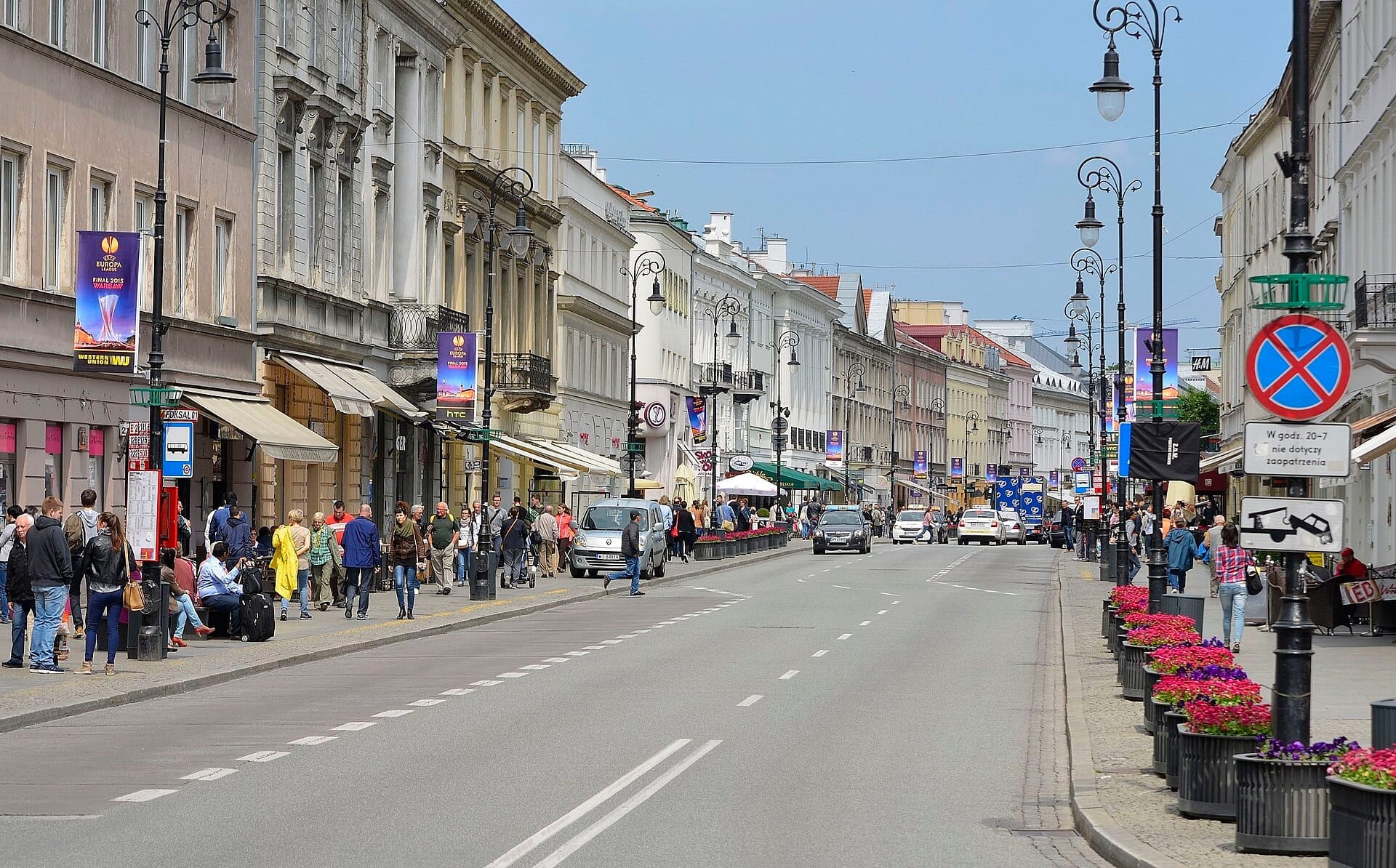
Nowy Świat, meaning 'New World Street,' is Warsaw's most celebrated pedestrian thoroughfare, stretching roughly one kilometre along the historic Royal Route. Lined with neoclassical facades, pavement cafés, bookshops, and restaurants, it offers one of the most rewarding urban walks in Poland. Free to visit at any hour, it rewards visitors who take the time to slow down and read the layers of the city embedded in its rebuilt facades.
Quick Facts
- Location
- ul. Nowy Świat, Śródmieście, Warsaw — running between Krakowskie Przedmieście and Rondo de Gaulle’a, near Plac Trzech Krzyży
- Getting There
- Metro: Nowy Świat-Uniwersytet (Line M2, northern end); Bus 175 stops nearby at Muzeum Narodowe
- Time Needed
- 30–45 min to walk end-to-end; 2–3 hours if you stop at cafés or nearby museums
- Cost
- Free to walk; individual cafés, shops, and restaurants charge their own prices
- Best for
- Architecture lovers, café culture, Royal Route walks, evening strolls
What Nowy Świat Actually Is
Nowy Świat — officially 'Ulica Nowy Świat,' or New World Street in English — is a central historic thoroughfare in Warsaw running approximately one kilometre through the Śródmieście district. It forms a central segment of the Royal Route, the historic ceremonial road that once connected Warsaw's Old Town with the royal summer residence at Wilanów. Today it functions as the city's most recognizable promenade: a place for coffee, window shopping, people-watching, and a surprisingly candid look at Warsaw's architectural and social history.
The street connects two significant urban focal points. At its northern end, it meets Krakowskie Przedmieście, Warsaw's most historically loaded boulevard, near the university and several major churches. At its southern end, it reaches the Charles de Gaulle roundabout (Rondo de Gaulle’a), with Plac Trzech Krzyży (Three Crosses Square), a classically proportioned space anchored by the Church of St. Alexander, lying a short distance further south along the Royal Route. Private cars are excluded from most of the street, which makes walking it a far more comfortable experience than most central European city streets of comparable length.
💡 Local tip
The Nowy Świat-Uniwersytet metro station (Line M2) sits at the northern tip of the street, making this a logical starting point if you're arriving by metro. Walk south toward Three Crosses Square and you'll be moving with the street's natural gradient and rhythm.
A Street That Has Reinvented Itself Several Times
The name 'Nowy Świat' dates to the 17th century, when Warsaw was expanding southward beyond its medieval Old Town walls and this stretch of road represented the city's new outer edge. Early settlement here was modest: wooden manor houses and merchant plots that grew up along the road connecting the urban core to the countryside beyond.
The street's present architectural character was largely set during the Napoleonic period in the early 19th century. As Warsaw became capital of the Duchy of Warsaw, Nowy Świat was rebuilt in earnest. Wooden structures gave way to stone-and-brick buildings, mostly three storeys tall, designed in the neoclassical style fashionable across Europe at the time. The proportions were formal without being monumental: pilasters, symmetrical window arrangements, and restrained cornices that gave the street a coherent, measured elegance.
That coherence was almost entirely destroyed during the Warsaw Uprising of 1944. Like most of the city, Nowy Świat was reduced to ruins by German forces. What you see today is a postwar reconstruction, largely completed through the late 1940s and 50s, that deliberately replicated the 19th-century facades from historic photographs, drawings, and architectural records. A major renovation in 1996 reinforced the street's pedestrian-first character and restored much of its surface and street furniture. The result is a thoroughfare that looks genuinely historic but is almost entirely reconstructed — a fact worth holding in mind as you walk it.
Tickets & tours
Hand-picked options from our booking partner. Prices are indicative; availability and final rates are confirmed when you complete your booking.
Museum of John Paul II and Primate Wyszyński entrance ticket
From 8 €Instant confirmationPub crawl in Warsaw
From 28 €Instant confirmationFree cancellationWarsaw Museum of Modern Art entrance ticket
From 8 €Instant confirmationSafe and Convenient Luggage Storage in Warsaw Old Town
From 6 €Instant confirmationFree cancellation
What You See Walking the Street
The dominant physical impression is one of regularity and scale. The neoclassical facades along Nowy Świat are neither enormous nor ornate, which is part of why the street works as a pedestrian environment. The buildings are human in proportion, and because private vehicles are restricted, the pavement feels wider than it actually is. Ground floors are almost entirely given over to commercial use: cafés, restaurants, bookshops, international fashion retailers, and pharmacies sit behind the older facades in a mixture that is part historic city centre, part upscale high street.
Several cafés extend seating directly onto the pavement, particularly in the warmer months. These terraces are the street's primary social infrastructure: in the morning they fill with people reading, working on laptops, or simply slowing down before the day begins. By midday the street is at its most crowded, with tourists, office workers from nearby ministries, and students from Warsaw University mixing together. The smell of coffee is persistent; bakery and pastry smells drift from several spots, particularly toward the northern end.
Look up regularly. The upper floors of the buildings preserve more of the reconstruction's character than the commercially altered ground floors, and the rooflines, pediments, and carved details are where the 19th-century references are clearest. The street also contains several notable cultural institutions set back slightly from the main flow, including the Polish Academy of Sciences and a handful of period townhouses that have avoided heavy commercial conversion.
How the Street Changes Through the Day
Early morning on Nowy Świat is genuinely different from the midday experience. Before 9am the street is quiet enough that you can properly examine the facades and notice the reconstruction's craft without being moved along by foot traffic. The light in summer falls cleanly along the street's north-south axis, catching the window details and the pale render of the buildings. A few residents walk dogs. Delivery vehicles service the cafés. The city is audible at its edges but the street itself is calm.
The peak crowd period runs from around noon to 8pm, particularly on weekends and during the summer. Pavement seating fills quickly, queues form at the more popular coffee spots, and the street is loud with conversation in Polish and several other languages. This is not the time to look for quiet contemplation, but it is an excellent time to observe Warsaw's contemporary social character. The city's young professional class is highly visible here, as are tourists moving between the Old Town and the National Museum.
Evening on Nowy Świat has its own texture. The restaurants and bars take over from the cafés, lighting shifts to warmer tones from the ground-floor windows, and the pace slows noticeably. In summer, evenings here can extend late into the night. In winter, the street takes on a different quality entirely: colder, less populated, with the lit facades reflecting off damp pavement. It is worth visiting in both seasons, as the contrast tells you something about how the city uses its public spaces.
ℹ️ Good to know
Photography works best in the early morning or in the hour before sunset, when the street is less crowded and the light sits at a lower angle. The uniform neoclassical facades photograph well in soft, directional light. Midday sun tends to flatten the architectural details.
The Royal Route Context: Where Nowy Świat Fits
Nowy Świat makes the most sense when understood as part of a longer walk rather than as a standalone destination. The Royal Route begins at the Royal Castle in the Old Town and moves south along Krakowskie Przedmieście before continuing as Nowy Świat and then on toward Łazienki Park and, eventually, Wilanów. Walking the full route in sequence, you move through nearly four centuries of Warsaw's urban development in a single continuous line.
The transition from Krakowskie Przedmieście to Nowy Świat is subtle but real. Krakowskie Przedmieście is wider, more monumental, and more heavily associated with national institutions: the university, the presidential palace, major churches. Nowy Świat is smaller in scale and more commercial, with a character closer to a prosperous residential high street. Continuing south beyond Three Crosses Square, you eventually reach Łazienki Park, Warsaw's largest and most celebrated green space, which provides a complete contrast to the built environment of the street.
Just off the southern end of Nowy Świat, the National Museum of Warsaw sits a short walk east along Al. Jerozolimskie. It is one of Poland's most significant art collections, covering Polish painting, decorative arts, and ancient artefacts. If you are walking the Royal Route, building in an hour or two at the National Museum adds substantial depth to the broader experience of this part of the city.
Practical Notes for Getting There and Walking It
Access is straightforward from any direction. The Nowy Świat-Uniwersytet metro station on Line M2 deposits you at the northern end of the street directly. Bus line 175, which runs from Warsaw Chopin Airport through the city centre, stops nearby at Muzeum Narodowe, making the street accessible from the airport without a taxi. Trams also serve the surrounding area along Al. Jerozolimskie.
The street itself is level, paved, and step-free along most of its length, making it accessible for pushchairs and wheelchairs. Individual businesses have their own access arrangements, which vary by property. There are no entrance fees anywhere on the street itself. It is open at all hours, every day of the year.
What to wear depends entirely on the season. Warsaw winters can be genuinely cold, with temperatures dropping below freezing and the street exposed to wind along its north-south axis. Dress accordingly and note that the pavement can be slippery after rain or snow. Summer visits are comfortable in light clothing, though the sun can be strong in July and August between midday and mid-afternoon.
⚠️ What to skip
Nowy Świat is sometimes listed as a top attraction in Warsaw rankings, which can set expectations slightly too high. It is a very pleasant urban street with genuine historical weight, but it is not a set-piece attraction in the way the Royal Castle or POLIN Museum are. Visitors looking for a specific landmark or exhibit may feel it underdelivers. Those who appreciate the texture of a city on foot will find it exactly right.
Connections to the Surrounding City
The area around Nowy Świat is dense with other worthwhile stops. The Holy Cross Church on Krakowskie Przedmieście, a short walk north, contains an urn with Frédéric Chopin's heart — one of the most quietly affecting details in the city. The Fryderyk Chopin Museum is also within comfortable walking distance and offers far more context for visitors interested in the composer's connection to Warsaw.
For those interested in planning a full day in this part of the city, the Warsaw walking tour guide covers how to structure a route that takes in Nowy Świat alongside the key nearby sights without doubling back unnecessarily. The street works best as part of a larger loop rather than an isolated visit.
Insider Tips
- The bookshop Empik on Nowy Świat stocks a solid selection of English-language books about Warsaw and Poland, including photography books and history titles that make better souvenirs than most tourist-shop offerings.
- If you want pavement café seating without a wait, arrive before 10am on weekdays. By 11am on a sunny weekend, the best spots outside the main cafés are taken.
- The stretch of Nowy Świat between the Foksal side street and Three Crosses Square is quieter and less tourist-oriented than the northern half. The buildings here show more of the reconstruction's original character without as much commercial overlay at street level.
- Walking north from Three Crosses Square in the early evening, when the sky is still light but the street lamps are on, produces one of the most photogenic urban vistas in central Warsaw. The perspective line of the facades converges naturally toward Krakowskie Przedmieście.
- Nowy Świat runs alongside or very close to several small streets and courtyards that see almost no tourist traffic. Ducking into Foksal Street or the side passages near Chmielna Street gives you an immediate sense of the quieter residential layer behind the main thoroughfare.
Who Is Nowy Świat Street For?
- Walkers who want to understand how Warsaw rebuilt and reinvented its historic centre after wartime destruction
- Coffee and café culture enthusiasts looking for quality options in a pleasant outdoor setting
- Travelers using the Royal Route as a structural spine for a full day of sightseeing in central Warsaw
- Architecture and urban design readers interested in postwar reconstruction and neoclassical urban form
- First-time visitors to Warsaw who want a readable introduction to the city's contemporary street life
Nearby Attractions
Other things to see while in City Centre (Śródmieście):
- Fryderyk Chopin Museum
Housed inside the 17th-century Ostrogski Palace near Warsaw's Royal Route, the Fryderyk Chopin Museum holds one of the world's richest collections of Chopin memorabilia. Closed for full renovation throughout 2026; reopening is planned for 2027 — plan post-renovation visits and confirm dates on the official site.
- Grand Theatre – National Opera
The Grand Theatre – National Opera (Teatr Wielki – Opera Narodowa) is one of the largest opera houses in Europe, anchoring Theatre Square in central Warsaw with a neoclassical facade that survived war and rebuilding. Whether you attend a full opera, a ballet, or simply walk across the square to take in the architecture, this institution rewards both serious culture-seekers and curious first-time visitors.
- Hala Koszyki Food Hall
Built in 1909 and reborn in 2016, Hala Koszyki is a restored Art Nouveau market hall in central Warsaw where locals actually eat, drink, and shop. Free to enter, open daily until 1am, and genuinely good.
- Holy Cross Church (Kościół Świętego Krzyża)
One of Warsaw's most historically charged sites, Holy Cross Church on Krakowskie Przedmieście holds the preserved heart of Frédéric Chopin in a nave pillar. A Minor Basilica with a Baroque facade, 17th-century origins, and free entry, it rewards visitors who take the time to look closely.