Łazienki Park (Royal Baths Park): Warsaw's Grand Royal Garden
Covering 76 hectares along Warsaw's Royal Route, Łazienki Królewskie is the city's most expansive royal park, home to the water-bound Palace on the Isle, peacocks roaming shaded paths, and free outdoor Chopin concerts every Sunday in summer. Entry to the gardens is free, making it one of Warsaw's most rewarding and accessible green spaces.
Quick Facts
- Location
- Agrykola 1, 00-460 Warsaw — along Ujazdów Avenue on the Royal Route
- Getting There
- City buses and trams along Aleje Ujazdowskie; the museum recommends public transport due to limited parking
- Time Needed
- 2–4 hours for gardens; half a day if visiting museum interiors
- Cost
- Gardens: free. Museum buildings: paid (normal, reduced, and free categories); Fridays offer free admission to selected interiors
- Best for
- Nature walks, Polish royal history, Chopin fans, families, photographers
- Official website
- www.lazienki-krolewskie.pl/en
What Łazienki Park Actually Is
Łazienki Królewskie, translated as the Royal Łazienki Park or Royal Baths Park, is a 76-hectare park-museum complex stretching along Ujazdów Avenue, roughly midway along Warsaw's historic Royal Route. It is not just a park where Varsovians walk their lunch breaks. It is an active museum estate with around 40 historic buildings, nearly 5 hectares of water bodies, and one of the finest examples of late 18th-century landscape garden design in Central Europe.
The word Łazienki means 'baths' in Polish, referencing the original bathing pavilion built here in the 17th century for the nobleman Stanisław Herakliusz Lubomirski. What you see today is largely the vision of Poland's last king, Stanisław August Poniatowski, who transformed the estate through the 1770s–1790s into a summer royal residence of palaces, garden theatres, sculpture, and ornamental waterways. He used the park as a philosophical and artistic project as much as a practical retreat.
The gardens opened to the public as a municipal park in 1918, following the end of Polish royal rule. Today the estate is managed by the Royal Łazienki Museum (Muzeum Łazienki Królewskie w Warszawie) and operates as both a cultural institution and a genuinely usable city park — a combination Warsaw does exceptionally well.
💡 Local tip
Entry to the park grounds is always free. You only pay if you want to enter the museum buildings (Palace on the Isle, Old Orangery, White Pavilion, Myślewicki Palace, Cadet School). On Fridays, selected interiors offer free admission — check the official website for which buildings are included each season.
The Palace on the Isle: The Centrepiece You Came For
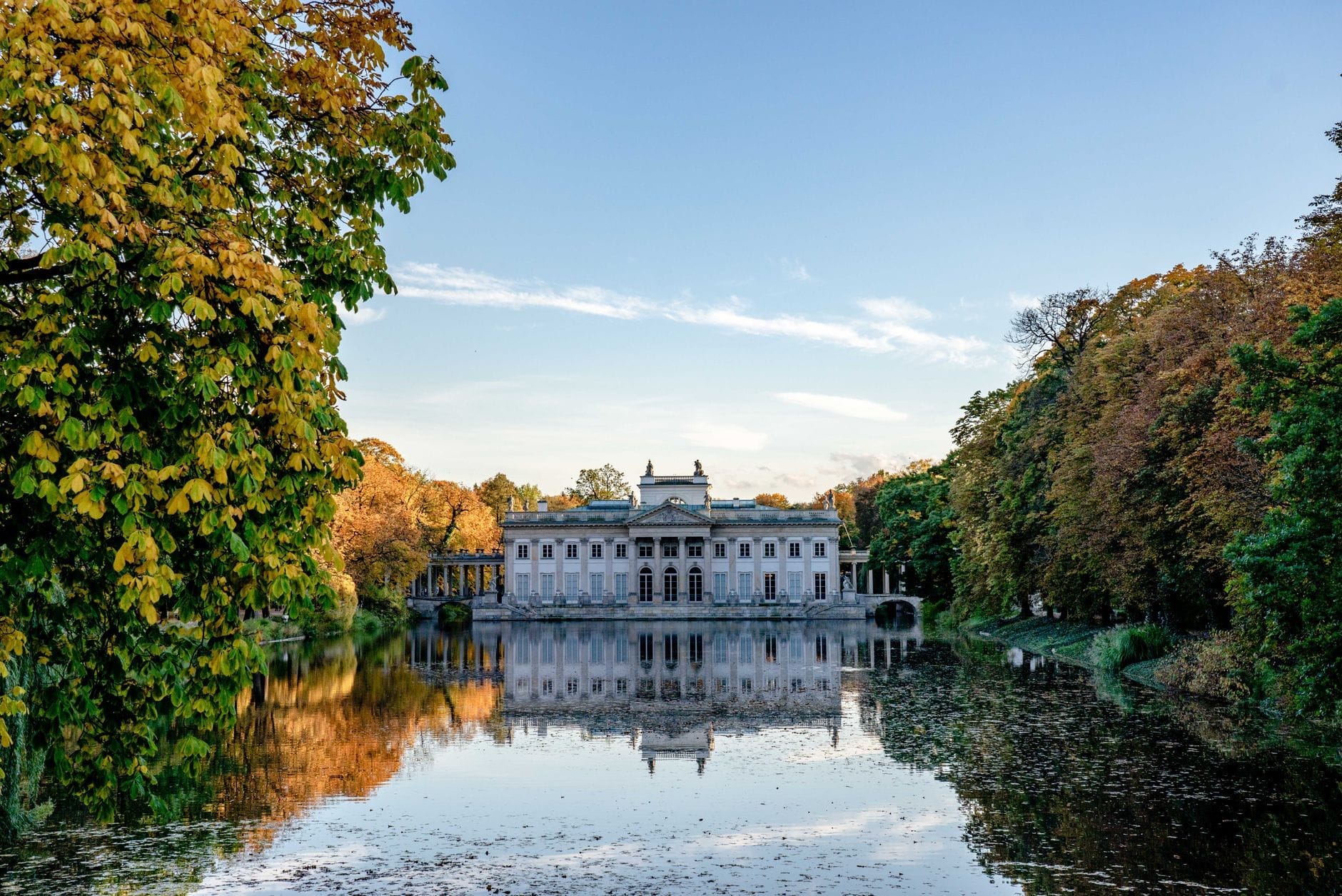
The Palace on the Isle is the park's architectural anchor, and it earns the attention it receives. The neoclassical palace sits on a small artificial island surrounded by a reflective canal, its white facade mirrored in still water on calm mornings. King Poniatowski commissioned the conversion of the original bath pavilion into this summer palace between 1772 and 1793, working with architects including Domenico Merlini and Jan Chrystian Kamsetzer.
Inside, the interiors include royal apartments, a picture gallery, and a ballroom with Neoclassical painted ceilings. The building survived World War II in damaged but largely intact condition — a rare distinction in Warsaw, where most of the city was deliberately destroyed. The palace is open Tuesday through Sunday, with hours varying by season, and requires a paid ticket separate from the free park entry; admission to the museum buildings is free on Fridays for individual visitors.
Photographically, the palace is best approached in the early morning before tour groups arrive. The light hits the south-facing facade cleanly between 9am and 11am in summer, and the canal surface stays calm before the wind picks up later in the day. In autumn, the surrounding beeches and oaks turn amber and rust, framing the white building in a way that makes this one of the better photography locations in the city without any special access required.
Tickets & tours
Hand-picked options from our booking partner. Prices are indicative; availability and final rates are confirmed when you complete your booking.
Museum of John Paul II and Primate Wyszyński entrance ticket
From 8 €Instant confirmationPub crawl in Warsaw
From 28 €Instant confirmationFree cancellationWarsaw Museum of Modern Art entrance ticket
From 8 €Instant confirmationSafe and Convenient Luggage Storage in Warsaw Old Town
From 6 €Instant confirmationFree cancellation
Moving Through the Park: What You'll Actually See
Łazienki has ten entrances and no single prescribed route, which is both its strength and its occasional source of mild confusion for first-time visitors. The internal paths are wide and mostly gravel or compressed earth, shaded by mature lindens and chestnuts in the northern sections and more open near the southern meadows. Peacocks, fallow deer, and red squirrels move through the grounds freely — the peacocks in particular tend to hold their position near the main promenade, unbothered by foot traffic.
Beyond the Palace on the Isle, the estate includes the Old Orangery (which houses a sculpture gallery and a beautifully preserved court theatre), the Myślewicki Palace, the neoclassical Amphitheatre set on a small island with seating on the opposite bank, the White Pavilion, and the Museum of Hunting and Horsemanship. Most visitors with limited time see only the central island area. Those with half a day can cover the whole estate comfortably on foot.
Accessibility is genuine but not unlimited. The main paths around the palace are wheelchair accessible. Some of the hillier paths in the southern section have slopes steep enough to be difficult in wet conditions, and portions of the terrain near the water's edge are uneven. Dogs are not permitted in most of the park, even on a leash — this is enforced.
⚠️ What to skip
Dogs are not allowed in most of Łazienki Park, even on a leash. If you are traveling with a pet, plan accordingly before arriving.
The Chopin Statue and Sunday Concerts
The Chopin Monument in the northern section of the park is one of the most recognizable sculptures in Poland. Created by Wacław Szymanowski and unveiled in 1926 (then destroyed by Nazi occupiers in 1940 and recast after the war), the bronze figure of Frédéric Chopin sits beneath a stylized willow tree, one hand raised as if caught mid-composition.
From May through September, free outdoor piano concerts are held at the monument every Sunday, typically at noon and at 4pm. These are proper recitals, performed by Polish pianists, featuring Chopin's works exclusively. The concerts draw a consistent crowd — locals on blankets, tourists standing along the path, children who somehow stay quiet during the nocturnes. If you are in Warsaw on a Sunday in summer, this is not optional. For more context on Chopin's deep connection to this city, the Chopin in Warsaw guide covers every major site associated with the composer.
When to Visit and How the Park Changes
Łazienki is a different experience in every season, and all four are worth considering. Summer brings full canopy cover, the Chopin concerts, and the highest foot traffic — expect the central paths to be genuinely busy on weekend afternoons. Spring, particularly late April and May, is arguably the best time: the chestnuts flower, the rose garden south of the palace fills in, and the crowds are smaller. Autumn delivers the foliage color that makes the palace canal especially photogenic. Winter empties the park dramatically; you can walk the main promenade on a weekday morning and see almost no one, with the palace reflected in dark water and frost on the gravel paths. For broader seasonal context, the best time to visit Warsaw guide has month-by-month breakdowns.
On weekday mornings, the park is predominantly used by runners, dog owners near the perimeter where dogs are permitted, and older residents doing slow circuits of the main paths. From about 11am on weekends, the character shifts toward families with children and tour groups. The Chopin concert times (noon and 4pm on Sundays in summer) create the two busiest moments of the week. If crowds bother you, Tuesday or Wednesday morning is the quietest window.
Weather affects the experience meaningfully. The gravel paths turn soft after heavy rain, and some of the slope sections near the southern meadow become muddy. Flat-soled shoes are fine in dry conditions; anything with grip is better after rainfall. The park has no large indoor shelter, so if a summer thunderstorm rolls in, the Old Orangery or nearby museum buildings are the only real options.
ℹ️ Good to know
The park gardens are open daily 06:00–22:00 (or 06:00–21:00 in some seasons). Museum buildings (Palace on the Isle, Old Orangery, and others) are open Tuesday through Sunday, with hours varying by season. Always check the official website before visiting if you plan to enter ticketed interiors.
Fitting Łazienki Into Your Warsaw Visit
Łazienki sits at the southern end of the Royal Route, which runs from the Royal Castle in the Old Town southward through Krakowskie Przedmieście and Ujazdów Avenue. Visiting on foot from the city centre is practical: the walk from Nowy Świat to the main park entrance takes around 20–25 minutes at a moderate pace and passes several other significant buildings along the way. Buses and trams running along Aleje Ujazdowskie stop directly adjacent to the park; the museum strongly recommends public transport because parking in the area is very limited.
If you are spending more than one day in Warsaw, Łazienki pairs naturally with a visit to Wilanów Palace, which lies further south along the Royal Route and represents the other major royal estate within city limits. The two together make a full day. For a shorter afternoon, pairing Łazienki with a walk along Krakowskie Przedmieście and a stop at the Fryderyk Chopin Museum gives a coherent thread of Polish royal and musical history.
Who should skip it: if you have only a few hours in Warsaw and your priority is the Old Town, wartime history, or contemporary galleries, Łazienki is a longer walk from those areas and requires a separate trip. It is also less rewarding if you visit only for the palace interiors without time to walk the grounds, since the setting is much of what makes it worthwhile. For anyone who finds green spaces uninteresting and prefers dense urban sightseeing, the park portion will feel like a slow detour.
Insider Tips
- Friday free admission applies to selected museum buildings, but the specific buildings included can rotate by season. Check the official website before planning a Friday visit around specific interiors.
- The Amphitheatre on the southern edge of the estate occasionally hosts summer performances. Check the museum's events calendar — a performance here, with the stage set on water and seating carved into the hillside, is a genuinely unusual experience.
- The peacocks that roam the central promenade are most active in the morning. They tend to retreat into the tree cover by midday in summer heat. If you want photographs of them with the palace in the background, arrive before 10am.
- There is a small café on the estate grounds near the Old Orangery. It is adequate for a coffee and a light snack but not a destination in itself. Better options are a short walk away on Ujazdów Avenue.
- If you are visiting in winter, the frozen canal around the palace creates an entirely different atmosphere. Visitor numbers drop sharply, and you can take photographs of the palace exterior without any crowds in frame. Museum interiors may have reduced hours in the off-season, so confirm in advance.
Who Is Łazienki Park (Royal Baths Park) For?
- Chopin enthusiasts who want to experience his music outdoors at the monument concerts in summer
- Families with children who need green space, wildlife, and room to move between cultural sites
- Photographers looking for neoclassical architecture reflected in water, especially in early morning light
- History-focused travelers interested in Polish royal heritage and 18th-century landscape design
- Anyone who wants a long, unhurried walk through a well-maintained historic park without paying entry fees
Nearby Attractions
Other things to see while in Łazienki Park & Ujazdów:
- Chopin Monument in Łazienki Park
Standing beneath a wind-swept willow in Łazienki Królewskie Park, the Fryderyk Chopin Monument is the emotional heart of Warsaw's classical music identity. Free to visit any time and framed by Sunday afternoon piano concerts in summer, it rewards visitors at almost every hour of the day.
- Palace on the Isle
Rising from a small lake in the heart of Łazienki Park, the Palace on the Isle is Warsaw's most photogenic royal residence. Built for King Stanisław August Poniatowski in the 18th century, it houses 140 works from his personal art collection, arranged exactly as they were in his lifetime. The setting alone is worth the detour.
- Polish Army Museum
Located within the grounds of the 19th-century Warsaw Citadel, the Polish Army Museum traces over a thousand years of Polish military history through vast collections of weapons, armor, uniforms, and aircraft. It is one of the largest military museums in Central Europe and a serious half-day commitment for anyone interested in Polish history.