The Fryderyk Chopin Monument: Warsaw's Most Evocative Outdoor Tribute
Standing beneath a wind-swept willow in Łazienki Królewskie Park, the Fryderyk Chopin Monument is the emotional heart of Warsaw's classical music identity. Free to visit any time and framed by Sunday afternoon piano concerts in summer, it rewards visitors at almost every hour of the day.
Quick Facts
- Location
- Łazienki Królewskie Park, near Aleje Ujazdowskie, Warsaw
- Getting There
- Bus stops on Aleje Ujazdowskie (lines 116, 166, 180, 503 and others); trams run along Trasa Łazienkowska to stops on Gagarina Street
- Time Needed
- 15–30 minutes for the monument alone; 2–3 hours combined with the park
- Cost
- Free to view; Sunday Chopin concerts are free and open to the public
- Best for
- Classical music lovers, photographers, history seekers, Sunday strollers
- Official website
- www.lazienki-krolewskie.pl/en/pomniki/pomnik-fryderyka-chopina
What You're Looking At
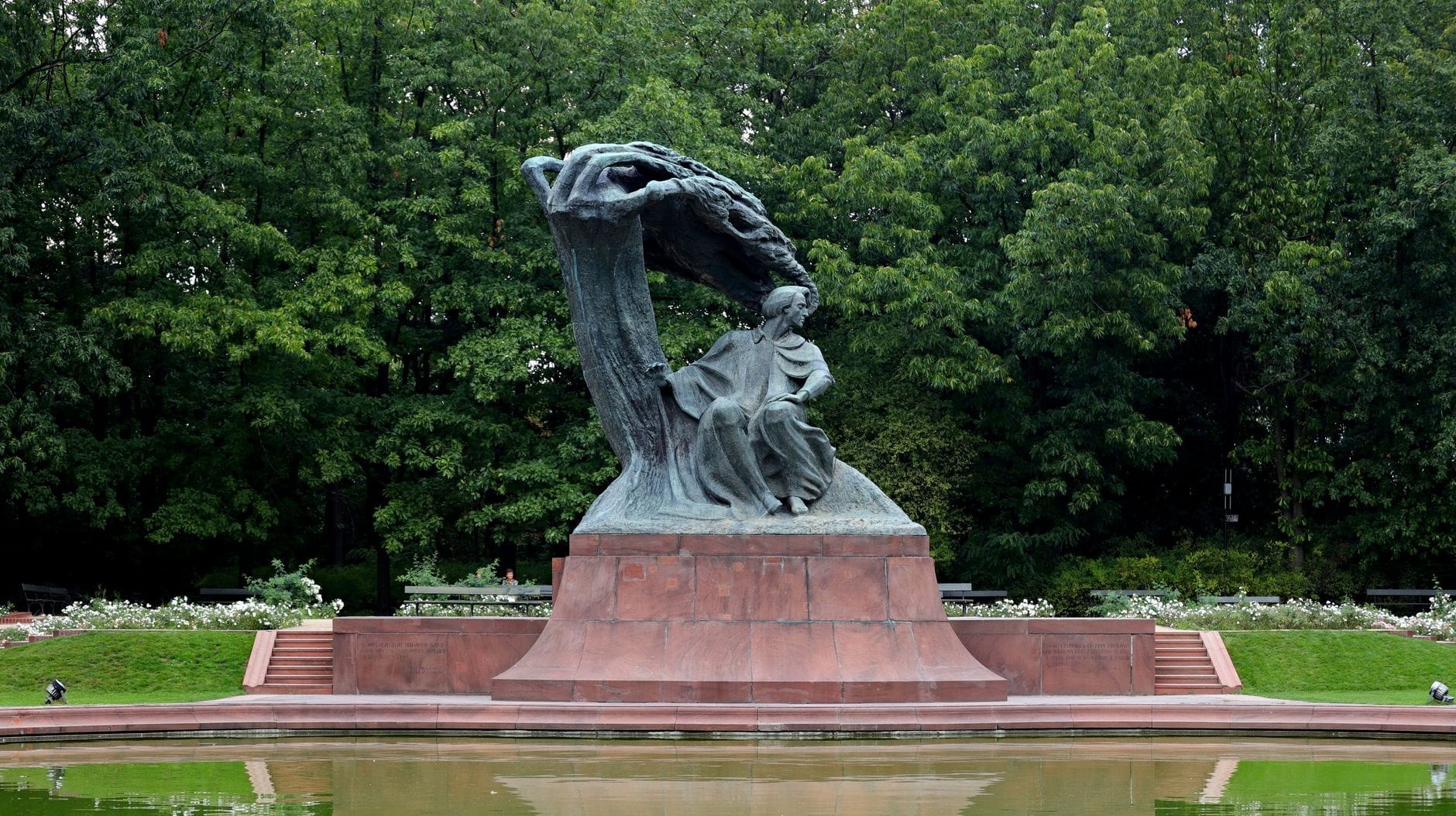
The Fryderyk Chopin Monument is not a small plaque or a polite civic gesture. The bronze sculpture rises approximately six to seven metres from a low stone plinth, depicting Chopin seated beneath a stylised willow tree whose trailing branches curl dramatically overhead. His head is inclined, his body poised, his coat swept by an imaginary wind. The whole composition has a controlled romanticism that feels exactly right for its subject.
Sculptor Wacław Szymanowski won the design competition in 1908, but the road from concept to installed monument was long. The sculpture was first unveiled in 1926, destroyed by the Nazi occupiers in 1940, and then reconstructed using the original plaster model. It was re-unveiled on 11 May 1958, thirteen years after the war's end.
ℹ️ Good to know
The monument area is generally wheelchair accessible via paved, level paths, making it one of the easier cultural stops in the park for many visitors with mobility needs.
The Setting: Łazienki Królewskie Park
The monument stands in Łazienki Królewskie Park, Warsaw's largest and most elegant royal park. It sits in the northern section of the grounds, near Aleje Ujazdowskie, surrounded by a broad semi-circular lawn and symmetrical flowerbeds that frame the base like a natural stage set. In spring and early summer, those beds are thick with colour. By autumn, the trees behind the statue shift to amber and rust, giving the bronze a warmer, more melancholy backdrop.
Paths converge on the monument from multiple directions, and benches arc around it in a loose amphitheatre shape. On weekday mornings you will often find the space nearly empty: dog walkers cutting through, a jogger on the outer path, a photographer working without crowds. The light in the morning hours falls from the east and catches the textured surface of the bronze in ways that midday flat light cannot replicate.
The park itself is free to enter during its opening hours, though some individual buildings inside have their own ticketed hours. Getting to the monument requires only a short walk from the main Aleje Ujazdowskie entrance, and signage inside the park is clear.
Tickets & tours
Hand-picked options from our booking partner. Prices are indicative; availability and final rates are confirmed when you complete your booking.
Chopin Concert in Warsaw Old Town with complimentary drink
From 13 €Instant confirmationFree cancellationEntrance tickets to a Chopin piano recital inside the Archdiocese Museum Warsaw
From 14 €Instant confirmationFree cancellationChopin Piano Concert in the Old Town of Warsaw
From 16 €Instant confirmationFree cancellationTickets for Chopin concerts at Warsaw Fryderyk Concert Hall
From 22 €Instant confirmation
The Sunday Chopin Concerts
Every Sunday during summer, a free open-air piano concert takes place at the foot of the monument. A grand piano is positioned in front of the plinth, and performers, often young Polish pianists of considerable skill, play Chopin's works while an audience gathers on the surrounding benches and lawn. Concerts are typically scheduled in two sessions on Sunday afternoons, usually around 12:00 and 16:00, though exact times should be confirmed with Łazienki Królewskie directly as scheduling can shift year to year.
If you have any interest in classical music, or even if you don't, a Sunday concert at the Chopin Monument is one of the most distinctive free experiences Warsaw offers. The setting does the work: a warm afternoon, the rustling of mature trees, the smell of cut grass, and a Nocturne drifting across the park. Crowds can be significant on summer Sundays, particularly in July and August. Arrive at least twenty minutes early to secure a bench. Latecomers stand or sit on the grass, which most people find perfectly acceptable.
💡 Local tip
For the Sunday concerts, a light folding chair or a picnic blanket makes the experience considerably more comfortable. Shade is limited around the monument itself in afternoon sun, so a hat is worth carrying in summer.
Historical Weight: Destruction and Reconstruction
Warsaw's relationship with this monument goes beyond artistic appreciation. When German forces occupied the city in late 1939, they quickly identified cultural symbols as targets. The Chopin Monument was blown up in June 1940, an act intended to erase Polish identity from the public landscape. Chopin's music was severely restricted in public life throughout the occupation.
The postwar reconstruction was both a practical and symbolic project. Szymanowski had died in 1938, but the original plaster model had survived, and foundry work proceeded on that basis. The 1958 unveiling came during a period of significant political complexity in Poland, yet the monument was embraced immediately as a statement of cultural continuity. For visitors who want deeper context on Warsaw's wartime losses and recovery, the Warsaw Uprising Museum provides the broader historical frame that makes a visit to the monument more resonant.
The story of Chopin himself and his relationship with Warsaw is explored in detail at the Fryderyk Chopin Museum in the city centre, which holds the world's largest collection of Chopin-related artefacts. The museum and the monument work well together as a half-day itinerary for anyone seriously interested in the composer — note that the museum is closed for renovation throughout 2026, so plan for a post-reopening visit or focus on the monument and outdoor concerts in the meantime.
Photography and Best Times to Visit
The monument is most photogenic in the first two hours after sunrise, when low-angle light catches the sculpture's surface detail and the surrounding park is still quiet. The willow-like bronze branches overhead create natural framing from below, and the plinth's stone texture reads clearly without harsh overhead shadows.
Overcast days are also productive for photography. The diffuse light eliminates the blown-out highlights that occur under direct midday sun. Winter visits have their own appeal: snow on the plinth and bare trees behind the statue produce an austere composition that feels appropriate given the sculpture's themes. The park is generally open throughout the year, and the monument is accessible in all seasons during garden opening hours.
Avoid the hour immediately before and after Sunday summer concerts if you want quiet photographs. The area fills quickly, and benches and standing visitors will be in most frames. After the concert ends, the crowd disperses within fifteen minutes, and the late afternoon light that follows can be excellent.
Getting There and Combining Visits
The monument is most easily reached by bus along Aleje Ujazdowskie, with multiple lines stopping within a short walk of the main park entrance. From central Warsaw, the journey takes roughly ten to fifteen minutes by bus. The broader Łazienki Park area is dense with things worth seeing: the Palace on the Isle, the amphitheatre, the rose garden, and quiet lake-side paths that most visitors overlook.
If you're planning a full afternoon, the monument pairs naturally with the Palace on the Isle further into the park, or with a walk south toward the Belvedere area. Heading north along Aleje Ujazdowskie leads toward Krakowskie Przedmieście, Warsaw's grand ceremonial boulevard, making a logical end-point for a longer afternoon route.
⚠️ What to skip
Łazienki Park is large and its internal signage, while present, can be confusing at path junctions. Download an offline map or the Łazienki Królewskie app before entering if you are unfamiliar with the grounds.
Who Might Want to Skip It
Travellers on extremely tight itineraries who are not particularly interested in music, Polish history, or sculpture may find that the monument, viewed in isolation, is a five-minute stop rather than a destination. It is a single artwork in an open space, and it does not have an interpretive centre or exhibition attached to it. The experience is entirely what you bring to it in terms of context and interest.
If you are in Warsaw for only one or two days and need to prioritise, the monument makes most sense as part of a longer park visit rather than a standalone journey. The 2-day Warsaw itinerary can help you decide how to weight your time across the city's main draws.
Insider Tips
- The Sunday concerts are listed on the Łazienki Królewskie official website with exact dates and performer names each season. Check before you go, as weather cancellations do happen and the schedule is not identical every year.
- The monument's base has enough detail, inscriptions, and texture to merit close inspection, not just a wide-angle photograph from the path. Walk up to the plinth and look at the bronze surface at eye level.
- Peacocks roam freely in Łazienki Park and frequently wander into the area near the monument. They are photogenic but assertive around food, so keep any snacks out of sight.
- The semi-circular lawn in front of the monument is an informal picnic spot on summer weekdays when the concert setup is not in place. Locals use it this way regularly and it is perfectly acceptable.
- If you visit in winter, the absence of leaves reveals the full geometric structure of the surrounding trees and gives the monument a starkly different character from its summer appearance, quieter and considerably more melancholy.
Who Is Chopin Monument in Łazienki Park For?
- Classical music enthusiasts, especially those with a specific interest in Chopin
- History-minded travellers who want to engage with Warsaw's wartime cultural losses in a concrete, visual way
- Photographers looking for a sculptural subject that changes dramatically across seasons and lighting conditions
- Families visiting Łazienki Park who want a cultural anchor point within a wider afternoon in the park
- Sunday visitors who want to combine a free outdoor concert with a park walk
Nearby Attractions
Other things to see while in Łazienki Park & Ujazdów:
- Łazienki Park (Royal Baths Park)
Covering 76 hectares along Warsaw's Royal Route, Łazienki Królewskie is the city's most expansive royal park, home to the water-bound Palace on the Isle, peacocks roaming shaded paths, and free outdoor Chopin concerts every Sunday in summer. Entry to the gardens is free, making it one of Warsaw's most rewarding and accessible green spaces.
- Palace on the Isle
Rising from a small lake in the heart of Łazienki Park, the Palace on the Isle is Warsaw's most photogenic royal residence. Built for King Stanisław August Poniatowski in the 18th century, it houses 140 works from his personal art collection, arranged exactly as they were in his lifetime. The setting alone is worth the detour.
- Polish Army Museum
Located within the grounds of the 19th-century Warsaw Citadel, the Polish Army Museum traces over a thousand years of Polish military history through vast collections of weapons, armor, uniforms, and aircraft. It is one of the largest military museums in Central Europe and a serious half-day commitment for anyone interested in Polish history.