Polish Army Museum (Muzeum Wojska Polskiego): Warsaw's Most Ambitious Military Museum
Located within the grounds of the 19th-century Warsaw Citadel, the Polish Army Museum traces over a thousand years of Polish military history through vast collections of weapons, armor, uniforms, and aircraft. It is one of the largest military museums in Central Europe and a serious half-day commitment for anyone interested in Polish history.
Quick Facts
- Location
- Warsaw Citadel, Żoliborz – main visitor entrance at ul. Gwardii 4; Katyń Museum branch at Jana Jeziorańskiego 4 within the Citadel grounds
- Getting There
- Metro: Dworzec Gdański (Line M1); Trams: 6, 15, 28, 78; Buses: 116, 157, 178, 503
- Time Needed
- 3–5 hours for a thorough visit; allow the full day if you plan to explore the Citadel grounds
- Cost
- Regular: 40 PLN; Concession: 30 PLN; Free on Thursdays; Children under 7 free
- Best for
- Military history enthusiasts, families with older children, WWII researchers, architecture buffs
- Official website
- muzeumwp.pl/en/visit
Why This Museum Is Worth Your Attention
The Polish Army Museum, known in Polish as Muzeum Wojska Polskiego, is not a modest collection tucked into a repurposed barracks. It is a purpose-built institution occupying part of a 32-hectare, 19th-century hilltop fortress and presenting Poland's military past from the medieval period through modern peacekeeping missions. Established in April 1920 during the Second Polish Republic, it is one of the oldest and largest military museums in Central Europe.
The move to the Warsaw Citadel gave the museum something it lacked at its previous city-centre location: space. Outdoors, you can walk past aircraft, artillery pieces, and armored vehicles at your own pace. Indoors, the newly designed exhibition halls handle large crowds without feeling congested. The result is a museum that rewards patience and punishes rushing.
💡 Local tip
Visit on a Thursday for free general admission. Weekday mornings are significantly quieter than Saturday afternoons, when school groups and weekend families arrive in volume.
The Setting: Warsaw Citadel as Context
The Warsaw Citadel was constructed by Tsarist Russia between 1832 and 1834 as an instrument of control over the Polish population following the failed November Uprising of 1830. Its walls and bastions were designed not to defend Warsaw from external enemies but to dominate the city from within. Prisoners held here included figures central to Polish national memory, making the site itself a layer of the historical narrative before you enter a single exhibition room.
The fortress sits on a bluff above the Vistula, and approaching from the Żoliborz Gate on Dymińska Street, the brick walls set a tone that no interior design choice could replicate. Visitors arriving this way walk through the fortification before they reach the museum entrance, which is an experience in itself. If you're combining the visit with nearby sites, the Warsaw Citadel has its own story that complements what you'll see inside.
Tickets & tours
Hand-picked options from our booking partner. Prices are indicative; availability and final rates are confirmed when you complete your booking.
Palace of Culture and Science skip-the-line ticket and tour in Polish
From 19 €Instant confirmationFree cancellationMuseum of John Paul II and Primate Wyszyński entrance ticket
From 8 €Instant confirmationPub crawl in Warsaw
From 28 €Instant confirmationFree cancellationWarsaw Museum of Modern Art entrance ticket
From 8 €Instant confirmation
What You'll Actually See Inside
The permanent collection spans roughly a millennium of Polish military history. The earliest galleries cover medieval arms, with chainmail, swords, and crossbows displayed under lighting that lets you read the craftsmanship in the metalwork. Display cases are generously spaced, and the bilingual labeling in Polish and English makes the exhibits accessible without a guided tour, though guided options are available at additional cost.
The 20th-century sections are the most emotionally dense. Displays on the 1920 Polish-Soviet War, the September 1939 campaign, and the resistance movements operating across occupied Europe carry weight that a casual glance will not capture. Uniform collections, field equipment, personal documents, and photographs shift the scale from geopolitical abstraction to individual lives. Allow extra time here if World War II history is your primary interest.
The museum does not avoid difficult subjects. The section relating to the Katyń massacre, the 1940 Soviet execution of Polish officers primarily associated with the Katyń forest and other sites, is presented with documentary sobriety. If this period of Polish history is new to you, the Katyń Museum nearby offers an even deeper focus on that specific tragedy.
The Outdoor Collection: Artillery, Aircraft, and Armor
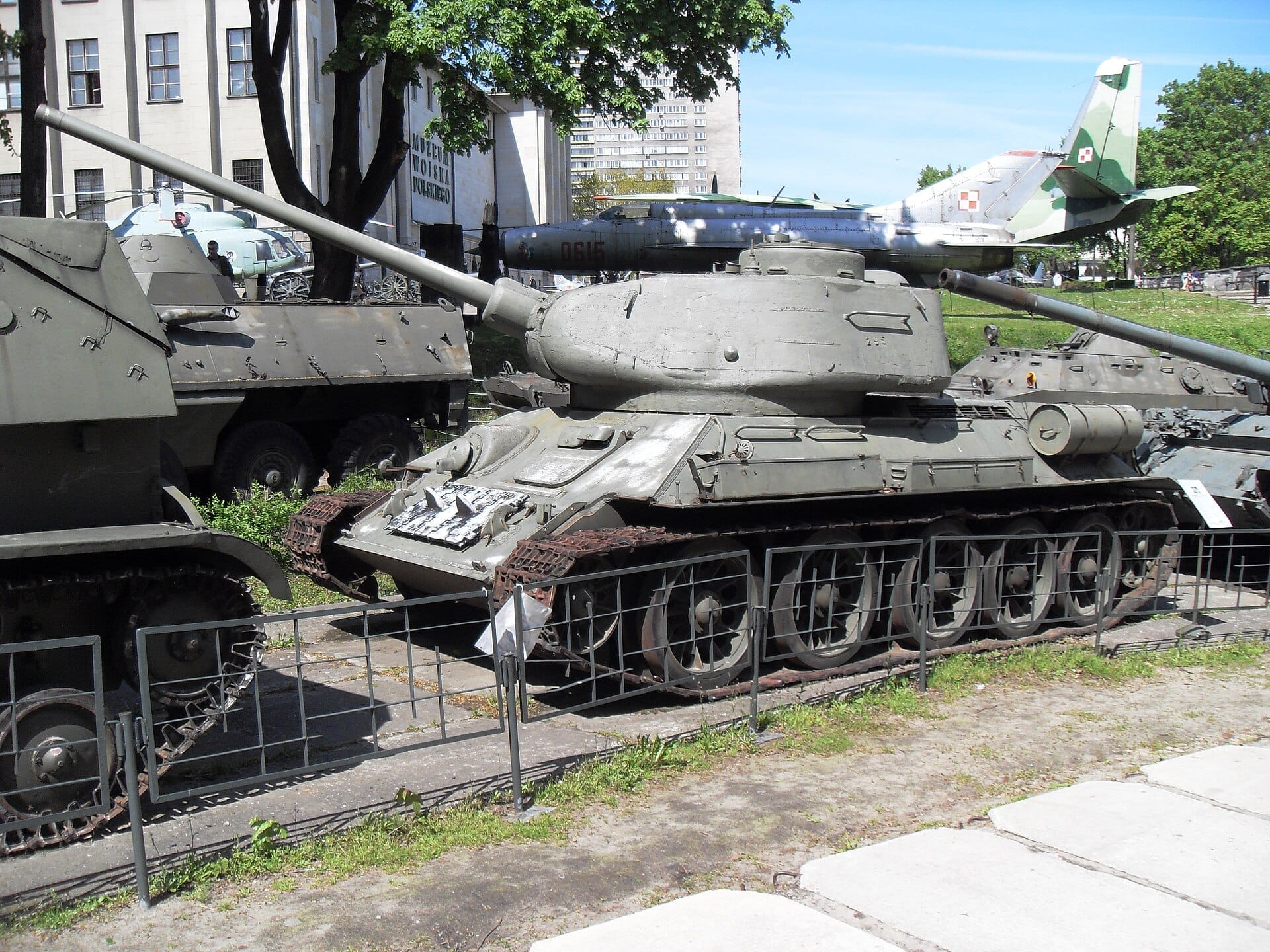
One of the museum's clearest strengths is its outdoor display. The grounds between the fortress walls hold a substantial collection of heavy equipment: tanks, armored cars, artillery pieces of various calibers, and aircraft, including jet-era fighters. Children who have little patience for glass cases will find the outdoor section genuinely engaging, particularly the aircraft, which can be observed at close range.
On bright mornings, the light falls cleanly across the aircraft and vehicles in a way that makes photography straightforward. Later in the afternoon, the angle changes and the fortress walls cast longer shadows across parts of the outdoor area. Neither is strictly better for photography, but morning visits tend to yield cleaner images of the aircraft. Wear comfortable shoes: the ground is uneven in places, and covering the full outdoor collection involves more walking than the indoor galleries suggest.
ℹ️ Good to know
The outdoor collection is partially exposed to weather. In heavy rain, the aircraft and vehicle displays are still accessible but the experience is diminished. If rain is forecast, prioritize the indoor galleries first and finish outdoors if conditions improve.
Practical Details: Getting There, Hours, and Tickets
The museum is open Tuesday through Sunday, 10:00 to 18:00, with last admission at 17:20. It is closed on Mondays. The standard adult ticket costs 40 PLN, with a concession ticket at 30 PLN for eligible categories. Thursday is free admission day for general visitors. Children under 7 enter free, as do active-duty military personnel and veterans including those who served on missions abroad. Organized school groups from 10 people pay 20 PLN per person, and general organized groups from 10 people pay 25 PLN. An annual pass is available at 250 PLN.
The nearest metro station is Dworzec Gdański on Line M1, from which the Citadel is a short walk. Tram lines 6, 15, 28, and 78 serve the area, as do bus lines 116, 157, 178, and 503. If arriving by car, there is an underground car park accessible from the Wisłostrada side, with the first 15 minutes free. Bus parking is available inside the gate from Wisłostrada.
The museum explicitly accommodates visitors with disabilities. The new building and grounds were designed with accessibility in mind, and the staff can advise on routing through the site if needed.
How the Experience Changes by Time of Day
Arriving at opening (10:00) gives you the indoor galleries almost entirely to yourself for the first hour. The lighting in the early gallery sections has a clean, quiet quality and you can linger at individual cases without navigating around other visitors. By midday, school groups and organized tours begin to circulate, particularly through the 20th-century halls. If you are visiting with a particular focus on a specific period, heading to that section first is a practical strategy.
Saturday afternoons are the busiest period of the week. Families with children tend to move quickly through the indoor sections and concentrate in the outdoor vehicle area. If solitude and careful reading of exhibit labels matters to you, Saturday between noon and 16:00 is the time to avoid. Thursday mornings on the free admission day can also attract larger crowds than a typical weekday, though the museum is large enough that congestion is rarely severe.
The Żoliborz neighborhood surrounding the Citadel is one of Warsaw's quieter inner districts, with a prewar urban character that contrasts with the city centre. If you are exploring more of Warsaw's military and historical landscape, the Pawiak Prison Museum and the Warsaw Uprising Museum together with this museum form a serious and coherent itinerary covering occupied Warsaw from multiple angles.
Honest Assessment: Who Should and Should Not Visit
The Polish Army Museum is not a place you can assess in 45 minutes and feel you have seen it properly. The collection is dense, the chronological scope is wide, and the outdoor area adds significant walking time. Visitors looking for a quick cultural check-in between other sightseeing stops will likely find it overwhelming rather than satisfying. It is a destination, not a stop on a walking tour.
For travelers whose Warsaw visit is primarily focused on architecture, food, or the city's contemporary culture, the museum may not align with their priorities. Those visitors are better served by exploring the Old Town or the Vistula Boulevards. But for anyone with a genuine interest in Polish history, particularly the 20th century, the museum is one of the most substantive experiences Warsaw offers.
Young children under 8 may find the indoor galleries slow-moving, though the outdoor collection with its tanks and aircraft tends to hold their attention well. Families should plan to sequence the visit accordingly: outdoor displays first, indoor galleries when energy permits.
Insider Tips
- Thursday is the free admission day, but if you want the free-day experience without peak crowds, arrive as close to 10:00 opening as possible and head directly to the indoor permanent collection before the midday surge.
- The two entrance gates serve different parts of the site. The main visitor entrance for the Polish Army Museum is at ul. Gwardii 4 within the Citadel. The Katyń Museum gate on Jana Jeziorańskiego 4 is convenient if arriving from the Wisłostrada car park side.
- Guided tours are available at additional cost and are worth considering for the World War II sections specifically. The docents can contextualize exhibits in ways that the labels, however detailed, cannot replicate for visitors unfamiliar with Polish military history.
- Photography of the outdoor collection is straightforward and generally permitted. If you want the aircraft without crowds in the background, arrive in the first hour after opening on a weekday.
- Combine the visit with the Katyn Museum, which is also located within the Citadel complex. The two collections address overlapping periods from distinct perspectives and together make a coherent full-day itinerary without requiring additional transport.
Who Is Polish Army Museum For?
- Military history enthusiasts seeking depth beyond a standard museum experience
- Travelers following a WWII or 20th-century Polish history itinerary through Warsaw
- Families with children aged 8 and up, particularly those interested in aircraft and armored vehicles
- Architecture and heritage visitors interested in the 19th-century Citadel fortress itself
- Researchers or students of Polish national identity and modern European military history
Nearby Attractions
Other things to see while in Łazienki Park & Ujazdów:
- Chopin Monument in Łazienki Park
Standing beneath a wind-swept willow in Łazienki Królewskie Park, the Fryderyk Chopin Monument is the emotional heart of Warsaw's classical music identity. Free to visit any time and framed by Sunday afternoon piano concerts in summer, it rewards visitors at almost every hour of the day.
- Łazienki Park (Royal Baths Park)
Covering 76 hectares along Warsaw's Royal Route, Łazienki Królewskie is the city's most expansive royal park, home to the water-bound Palace on the Isle, peacocks roaming shaded paths, and free outdoor Chopin concerts every Sunday in summer. Entry to the gardens is free, making it one of Warsaw's most rewarding and accessible green spaces.
- Palace on the Isle
Rising from a small lake in the heart of Łazienki Park, the Palace on the Isle is Warsaw's most photogenic royal residence. Built for King Stanisław August Poniatowski in the 18th century, it houses 140 works from his personal art collection, arranged exactly as they were in his lifetime. The setting alone is worth the detour.