Palace on the Isle: Warsaw's Royal Villa on the Water
Rising from a small lake in the heart of Łazienki Park, the Palace on the Isle is Warsaw's most photogenic royal residence. Built for King Stanisław August Poniatowski in the 18th century, it houses 140 works from his personal art collection, arranged exactly as they were in his lifetime. The setting alone is worth the detour.
Quick Facts
- Location
- Agrykola 1, Łazienki Park, Warsaw
- Getting There
- Bus 116, 166, 180, stop Łazienki-Królewskie
- Time Needed
- 1.5–3 hours (palace + park)
- Cost
- Combined ticket: 50 PLN / 25 PLN reduced. Free on Fridays.
- Best for
- History lovers, architecture fans, scenic walks, photography
- Official website
- www.lazienki-krolewskie.pl/en/architektura/palac-na-wyspie
What You're Actually Looking At
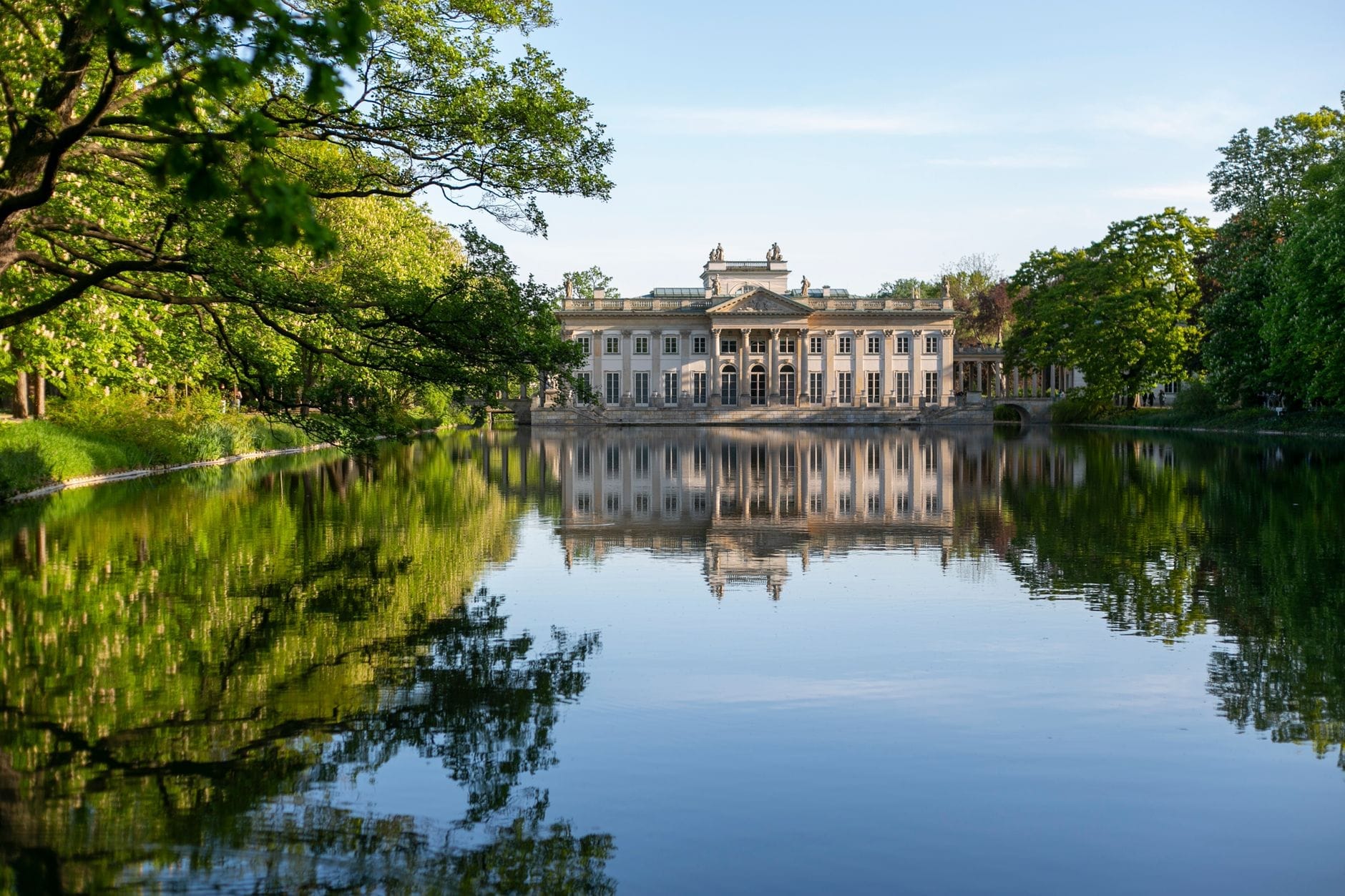
The Palace on the Isle (Pałac na Wyspie) is not a palace in the towering, fortress-like sense. It is a refined neoclassical villa that happens to sit on a small artificial island, its honey-coloured facade reflected in the still water of a formal lake. The effect is theatrical but not overwrought. On a clear morning, when the light is low and the park is quiet, it reads less like a royal monument and more like a painting brought to life.
The building began its life in the late 17th century as a Baroque bathhouse pavilion, commissioned by Prince Stanisław Herakliusz Lubomirski and designed by the Dutch-born architect Tylman van Gameren. That early structure was modest by royal standards. Everything changed in 1764, when King Stanisław August Poniatowski purchased the estate and handed the project to architects Domenico Merlini and Johann Christian Kammsetzer, who transformed it over several decades into the neoclassical residence you see today, modelled on Italian lakeside villas.
Poniatowski was Poland's last king and, by most accounts, one of its most cultured rulers. He did not simply want a summer retreat. He wanted a working villa museum, a place where his art collection would be displayed and debated during his famous Thursday Dinners, the weekly salon gatherings that drew philosophers, poets, and scientists. That intention is still visible inside: 140 works from his original collection remain on display, arranged according to 18th-century hanging principles, which means paintings stacked floor to ceiling in dense, considered groupings rather than spaced out for modern comfort.
The Interior: What to Expect Room by Room
The palace interior is smaller than first-time visitors tend to expect, which is part of its appeal. This is not the Palace of Versailles. The rooms are human in scale, ornate without being oppressive, and the density of the art collection gives each space a lived-in quality that larger royal residences rarely achieve.
The Rotunda, the building's central hall, sets the tone immediately. Its domed ceiling and circular form were a deliberate architectural statement about Enlightenment ideals, order, proportion, and reason made physical. From there, the sequence of apartments includes the king's study, reception rooms with original period furniture, and several galleries where Dutch, Flemish, and Italian paintings are hung as they would have been in Poniatowski's day. The quality of the collection is genuine: this was a king who bought seriously.
💡 Local tip
Audio guides are available at the ticket desk and add real depth to the collection. The English commentary is clear and covers both architectural details and the individual paintings. Worth the small additional cost.
Photography policies inside the palace should be checked at the entrance, as rules on flash and tripods vary. The ticket covers not just the Palace on the Isle but also four other buildings in the park complex: the Old Orangery, the White Pavilion, Myślewicki Palace, and the Officer Cadets School. Most visitors focus on the main palace and one or two of the outbuildings. Trying to see everything in a single afternoon is possible but rushed.
Tickets & tours
Hand-picked options from our booking partner. Prices are indicative; availability and final rates are confirmed when you complete your booking.
Museum of John Paul II and Primate Wyszyński entrance ticket
From 8 €Instant confirmationPub crawl in Warsaw
From 28 €Instant confirmationFree cancellationWarsaw Museum of Modern Art entrance ticket
From 8 €Instant confirmationSafe and Convenient Luggage Storage in Warsaw Old Town
From 6 €Instant confirmationFree cancellation
The Setting: Łazienki Park at Different Hours
The palace sits at the heart of Łazienki Park, Warsaw's largest and most formally designed royal park. The park itself is free to enter at all times, which means the lake and its iconic view are accessible even when the museum is closed. This matters because the exterior of the palace, framed by water and mature linden trees, is arguably as rewarding as the interior.
Early mornings, particularly on weekdays, bring the park close to silence. The peacocks that roam the paths (yes, actual peacocks, a long-standing feature of the grounds) are more visible before the midday crowds arrive. The light on the lake facade between roughly 9 and 11am in summer is clean and direct, ideal for photography without the flat midday glare. By afternoon, especially on weekends, the paths fill with families, joggers, and tour groups, and the atmosphere shifts toward something more like a city park than a royal estate.
Winter visits deserve a specific mention. Snow transforms the park into something spare and austere. The bare trees reveal the formal geometry of the landscape design more clearly than summer foliage allows, and the lake sometimes half-freezes around the palace, creating an atmosphere that is genuinely striking. Visitor numbers drop significantly, and the museum rooms feel more intimate. The tradeoff is shorter opening hours and colder conditions, so layering appropriately matters.
⚠️ What to skip
Some paths in the park become slippery after rain or in winter frost. The slopes near the lake are uneven in places. Comfortable, closed-toe shoes are strongly recommended. The park and palace are described as barrier-free, but steep gradients can be challenging for wheelchair users in wet conditions.
Getting There and Practical Details
The palace is located at Agrykola 1, within the Łazienki Królewskie complex in central Warsaw. The park has several entrances; the most direct approach from central Warsaw is from the north, off Aleje Ujazdowskie. From there, it is roughly a 10-minute walk through the park to reach the palace itself.
Bus lines including 116, 166, 180, and 517 stop at Łazienki-Królewskie, at the northern edge of the park. There is no tram or metro stop within easy walking distance, so public transport access relies on these bus routes. Those staying near Krakowskie Przedmieście or the Royal Route can reach the park entrance on foot in under 15 minutes, making walking the practical choice for most visitors staying in the central districts.
Cycling is a good option. The park has cycling connections and there are docking stations for Warsaw's public bike-share system nearby. Bikes must be left at the park entrance rather than ridden through the grounds.
Museum opening hours are Tuesday through Sunday, with seasonal hours varying by date; the last entry is 30 minutes before closing. Friday admission is free, which makes it the most crowded day of the week. If crowd management matters to you, Tuesday or Wednesday mornings are quieter. Tickets cost 50 PLN for a standard combined ticket, 25 PLN reduced, and 1 PLN for children, pupils, and students under 26 with valid identification or an ISIC card. Cash and card are both accepted.
Historical Weight: The Last King's Legacy
Understanding Stanisław August Poniatowski's story adds considerable weight to a visit. He was Poland's last monarch before the country was partitioned and disappeared from the map of Europe for over 120 years. He was also a man caught between genuine intellectual ambition and political impossibility, a reformer who could not hold his country together against the pressure of surrounding powers.
The Palace on the Isle was where he chose to live and think. The Thursday Dinners held here were not merely social events; they were a sustained attempt to build a Polish Enlightenment culture during a period of existential political crisis. Walking through the Rotunda with this context in mind changes how the building feels. For visitors interested in going deeper into Warsaw's royal and cultural history, the Royal Castle and the Wilanów Palace provide complementary perspectives on Polish royal patronage, though neither has quite the same intimate, lived-in atmosphere.
The palace survived the Second World War in damaged but repairable condition, unlike large parts of Warsaw that were systematically destroyed. Its relative survival is something of a historical accident, and while much of the interior was restored after the war, the building retains more original fabric than most reconstructed sites elsewhere in the city.
Honest Assessment: Is It Worth Your Time?
For visitors whose primary interest is the park experience rather than the museum, spending an hour or two walking the grounds, sitting by the lake, and taking in the exterior view is entirely satisfying and costs nothing. The palace interior rewards those who engage with it properly, meaning allowing at least 45 minutes inside, using an audio guide, and arriving with some awareness of Poniatowski's story. Visitors who treat it as a quick photo stop and move on often leave underwhelmed.
Those primarily focused on Warsaw's wartime history rather than its royal heritage may find the palace less engaging than the Warsaw Uprising Museum or the POLIN Museum. And visitors who have already toured royal palaces extensively across Europe may find the collection solid but not revelatory. That is an honest caveat. But as a combination of architectural setting, intact 18th-century interiors, and parkland, the Palace on the Isle has few equivalents in Warsaw.
ℹ️ Good to know
Free admission on Fridays applies to all visitors regardless of age or nationality. If your schedule is flexible, Friday is the best day for free entry.
Insider Tips
- The view of the palace from the southern end of the lake is the classic one, but the northern view, looking back toward the building with the amphitheatre visible to the left, gives better context for the ensemble as a whole. Walk the full perimeter of the lake before entering the museum.
- Peacocks roam the park freely and are most active in the morning. They occasionally wander close to the lakeside terrace. Do not feed them or approach them directly; they are more territorial than they look.
- The combined ticket covers four additional buildings. The Old Orangery is the most worthwhile of the outbuildings, housing an 18th-century court theatre that is one of the best-preserved of its kind in Poland. Even if you don't catch a performance, the interior is open to ticket holders.
- Friday free admission means longer queues at the ticket desk. Arrive at 10:00 when the doors open, or visit later in the afternoon when the first wave of visitors has cleared.
- The park's formal gardens are at their best in late May and June when the beds are in full bloom. Late September brings good foliage colour along the main allées without summer heat or weekend congestion.
Who Is Palace on the Isle For?
- History and culture travellers who want to engage with Poland's Enlightenment-era royal heritage
- Architecture enthusiasts interested in neoclassical Italian-influenced design
- Photographers looking for a reflective water facade in a green setting
- Families combining a museum visit with a long park walk
- Travellers visiting on a Friday, who can access the full palace complex free of charge
Nearby Attractions
Other things to see while in Łazienki Park & Ujazdów:
- Chopin Monument in Łazienki Park
Standing beneath a wind-swept willow in Łazienki Królewskie Park, the Fryderyk Chopin Monument is the emotional heart of Warsaw's classical music identity. Free to visit any time and framed by Sunday afternoon piano concerts in summer, it rewards visitors at almost every hour of the day.
- Łazienki Park (Royal Baths Park)
Covering 76 hectares along Warsaw's Royal Route, Łazienki Królewskie is the city's most expansive royal park, home to the water-bound Palace on the Isle, peacocks roaming shaded paths, and free outdoor Chopin concerts every Sunday in summer. Entry to the gardens is free, making it one of Warsaw's most rewarding and accessible green spaces.
- Polish Army Museum
Located within the grounds of the 19th-century Warsaw Citadel, the Polish Army Museum traces over a thousand years of Polish military history through vast collections of weapons, armor, uniforms, and aircraft. It is one of the largest military museums in Central Europe and a serious half-day commitment for anyone interested in Polish history.