Wilanów Palace: Warsaw's Royal Baroque Residence
Built between 1677 and 1696 for King John III Sobieski, Wilanów Palace is among the most complete royal residences in Poland. Set within 45 hectares of formal and landscape gardens on Warsaw's southern edge, it combines Baroque architecture, centuries of royal history, and one of the country's oldest public museums — all within reach of the city centre.
Quick Facts
- Location
- ul. Stanisława Kostki Potockiego 10/16, Wilanów district, ~10 km south of central Warsaw
- Getting There
- Bus lines 116, 180, 519, and others from city centre; stop: Wilanów
- Time Needed
- 2–4 hours for palace interiors and main gardens; half a day if exploring the full park
- Cost
- Paid entry for palace interiors and park; museum free on Thursdays. Current prices in PLN at wilanow-palac.pl/en/plan_your_visit/tickets
- Best for
- History enthusiasts, architecture lovers, garden walkers, families with older children
- Official website
- wilanow-palac.pl/en
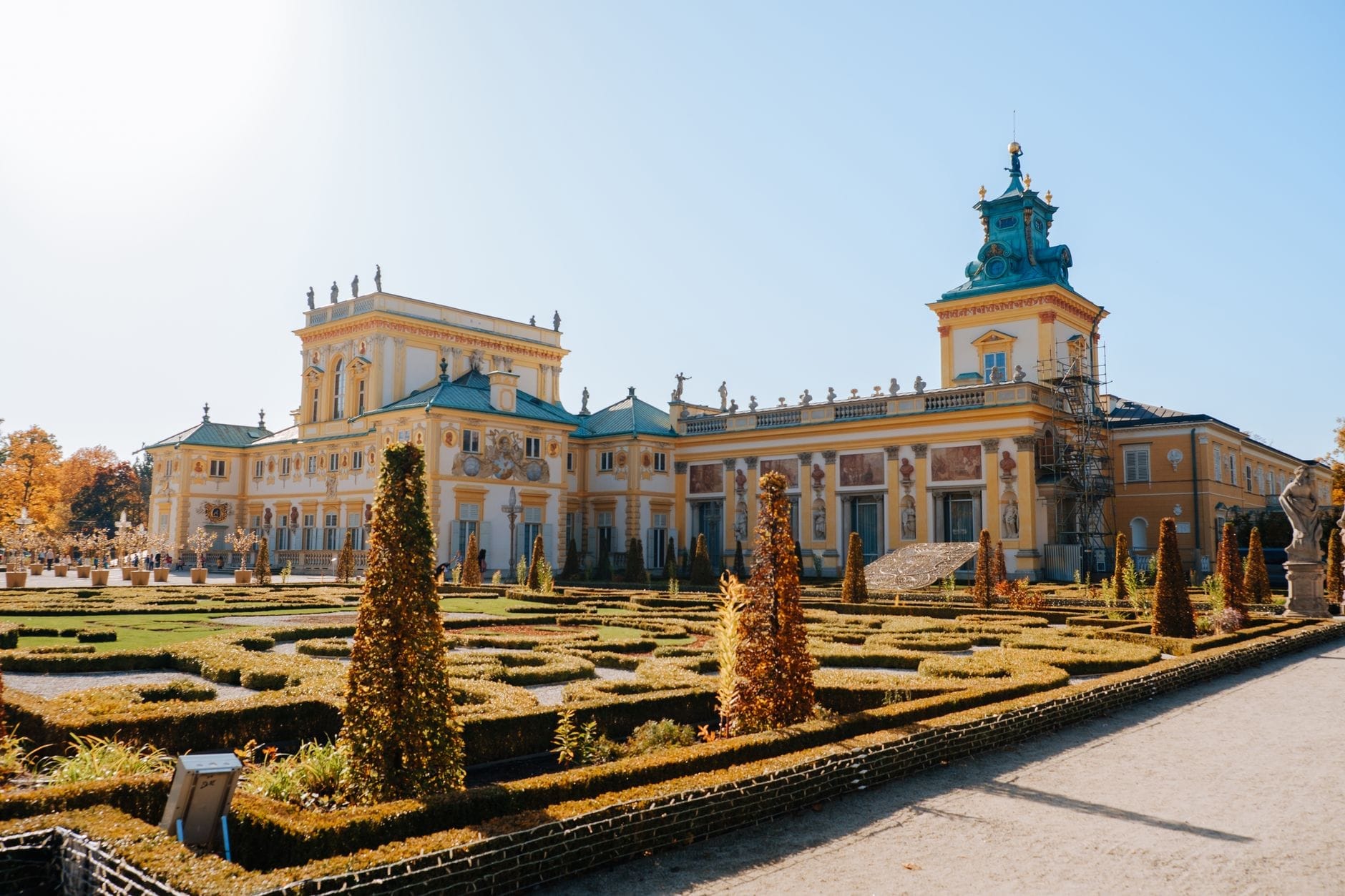
What Wilanów Palace Actually Is
Wilanów Palace is not a reconstruction or a replica. Unlike much of Warsaw, which was rebuilt from rubble after World War II, the palace survived the war largely intact and represents something genuinely rare in Poland: an original royal residence that still holds its historic interiors, furnishings, and art collections in place. That fact alone makes it worth the journey south from the city centre.
Construction began in 1677 under King John III Sobieski, the Polish-Lithuanian Commonwealth monarch best remembered for leading the Christian coalition that broke the Ottoman siege of Vienna in 1683. His court architect, Augustyn Wincenty Locci, designed the palace in the Italian Baroque style, drawing on Sobieski's own experiences with French and Italian court architecture. The result was intended as a private villa retreat rather than a formal seat of power, which gives the complex a more human scale than many royal palaces of the era.
After Sobieski's death in 1696, the palace passed through several noble families, each leaving architectural additions and alterations. The Sieniawski, Czartoryski, and Potocki families all shaped the estate over the following century, expanding the wings, redesigning the gardens, and adding new collections. In 1805, Stanisław Kostka Potocki opened the palace to the public as a museum, one of the first such institutions in Poland. That founding purpose has never changed: the palace has operated as a public museum, with varying interruptions, for over two centuries.
💡 Local tip
The museum is free to enter on Thursdays. If your priority is the palace interiors rather than the park, a Thursday visit saves money and is particularly good in late spring and early autumn when the rose garden is in bloom.
The Architecture: What You Are Looking At
From the main forecourt, the palace presents a three-part facade: a central corps de logis flanked by lower wings added in later decades. The exterior surfaces are unusually rich, covered in relief sculpture, Latin inscriptions, and allegorical figures that celebrate Sobieski's military victories. These decorative elements are not ornamental afterthoughts; they were designed as a deliberate political statement, projecting the king's image as defender of Christian Europe. Take time to read the facade before entering — the stone reliefs tell a story that the interior rooms continue.
The roofline carries a distinctive Polish Baroque crown motif, and the overall silhouette is more compact and vertical than French châteaux of the same period, reflecting a Central European interpretation of Italian villa design. The palace was designated a Polish national Historic Monument on 16 September 1994, recognizing both its architectural integrity and its cultural significance.
Visitors approaching from Krakowskie Przedmieście along the historic Royal Route will find that Wilanów is its natural southern terminus. The entire Royal Route, running from the Royal Castle through to Wilanów, traces the ceremonial spine of old Warsaw.
Tickets & tours
Hand-picked options from our booking partner. Prices are indicative; availability and final rates are confirmed when you complete your booking.
Museum of John Paul II and Primate Wyszyński entrance ticket
From 8 €Instant confirmationPub crawl in Warsaw
From 28 €Instant confirmationFree cancellationWarsaw Museum of Modern Art entrance ticket
From 8 €Instant confirmationSafe and Convenient Luggage Storage in Warsaw Old Town
From 6 €Instant confirmationFree cancellation
Inside the Palace: The Museum Collections
The palace interiors are arranged across two floors, taking visitors through state apartments, private chambers, galleries, and exhibition rooms. The decoration mixes original 17th-century elements with later 18th-century additions, so different rooms belong to different historical periods. The King's Anteroom, the Great Crimson Room, and the bedroom suites retain much of their period character, with painted ceilings, period furniture, and portraits. The collections include European paintings, Chinese and Japanese decorative arts that were fashionable among Polish aristocracy in the Baroque period, and a significant collection of Polish and foreign portraits.
Audio guides are available and are genuinely useful here. The palace lacks the exhaustive room-by-room labeling of some major European museums, and the audio commentary provides context that bare text panels often cannot. Budget time to move slowly: the rooms reward close attention to detail rather than a quick walk-through.
Temporary exhibitions occupy parts of the palace and the Orangery building. These change seasonally and sometimes focus on specific periods of the collection or broader themes in Polish cultural history. Check the official website before visiting to see what is currently showing.
ℹ️ Good to know
Opening hours vary by season and by area (palace interiors, park, Orangery). The museum publishes current schedules at wilanow-palac.pl/en/opening-hours. Verify before you travel, especially outside the main summer season.
The Gardens: 45 Hectares Worth Exploring
The park complex at Wilanów covers approximately 45 hectares and incorporates four distinct garden styles laid out across different periods. The formal Baroque garden immediately behind the palace features symmetrical parterres, sculpted hedges, and a geometric layout designed to extend the architectural order of the palace into the landscape. In the morning light, when the gravel paths are quiet and the shadows are long, this section has a stillness that the afternoon crowds tend to erase.
Beyond the Baroque parterre, the park opens into an English landscape garden with informal paths, a lake, and naturalistic planting — a style added in the late 18th century by the Potocki family as tastes shifted away from rigid formalism. Further out, a neo-Renaissance rose garden and an English-Chinese style section with decorative elements complete the sequence. Each zone has a different character and a different pace.
The rose garden is worth timing carefully. Late May through June is peak season, when several hundred rose varieties are in flower simultaneously and the scent carries across the path. Early morning visits avoid the worst of the crowds and offer better photographic light on the parterre hedges and the palace's garden facade.
If you enjoy designed landscapes, Warsaw has several other notable green spaces worth comparing. Łazienki Park in the city centre occupies a similar intersection of palace architecture and formal gardens, though on a different scale and historical context. The two parks represent distinct chapters in Polish aristocratic landscape design.
How the Experience Changes Through the Day
Wilanów draws the largest crowds on weekend afternoons, particularly from late spring through early autumn. Tour groups arrive mid-morning and tend to move through the palace interiors together. If you want to walk the state apartments without navigating around guided tours, arrive at opening time on a weekday.
The gardens behave differently. On weekday mornings in spring and autumn, the park can feel almost private: dog walkers from the surrounding Wilanów residential district, joggers on the outer paths, and very few tourists in the formal sections near the palace. By early afternoon, particularly on Sundays, the atmosphere shifts considerably and the forecourt area fills with visitors and food vendors.
Winter visits are underrated. The palace is generally open across the year (with some seasonal closures; verify specific dates and hours), and the gardens without foliage reveal the underlying geometry of the Baroque layout more clearly than summer allows. The palace facade, unobscured by tree canopy, reads as a complete composition. Visitor numbers drop sharply from October onward, and the interior rooms feel appropriately quiet and contemplative.
⚠️ What to skip
The palace is located about 10 km from central Warsaw and public transport options, while available, are slower than comparable journeys within the city. Allow around 30–40 minutes from the city centre by bus. If you are on a short visit to Warsaw, factor this travel time into your decision about whether Wilanów fits your schedule.
Getting There and Practical Logistics
Several bus lines connect the palace to the city centre, including lines 116, 180, and 519, with stops at Wilanów. The journey from central Warsaw typically takes around 30–40 minutes depending on traffic. The official site publishes current transport guidance under the 'Plan your visit' section.
Ride-hailing apps including Bolt and Uber operate in Warsaw and can reduce travel time significantly, particularly outside peak hours. A taxi or ride from the city centre takes roughly 20–30 minutes without heavy traffic. This is a reasonable option if you are traveling with children or heavy bags, or if you are combining Wilanów with another southern Warsaw destination.
Wear comfortable shoes. The park paths are a mix of gravel and cobblestone, and covering the full garden circuit involves several kilometers of walking. In wet weather, some paths near the lake and the outer garden sections become soft underfoot. The museum provides accessibility information including step-free routes and assistance policies at wilanow-palac.pl/en/plan_your_visit/accessibility; visitors with specific requirements are encouraged to contact the museum in advance.
For broader planning advice on how to fit Wilanów into a Warsaw trip, the Warsaw 3-day itinerary guide covers how to sequence the city's major attractions without overloading a single day.
Who Should Think Twice
Wilanów requires a deliberate effort to reach and rewards visitors who give it adequate time. If you have only one day in Warsaw and want to cover the Old Town, Royal Castle, and major central museums, Wilanów will feel rushed or like an afterthought. The palace interior is genuinely interesting but is not significantly more impressive than other major European Baroque residences. For visitors who have already seen Versailles, Schönbrunn, or Peterhof, the interior rooms may feel familiar rather than revelatory.
The palace also closes on some days and operates reduced hours outside the main season. Always check the official schedule before making the journey. Nothing about this destination is worse than arriving to find a section closed unexpectedly.
Travelers focused primarily on Warsaw's wartime and 20th-century history may find the Warsaw Uprising Museum or the POLIN Museum of the History of Polish Jews a better use of limited time. Wilanów sits in a different chapter of Polish history, one of royal ambition and Baroque culture rather than modern tragedy.
Insider Tips
- Thursday is the day to visit if your priority is the palace interiors rather than the park. Entry to the museum is free on Thursdays, and the crowds tend to be lighter than on weekends.
- The palace's garden facade is architecturally distinct from the entrance forecourt facade and is best seen from the formal Baroque parterre in the late afternoon, when the sun lights the rear elevation directly. Most visitors photograph the front and leave without seeing this view.
- The Orangery hosts temporary exhibitions that are occasionally excellent and consistently underattended compared to the main palace rooms. Check what is showing before you go.
- If you are visiting in summer and want to combine Wilanów with the city's broader royal history, the bus route back toward the centre passes close to Łazienki Park, making a two-palace day feasible if you start early.
- The neighborhood around the palace includes a market street and several cafes. The area immediately outside the main gate has food options, but the quality varies significantly. Bring water and snacks if you plan to spend a full half-day in the park.
Who Is Wilanów Palace For?
- Visitors with a strong interest in Baroque architecture and royal court culture
- Garden enthusiasts, especially during the rose season in late May and June
- Travelers on a second or third visit to Warsaw who have covered the central highlights
- Families with older children who can engage with the historical context of the palace rooms
- Photographers looking for formal geometry, architectural ornament, and seasonal garden compositions
Nearby Attractions
Other things to see while in Wilanów:
- Wilanów Palace Gardens
The Gardens of the Museum of King Jan III's Palace at Wilanów spread across 45 hectares at the southern tip of Warsaw's historic Royal Route. Formal Baroque parterres, a lakeside landscape park, and seasonal light installations make this one of Poland's most complete palace-garden ensembles — and one of the few royal grounds in Warsaw that rewards an unhurried half-day.