Wilanów Palace Gardens: Warsaw's Baroque Masterpiece Beyond the City Centre
The Gardens of the Museum of King Jan III's Palace at Wilanów spread across 45 hectares at the southern tip of Warsaw's historic Royal Route. Formal Baroque parterres, a lakeside landscape park, and seasonal light installations make this one of Poland's most complete palace-garden ensembles — and one of the few royal grounds in Warsaw that rewards an unhurried half-day.
Quick Facts
- Location
- Stanisława Kostki Potockiego 10/16, Wilanów district — about 10 km south of Warsaw city centre
- Getting There
- City buses from central Warsaw (e.g., from Nowy Świat or Wilanowska area); no metro direct to Wilanów — check ZTM Warsaw for current routes
- Time Needed
- 2–3 hours for gardens alone; add 1–2 hours if visiting the palace interior
- Cost
- Garden-only tickets from 15 PLN; free entry every Thursday (limited tickets, issued same-day at the ticket office). Verify current prices at wilanow-palac.pl
- Best for
- Garden enthusiasts, history lovers, families, photographers, and anyone wanting royal-era Warsaw outside the tourist centre
- Official website
- wilanow-palac.pl/en
What Are the Wilanów Palace Gardens?
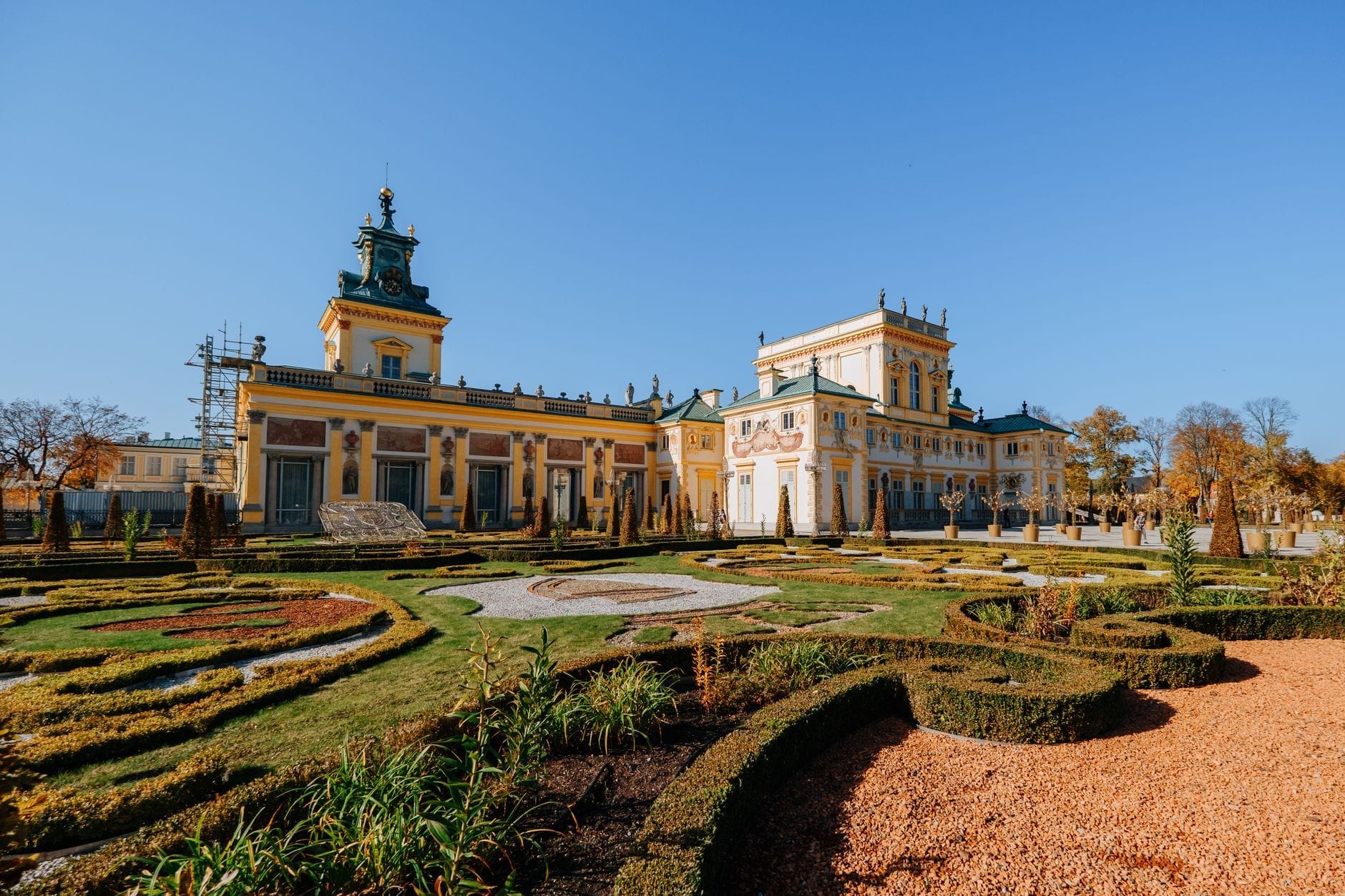
The Wilanów Palace Gardens — formally part of the Gardens of the Museum of King Jan III's Palace at Wilanów — are among the most historically significant royal garden complexes in Warsaw. Laid out originally between 1677 and 1696 for King John III Sobieski, the grounds stretch across roughly 45 hectares at the far southern end of the city's historic Royal Route. They represent the most complete surviving example of Polish Baroque garden design, and unlike many European royal gardens that were later reworked beyond recognition, Wilanów retains the layered character of its different eras.
The complex divides into two distinct personalities. Closest to the palace facade, the formal Baroque parterre gardens are precisely geometric: sculpted box hedges, gravel paths, ornamental fountains, and symmetrical flowerbeds that mirror the palace's architectural rhythm. Further out, the grounds open into a softer 19th-century landscape park arranged around a lake, with weeping willows, informal paths, and long views back toward the palace's southern elevation. The contrast between these two halves is part of what makes a visit here feel layered rather than one-note.
💡 Local tip
Thursday is free entry day for both the palace and gardens, but the number of free tickets is limited and issued on the day at the ticket office. Arrive early if you plan to visit on a Thursday, especially in summer.
The Gardens Through the Day: How the Experience Changes
The gardens typically open from the morning, with exact opening times varying by season; check the museum’s website for current hours before you go. In the first hour or two after opening, you will encounter a different Wilanów from the one midday visitors see: the gravel paths are freshly raked, the light is low and angled, and the palace's gilded ornamental details catch the morning sun in a way that afternoon visits rarely replicate. Weekday mornings bring a quiet that lets you hear the birds in the linden trees along the north parterre walk and notice the faint smell of damp soil and box hedging that defines the formal garden's sensory signature.
By late morning on weekends, especially in May, June, and September, the gardens fill considerably. Tour groups congregate near the palace entrance and the upper terrace. The lake area tends to stay calmer even when the formal gardens are crowded — it is worth walking the full circuit rather than turning back at the palace's rear facade. On warm summer afternoons the gravel holds heat, and the exposed parterre areas can feel relentless without shade. Carry water.
Closing times vary by season, typically falling between 16:00 in winter and 20:00 or later in summer. On selected autumn and winter dates, the museum runs its Royal Garden of Light installation, with evening entry typically from 17:00 to 21:00 and last admission around 20:30. This event transforms the formal parterre into an illuminated landscape that bears no resemblance to the daytime experience — it is worth checking the official website for current dates if you are visiting between October and January.
Tickets & tours
Hand-picked options from our booking partner. Prices are indicative; availability and final rates are confirmed when you complete your booking.
Beauty and the Beast Garden of Lights exhibition in Warsaw
From 9 €Instant confirmationMuseum of John Paul II and Primate Wyszyński entrance ticket
From 8 €Instant confirmationPub crawl in Warsaw
From 28 €Instant confirmationFree cancellationWarsaw Museum of Modern Art entrance ticket
From 8 €Instant confirmation
Historical and Architectural Context
King John III Sobieski, who commissioned Wilanów, is best remembered in European history for leading the relief of Vienna in 1683 — a campaign that halted the Ottoman advance into central Europe. The palace and gardens he built at Wilanów were his personal statement of royal ambition, conceived in the Italian villa tradition but adapted for the Polish climate and political context. The garden layout at the time of Sobieski's death in 1696 already had the essential structure that survives today: terraced parterres descending from the palace's garden facade, a geometric framework with sculpture and water features, and a broader park beyond.
Later owners, particularly the Lubomirski and Potocki families who held the estate through the 18th and 19th centuries, modified and expanded the grounds. The lake and landscape park to the south were developed during the Romantic era, grafting an English-style naturalistic layer onto the earlier Baroque skeleton. This is why the gardens feel historically multi-dimensional: you are walking through overlapping centuries rather than a single frozen moment.
The gardens are officially classified as a historical monument and form part of a complex regarded as one of Poland's foremost examples of Baroque heritage. For context on how Wilanów fits within Warsaw's broader landscape of royal and ecclesiastical sites, the Wilanów Palace interior guide covers the palace rooms in detail. Those more interested in Warsaw's other green spaces can find a broader overview in the Warsaw parks and green spaces guide.
Walking the Gardens: A Practical Route
Tickets are purchased at the main ticket office near the palace entrance on the north side. Garden tickets can be bought separately from palace interior admission — this matters because many visitors come specifically for the outdoor space and have no interest in the palace rooms. The ticket covers defined garden zones; check at the desk which areas are included on the day of your visit, as seasonal events can alter access.
Most visitors begin on the north parterre, the formal garden directly in front of the palace's main facade. The clipped hedges and geometric beds here give the clearest impression of Baroque garden design — the idea that nature is ordered and controlled as an extension of royal authority. A central axis runs from the palace through the parterre; if you stand at the far end of this axis and look back toward the building, you get the photograph that appears in every Warsaw travel article. It is framed best in the morning when the palace face catches the light.
From the north parterre, move around to the rear of the palace to access the south garden and lake area. The path follows the palace's garden facade — worth slowing down to examine the sculptural decoration on the rear elevation, which is arguably more elaborate than the front. The lake walk is mostly flat and shaded by old trees, making it the most comfortable part of the grounds on hot days. Allow 30 to 45 minutes for the full lake circuit, more if you stop frequently.
ℹ️ Good to know
The historic garden paths include gravel surfaces and some terraced stone steps typical of 17th-century Baroque design. Visitors with mobility challenges should check current accessibility details directly with the museum, as some areas may be difficult to navigate with wheelchairs or strollers.
Getting to Wilanów from the City Centre
Wilanów sits about 10 kilometres south of central Warsaw, and there is no direct metro connection. City buses serve the palace from several points in the centre, including stops along the Royal Route. The journey by bus typically takes 30 to 50 minutes depending on traffic — Warsaw's southern corridors can slow considerably on weekend afternoons, so factor this in when planning your return. Taxis and ride-hailing apps (Bolt and Uber both operate in Warsaw) offer a faster but costlier alternative, particularly useful for families with young children or visitors with heavy luggage.
If you are combining Wilanów with other stops along the Royal Route, the Warsaw walking tour guide outlines how the route connects from the Old Town south through Łazienki and onward to Wilanów — though it is too far to walk the full distance comfortably in a single day without transport assistance for at least part of the journey.
Photography, Seasons, and What to Expect in Different Conditions
Spring, from late April through June, is the garden's most photogenic season. The parterres are in full growth, tulips and other formal planting schemes are at their peak, and the surrounding trees carry fresh green. This is also the busiest period. Early September offers a quieter alternative with warm light and the first hints of autumn color beginning in the landscape park — particularly attractive around the lake.
Winter visits are underrated. Snow on the formal parterre creates stark contrasts against the bare hedging and the gilded palace facade, and the crowds thin dramatically. The Royal Garden of Light installation, if running, gives winter visitors an experience entirely unavailable in summer. Cold weather is genuine — January averages are well below freezing in Warsaw — so dress accordingly: waterproof boots, layers, and a warm coat are not optional.
Rain significantly changes the garden experience. Gravel paths drain reasonably well, but the formal areas can become muddy at the edges after sustained rain, and the lake path can be slippery in wet conditions. The palace interior remains accessible in bad weather; if you have not bought a combined ticket and the forecast turns, check whether you can add indoor access at the ticket desk.
⚠️ What to skip
On rainy days, avoid wearing leather-soled shoes or non-waterproof footwear — the historic gravel paths and stone terraces become slippery, and the grass areas between beds will be wet underfoot.
Is It Worth the Trip?
Wilanów is not a short detour. The 10-kilometre distance from the city centre means you are committing a meaningful portion of a day to the visit, particularly if you are also touring the palace interior. For travellers with only one or two days in Warsaw, that trade-off deserves honest consideration. If your primary interest is green space and royal landscape, Łazienki Park is closer to the city centre, easier to reach by public transport, and arguably more atmospheric for casual walking. Wilanów's advantage is the formal Baroque garden design, which Łazienki does not replicate at the same scale or historical depth.
Visitors who treat Wilanów as a destination rather than a box to tick — who come with time to walk the full grounds, sit by the lake, and examine the sculptural program on the palace facade — consistently find it rewarding. Those who arrive expecting a quick photo stop and leave after 45 minutes often feel the travel time was not justified. The gardens are not overhyped, but they do require a patient approach to reveal what makes them significant.
For those building a fuller itinerary, the Warsaw 3-day itinerary includes Wilanów as a dedicated half-day, paired with Łazienki in the same southern arc of the city.
Insider Tips
- The ticket office issues Thursday free-entry tickets on a first-come basis — they are not bookable online. Arrive at 09:00 for the best chance, especially on sunny summer Thursdays when demand is highest.
- The south garden elevation of the palace, visible from the lake path, carries some of the most ornate sculptural decoration on the entire building. Most visitors photograph only the north facade and miss it entirely.
- Bus return times from Wilanów back to the city centre can stretch significantly on Sunday afternoons. If you need to catch a train or flight, allow an extra hour of buffer or book a taxi for the return leg.
- The formal parterre is at its most fragrant in late May when the box hedging releases its characteristic earthy scent in the morning warmth — a sensory detail that photographs cannot capture.
- If the Royal Garden of Light event is running during your visit, book tickets online in advance. The illuminated evening sessions sell out on weekends and on days with good autumn weather.
Who Is Wilanów Palace Gardens For?
- Garden and landscape history enthusiasts who want to understand Polish Baroque design in an intact setting
- Photographers seeking palace-garden compositions, especially in spring bloom or winter snow
- Families with children who need open outdoor space and a structured walkable circuit
- Travellers on a Thursday budget visit — free entry makes this one of Warsaw's best-value days out
- Visitors on a longer Warsaw stay (3+ days) who have already covered the Old Town and Łazienki and want more depth
Nearby Attractions
Other things to see while in Wilanów:
- Wilanów Palace
Built between 1677 and 1696 for King John III Sobieski, Wilanów Palace is among the most complete royal residences in Poland. Set within 45 hectares of formal and landscape gardens on Warsaw's southern edge, it combines Baroque architecture, centuries of royal history, and one of the country's oldest public museums — all within reach of the city centre.