University of Warsaw Library Garden (Ogrody BUW): A Rooftop Garden Above the Vistula
Perched 16 meters above the Powiśle campus, the University of Warsaw Library Garden (Ogrody BUW) is one of Europe's largest roof gardens, covering about 10,000 square meters of planted terraces, color-themed beds, and pedestrian bridges. Admission is free, the views toward the Vistula are genuine, and the atmosphere is calm enough to make most of Warsaw's tourist attractions feel very far away.
Quick Facts
- Location
- Dobra 56/66, Powiśle, Warsaw (Vistula Riverfront area)
- Getting There
- Metro M2: Centrum Nauki Kopernik station, approx. 500 m walk along Dobra Street
- Time Needed
- 45–90 minutes
- Cost
- Free — no tickets required
- Best for
- Scenic walks, photography, peaceful breaks, architecture enthusiasts
What the Ogrody BUW Actually Is
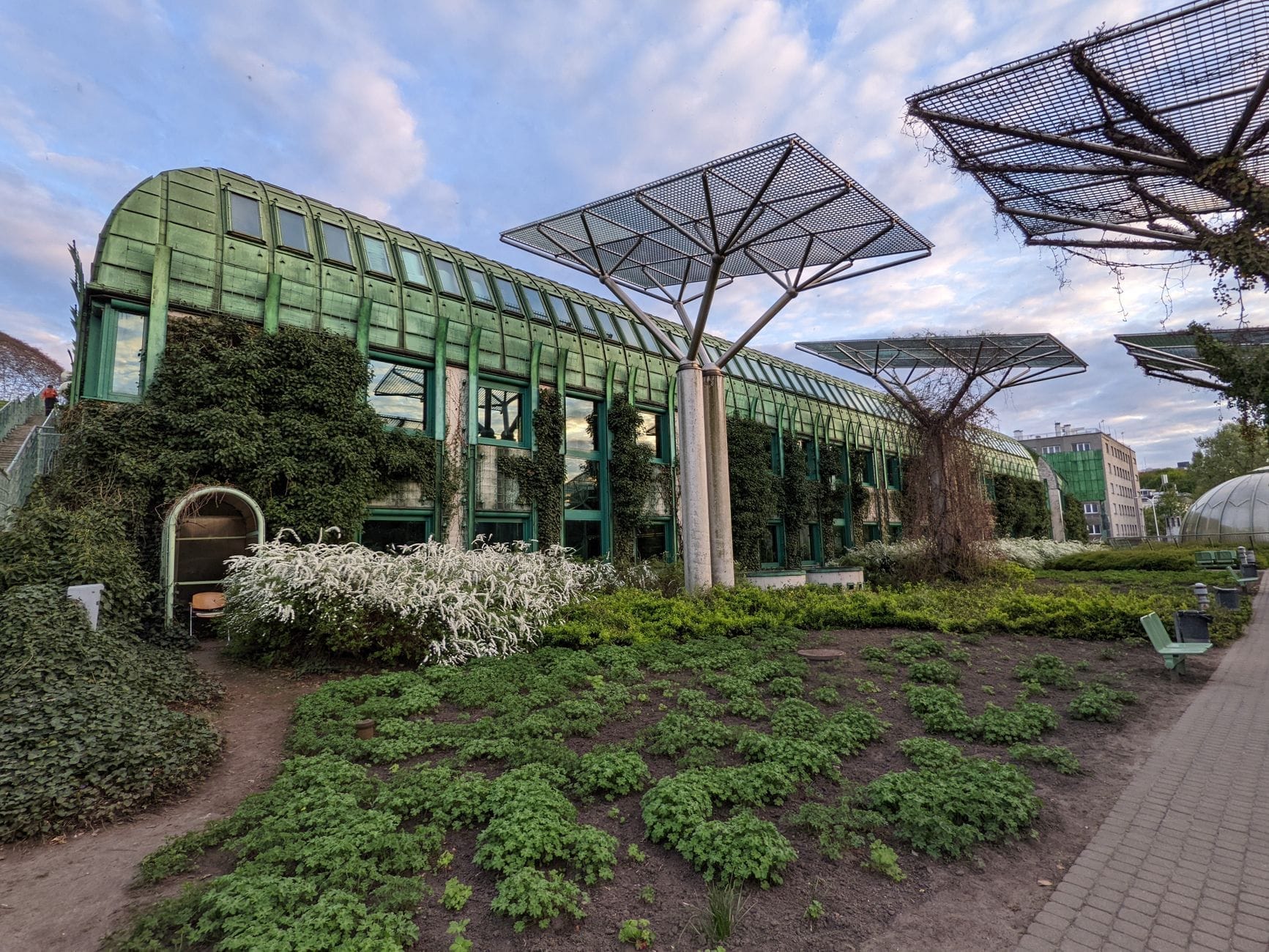
The University of Warsaw Library Garden, known locally as Ogrody BUW or simply Ogród na dachu BUW (the rooftop garden), sits on top of and around the university's main library building on Dobra Street in the Powiśle district. The library itself opened in 1999, designed by the Polish architectural firm Budzynski and Badowski. The rooftop garden followed in 2002, and it has since become one of the most quietly compelling public spaces in Warsaw.
The total green area across both the Lower Garden at ground level and the Upper Rooftop Garden is approximately 15,000 square meters, with an additional rooftop section sitting 16 meters above the ground that measures over 10,000 square meters. That rooftop portion alone places Ogrody BUW among the largest green roofs in Europe. The planting is not decorative filler: the garden is divided into four color-themed zones based on the dominant hues of the plants chosen for each section — gold, silver, carmine, and green — giving the space a deliberate, almost curatorial quality.
💡 Local tip
The rooftop section closes seasonally: from November 1 through March 31, only the Lower Garden remains open (08:00–15:00). The full garden, including the roof, is accessible from April 1 through October 31. Check the official library website for event-related closures before visiting.
The Experience at Ground Level and on the Roof
Entering from Dobra Street, you first pass through the Lower Garden, a planted forecourt that softens the transition from the urban street into the library complex. Ground-level plantings here are dense and mature, with ivy, shrubs, and ornamental grasses creating a sense of enclosure that makes the noise from nearby traffic fade. Benches are positioned along the paths, and on warm weekday mornings, you will often find university students reading here rather than inside.
The ascent to the rooftop is gradual: gently sloped paths wind upward through planted terraces rather than a single sharp staircase, which means the transition to the upper level feels continuous with the landscape rather than mechanical. By the time you reach the observation deck and bridges at the top, the city has opened up around you. To the east, the Vistula River is clearly visible. To the south, the Copernicus Science Centre building sits close to the water. The Praga district occupies the far bank, and on clear days, the sight lines extend further than you might expect from a garden in the middle of a dense urban area.
The bridges connecting sections of the roof are a detail worth noting. They are not wide pedestrian thoroughfares but narrower crossings that give the garden a layered, slightly theatrical quality, as if you are moving through a stage set designed to reveal different angles of both the planting and the city below. In late May and through June, when much of the vegetation is at its greenest and the color-zone plantings are most vivid, the roof feels more like a botanical collection than a conventional garden.
Tickets & tours
Hand-picked options from our booking partner. Prices are indicative; availability and final rates are confirmed when you complete your booking.
Beauty and the Beast Garden of Lights exhibition in Warsaw
From 9 €Instant confirmationPub crawl in Warsaw
From 28 €Instant confirmationFree cancellationWarsaw Museum of Modern Art entrance ticket
From 8 €Instant confirmationSafe and Convenient Luggage Storage in Warsaw Old Town
From 6 €Instant confirmationFree cancellation
How the Garden Changes Through the Day
Mornings at Ogrody BUW are the quietest. Between 08:00 and 10:00, the garden is almost empty. The light at this hour hits the rooftop beds at a low angle, which is useful for photography because it emphasizes the texture of the plantings and casts shadows across the bridges and paths. The air carries the smell of irrigated soil and, depending on the season, flowering plants from the ornamental sections.
By midday on weekends in summer, the garden sees its heaviest foot traffic. Groups arrive from the nearby Vistula boulevards, and the benches and shaded corners fill up. Even at its busiest, though, the space absorbs visitors without feeling crowded in the way that a compact urban park might, because the multiple levels and distinct zones distribute people naturally across the site.
The late afternoon window, roughly 17:00 to 19:00 in summer (the garden stays open until 20:00 from May through September), is probably the best overall time to visit. The heat of midday has passed, the light is warm and directional for photography, and the Vistula views to the east catch the low sun. Students from the university campus nearby tend to arrive around this time, giving the garden a casual, local quality that is different from the more tourist-oriented crowds of the middle of the day.
Architecture and Design Worth Paying Attention To
The library building itself is significant enough that the garden should not completely overshadow it. The structure by architects Marek Budzynski and Zbigniew Badowski won recognition for integrating a large institutional building into a sensitive riverside site. The facade facing Dobra Street uses transparent and reflective surfaces that shift the appearance of the building across the day, while the riverside side steps down toward the Vistula in a way that feels considered rather than imposed. The green roof was always part of the original design concept, not a retrofit.
For visitors interested in the relationship between landscape and architecture, Ogrody BUW offers a case study in how a utilitarian public building can become a public amenity in ways that extend well beyond its core function. The library is still a working research library, which means the building is active on a daily basis, and the garden is genuinely integrated into that daily life rather than existing as a separate tourist feature.
The surrounding Powiśle neighborhood has changed significantly since the library opened, particularly with the development of the Vistula Boulevards running along the riverbank to the south and east. What was once a fairly quiet stretch of the riverfront has become one of Warsaw's most frequented outdoor spaces, and the library garden sits at the upper edge of that zone, connecting the formal academic campus to the more casual recreational landscape below.
Practical Details for Your Visit
Getting here is straightforward. The nearest metro station is Centrum Nauki Kopernik on the M2 line, approximately 500 meters from the library entrance along Dobra Street. The walk from the station is flat and direct, passing through the Powiśle district's street-level mix of cafes, small shops, and residential buildings. Trams also serve the broader area; check current ZTM Warsaw route information for up-to-date stops near Dobra Street.
Admission is free and no booking is required. The garden is open seven days a week, with hours varying by season: 08:00–18:00 in April, 08:00–20:00 from May through September, 08:00–18:00 in October, and 08:00–15:00 (lower garden only; roof closed) from November through March. Occasional closures for events are listed on the library's official website at buw.uw.edu.pl.
Cycling and dog walking are not permitted on the garden paths. Visitors are asked to stay on designated routes to protect the planted surfaces, which is a reasonable constraint given that much of the garden is technically a structural roof. Comfortable flat shoes are fine for the sloped paths, though the surfaces can become slippery in wet weather, particularly on the upper sections.
⚠️ What to skip
In wet weather, the sloped paths on the rooftop garden can become slippery. Wear shoes with grip if rain is likely. The views are also significantly diminished by low cloud or heavy overcast, so a clear or partly cloudy day makes a genuine difference to the quality of the visit.
If you are combining this visit with a broader afternoon in the area, the Copernicus Science Centre is a short walk south along the riverbank, and the Vistula beach areas and boulevard cafes are easily accessible from the garden's lower entrance. The Vistula Riverfront district rewards an unhurried afternoon.
Photography Notes
The rooftop garden is one of Warsaw's more photogenic spaces, but it rewards patience more than quick snapshots. The color-themed planting zones read best in late spring and early summer when growth is fullest. The gold zone, with its yellow and amber-toned plants, and the carmine zone with deep reds and purples, offer the strongest visual contrast against the grey and green tones of the city backdrop.
Wide-angle lenses work well for capturing the relationship between the planted terraces and the Vistula in the background. For closer shots, the bridges and their metal railings create geometric framing opportunities. Avoid midday in midsummer for photography: the flat overhead light washes out the color distinctions between zones, and the background haze over the river reduces visibility. Early morning and late afternoon are consistently better.
Visitors interested in Warsaw's parks and green spaces more broadly may find it useful to read about Warsaw's parks and green spaces to plan a fuller day outdoors in the city.
Who Will Not Enjoy This
If you are looking for a dramatic, picture-postcard panorama of Warsaw's skyline, Ogrody BUW is not the right choice. The views are real and pleasant, but they are selective and low-key rather than sweeping. The Palace of Culture and Science is not visible from the rooftop, and the Old Town skyline is not part of the outlook either. For skyline views, there are better options in the city.
Visitors with limited mobility should note that while the sloped path design is gentler than a staircase, the garden's circulation is not fully step-free in a conventional accessibility sense; the library's own information does not specify elevator access to the roof garden level. Contacting the library directly before visiting is advisable if step-free access is a firm requirement.
In winter months (November through March), the experience is significantly reduced. Only the Lower Garden is open, the hours are short (closing at 15:00), and the planting is dormant. It is a pleasant enough walk on a clear winter day, but it does not represent the garden at anything close to its best.
Insider Tips
- Visit on a weekday morning in May or June: the rooftop is nearly empty, the plantings are at their seasonal peak, and the morning light from the east illuminates the Vistula views without the haze that builds up in afternoon heat.
- The Lower Garden's benches along the southern path are shaded even in midsummer and are a genuinely calm spot for a break, largely overlooked by visitors who head straight for the rooftop.
- The garden closes earlier than you might expect in October (18:00 through the month, after 20:00 closing times from May through September, then transitioning to winter hours on November 1). If you are visiting in late October, arrive by 17:00 to allow time on the roof before closing.
- After the garden, walk downhill toward the Vistula Boulevards and head north to find several well-regarded cafes and restaurants in the Powiśle neighborhood — the area between the library and the river has developed considerably and is worth exploring at street level.
- The color-zone planting scheme is easier to read from above than at eye level. Take time on the observation bridges to look down into the planting beds rather than only outward at the views: the contrast between the carmine, gold, silver, and green sections is the garden's most distinctive design feature.
Who Is University of Warsaw Library Garden (Ogrody BUW) For?
- Architecture and landscape design enthusiasts interested in green roof innovation
- Photographers looking for an unusual elevated perspective on the Vistula and Powiśle
- Travelers who want a calm, free outdoor space away from the Old Town tourist circuit
- Students and slow travelers looking for a genuine local working-neighborhood atmosphere
- Families with older children who enjoy a purposeful walk with a clear destination and views
Nearby Attractions
Other things to see while in Vistula Riverfront (Bulwary Wiślane):
- Copernicus Science Centre
The Copernicus Science Centre on the Vistula riverfront is Warsaw's flagship interactive science museum, with over 450 hands-on exhibits spread across 15,000 m², a digital planetarium, and a seasonal rooftop garden. It draws children and adults equally, though it demands at least half a day to do it justice.
- National Stadium (PGE Narodowy)
The PGE National Stadium (officially PGE Narodowy im. Kazimierza Górskiego) is Warsaw's largest venue and one of Central Europe's most recognizable modern structures. Built on the east bank of the Vistula and completed in 2011, it hosts Poland's national football matches, major concerts, and year-round public tours with a rooftop viewing point over the city.
- Vistula Boulevards (Bulwary Wiślane)
The Vistula Boulevards stretch along the left bank of the Vistula River in central Warsaw, offering a free, open promenade lined with outdoor cafés, sandy beaches, cycling paths, and sweeping views of the eastern bank. Opened in phases from 2015, 2017, and 2019, they transformed a neglected riverfront into the city's most relaxed gathering space. This guide covers what to expect by season and time of day, how to get there, and what to do along the way.
- Vistula River Beaches
Every summer, sandy beaches emerge along Poland's longest river right in the heart of Warsaw. Free to access, strung with pop-up bars and volleyball nets, and backed by one of Europe's more dramatic city skylines, the Vistula River Beaches are genuinely worth an afternoon of your time.