PGE Narodowy (National Stadium): Warsaw's Landmark Arena on the Vistula
The PGE National Stadium (officially PGE Narodowy im. Kazimierza Górskiego) is Warsaw's largest venue and one of Central Europe's most recognizable modern structures. Built on the east bank of the Vistula and completed in 2011, it hosts Poland's national football matches, major concerts, and year-round public tours with a rooftop viewing point over the city.
Quick Facts
- Location
- Al. Księcia Józefa Poniatowskiego 1, Praga-Południe, Warsaw (east bank of the Vistula)
- Getting There
- Stadion Narodowy station (Metro Line M2); trams 7, 9, 22, 24, 25 and buses to Rondo Waszyngtona
- Time Needed
- 1.5–3 hours for a guided tour and viewing point; allow more for match or concert days
- Cost
- Ticket prices in PLN vary by tour type and age; check the official ticket shop for current tariffs
- Best for
- Architecture enthusiasts, football fans, panoramic city views, families
- Official website
- www.pgenarodowy.pl
What Is PGE Narodowy and Why It Matters
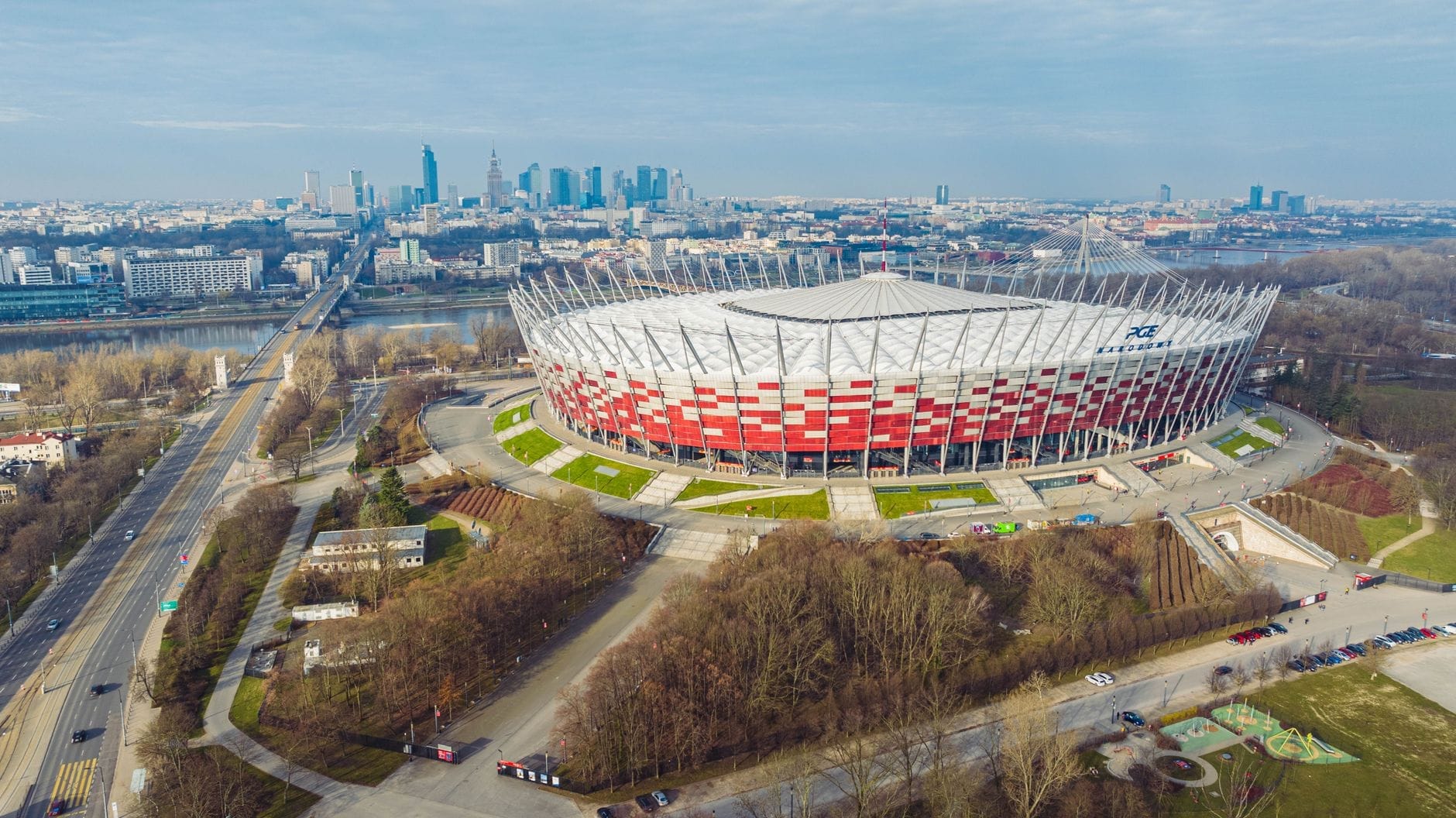
The PGE National Stadium (officially PGE Narodowy im. Kazimierza Górskiego) is Poland's largest sports and entertainment venue, with an official seating capacity of approximately 58,580 and a concert configuration that can accommodate up to 72,900 people. Completed in November 2011 and officially opened on 29 January 2012, it occupies a large site on the east bank of the Vistula River, directly across the water from Warsaw's city centre skyline.
The stadium is hard to miss from almost anywhere along the river. Its signature retractable roof, clad in panels of red and white that reference the Polish national flag, makes it instantly identifiable both up close and from a distance. On overcast days the roof closes over the pitch; on clear match nights, the illuminated structure is visible from Śródmieście's rooftops and from the bridges spanning the Vistula.
The stadium stands on the site of the old 10th-Anniversary Stadium (Stadion Dziesięciolecia), a vast earthwork structure built in 1955 from the rubble of postwar Warsaw. That earlier stadium became infamous in the post-communist era as the location of Europe's largest open-air market. Its demolition made way for Poland's successful bid to co-host UEFA Euro 2012 with Ukraine. For the broader story of how Warsaw rebuilt itself across the decades, the Warsaw WW2 history guide provides essential context.
The Architecture Up Close
The stadium was designed by the German-Austrian consortium gmp Architekten (von Gerkan, Marg and Partners) together with JSK Architekci from Warsaw. The structure uses a tensile roof membrane supported by a steel cable system, which allows it to open and close over the playing field. Walking toward the stadium from the metro station, the scale becomes apparent only gradually: the outer facade is relatively low and horizontal, and the full bowl interior only reveals itself once you pass through the entrance gates.
The exterior skin is a woven pattern of red and white steel mesh. Depending on the light, it reads as bright red in direct afternoon sun and shifts toward rust-orange as the day fades. At night, programmable LED lighting changes the color scheme entirely for special events. The surrounding plaza is generously wide, with large paved surfaces and sight lines to the Vistula.
💡 Local tip
If you approach from the Poniatowski Bridge side, you get the clearest unobstructed view of the full facade. The morning light hits the east-facing panels well before noon, making it a better photography angle than the afternoon.
Tickets & tours
Hand-picked options from our booking partner. Prices are indicative; availability and final rates are confirmed when you complete your booking.
Pub crawl in Warsaw
From 28 €Instant confirmationFree cancellationWarsaw Museum of Modern Art entrance ticket
From 8 €Instant confirmationSafe and Convenient Luggage Storage in Warsaw Old Town
From 6 €Instant confirmationFree cancellationInteractive spy-themed city game with host-guide in Warsaw Old Town
From 90 €Instant confirmationFree cancellation
Visiting on a Non-Event Day: Tours and the Viewing Point
On days without matches or concerts, PGE Narodowy offers guided tours and access to the viewing point. Tours run Monday through Sunday on dates and time slots listed in the online booking system at tours.pgenarodowy.pl. Tickets must be booked in advance and are priced in Polish złoty, with different rates by tour type and age category. Because the schedule depends on what events are booked on any given day, checking availability a few days ahead is necessary rather than just turning up.
The viewing point is the main draw for visitors who are not attending an event. From the upper levels, the panorama takes in the Vistula, the Old Town skyline, the Palace of Culture and Science, and on clear days the full sweep of modern Warsaw towers in the financial district. It is a genuinely useful vantage point for orienting yourself in the city, and the perspective is different enough from rooftop bars or the Palace of Culture observation deck to justify the trip.
The guided tour takes visitors through areas including the changing rooms, the players' tunnel, the press areas, and the pitch-side perimeter. It is a format similar to stadium tours across Europe, well-executed and informative even for visitors with no strong interest in football. Families with children tend to respond well to the tunnel and pitch sections. For other family-friendly options in Warsaw, see the guide on Warsaw with kids.
⚠️ What to skip
Tours do not run on match days or when major events are taking place. Always check the official booking system before planning your visit around a tour, especially during the football season and summer concert period.
Match Days and Major Events
Poland's national football team plays home matches at PGE Narodowy, and the stadium hosts UEFA qualifiers, domestic cup finals, and periodic European club fixtures. The atmosphere on match days is notably different from the quiet of a regular tour day. The metro fills with supporters before kickoff; the Rondo Waszyngtona tram stop becomes a genuine crowd-management exercise. Tickets for national team matches sell through the Polish Football Association (PZPN) and through the stadium's official channels.
Beyond football, the stadium hosts some of the largest concerts staged in Poland. Acts that require a venue of this scale use PGE Narodowy as the default Warsaw option. The retractable roof means weather disruption is limited for pitch-level audiences, though the acoustic experience in a 72,900 concert configuration is typical of large-scale outdoor venues: clear at the front, more diffuse toward the upper tiers.
The stadium also operates a large conference and commercial complex underneath the stands, including underground parking for several thousand vehicles. This infrastructure makes it a working commercial address as much as a sports venue, and parts of the building function year-round regardless of what is happening on the pitch.
Getting There and Around the Riverfront
The most direct route is Metro Line M2 (the red line), which stops at Stadion Narodowy station. The walk from the metro exit to the stadium entrance takes a short walk across the plaza. Trams 7, 9, 22, 24, and 25, along with bus routes 158, 507, and 517, serve Rondo Waszyngtona, which is a short walk from the stadium. From the Old Town area, buses 226 stop at Kijowska and Zieleniecka.
The stadium sits on the east bank of the Vistula, which puts it close to the Vistula Boulevards and the riverfront walking and cycling infrastructure. After a tour or event, walking back across the Poniatowski Bridge toward the city centre is a reasonable option in good weather and takes about 15-20 minutes on foot. The river path also connects north toward Praga and south toward the summer beach areas.
ℹ️ Good to know
The stadium has underground parking, but driving on match or concert days is not recommended. Road closures and heavy pedestrian traffic make the metro significantly faster and less stressful. Warsaw's M2 line connects directly to Centrum station in the heart of the city.
If you are combining this visit with a wider exploration of the east bank, the Praga district is accessible by tram or on foot to the north, with its own distinct architectural character and cultural venues.
What to Expect at Different Times of Day
On a quiet weekday morning with no event scheduled, the stadium plaza is nearly empty. The scale of the structure is most legible at this hour, with no crowds obscuring the facade. Tour groups are small, the changing room visit feels genuinely exclusive, and the viewing point has no queue. The Vistula and city skyline are clearest in the morning before any heat haze develops.
Afternoons on tour days see higher visitor numbers, particularly in summer when Warsaw receives most of its tourism. The viewing point can develop a short wait. The surrounding area picks up with cyclists and pedestrians on the riverside path, and the plaza becomes a meeting point for families and groups heading into the stadium.
On match evenings, the approach via the metro feels noticeably charged from around 90 minutes before kickoff. The floodlights and roof lighting transform the structure entirely after dark: the red and white panels glow from within, and the stadium becomes the visual anchor of the entire riverfront. If you are not attending the match, the Poniatowski Bridge offers a free vantage point over the illuminated stadium and is worth the detour on a game night.
Honest Assessment: Who Will Get the Most From This Visit
The PGE Narodowy tour is a well-organized, properly managed experience. It is not a profound cultural encounter. Visitors who are genuinely interested in stadium architecture, engineering, or football history will find it worthwhile. The viewing point genuinely delivers as a city panorama, particularly for first-time visitors to Warsaw trying to understand the city's spatial layout.
Visitors with very limited time and a strong focus on Warsaw's historical narrative may find more per hour at the Warsaw Uprising Museum or the POLIN Museum of the History of Polish Jews. The stadium does not compete with those institutions on historical depth. But as an example of contemporary Polish infrastructure and ambition, built over the ruins of a communist-era stadium on a site that once held Warsaw's chaotic post-transition market, it carries its own quiet significance.
Travelers who dislike large crowds should avoid any visit on match or concert days unless they are there specifically for the event. The area around Rondo Waszyngtona and the plaza becomes genuinely congested in the hour before major events.
Insider Tips
- Book tour tickets online before you travel rather than counting on walk-up availability. The booking system shows real-time slot availability, and popular weekend morning slots do fill up, especially in summer.
- The Poniatowski Bridge is a free alternative viewing point for the stadium exterior at any hour. On match evenings with the floodlights on, the view from the bridge walkway is worth the detour even if you are not attending the event.
- Combine a morning tour with a walk south along the Vistula Boulevards afterward. The riverside path is cycle-friendly and connects to the sandy Vistula beaches in summer, making for a half-day that covers architecture and waterfront in one loop.
- If you want the viewing point with no other visitors, book the earliest available slot on a weekday. The upper-tier panorama is the same regardless of crowd size, but the experience is calmer with fewer people competing for the same angles.
- The stadium naming rights are commercial: the full official name is PGE Narodowy im. Kazimierza Górskiego, named after the legendary Poland national team coach. Locals still commonly call it just Stadion Narodowy or the National Stadium.
Who Is National Stadium (PGE Narodowy) For?
- Football supporters visiting Warsaw who want to see Poland's national venue up close
- Architecture and engineering enthusiasts interested in large-scale tensile roof structures
- Families looking for a structured, access-all-areas tour experience with wide appeal across ages
- Travelers seeking a panoramic city viewpoint that differs from the usual Palace of Culture angle
- Anyone attending a national team match or major concert who wants the full context of the venue
Nearby Attractions
Other things to see while in Vistula Riverfront (Bulwary Wiślane):
- Copernicus Science Centre
The Copernicus Science Centre on the Vistula riverfront is Warsaw's flagship interactive science museum, with over 450 hands-on exhibits spread across 15,000 m², a digital planetarium, and a seasonal rooftop garden. It draws children and adults equally, though it demands at least half a day to do it justice.
- University of Warsaw Library Garden (Ogrody BUW)
Perched 16 meters above the Powiśle campus, the University of Warsaw Library Garden (Ogrody BUW) is one of Europe's largest roof gardens, covering about 10,000 square meters of planted terraces, color-themed beds, and pedestrian bridges. Admission is free, the views toward the Vistula are genuine, and the atmosphere is calm enough to make most of Warsaw's tourist attractions feel very far away.
- Vistula Boulevards (Bulwary Wiślane)
The Vistula Boulevards stretch along the left bank of the Vistula River in central Warsaw, offering a free, open promenade lined with outdoor cafés, sandy beaches, cycling paths, and sweeping views of the eastern bank. Opened in phases from 2015, 2017, and 2019, they transformed a neglected riverfront into the city's most relaxed gathering space. This guide covers what to expect by season and time of day, how to get there, and what to do along the way.
- Vistula River Beaches
Every summer, sandy beaches emerge along Poland's longest river right in the heart of Warsaw. Free to access, strung with pop-up bars and volleyball nets, and backed by one of Europe's more dramatic city skylines, the Vistula River Beaches are genuinely worth an afternoon of your time.