Copernicus Science Centre: Warsaw's Best Day Out for Curious Minds
The Copernicus Science Centre on the Vistula riverfront is Warsaw's flagship interactive science museum, with over 450 hands-on exhibits spread across 15,000 m², a digital planetarium, and a seasonal rooftop garden. It draws children and adults equally, though it demands at least half a day to do it justice.
Quick Facts
- Location
- Wybrzeże Kościuszkowskie 20, Powiśle district, western bank of the Vistula River
- Getting There
- Metro Line M2, Centrum Nauki Kopernik station (~5-min walk); buses 102, 105, 118, 127, 162, 185
- Time Needed
- 3–4 hours for the main exhibition; add 45 min for a planetarium show
- Cost
- Exhibition: 48 zł (full), 34 zł (reduced); Planetarium: 34 zł (full), 24 zł (reduced); children under 2 free
- Best for
- Families with school-age children, science enthusiasts, rainy-day visitors
- Official website
- www.kopernik.org.pl/en
What the Copernicus Science Centre Actually Is
The Copernicus Science Centre (Polish: Centrum Nauki Kopernik) opened on 5 November 2010 on the left bank of the Vistula River, and it is one of Poland's leading cultural and educational institutions. The name pays tribute to Nicolaus Copernicus, the Renaissance-era astronomer born in what is now Poland, who upended humanity's understanding of the solar system. The centre takes that spirit of inquiry seriously: rather than presenting science as a collection of facts to read off placards, it is built around doing, testing, and failing productively.
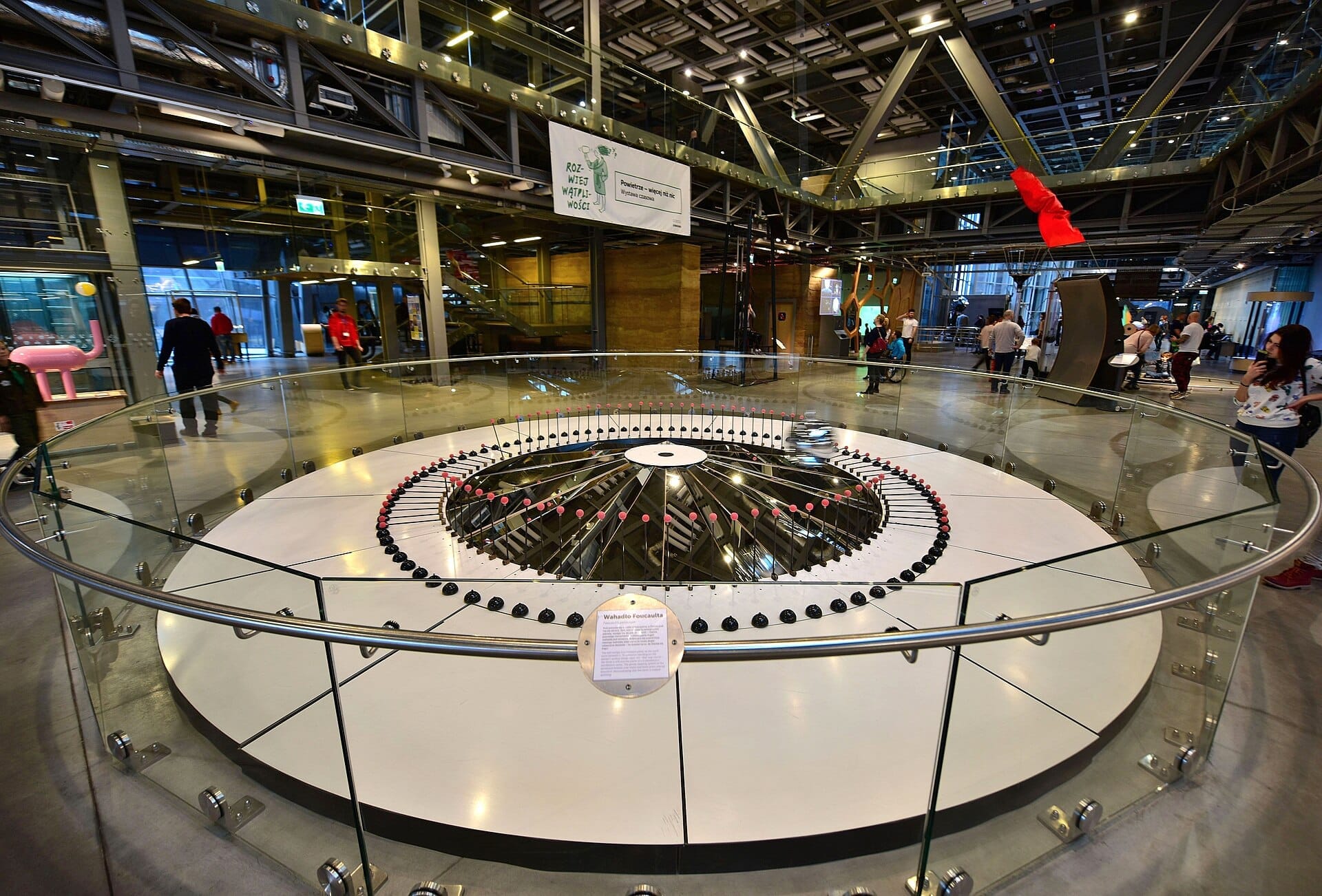
The building covers roughly 15,000 m² and holds more than 450 interactive exhibits organised into thematic zones covering physics, biology, human perception, technology, mathematics, and Earth sciences. There is also a planetarium, a children's laboratory zone for younger visitors, and a rooftop garden that doubles as an outdoor science park during the warmer months. Few science museums in Central Europe match the breadth and production quality on offer here.
💡 Local tip
Book tickets online in advance, especially on weekends and school holidays. The planetarium runs ticketed shows on a fixed schedule and sells out regularly. The official website (kopernik.org.pl) allows seat selection for planetarium sessions.
The Exhibition Floors: What You Will Actually Encounter
Walking into the main hall, the first thing you notice is the noise: not chaotic noise, but the productive hum of people actively engaged with objects. Children are pedalling bicycle generators to light bulbs, adults are leaning over tables watching fluid dynamics experiments, and teenagers are competing on reaction-time stations. The exhibits are built to survive heavy daily use and most of them work exactly as intended.
The zones are loosely themed but the floor plan is open enough that you move between them naturally. The human biology section lets visitors explore perception, optical illusions, and the mechanics of the body through tactile models and live feedback stations. The physics and motion zones cover everything from pendulum dynamics to gyroscopes scaled large enough to sit inside. The mathematics area is unexpectedly engaging even for people who claim to dislike the subject, partly because the exhibits focus on pattern, structure, and surprise rather than calculation.
Temporary exhibitions rotate throughout the year and are usually ticketed separately from the permanent collection. They tend to focus on applied science topics with contemporary relevance, including climate, urban systems, and digital technology. Check the centre's website before your visit to see what is running, as these exhibitions can meaningfully change the experience.
Tickets & tours
Hand-picked options from our booking partner. Prices are indicative; availability and final rates are confirmed when you complete your booking.
Palace of Culture and Science skip-the-line ticket and tour in Polish
From 19 €Instant confirmationFree cancellationEscape Tour self-guided, interactive city challenge in Warsaw
From 30 €Instant confirmationEscape Tour self-guided, interactive city challenge in Warsaw
From 30 €Instant confirmationPalace of Culture and Science skip-the-line ticket and tour in English
From 34 €Instant confirmationFree cancellation
The Planetarium: A Separate Experience Worth Scheduling Around
The planetarium sits within the main building complex and screens a rotating programme of dome films, science shows, and evening concerts. The standard daytime show covers astronomical observation and runs about 40 minutes. Tickets cost 34 zł full price and 24 zł reduced. Evening planetarium concerts are a different proposition entirely: the dome becomes a visual and audio environment for music performances, and tickets run 55 zł. These sell out well ahead of time.
The dome itself is a digital projection system capable of rendering the full night sky with a fidelity that makes it worth experiencing on its own merits, independent of the specific programme running during your visit. If you are visiting with children who are engaged by space, factor in at least one planetarium session when planning your day. Shows are offered in Polish, but some programmes have English audio guides or subtitles — confirm availability when booking.
ℹ️ Good to know
Planetarium shows begin on time and latecomers are typically not admitted once the dome is dark. Arrive at least 10 minutes before your session starts.
The Rooftop Garden: An Often-Overlooked Layer
The rooftop garden, referred to as 'The Garden' by the centre, is an outdoor science park with exhibits calibrated for younger children and open-air experiments. It opens daily from 1 May through 1 September, 10:00–20:00, and from 2 September through 31 October, 10:00–17:00. It is closed from November through April.
From the rooftop, you get an unobstructed view across the Vistula River toward the Praga district on the eastern bank, with the railway bridges framing the scene to the north. On a clear afternoon this is one of the better river views in Warsaw, and it is rarely as crowded as the main exhibition floors below. The outdoor exhibits here include water flow channels, sand dynamics, and shadow experiments, making it particularly good for children aged roughly 3–8 who might find the indoor exhibits too cognitively demanding.
The rooftop garden connects visually and thematically to the wider Vistula riverfront development, which has transformed this stretch of the left bank into a public space with cycling paths, cafes, and riverside access. After your visit, it is worth walking south along the riverbank toward the Vistula Boulevards, particularly in the evening when the city lights reflect off the water.
When to Visit and How the Experience Changes by Time of Day
Weekday mornings, particularly Tuesday through Thursday between 9:00 and 11:30, are the quietest windows. School groups begin arriving mid-morning and by 11:00 the main exhibition floors pick up significantly. If you are visiting without children and want to engage thoughtfully with the exhibits, arriving at opening on a weekday is the best approach.
Weekends between 10:00 and 14:00 are the busiest periods of the week, and the noise level in the main hall rises considerably. This does not make the experience unpleasant, but it does mean queuing for some of the more popular interactive stations. By mid-afternoon on Saturdays and Sundays, visitor flow typically eases as families with young children begin to leave. Friday evenings are a practical option: the centre often stays open until 20:00 on Fridays, which is later than most other days, and the evening crowd tends to include more older visitors and fewer school groups.
Polish school holidays, which vary by region but typically fall in late January, April, June through August, and late December, bring dramatically higher visitor numbers. During summer in particular, expect the planetarium to be fully booked days in advance and the exhibition floors to feel crowded by late morning. Visiting in autumn or early spring avoids both the summer crowds and the winter closure of the rooftop garden.
⚠️ What to skip
During school holiday periods, planetarium tickets can sell out 2–3 days ahead. If the planetarium is a priority, book the moment your travel dates are confirmed.
Getting There, Accessibility, and Practical Logistics
The most direct public transport option is Metro Line M2, which stops at Centrum Nauki Kopernik station, roughly a 5-minute walk from the building entrance. Bus lines 102, 162, and 185 stop at Metro Centrum Nauki Kopernik, while lines 105, 118, and 127 stop at Biblioteka Uniwersytecka, slightly further but still within easy walking distance. The building sits on Wybrzeże Kościuszkowskie, the riverside road, and is clearly visible from the riverbank.
The Copernicus Science Centre is described by the institution as fully barrier-free, with step-free access throughout the building, accessible toilet facilities, and elevators connecting all floors. Visitors with disabilities qualify for reduced-price tickets. Prams and pushchairs are accommodated without difficulty. This is one of the more accessible large museums in Warsaw.
If you are planning a full day in this part of the city, the University of Warsaw Library Garden is a short walk north along the riverbank and makes a calm counterpoint to an afternoon at the science centre. For a longer itinerary, the guide to Warsaw with kids covers how to combine the science centre with other family-appropriate stops across the city.
Opening Hours at a Glance
- Tuesday–Thursday: 9:00–18:00
- Monday: 9:00–18:00 during Polish summer school holidays only; closed on other Mondays (verify on kopernik.org.pl)
- Friday: 9:00–20:00
- Saturday–Sunday: 9:00–19:00
- Rooftop garden (May 1–Sep 1): open daily 10:00–20:00
- Rooftop garden (Sep 2–Oct 31): open daily 10:00–17:00
- Rooftop garden: closed November–April
Is It Worth Your Time?
For visitors with children aged roughly 5 to 15, the Copernicus Science Centre is close to the most productive use of half a day in Warsaw. The exhibits hold attention, the building is comfortable, there is an on-site cafe for breaks, and the planetarium adds a structured anchor to what might otherwise be an unstructured wander. The ticket price is reasonable by Western European museum standards.
For adults visiting without children, the verdict is more conditional. If you enjoy hands-on science engagement, the centre offers enough depth to keep an intellectually curious adult occupied for two to three hours. If you are primarily interested in Warsaw's history, architecture, or cultural heritage, your time is probably better spent elsewhere. The centre does not address Warsaw's history in any significant way, which means it functions as a complement to, rather than a substitute for, institutions like the Warsaw Uprising Museum or POLIN.
Visitors focused primarily on Warsaw's Jewish heritage or wartime history should consider the POLIN Museum of the History of Polish Jews or the Warsaw Uprising Museum as higher priorities. Those interested in natural and applied sciences will find the Copernicus Science Centre far more rewarding than the National Museum Warsaw for this type of experience.
Insider Tips
- Friday evenings (open until 20:00) tend to be quieter than weekend mornings and are a good option if you prefer fewer school groups. The planetarium sometimes runs special evening programmes on Fridays that are not available on other days.
- The on-site cafe has reasonable prices by Warsaw standards and serves hot food. Eating there saves backtracking outside to find lunch during a long visit, especially useful with children who are mid-exhibit and reluctant to leave.
- The rooftop garden is not well-signposted from the main exhibition floors. Ask at the information desk for the fastest route up, as taking the wrong elevator will add unnecessary time.
- If your children are under about 6 years old, the dedicated children's laboratory zone (Dzieci na Pokładzie area) is worth locating first. It is scaled and paced for younger children and will hold their attention better than the general exhibition floor, where many exhibits require reading or more developed motor skills.
- Photography is allowed throughout the exhibition without flash. The rooftop in late afternoon light gives excellent shots of the Vistula with the Praga skyline as a backdrop, and it requires no special equipment or permit.
Who Is Copernicus Science Centre For?
- Families with school-age children (roughly 5–15) looking for a full half-day activity
- Rainy or cold-weather days when outdoor Warsaw exploration is impractical
- Science and technology enthusiasts who enjoy participatory rather than display-based museums
- Visitors combining a museum morning with an afternoon walk along the Vistula riverbank
- Groups with mixed ages, where the planetarium provides a shared structured experience that works for all
Nearby Attractions
Other things to see while in Vistula Riverfront (Bulwary Wiślane):
- National Stadium (PGE Narodowy)
The PGE National Stadium (officially PGE Narodowy im. Kazimierza Górskiego) is Warsaw's largest venue and one of Central Europe's most recognizable modern structures. Built on the east bank of the Vistula and completed in 2011, it hosts Poland's national football matches, major concerts, and year-round public tours with a rooftop viewing point over the city.
- University of Warsaw Library Garden (Ogrody BUW)
Perched 16 meters above the Powiśle campus, the University of Warsaw Library Garden (Ogrody BUW) is one of Europe's largest roof gardens, covering about 10,000 square meters of planted terraces, color-themed beds, and pedestrian bridges. Admission is free, the views toward the Vistula are genuine, and the atmosphere is calm enough to make most of Warsaw's tourist attractions feel very far away.
- Vistula Boulevards (Bulwary Wiślane)
The Vistula Boulevards stretch along the left bank of the Vistula River in central Warsaw, offering a free, open promenade lined with outdoor cafés, sandy beaches, cycling paths, and sweeping views of the eastern bank. Opened in phases from 2015, 2017, and 2019, they transformed a neglected riverfront into the city's most relaxed gathering space. This guide covers what to expect by season and time of day, how to get there, and what to do along the way.
- Vistula River Beaches
Every summer, sandy beaches emerge along Poland's longest river right in the heart of Warsaw. Free to access, strung with pop-up bars and volleyball nets, and backed by one of Europe's more dramatic city skylines, the Vistula River Beaches are genuinely worth an afternoon of your time.