Krasiński Palace & Garden: Warsaw's Free Baroque Jewel
Krasiński Palace, also known as the Palace of the Commonwealth, is a late 17th-century Baroque masterpiece designed by Tylman van Gameren. After decades as a closed National Library repository, it reopened to the public in May 2024 with free admission. Behind the palace, the 11.8-hectare Krasiński Garden offers a welcome green escape just north of the Old Town.
Quick Facts
- Location
- Plac Krasińskich 3/5, 00-288 Warsaw (Muranów, north of Old Town)
- Getting There
- Ratusz Arsenał metro (M1 line, ~7 min walk); Muranów tram/bus stop (~5 min walk)
- Time Needed
- 45–90 min for palace interior; add 30–60 min for the garden
- Cost
- Free admission to the palace’s permanent exhibition; garden always free
- Best for
- Architecture lovers, history buffs, families wanting a peaceful park, budget travelers
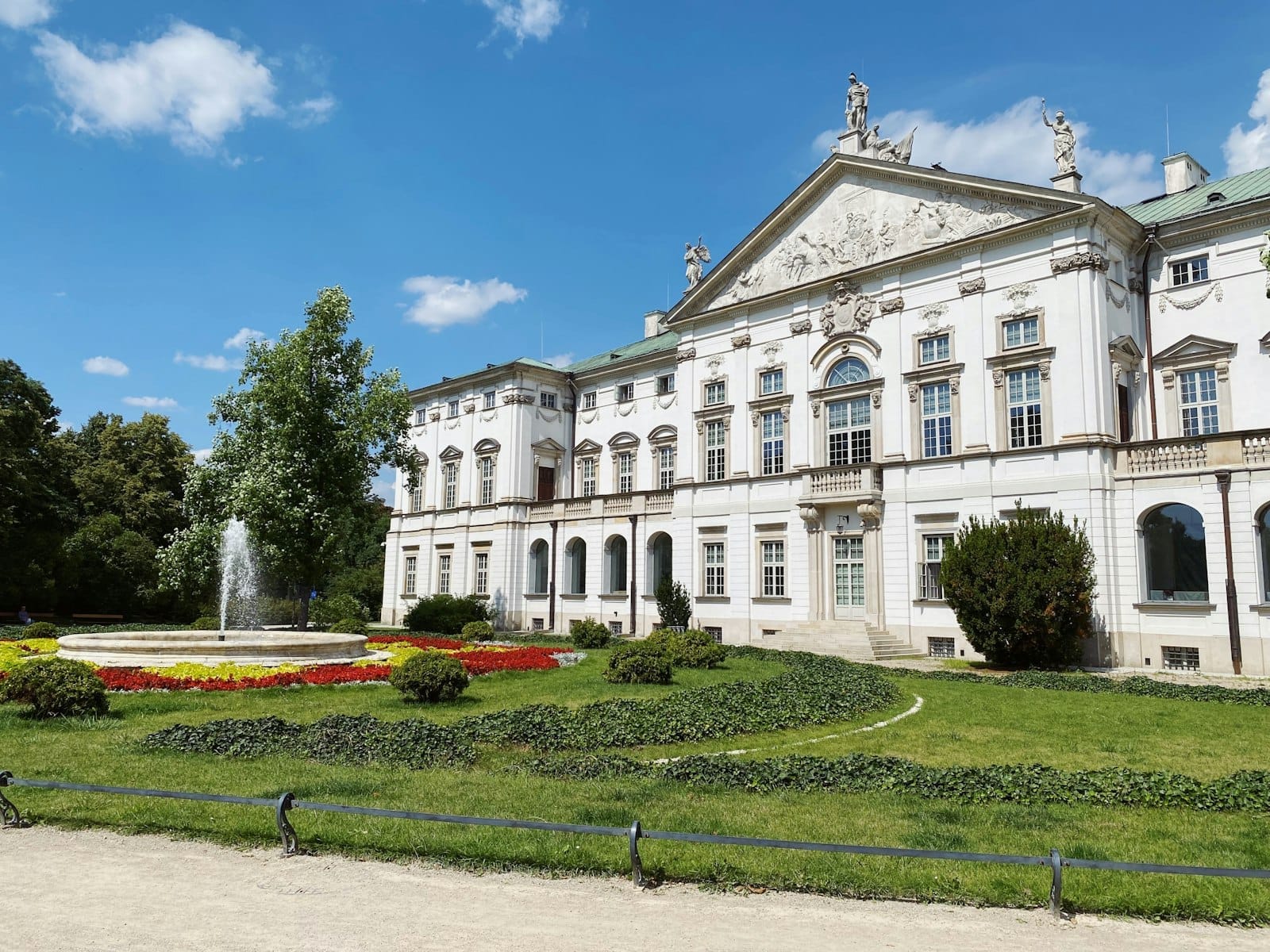
What Is Krasiński Palace?
Krasiński Palace, formally known as the Palace of the Commonwealth (Pałac Rzeczypospolitej), stands on Krasiński Square just a short walk north of Warsaw's Old Town. It is one of the finest examples of Baroque civil architecture in Poland, and for most of its post-war existence it was not regularly open to the public, serving as the special collections repository of the Polish National Library. That changed on 21 May 2024, when the palace reopened after a major modernisation with a public exhibition and free admission.
The building was commissioned by Jan Dobrogost Krasiński, Voivode of Płock, and constructed in stages from approximately 1677 to the mid-1690s. Its architect, Tylman van Gameren, was a Dutch-born master working in Warsaw who shaped the visual character of the Polish-Lithuanian Commonwealth's Baroque capital. The palace's symmetrical facade, rusticated ground floor, and richly carved tympanum reliefs depicting the mythological deeds of Marcus Valerius Corvinus mark it as van Gameren's most ambitious secular commission in Poland.
ℹ️ Good to know
The palace is open six days a week, Wednesday–Monday, and closed on Tuesdays. Admission is free. Confirm current times directly with the Polish National Library (bn.org.pl) before your visit, as hours may change.
The Architecture: What to Look For on the Facade
Standing in Krasiński Square and facing the palace, the first thing that commands attention is the central avant-corps: the slightly projecting centrepiece of the facade crowned with a triangular pediment. The relief carvings in that pediment, executed by Andreas Schlüter, depict scenes from Roman history layered with Baroque allegory. Look for the compositional energy in these reliefs — figures in motion, drapery caught mid-billow — which was considered remarkably dynamic for its period.
The overall proportions are restrained by Baroque standards, which gives the building an air of authority rather than exuberance. Van Gameren drew on Italian and French influences but adapted them to local materials and the Polish architectural tradition, creating something that feels both cosmopolitan and grounded. The building is two storeys over a high basement, with corner projections that anchor the composition visually.
The palace suffered severe damage in 1944 during the Warsaw Uprising and the subsequent Nazi destruction of the city. Reconstruction began in the mid-20th century, with major works in the 1950s and 1960s, and by 1961 the National Library had taken custody of the building for its manuscript and rare book collections. The exterior you see today is a faithful reconstruction of the 17th-century original, which itself makes it part of Warsaw's broader story of painstaking rebuilding from near-total ruin.
For deeper context on how reconstructed architecture fits into Warsaw's identity, the Royal Castle a few minutes' walk south tells a parallel story of destruction and meticulous restoration.
Tickets & tours
Hand-picked options from our booking partner. Prices are indicative; availability and final rates are confirmed when you complete your booking.
Beauty and the Beast Garden of Lights exhibition in Warsaw
From 9 €Instant confirmationMuseum of John Paul II and Primate Wyszyński entrance ticket
From 8 €Instant confirmationPub crawl in Warsaw
From 28 €Instant confirmationFree cancellationWarsaw Museum of Modern Art entrance ticket
From 8 €Instant confirmation
Inside the Palace: The Public Exhibition
The 2024 reopening transformed the palace interior with a new permanent exhibition curated by the Polish National Library. The exhibition draws on the Library's extraordinary special collections: illuminated manuscripts, early printed books, historical maps, and archival documents spanning centuries of Polish and European cultural life. Because the palace had served as a closed repository for decades, much of this material has rarely been seen by the general public.
The interior spaces themselves are part of the experience. The modernisation aimed to make the building publicly accessible while preserving its historical character. Expect high ceilings, period architectural detailing, and display cases that contrast the fragility of centuries-old paper with the solidity of Baroque stonework around them. The atmosphere is quiet and unhurried — closer to a specialized library gallery than a crowded national museum.
This is not a comprehensive survey museum with hours of content. A focused visitor can absorb the exhibition in 45 to 60 minutes. What you will take away is a specific, concentrated encounter with Polish manuscript and book culture rather than a broad historical overview. Visitors who arrive expecting the scope of a large national museum may find the exhibition more intimate than anticipated, but that is a feature, not a flaw.
💡 Local tip
Because the exhibition opened recently, labelling and audio guides may still be limited in English. If Polish-language interpretation concerns you, check the National Library website for current language support before visiting.
Krasiński Garden: The 11.8-Hectare Park Behind the Palace
Directly behind the palace, Krasiński Garden extends across 11.8 hectares of formal and semi-formal green space. The garden predates the palace's post-war closure and has long been a public park for the Muranów and Old Town neighborhoods. On weekday mornings the park is calm enough to hear birdsong over the distant rumble of trams on Bonifraterska Street. By weekend afternoons in spring and summer, families with pushchairs and groups of school children fill the central paths.
The layout retains a formal Baroque structure in parts, with axial paths and geometric planted areas, though the overall feel today is that of a comfortable urban park rather than a strictly maintained historical garden. Mature trees provide dense shade in summer, making the garden genuinely cooler than the surrounding streets. In autumn, the leaf canopy turns quickly and the fallen leaves on the gravel paths give the whole space a melancholy, photogenic quality.
There are benches throughout, and the central fountain area is a natural gathering point. The park is fully open and free at all hours. Note that lighting after dark is moderate rather than bright, so late evening visits in winter are better avoided if you are unfamiliar with the layout.
Krasiński Garden is one of several historic green spaces clustered north of the Old Town. For a broader picture of Warsaw's park landscape, the guide to Warsaw's parks and green spaces covers the full range across the city.
Getting Here and Moving Around the Area
The palace sits on Plac Krasińskich (Krasiński Square) in the Muranów district. The most convenient metro option is Ratusz Arsenał on Line M1, a roughly seven-minute walk heading north along Andersa Street. The Muranów tram and bus stop on Andersa or Bonifraterska Street brings you within five minutes on foot. If you are already in the Old Town, the walk north through the New Town or along Miodowa Street takes about ten to fifteen minutes and passes several other notable buildings.
The square itself is a useful orientation point. The palace faces west across a paved forecourt. The garden entrance is on the east side of the building, accessible via gates on Świętojerska Street and from the square. There is no dedicated parking facility; drivers should use city parking along the surrounding streets and walk in.
The palace sits at a natural junction between the Old Town and the Muranów area. If you are building a half-day route, pairing it with the Monument to the Ghetto Heroes and the POLIN Museum of the History of Polish Jews ten minutes further north makes a coherent and historically resonant morning.
Best Time to Visit and Photography Notes
The palace square faces roughly west, which means the facade catches good light in the afternoon. For exterior photography, arriving between 2pm and 5pm on a sunny day gives the best illumination on the carved reliefs. Morning visits work well for the garden, when the light filters through the tree canopy from the east and the crowds are thinner.
Spring and early summer are the most rewarding times to combine the palace visit with the garden. Blossom appears on several of the ornamental trees in April and May, and the garden feels actively maintained and colourful. In winter, the bare trees and quiet square have their own stark appeal, particularly on a clear frost morning, but check opening hours carefully as the palace may adjust its schedule in the low season.
Photography inside the exhibition is subject to National Library rules. Typically, personal photography without flash is permitted in public exhibition areas, but this should be confirmed at the entrance. The exterior and garden are freely photographable.
⚠️ What to skip
The palace only reopened in May 2024. Opening hours, exhibition content, and language support are all subject to change as the institution settles into regular public programming. Always verify current information at bn.org.pl before planning a trip around this attraction.
Who Should Skip This Attraction
Travelers whose primary interest is Warsaw's World War II history or its post-communist urban transformation will find the palace a side note rather than a centrepiece. The exhibition is focused on manuscript and book heritage, not military or political history. If you have limited time in Warsaw and are choosing between this and the Warsaw Uprising Museum or POLIN, those larger institutions carry more narrative weight for a first-time visitor.
Similarly, visitors who have already spent time at the Royal Castle and the Old Town Market Square may find Krasiński Palace rounds out an architecture-focused day rather than anchoring one.
Insider Tips
- The tympanum reliefs by Andreas Schlüter are best examined with binoculars or a telephoto lens: from street level the detail is easy to miss. Bring a camera with optical zoom if the carvings interest you.
- Weekday mornings between opening and noon are the quietest window inside the exhibition. Weekend afternoons draw school groups and families to both the palace and the garden.
- The garden's north gate on Świętojerska Street is less used and offers a quieter entry point if the main square is busy with tour groups moving between the Old Town and Muranów.
- Because admission is free and the palace is still relatively unknown to international visitors, there are no timed entry slots and no advance booking system. Simply turn up during opening hours.
- Combine the visit with a coffee stop on Freta Street in the New Town, a five-minute walk south, before or after. It is one of the least commercialised stretches near the Old Town and a good decompression point between sights.
Who Is Krasiński Palace & Garden For?
- Architecture enthusiasts interested in Polish Baroque and the work of Tylman van Gameren
- History readers curious about rare manuscripts and early printed books from the Polish-Lithuanian Commonwealth
- Budget travelers: the palace, the garden, and the surrounding walk cost nothing
- Families who want a proper park within easy reach of the Old Town
- Photographers looking for a Baroque facade that draws far fewer crowds than the Royal Castle
Nearby Attractions
Other things to see while in Old Town (Stare Miasto):
- Field Cathedral of the Polish Army
The Field Cathedral of the Polish Army (Katedra Polowa Wojska Polskiego) stands on Długa Street just north of the Old Town, opposite the Warsaw Uprising Monument. It is simultaneously a functioning place of worship, the official church of the Polish military, and a layered historical document stretching from a 17th-century wooden chapel to a Katyn memorial added decades after the Second World War.
- Krakowskie Przedmieście
Krakowskie Przedmieście is Warsaw's most storied street, a just-over-1km boulevard connecting Castle Square to Nowy Świat along the historic Royal Route. Lined with baroque churches, neoclassical palaces, statues of Poland's greatest figures, and pavement cafés, it is the spine of the city's public life and the best single walk for understanding Warsaw's history and character.
- Little Insurgent Monument
Standing roughly 1.5 metres tall against Warsaw's ancient red brick city walls, the Little Insurgent Monument is a bronze statue of a child soldier that carries the weight of an entire generation. Free to visit at any hour, it is one of the most emotionally affecting stops in the Old Town.
- Museum of Warsaw
Spread across a row of reconstructed tenement houses on the UNESCO-listed Old Town Market Square, the Museum of Warsaw (Muzeum Warszawy) traces the capital's history from medieval origins to the present day. It is a serious, carefully curated institution that rewards visitors who want context, not just sightseeing.