St. John's Archcathedral: Warsaw's Oldest and Most Significant Church
Standing at the heart of Warsaw's Old Town, St. John's Archcathedral is the city's oldest surviving place of worship, with roots tracing back to the late 14th century. Free to enter and deeply woven into Poland's national story, it rewards visitors who slow down long enough to notice the details — the worn stone floors, the royal tombs below, and the silence that persists even when the streets outside are full.
Quick Facts
- Location
- Kanonia 6, Old Town, Warsaw (Świętojańska Street entrance)
- Getting There
- Bus stops 'Stare Miasto' or 'Plac Zamkowy'; Metro Ratusz Arsenal approx. 1.3 km away
- Time Needed
- 30–60 minutes for the church; extra time if visiting the crypts
- Cost
- Free entry to the main church; crypts may have a separate fee
- Best for
- History enthusiasts, architecture lovers, quiet reflection, Old Town walkers
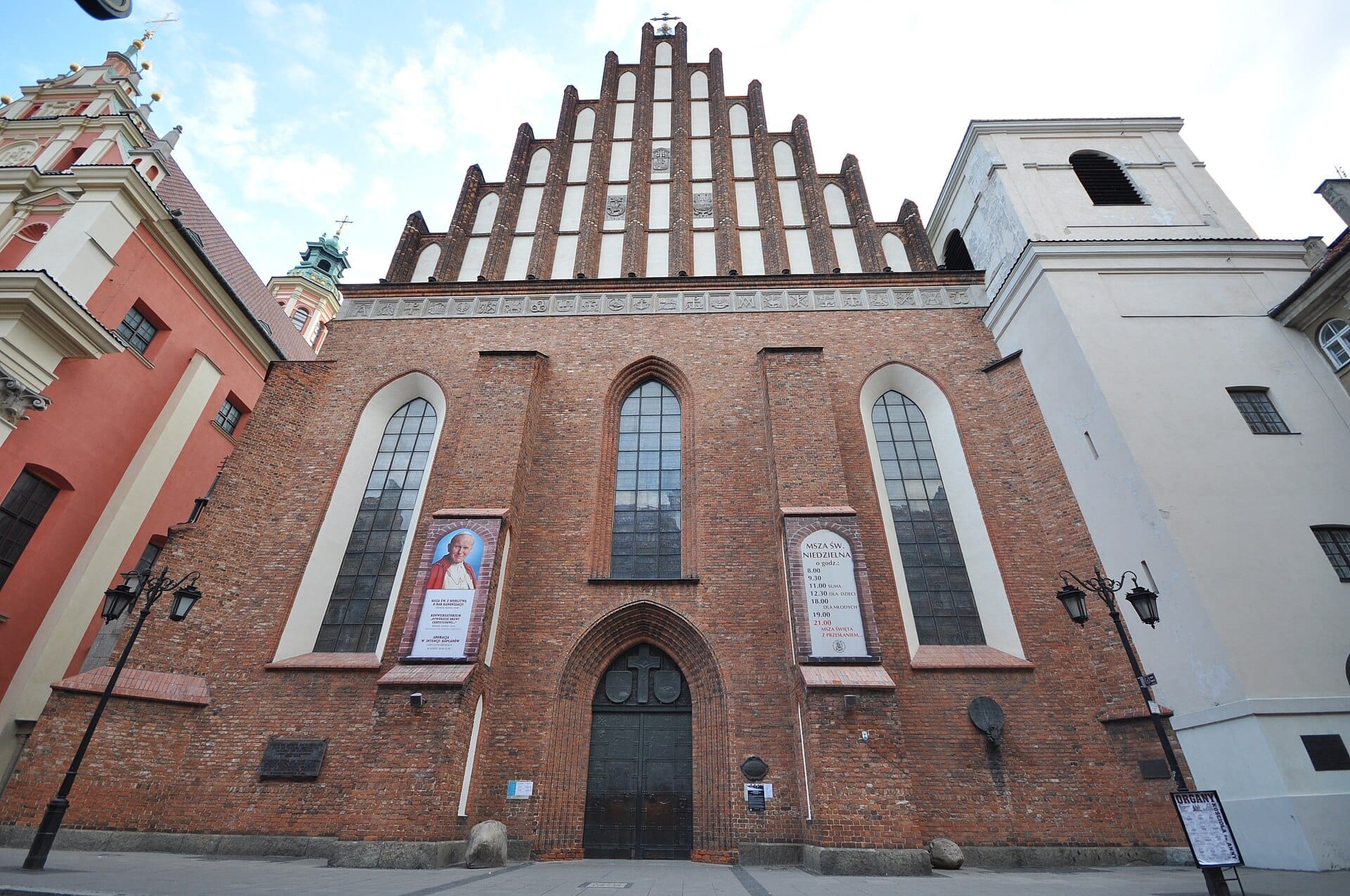
What Is St. John's Archcathedral?
St. John's Archcathedral in Warsaw, officially the Archikatedra św. Jana Chrzciciela w Warszawie, is the oldest church in the city and one of the most historically significant religious buildings in Poland. It stands on Świętojańska Street, threading between the Old Town Market Square and the Royal Castle, which means it sits at the precise geographical and symbolic center of historic Warsaw.
The first wooden structure on this site is believed to date to the late 14th century. By the 15th century, the church had been rebuilt in brick and stone in the Mazovian Gothic style. It became a cathedral in 1798 and was elevated to an archcathedral basilica in 1818. That institutional history matters: this is not a decorative church that happens to be old. It has been a site of royal coronations, state funerals, and pivotal moments in Polish political life across several centuries.
ℹ️ Good to know
Entry to the main church interior is free of charge. The crypts, which hold royal and notable tombs, may require a separate ticket. Verify current crypt admission on-site, as prices are subject to change.
The Architecture: Gothic Bones Under a Reconstructed Shell
From the outside, the cathedral's facade can initially feel understated compared to the ornate tenement houses lining the surrounding streets. The exterior was rebuilt after World War II using photographs, drawings, and architectural surveys, and the decision was made to restore it to a relatively austere Mazovian Gothic appearance rather than a more embellished later form. The result is a church that reads as older and more restrained than many of its European counterparts, which is entirely appropriate given its age.
Step inside and the proportions become clear. The nave is tall and narrow, with the kind of compressed verticality typical of Gothic ecclesiastical architecture. Three aisles run the length of the interior, and light enters at an angle that changes significantly depending on the time of day. Morning visits in summer bring a warm, amber light through the windows that falls across the stone columns in a way that early afternoon does not replicate.
Look carefully at the floor: the stone is original in sections, or reflects the texture of what came before. The woodwork of the pews, the side chapels set into the lateral walls, and the ornamental details of the altarpieces reward closer inspection. This is a building best explored slowly, not photographed from the doorway and left.
💡 Local tip
Photography inside is generally permitted without flash, but check posted signs near the entrance. During services, photography is inappropriate and visiting should be paused or done with discretion.
Tickets & tours
Hand-picked options from our booking partner. Prices are indicative; availability and final rates are confirmed when you complete your booking.
Museum of John Paul II and Primate Wyszyński entrance ticket
From 8 €Instant confirmationPub crawl in Warsaw
From 28 €Instant confirmationFree cancellationWarsaw Museum of Modern Art entrance ticket
From 8 €Instant confirmationSafe and Convenient Luggage Storage in Warsaw Old Town
From 6 €Instant confirmationFree cancellation
History Written in Stone: From Mazovian Dukes to Polish Independence
The cathedral's history is inseparable from Warsaw's own. The Mazovian dukes who governed the region before Warsaw's rise as capital held important ceremonies here. When Poland's political center shifted and Warsaw became the seat of the Sejm (the Polish parliament) in the late 16th century, St. John's grew in national importance accordingly.
The Constitution of May 3, 1791, widely regarded as the first modern national constitution in Europe, was solemnly proclaimed at St. John's immediately after its adoption at the Royal Castle next door. Deputies took an oath before the altar. That moment is commemorated in Polish national memory as one of the defining acts of the late Polish-Lithuanian Commonwealth.
The crypts beneath the cathedral contain the remains of notable figures from Polish history, including Henryk Sienkiewicz, Gabriel Narutowicz, and various Mazovian nobles, alongside other prominent statesmen and cultural figures. Exploring these underground spaces adds a layer to the visit that the main nave alone cannot provide. For broader context on Warsaw's layered past, the nearby Royal Castle and the Museum of Warsaw both hold relevant collections.
World War II was catastrophic for the cathedral. During the 1944 Warsaw Uprising, the building was heavily damaged by German forces and later deliberately demolished as part of the systematic destruction of Warsaw. What stands today is a postwar reconstruction, completed through meticulous archival work. Knowing this does not diminish the experience, but it does reframe it: what you are seeing is as much a testament to Polish determination to restore what was lost as it is to the original medieval builders.
Visiting: What to Expect at Different Times of Day
The cathedral is an active place of worship, which shapes the rhythm of visits. Weekday mornings tend to be the quietest periods, with a modest trickle of tourists and local worshippers. The relative calm allows you to stand and absorb the nave without feeling the pressure of a group moving through. Morning light from the east-facing windows is worth catching if you are already in the Old Town at that hour.
Midday and early afternoon on weekends bring noticeably more visitors, particularly in summer. The street outside, Świętojańska, channels foot traffic between the Market Square and the Royal Castle, so the church entrance receives visitors almost constantly. Even so, the interior has enough depth and side chapels that it rarely feels genuinely crowded. If you want a few minutes of near-solitude, stepping into one of the lateral chapels away from the main nave usually does it.
Late afternoon in the warmer months is a reasonable alternative: tourist volume begins to drop after 4pm, and evening light gives the exterior stonework a different, warmer quality. Attending a weekday evening Mass, if your schedule allows, provides a completely different register of the space, with organ music and candlelight creating an atmosphere that standard tourist visits do not replicate.
⚠️ What to skip
The approach along Świętojańska Street is paved with uneven cobblestones. The entrance to the nave involves steps; a wheelchair ramp is sometimes available but cannot be guaranteed. Visitors with mobility concerns should contact the cathedral in advance.
The Surrounding Area: Fitting the Cathedral Into Your Old Town Visit
St. John's sits in one of the most compact concentrations of historic sites in Warsaw. The Old Town Market Square is a two-minute walk north. The Royal Castle is practically adjacent to the south. The Sigismund's Column stands in Castle Square at the bottom of Świętojańska Street, making it a natural orientation point.
A short distance further, the Warsaw Barbican marks the northern edge of the Old Town walls and connects the historic core to the New Town. Combining the cathedral with these sites makes for a coherent half-day walk that covers the most historically layered part of the city without requiring transport.
If Warsaw's religious heritage interests you more broadly, the best churches in Warsaw guide covers a range of denominations and architectural periods across the city, many of which are also free to enter.
Honest Assessment: Is It Worth Your Time?
For most visitors to Warsaw's Old Town, St. John's Archcathedral is genuinely worth thirty minutes of attention, particularly if history or architecture is part of what drew you here. It is not a spectacle in the way that some European cathedrals are: it does not have ceiling frescoes that stop you in your tracks or a treasury of gold artifacts on display. Its power is quieter than that.
Visitors who prefer dramatic, ornate interiors and are making choices about limited time may find the cathedral underwhelming relative to other stops. The same honest caveat applies to the Old Town as a whole: it is a reconstruction, and the cobblestoned perfection can feel slightly stage-managed compared to the more gritty and authentic districts across the river. Understanding that context ahead of time helps set appropriate expectations.
Those who arrive knowing a little about Polish history, particularly the Constitution of 1791 or the fate of Warsaw during World War II, will find the cathedral significantly more resonant. The physical space becomes a vessel for those stories rather than just an old building.
Insider Tips
- If you want to see the crypts, ask about access near the entrance or at the information point inside. The crypt section is not always prominently signed and easy to miss on a self-guided visit.
- Weekday mornings between opening and 10am are the quietest period. Arriving then means you may have the nave nearly to yourself for several minutes at a time, which is rare for any Old Town attraction in summer.
- The small Kanonia Square behind the cathedral (accessible through a passage off Świętojańska) contains one of the oldest bells in Warsaw and a quiet courtyard that almost no tourists find. It takes ninety seconds to walk through and is a worthwhile detour.
- If you are visiting in May, check whether any events mark the anniversary of the Constitution of May 3, 1791. Ceremonies sometimes take place at or near the cathedral and add a layer to the visit that no standard tour provides.
- The church faces east on Świętojańska, so morning sun falls more directly on the facade, while photographers aiming for evenly lit exterior shots may prefer earlier in the day or overcast conditions.
Who Is St. John's Archcathedral For?
- History enthusiasts interested in Polish political and religious heritage
- Architecture lovers exploring medieval and Gothic reconstruction
- Travelers doing a full Old Town walking circuit
- Those seeking a quiet, reflective pause amid the busy Market Square area
- Visitors with an interest in World War II reconstruction and Polish resilience
Nearby Attractions
Other things to see while in Old Town (Stare Miasto):
- Field Cathedral of the Polish Army
The Field Cathedral of the Polish Army (Katedra Polowa Wojska Polskiego) stands on Długa Street just north of the Old Town, opposite the Warsaw Uprising Monument. It is simultaneously a functioning place of worship, the official church of the Polish military, and a layered historical document stretching from a 17th-century wooden chapel to a Katyn memorial added decades after the Second World War.
- Krakowskie Przedmieście
Krakowskie Przedmieście is Warsaw's most storied street, a just-over-1km boulevard connecting Castle Square to Nowy Świat along the historic Royal Route. Lined with baroque churches, neoclassical palaces, statues of Poland's greatest figures, and pavement cafés, it is the spine of the city's public life and the best single walk for understanding Warsaw's history and character.
- Krasiński Palace & Garden
Krasiński Palace, also known as the Palace of the Commonwealth, is a late 17th-century Baroque masterpiece designed by Tylman van Gameren. After decades as a closed National Library repository, it reopened to the public in May 2024 with free admission. Behind the palace, the 11.8-hectare Krasiński Garden offers a welcome green escape just north of the Old Town.
- Little Insurgent Monument
Standing roughly 1.5 metres tall against Warsaw's ancient red brick city walls, the Little Insurgent Monument is a bronze statue of a child soldier that carries the weight of an entire generation. Free to visit at any hour, it is one of the most emotionally affecting stops in the Old Town.