Old Royal Naval College: Greenwich's Baroque Masterpiece on the Thames
One of England's finest examples of Baroque architecture, the Old Royal Naval College occupies a dramatic riverside site in Greenwich where English monarchs were born and history was made. From Sir Christopher Wren's twin-domed colonnades to Sir James Thornhill's staggering Painted Hall ceiling, this UNESCO World Heritage Site rewards every visitor who makes the journey southeast.
Quick Facts
- Location
- Old Royal Naval College, Greenwich, London SE10 9NN
- Getting There
- DLR: Cutty Sark for Maritime Greenwich (5-min walk); River: Greenwich Pier via Uber Boat by Thames Clippers (about a 2–3‑min walk)
- Time Needed
- 1.5 to 3 hours (grounds + Painted Hall + Chapel)
- Cost
- Adult Painted Hall tickets from approximately £17.50–£19; grounds free to enter daily 07:00–19:00. Confirm current prices at ornc.org before visiting.
- Best for
- Architecture lovers, history enthusiasts, art admirers, and day-trippers combining Greenwich's World Heritage sites
- Official website
- ornc.org
What Is the Old Royal Naval College?
The Old Royal Naval College is the dominant riverside landmark of Greenwich, a grand Baroque complex of buildings that lines the south bank of the River Thames in southeast London. Designed by Sir Christopher Wren and continued by Nicholas Hawksmoor and John Vanbrugh, it is considered one of the finest groupings of Baroque architecture anywhere in the world. It forms the centrepiece of Maritime Greenwich, a UNESCO World Heritage Site inscribed in 1997.
The site has layers of history that stretch back centuries before Wren ever put pen to paper. This was the location of the Palace of Placentia, a 15th-century manor first established by Humphrey, Duke of Gloucester and later rebuilt as a proper royal palace by Henry VII in the late 1490s. Henry VIII was born here in 1491, as were his daughters Mary I and Elizabeth I. The palace fell into disuse during the Civil War and was eventually demolished, paving the way for the current complex, which was commissioned by William III and Mary II in 1694 as a Royal Hospital for Seamen.
💡 Local tip
The grounds are free to enter from 07:00 daily. Arriving before 10:00 means you can walk the colonnades and take photographs in near-solitude — the paid buildings open at 10:00.
The Painted Hall: England's Sistine Chapel
The single greatest reason to pay for entry is the Painted Hall. Completed between 1707 and 1726 by Sir James Thornhill, this immense Baroque interior covers over 3,700 square metres of painted walls and ceiling — one of the largest painted architectural interiors in Britain. Thornhill worked for nearly two decades on the commission, depicting allegorical scenes of the triumph of British naval power and the Protestant monarchs William and Mary on the ceiling above the Lower Hall.
Standing beneath the ceiling and looking straight up, the sheer density of detail is disorienting in the best way. Thornhill painted around 200 figures into the composition, layering classical allegory with portraits of real historical individuals. The colours retain surprising richness despite the centuries, and the illusionistic architectural framing painted around the scenes creates a false depth that warps your sense of the room's actual dimensions.
In January 1806, the body of Admiral Lord Nelson lay in state here following the Battle of Trafalgar. Tens of thousands of people queued to pay their respects. A small interpretive display within the hall notes the event, connecting the art around you directly to the human stories this building witnessed.
💡 Local tip
Bring a small pair of binoculars or use your phone's zoom camera to examine the ceiling detail from the floor. The perspective-altering painting is easiest to appreciate from the far end of the Lower Hall, near the entrance.
Tickets & tours
Hand-picked options from our booking partner. Prices are indicative; availability and final rates are confirmed when you complete your booking.
Thames Roundtrip Cruise and Old Royal Naval College with Painted Hall
From 43 €Instant confirmationFree cancellationThames One-Way Cruise and Old Royal Naval College with Painted Hall
From 31 €Instant confirmationFree cancellationThe Cotswolds day trip from London
From 67 €Instant confirmationFree cancellationThe British Royalty Tour with Changing of The Guard Ceremony
From 30 €Instant confirmationFree cancellation
The Chapel of St Peter and St Paul
The chapel sits across the site in the Queen Mary Court, and it delivers a completely different architectural mood. Where the Painted Hall is operatically theatrical, the chapel interior designed by James 'Athenian' Stuart after a fire in 1779 is cooler and more restrained: pale blue and white plasterwork, slender columns, and classical detailing that reflects the Neoclassical tastes of the late 18th century rather than the Baroque exuberance next door.
The chapel remains a working place of worship for the Old Royal Naval College community and local congregations, while the University of Greenwich now occupies much of the complex. Services are held regularly, and the organ is played on occasion. If you arrive and hear organ music drifting from the chapel door, pause: the acoustics in that space are impressive. The chapel is included in the standard paid ticket.
The Architecture and Grounds: A Walk Through Wren's Vision
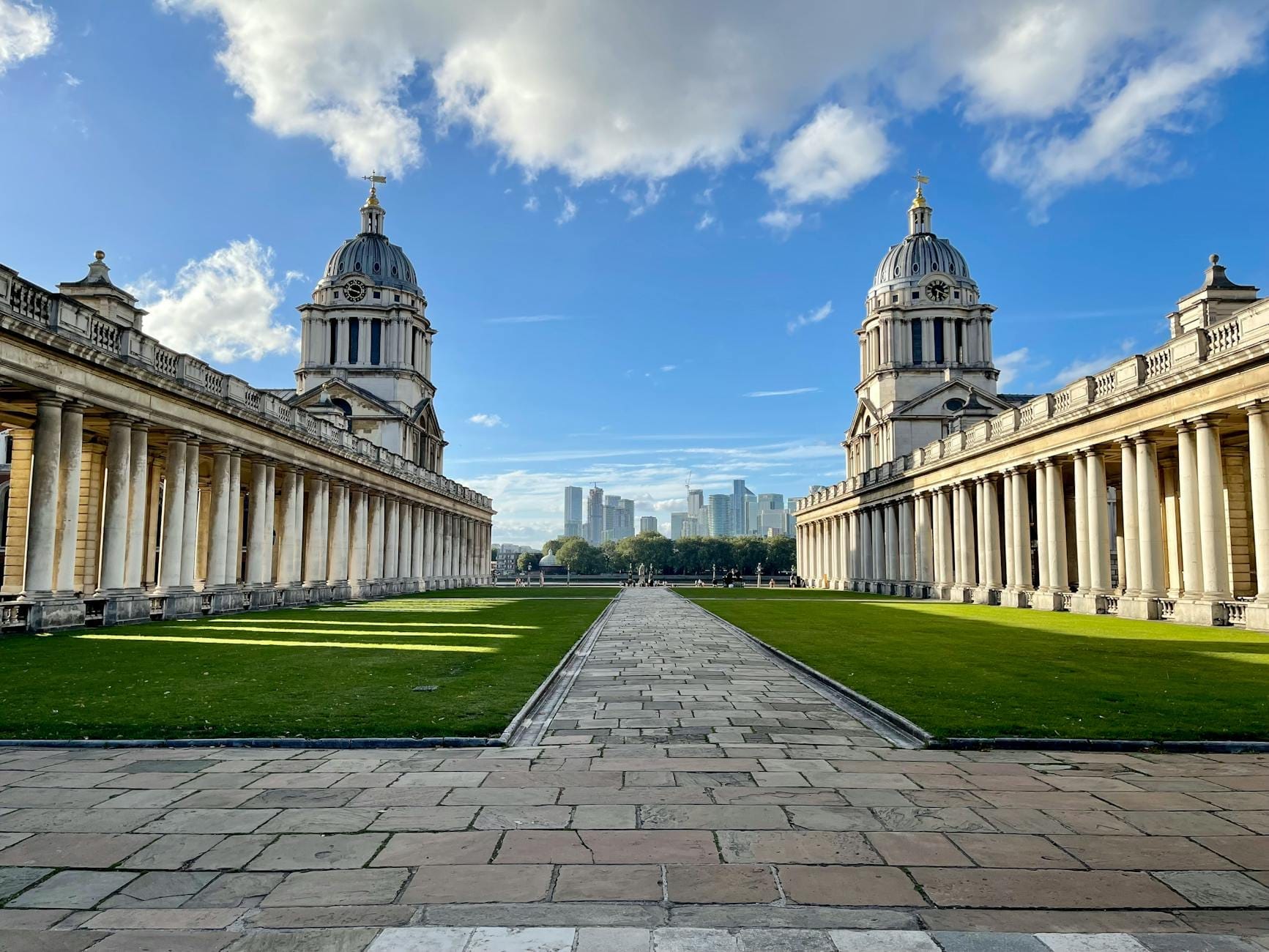
Wren's original design had to contend with a constraint that shaped the entire site: Queen Mary II insisted that the new hospital not block the Thames views from the Queen's House, Inigo Jones's earlier classical villa further inland. The result was the celebrated open vista — the two colonnaded wings pull apart symmetrically, framing the Queen's House in the middle distance with Greenwich Park's hill rising behind it. From the river, this view is one of the most photographed architectural compositions in London.
Walking between the two great courts, you pass through corridors of Portland stone columns beneath the twin domes of the King William and Queen Mary Buildings. The scale is naval in ambition: this complex was designed to house around 2,700 pensioners at its peak. It functioned as a naval hospital until 1869, then became the Royal Naval College in 1873 for officer education before the navy withdrew in 1997. Today it houses the University of Greenwich and Trinity Laban Conservatoire of Music and Dance. It also appears frequently in film and television productions — if the courtyard looks familiar, it featured prominently in productions celebrating British royal and historical settings.
The grounds themselves are a pleasure to walk at any hour. Early mornings on weekdays, you'll share the colonnades with university students and the occasional jogger. On weekend afternoons in summer, tour groups and families dominate. The paved areas between courts are broad enough to feel spacious even at peak times, and the constant sight lines toward the Thames keep the sense of openness intact.
ℹ️ Good to know
The grounds are open daily from 07:00 to 19:00 and are free to access. The Painted Hall, Visitor Centre shop and ticket desk are typically open 10:00–17:00, while the Chapel usually keeps shorter hours. Confirm hours at ornc.org as events occasionally cause early closures.
Best Time to Visit and How It Changes Through the Day
Weekday mornings between 10:00 and 12:00 offer the most comfortable experience inside the Painted Hall. The main tour groups typically arrive after midday, and you will have more room to stand at the optimal viewing distance from the ceiling without craning around other visitors. On summer weekends, the interior can feel crowded by 13:00.
The exterior is photogenic at almost any time, but the golden hour before sunset in late afternoon is exceptional when the light catches the Portland stone facades from the river side. If you arrive by Uber Boat from central London, the approach from the water gives you the most dramatic first sight of the colonnades. Overcast days reduce harsh shadows on the stone detail and often produce cleaner architectural photographs than direct midday sun.
The site pairs naturally with the rest of Greenwich's World Heritage cluster. The Royal Observatory Greenwich and the Prime Meridian Line sit a short uphill walk away through Greenwich Park, and the National Maritime Museum is immediately adjacent. Budget at least half a day to do the area justice.
Getting There: Your Options from Central London
The most straightforward route is the DLR from Bank or Tower Gateway, alighting at Cutty Sark for Maritime Greenwich station. The walk from the station to the college entrance takes about five minutes through a small pedestrian street. The station is step-free, making this a good option for wheelchair users or those with pushchairs.
The river journey on Uber Boat by Thames Clippersto Greenwich Pier is a enjoyable alternative that gives you the riverside approach Wren intended. Services run from multiple central London piers including Embankment, Bankside, and London Bridge. Journey time from central London is typically about 30–40 minutes, and the fare is covered by Oyster and contactless payment. Bus routes 129, 177, 188, 286, and 386, as well as night bus N1, stop on Nelson Road beside the site.
Practical Details: Accessibility, Photography, and What to Bring
Manual wheelchairs are available to hire from the Tourist Information Centre in the Visitor Centre between 10:00 and 17:00 on a first-come, first-served basis with a refundable £50 deposit. For detailed step-free access information or to arrange assistance in advance, contact the site directly via ornc.org.
Photography is permitted in the Painted Hall and Chapel without flash, and the ceiling is the obvious focus. A wide-angle lens or the ultra-wide setting on a smartphone gives the best impression of scale. Tripods are not permitted during opening hours. Bring a layer regardless of season: the stone interiors maintain a cool temperature year-round, and the grounds are exposed to Thames winds on cooler days.
There is a cafe in the Visitor Centre. For broader food options, the surrounding streets and the nearby Greenwich Market offer everything from quick bites to sit-down meals. The site is not ideally suited to very young children who cannot walk independently, as the interior spaces require staying on designated paths and the Painted Hall demands quiet.
⚠️ What to skip
Portions of the site close for private events, particularly evening functions in the Painted Hall, which is a popular corporate and wedding venue. Check the events calendar on ornc.org before you travel to confirm access on your chosen date.
Insider Tips
- Stand at the far western end of the Lower Hall in the Painted Hall and look back along the full length of the room before examining anything close-up. The perspective illusions in Thornhill's architectural painting only reveal themselves properly from that distance.
- The riverside path running along the north edge of the complex, between the colonnades and the Thames, is one of the best spots in London for an unobstructed photograph of the twin domes. Walk west along it until both domes appear equally spaced above the roofline.
- If you see the chapel doors open and hear music, go in. Organ recitals and choral events happen periodically and are sometimes open to casual visitors. The acoustics reward the detour.
- Combine your visit with the free National Maritime Museum next door before moving uphill to Greenwich Park and the Royal Observatory. Buy your Old Royal Naval College ticket online in advance to skip the queue at the Visitor Centre.
- The grounds are a regular filming location. If you spot equipment or crew on the colonnades, check ornc.org — public access is sometimes restricted on production days, typically with advance notice posted online.
Who Is Old Royal Naval College For?
- Architecture and design enthusiasts who want to understand how Baroque grandeur was applied to a civic institution
- History visitors tracing the Tudor royal birthplace, naval history, and Nelson's final journey home
- Photographers seeking iconic Baroque river views and extraordinary ceiling compositions
- Day-trippers building a full Greenwich World Heritage itinerary combining multiple sites in one visit
- Travellers who prefer substance over hype: this is a exceptional site that rarely feels overcrowded before noon on weekdays
Nearby Attractions
Other things to see while in Greenwich:
- Cutty Sark
Dry-docked in Greenwich since the 1950s, the Cutty Sark is the only surviving tea clipper in the world. Built in 1869 and once among the fastest sailing ships afloat, she now offers visitors a rare chance to walk her decks, stand beneath her hull, and understand what made her legendary. This guide covers everything you need to plan a rewarding visit.
- Greenwich Market
Greenwich Market is the only covered market in London located within a UNESCO World Heritage Site. Open most days with free entry, it blends handmade crafts, global street food, antiques, and independent art under a 19th-century roof, two minutes from Cutty Sark DLR station.
- Greenwich Meridian Line
The Meridian Line at Greenwich marks 0° longitude, the reference point from which all the world's time zones are measured. Set in the courtyard of the Royal Observatory on a hill in Greenwich Park, it's a brief but memorable stop with serious historical weight behind a deceptively simple act: placing one foot in each hemisphere.
- Greenwich Park
Sprawling across 74 hectares of hilltop southeast London, Greenwich Park combines one of the city's finest skyline panoramas with serious historical weight. It's home to the Royal Observatory, the Prime Meridian, a resident deer herd, and centuries of royal history — all free to enter.