Greenwich Market: The World Heritage Market Worth Crossing the City For
Greenwich Market is the only covered market in London located within a UNESCO World Heritage Site. Open most days with free entry, it blends handmade crafts, global street food, antiques, and independent art under a 19th-century roof, two minutes from Cutty Sark DLR station.
Quick Facts
- Location
- Greenwich Church Street, Greenwich, London SE10 9HZ
- Getting There
- Cutty Sark DLR (2 min walk); Greenwich rail station (6 min walk); Greenwich Pier river boat (3 min walk)
- Time Needed
- 1–2 hours for the market; allow half a day if combining with Greenwich Park or the Royal Observatory
- Cost
- Free entry; only pay for what you buy
- Best for
- Foodies, art collectors, weekend day-trippers, families, independent shoppers
- Official website
- greenwichmarket.london
What Makes Greenwich Market Different
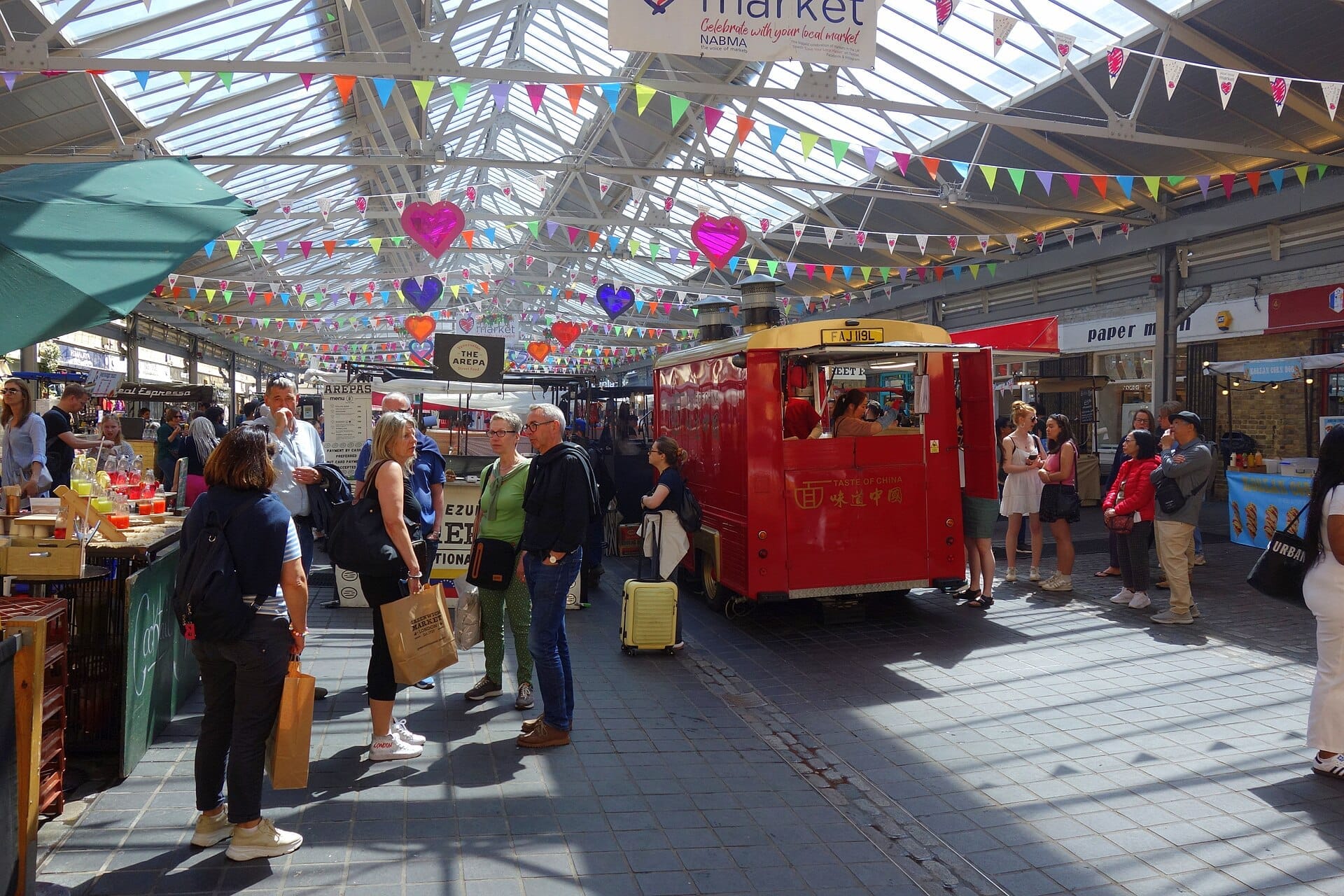
Greenwich Market holds a distinction that no other London market can claim: it is London’s only historic indoor market operating within a UNESCO World Heritage Site. The Maritime Greenwich World Heritage area encompasses the Old Royal Naval College, the Royal Observatory, and the grounds of Greenwich Park. The market sits right at the heart of this zone, tucked between the Naval College and the park entrance, inside a 19th-century covered structure; a market has existed in Greenwich in some form since at least the 14th century.
Its Royal Charter, granted in 1700, established Greenwich as a regulated market for a long term. The market was formally established in the early 18th century. That historical weight shows in the architecture: the iron-and-glass canopy lets in a cool, diffused light that makes the stalls feel more like an indoor piazza than a typical street market. Even on a grey London morning, there is enough natural light to browse without straining.
💡 Local tip
The market typically trades from 10:00 to 17:30 and is open on many bank holidays, but it closes on Christmas Day and occasionally on selected Mondays early in the year. Entry is always free.
The Market by Time of Day
Arrive before 11:00 on a weekday and the atmosphere is almost contemplative. Stallholders are still arranging displays, coffee cups are being topped up, and you can have a proper conversation with the makers and sellers without anyone jostling for position. The smell of fresh coffee and warm pastries drifts from the food vendors near the perimeter, and the light through the canopy has a sharp, clean quality before the midday crowds diffuse it.
Weekends between noon and 14:00 are the busiest period. The food stalls get queues, the craft aisles fill up, and the acoustic echo under the iron roof turns from a low hum into proper market noise: sizzling, chatter, the occasional burst of street music from the area just outside. If crowds bother you, weekday mornings are the clear choice. If you enjoy the energy of a market in full swing, Saturday around midday is when Greenwich Market feels most alive.
By 16:00, the energy softens again. Some food traders begin selling off remaining portions at reduced prices. This is a good window for a second pass if you spotted something earlier and want to buy without the midday pressure.
Tickets & tours
Hand-picked options from our booking partner. Prices are indicative; availability and final rates are confirmed when you complete your booking.
Tour London Greenwich with Where Time Began Exploration Game
From 8 €Instant confirmationFree cancellationLeeds Castle, Canterbury, Dover and Greenwich with river cruise
From 109 €Instant confirmationFree cancellationRoyal Museums Greenwich day pass
From 45 €Instant confirmationFree cancellationSoho Instagram a self-guided walking tour to top photo spots
From 6 €Instant confirmationFree cancellation
What You Will Actually Find Inside
The stall mix rotates across the week, but the market divides broadly into three zones: handmade crafts and artisan goods, art and collectibles, and food. The craft section features printmakers, ceramicists, jewellers, textile artists, and leather workers, most of them selling work they have made themselves. Prices are higher than a car boot sale but reasonable given the craftsmanship, and you are buying directly from the maker rather than a reseller.
The antiques and collectibles traders tend to cluster toward one side of the hall. You will find vintage maps, old photographs, naval memorabilia (fitting for the location), vinyl records, and a rotating selection of small furniture and decorative objects. Whether any of it qualifies as a genuine find depends on your knowledge and patience, but the density of interesting material is higher than in many of London's more tourist-facing markets.
Food is the other strong suit. The street food stalls cover a wide range: Brazilian coxinhas, Venezuelan arepas, Japanese gyoza, Ethiopian injera, Spanish churros, and a rotation of other cuisines that changes with the traders. Quality is generally high because the market is competitive and repeat visitors are part of the customer base. There are also a handful of permanent cafes and eateries on the surrounding streets within a minute's walk of the covered hall.
ℹ️ Good to know
The stall lineup changes across the week. Weekends tend to bring more craft and art traders. Midweek days lean more toward food and vintage goods. Check the Greenwich Market website before visiting if you are specifically targeting a category.
Getting There
The DLR is the most practical route for most visitors. Cutty Sark station puts you two minutes from the market entrance on foot, walking past the ship itself. The DLR runs from Bank and Shadwell in central London, and the journey from Bank takes roughly 20 minutes. Oyster and contactless payment work seamlessly.
If you prefer a scenic approach, the river boat is worth considering. Uber Boat by Thames Clippers serves Greenwich Pier, and the journey from central London piers gives you views of the City, Canary Wharf, and the Thames bends that you simply do not get underground. Greenwich Pier is about three minutes' walk from the market. For first-time visitors, combining the river boat one way with the DLR the other is a satisfying way to see more of the River Thames without doubling back.
Southeastern trains also stop at Greenwich rail station, with services from London Bridge and Charing Cross. The walk from the station to the market is about six minutes through the town centre. This is the least scenic option but useful if you are coming from south or southeast London.
⚠️ What to skip
Driving to Greenwich Market is not recommended. Parking nearby is limited, and the surrounding streets are congested on weekends. Public transport is faster and less stressful from every direction.
The World Heritage Context
Greenwich Market does not exist in isolation. It sits within a district that is one of London's most historically dense neighbourhoods. TheOld Royal Naval College, designed by Christopher Wren and Nicholas Hawksmoor in the late 17th century, is literally next door. The Cutty Sark, the last surviving tea clipper, is a two-minute walk away. The Royal Observatory and the Prime Meridian are a short uphill walk through Greenwich Park. This concentration of major attractions means that a visit to the market is naturally part of a longer Greenwich day, not just a standalone errand.
The National Maritime Museum, one of the largest maritime museums in the world, is also within comfortable walking distance and free to enter. If you are planning a full day in Greenwich, the market works well as a late morning stop between the Naval College and the park, or as a final browse before catching the DLR or boat back.
Photography, Accessibility, and Practical Details
For photography, the covered hall offers interesting light conditions: diffused natural light from above combined with the warm artificial lighting of individual stalls. The contrast can be challenging for automatic exposure, so shooting in RAW or adjusting exposure compensation manually gives better results. Early morning on a weekday, when the market is quieter, also means less movement in the frame if you are composing detailed shots of craft objects or food. Most traders are comfortable with photography of their stalls, but it is polite to ask before taking portraits.
The market is on a single level throughout, with no steps between sections. It is wheelchair accessible, and pushchairs move through the aisles without major difficulty, though the central areas can be tight on busy weekend afternoons. Public toilets are available nearby in the town centre.
Weather has almost no impact on the market experience itself, since the entire hall is covered. This is one of the practical advantages over open-air alternatives like Portobello Road or Borough Market. A wet Sunday in Greenwich is a perfectly good time to visit the market.
Who Should Think Twice
If you are looking for bargain hunting at the scale of Portobello Road Market or the density of Camden Market, Greenwich Market will feel relatively compact. The covered hall is not enormous, and a single circuit takes around 20 to 30 minutes at a relaxed pace. Visitors expecting a sprawling outdoor market experience may find the contained format underwhelming on its own. The market earns its place as part of a wider Greenwich itinerary, not as a destination that justifies a 45-minute journey all by itself.
Those primarily interested in cheap tourist souvenirs will find better value elsewhere. Greenwich Market leans toward original craft and independent food, which means prices reflect the quality of the work. If the goal is mass-produced gifts, the surrounding streets have shops that cater to that. For those building a proper London markets itinerary, Greenwich fits naturally alongside Spitalfields or Maltby Street as a market with genuine character rather than tourist theatre.
Insider Tips
- Weekday mornings between 10:00 and 11:30 offer the best combination of full stalls and minimal crowds. You can talk to the makers properly and take your time with food without queuing.
- The stall mix changes across the week. If you are specifically interested in antiques and vintage collectibles, midweek tends to bring those traders out. Weekend afternoons skew more toward crafts and art.
- Combine the market with a walk up to Greenwich Park and the Royal Observatory immediately after. The park entrance is a short walk from the market's south side, and the views of Canary Wharf and the City from the hilltop are among the best in London.
- The river boat journey from central London to Greenwich Pier is one of the most underused routes in the city. It adds about 20 minutes compared to the DLR but gives you a completely different perspective on the Thames and east London.
- If you are buying from craft stalls, most traders accept card payment, but having some cash for food vendors is still useful, as a few smaller food stalls operate cash-only, particularly on weekdays.
Who Is Greenwich Market For?
- Food lovers wanting to graze through a range of international street food under one roof
- Independent shoppers looking for handmade ceramics, jewellery, prints, and textiles directly from the makers
- Families combining market browsing with a wider Greenwich day trip including the park and museums
- Day-trippers who want a market visit that connects naturally to major London heritage sites
- Photographers drawn to the mix of 19th-century industrial architecture and colourful craft stalls
Nearby Attractions
Other things to see while in Greenwich:
- Cutty Sark
Dry-docked in Greenwich since the 1950s, the Cutty Sark is the only surviving tea clipper in the world. Built in 1869 and once among the fastest sailing ships afloat, she now offers visitors a rare chance to walk her decks, stand beneath her hull, and understand what made her legendary. This guide covers everything you need to plan a rewarding visit.
- Greenwich Meridian Line
The Meridian Line at Greenwich marks 0° longitude, the reference point from which all the world's time zones are measured. Set in the courtyard of the Royal Observatory on a hill in Greenwich Park, it's a brief but memorable stop with serious historical weight behind a deceptively simple act: placing one foot in each hemisphere.
- Greenwich Park
Sprawling across 74 hectares of hilltop southeast London, Greenwich Park combines one of the city's finest skyline panoramas with serious historical weight. It's home to the Royal Observatory, the Prime Meridian, a resident deer herd, and centuries of royal history — all free to enter.
- National Maritime Museum
The National Maritime Museum in Greenwich is the largest maritime museum in the world, housing a vast collection of ship models, navigational instruments, sea charts, and Nelson's bullet-pierced uniform. Entry is free, and the building itself — part of the UNESCO-listed Maritime Greenwich World Heritage Site — is worth the journey from central London alone.