Royal Observatory Greenwich: The Line That Divides the World
Perched on a hill in Greenwich Park, the Royal Observatory Greenwich is where time and longitude were standardised for the modern world. Founded in 1675, it is Britain's oldest purpose-built scientific institution, home to the Prime Meridian line, historic telescopes, and views across London that reward the uphill walk.
Quick Facts
- Location
- Blackheath Avenue, Greenwich, London SE10 8XJ
- Getting There
- Cutty Sark DLR, Greenwich Station (National Rail / Elizabeth line via changes), Maze Hill Station, or Greenwich Pier by river bus
- Time Needed
- 1.5 to 2.5 hours for the observatory; add 30–60 minutes for the park walk
- Cost
- Adults £24 / Children £12 (GBP). Greenwich Park itself is free.
- Best for
- History lovers, families, science enthusiasts, photography, and views over London
- Official website
- www.rmg.co.uk/royal-observatory
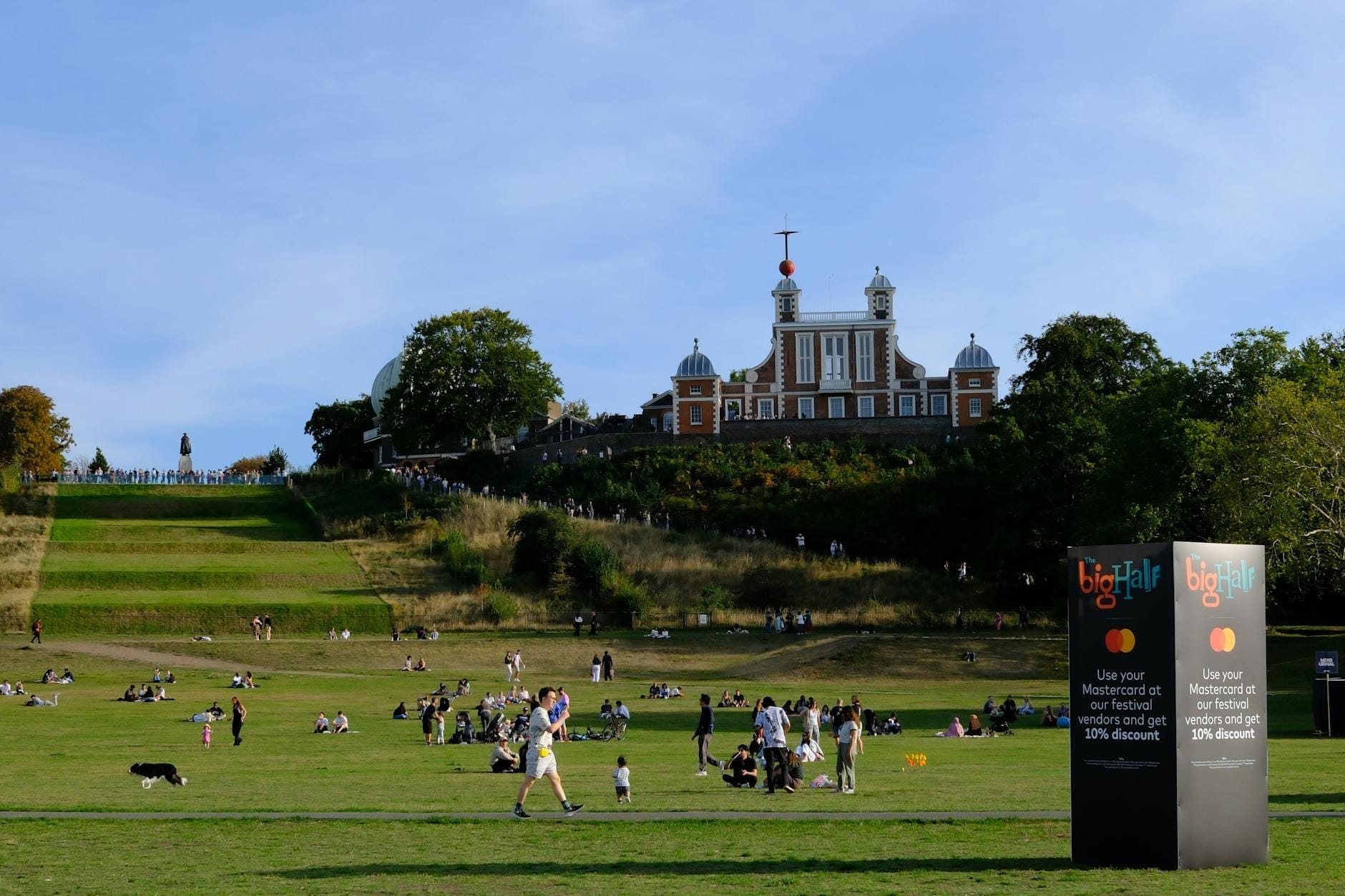
What the Royal Observatory Greenwich Actually Is
The Royal Observatory Greenwich sits on the crest of Greenwich Park's hill, about 46 metres above sea level, looking north across the rooftops of east London and the silver ribbon of the River Thames. Founded in 1675 by King Charles II, it is Britain's oldest purpose-built scientific institution. For most of the world, it is the place where time begins, where the Prime Meridian (0° longitude) is marked, and where Greenwich Mean Time (GMT) was first calculated and standardised. That is not a marketing slogan. It is a fact with direct consequences for every time zone, every GPS coordinate, and every flight departure time on the planet.
The site comprises several connected buildings, the most iconic being the Flamsteed House, designed by Christopher Wren in 1675 for the first Astronomer Royal, John Flamsteed. The red Time Ball on the roof, installed in 1833, drops at precisely 1:00pm daily and was originally used by ships on the Thames to set their marine chronometers. On clear days, you can watch it drop from the park below.
ℹ️ Good to know
Opening hours vary by season. Standard hours are 10:00am to 5:00pm (last entry 4:15pm), but the observatory stays open until 6:00pm in May and September, and until 7:00pm from June to August. Always confirm on the Royal Museums Greenwich website before visiting.
Getting There: The Approach Matters
The journey to the observatory is part of the experience. Most visitors arrive at Cutty Sark DLR station or Greenwich Station (served by National Rail and accessible via the Elizabeth line with a change at Canary Wharf or Whitechapel). From Greenwich town centre, the walk through Greenwich Park takes around 15 to 20 minutes on a steady uphill path through formal gardens and open grassland. In spring and early summer, the park's avenue of chestnut trees lines the route with colour.
Alternatively, arrive by river. The Thames Clipper (Uber Boat by Thames Clippers) docks at Greenwich Pier, dropping you right below the park. This route gives you a panoramic view of the Old Royal Naval College as you disembark, and frames the entire Greenwich World Heritage Site before you even begin climbing.
Note that the hill is steep in places. Visitors with limited mobility should check accessibility options with Royal Museums Greenwich directly before visiting, as this is a heritage site and the terrain and older buildings present real physical challenges that the available sources do not fully detail.
Tickets & tours
Hand-picked options from our booking partner. Prices are indicative; availability and final rates are confirmed when you complete your booking.
Royal Museums Greenwich day pass
From 45 €Instant confirmationFree cancellationRoyal Observatory and Prime Meridian
From 28 €Instant confirmationFree cancellationPainted Hall London tickets
From 19 €Instant confirmationFree cancellationThe Cotswolds day trip from London
From 67 €Instant confirmationFree cancellation
The Prime Meridian: More Interesting Than You Expect
The most photographed spot at the observatory is the brass strip embedded in the courtyard marking the Prime Meridian line, the 0° longitude that divides the Earth's eastern and western hemispheres. At most hours of the day, a short queue forms here as visitors wait to straddle the line with one foot in each hemisphere. It is a small thrill, even for sceptics. Children tend to stand and run back and forth across it, which tells you everything about its effect on the imagination.
In the evening, a green laser beam projects the Meridian line northward into the sky above London, visible on clear nights from the park and from the river below. If you are visiting during summer extended hours, arriving around dusk gives you both the interior experience and this outdoor spectacle.
💡 Local tip
Technically, the GPS Prime Meridian sits a few metres east of the brass strip in the courtyard, due to differences between historic and satellite-based measurements. The courtyard line remains the historically significant Meridian used on maps and in heritage interpretation, even though modern reference meridians used for GPS lie slightly to the east.
Inside the Observatory: What to See Floor by Floor
Flamsteed House contains the Octagon Room, one of the finest 17th-century interiors in London. Designed specifically for celestial observation, it has 15-foot ceilings and tall sash windows that originally accommodated large telescopes. Today it is beautifully preserved and free of the interpretive clutter that overwhelms many historic sites. You can stand in essentially the same space where John Flamsteed mapped over 3,000 stars and laid the groundwork for modern navigation.
The Meridian Building houses interactive exhibits on the history of longitude and timekeeping. The story of the longitude problem, and the clockmaker John Harrison's solution with his marine chronometers in the 18th century, is one of the great untold dramas of scientific history. His four sea clocks, displayed in the National Maritime Museum nearby, are extraordinary objects: beautifully engineered, historically transformative, and surprisingly moving to see in person. Harrison spent decades fighting the scientific establishment for recognition. The H4 watch, no bigger than a large pocket watch, solved a problem that had killed thousands of sailors.
The Great Equatorial Building, topped with a large copper dome, houses the 28-inch refractor telescope, which was one of the largest refracting telescopes in the world at the time of its installation in 1893. On select evenings, the observatory runs astronomy sessions where the dome opens and the telescope is in use, though these require separate booking.
The View from the Top
The observatory terrace provides one of the few rewarding panoramas of London that does not require you to pay for a lift ticket. From here, you can see the dome of St Paul's Cathedral, the tower clusters of Canary Wharf, the curve of the Thames, and on clear days, distant landmarks as far as Crystal Palace. It is a view that contextualises the city spatially in a way that no map quite does. For a broader comparison of London vantage points, see thebest views in London guide.
Early morning visits, when the park is quiet and the light is low from the east, produce the best photography conditions. By mid-morning, school groups arrive in earnest and the terrace becomes crowded. If you arrive when the observatory opens at 10:00am on a weekday, you will have the space largely to yourself for the first 45 minutes.
Making a Full Day of It in Greenwich
The Royal Observatory is part of a UNESCO World Heritage Site that includes the Old Royal Naval College, the National Maritime Museum (free entry), and the Cutty Sark clipper ship. Together, these attractions form a coherent day in Greenwich. Most people underestimate how long the park walk takes between them, particularly on the return journey downhill on cobblestones when it has been raining.
The Greenwich Marketoperates Thursday to Sunday and sits a short walk from the park entrance. It offers food stalls, vintage goods, and craft items of variable quality, but it is a reasonable place to eat before or after the observatory without paying central London restaurant prices.
⚠️ What to skip
The observatory is entirely outdoors between buildings, and the exposed hilltop catches wind year-round. Even on mild days, the terrace can be cold. Bring a layer. In winter, rain and wind can make the walk through the park unpleasant, though the interiors are well heated and worth the journey regardless.
Is It Worth the Ticket Price?
At £24 for adults, the observatory sits at the expensive end of London's paid attractions. The Worth Knowing: the historical significance is extraordinary, and Harrison's sea clocks alone justify the trip for anyone interested in science or navigation. The Octagon Room is beautiful. But the exhibits themselves, while solid, are not the most polished or expansive in London. If you are on a very tight budget, you can access Greenwich Park, stand on the Meridian line from outside the ticketed area (though the courtyard access requires a ticket), and enjoy the view from the park for free.
Families with children who have any interest in space, science, or history will find it engaging enough for 90 minutes. The Planetarium (located on-site, with separate ticketing) adds significant value if you include a show in your visit, particularly on overcast days when the outdoor elements are less appealing.
Insider Tips
- The Time Ball on the roof of Flamsteed House drops at exactly 1:00pm every day. Position yourself on the slope below the building just before 1pm to watch it fall, then check your own watch for a strange, centuries-old satisfaction.
- The green Meridian laser is only visible after dark. In winter, this means any evening visit works. In summer, you need to visit during extended hours (June to August, open until 7:00pm) and stay until dusk for the best effect.
- Book Planetarium shows in advance, especially at weekends and school holidays. They sell out and cannot be added on the day at many times of year.
- The National Maritime Museum at the base of the hill is free and arguably more impressive in terms of exhibition scale. Combining it with the observatory on the same visit makes the £24 ticket feel better value, but sets aside a full four to five hours minimum.
- Maze Hill Station (National Rail, served by Southeastern trains) is a quieter entry point than Greenwich Station and drops you at the east side of the park, closer to the observatory with a shorter uphill walk.
Who Is Royal Observatory Greenwich For?
- History and science enthusiasts who want context behind timekeeping and navigation
- Families with children aged 7 and up, especially with a Planetarium show included
- Photographers seeking elevated city views without paying for a glass-box observation deck
- First-time London visitors who want to combine heritage, a park, and a river journey in one day
- Travellers spending multiple days in London who want to explore beyond Zone 1
Nearby Attractions
Other things to see while in Greenwich:
- Cutty Sark
Dry-docked in Greenwich since the 1950s, the Cutty Sark is the only surviving tea clipper in the world. Built in 1869 and once among the fastest sailing ships afloat, she now offers visitors a rare chance to walk her decks, stand beneath her hull, and understand what made her legendary. This guide covers everything you need to plan a rewarding visit.
- Greenwich Market
Greenwich Market is the only covered market in London located within a UNESCO World Heritage Site. Open most days with free entry, it blends handmade crafts, global street food, antiques, and independent art under a 19th-century roof, two minutes from Cutty Sark DLR station.
- Greenwich Meridian Line
The Meridian Line at Greenwich marks 0° longitude, the reference point from which all the world's time zones are measured. Set in the courtyard of the Royal Observatory on a hill in Greenwich Park, it's a brief but memorable stop with serious historical weight behind a deceptively simple act: placing one foot in each hemisphere.
- Greenwich Park
Sprawling across 74 hectares of hilltop southeast London, Greenwich Park combines one of the city's finest skyline panoramas with serious historical weight. It's home to the Royal Observatory, the Prime Meridian, a resident deer herd, and centuries of royal history — all free to enter.