Greenwich Park: London's Oldest Royal Park, Views, and the Line That Divides the World
Sprawling across 74 hectares of hilltop southeast London, Greenwich Park combines one of the city's finest skyline panoramas with serious historical weight. It's home to the Royal Observatory, the Prime Meridian, a resident deer herd, and centuries of royal history — all free to enter.
Quick Facts
- Location
- Greenwich, London SE10 — part of the Maritime Greenwich UNESCO World Heritage Site
- Getting There
- Blackheath, Greenwich, or Maze Hill rail stations (all within about 20 minutes' walk of the main gates)
- Time Needed
- 1.5 to 3 hours for the park itself; allow a full half-day if you're visiting the Royal Observatory or nearby attractions
- Cost
- Free entry to the park. Separate tickets required for the Royal Observatory, Cutty Sark, and other nearby paid attractions
- Best for
- Families, history lovers, photographers, picnic seekers, and anyone wanting London's skyline without paying for it
- Official website
- www.royalparks.org.uk/visit/parks/greenwich-park
What Greenwich Park Actually Is
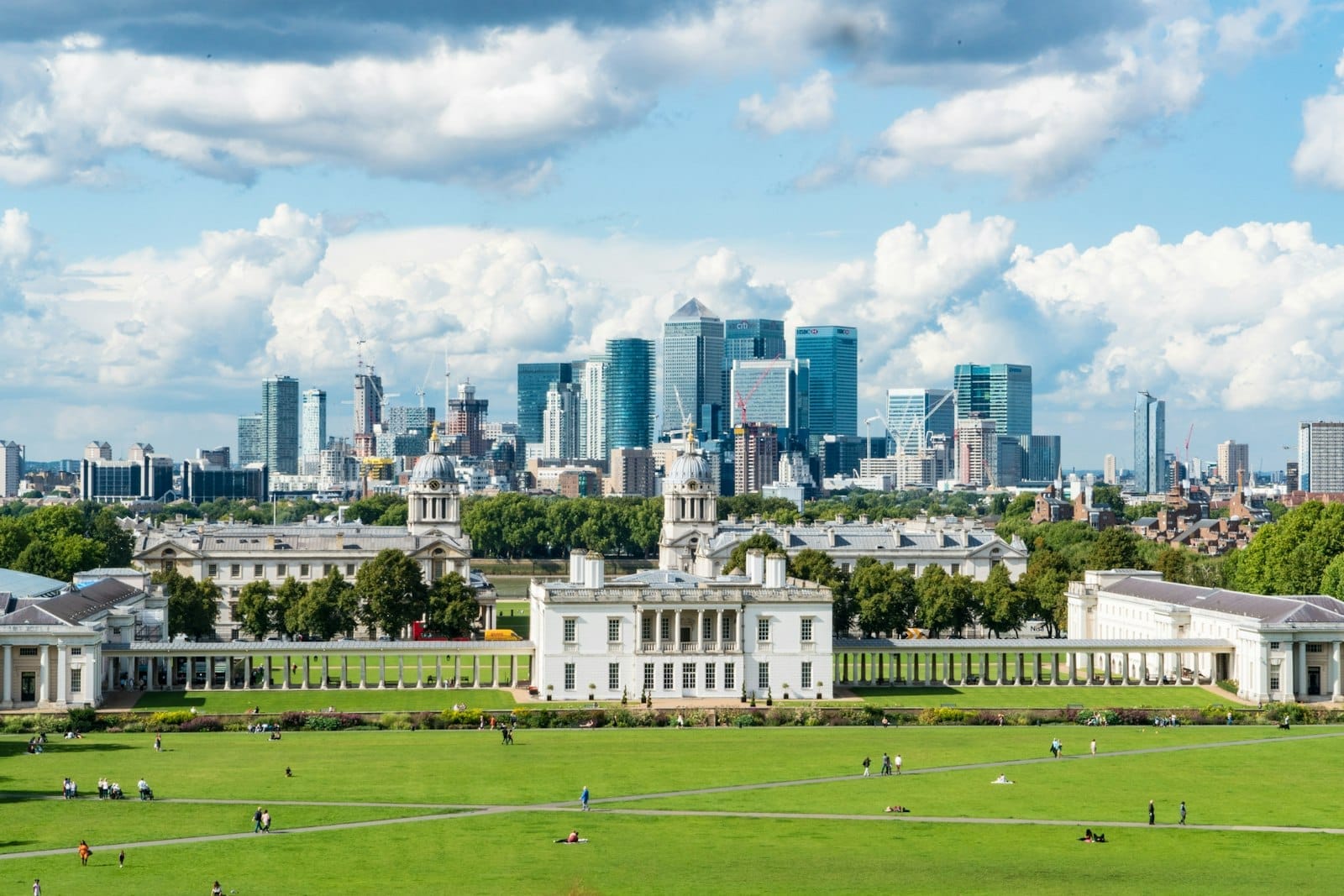
Greenwich Park is one of London's eight Royal Parks and, at 74 hectares (183 acres), one of its most dramatically positioned. Unlike the flat green expanses of Hyde Park or St James's Park in central London, this one rolls uphill from the riverfront towards a crest where the Royal Observatory sits — and that gradient makes all the difference. From the hilltop, you get an unobstructed sightline across the River Thames to Canary Wharf's towers, the City of London skyline, and on clear days, landmarks as far as Wembley.
The park is part of the Maritime Greenwich World Heritage Site, a UNESCO-designated zone that also takes in the Old Royal Naval College and the National Maritime Museum below. That designation isn't just ceremonial: the whole landscape has been shaped over centuries with unusual care, and the sense of coordinated grandeur is still visible whether you're looking up from the riverside or down from the observatory terrace.
ℹ️ Good to know
Pedestrian gates open daily from 06:00. Closing times vary: around 18:00 in January, 21:00 in May, and 21:30 at peak summer. Vehicle gates open from 07:00. Check the Royal Parks website for the current month's closing time before planning an evening visit.
History: From Royal Hunting Ground to the Centre of Time
The park's origins trace back to 1433, when Humphrey, Duke of Gloucester, began enclosing the land — making Greenwich Park the oldest enclosed Royal Park in London. It became a favourite of the Tudor monarchs, with Henry VIII and both of his daughters, Mary I and Elizabeth I, born at the adjacent Greenwich Palace. The Palace no longer stands, but the sense of royal purpose that shaped this landscape persists in everything from the avenue plantings to the hilltop observatory.
The Royal Observatory was founded here in 1676 by Charles II, with John Flamsteed appointed as the first Astronomer Royal. The specific purpose was navigational: accurate timekeeping was critical to determining longitude at sea, and the work done on this hill contributed directly to the standardisation of time that we now take entirely for granted. The Prime Meridian, the 0° longitude line that divides the eastern and western hemispheres, runs through the observatory grounds. Since 1884, Greenwich Mean Time (GMT) has been the world's baseline for world time, and it later underpinned Coordinated Universal Time (UTC).
That history gives the park a weight that's unusual for a green space. You're not just in a park: you're standing on a site that shaped how the entire world tells time. Visitors who want to go deeper into this story can visit the Royal Observatory Greenwich, which has its own entrance fee and contains the original telescopes, the famous Shepherd Gate Clock, and the laser beam that marks the meridian line after dark.
Tickets & tours
Hand-picked options from our booking partner. Prices are indicative; availability and final rates are confirmed when you complete your booking.
Tour London Greenwich with Where Time Began Exploration Game
From 8 €Instant confirmationFree cancellationLeeds Castle, Canterbury, Dover and Greenwich with river cruise
From 109 €Instant confirmationFree cancellationRoyal Museums Greenwich day pass
From 45 €Instant confirmationFree cancellationSoho Instagram a self-guided walking tour to top photo spots
From 6 €Instant confirmationFree cancellation
The Hilltop View: London's Best Free Panorama
The view from the park's upper terrace, immediately in front of the Royal Observatory, is one of the most reproduced in London photography — and it earns that status. In the foreground, the symmetrical baroque wings of the Old Royal Naval College frame the Thames perfectly. Behind them, Canary Wharf's steel-and-glass towers rise above the water, and on a clear day the dome of St Paul's Cathedral is visible further west. It's a composition that puts London's architectural history in sequence, from the 17th century to the present, all in one glance.
Morning light falls onto the Naval College from the east, which makes the period between 08:00 and 10:00 particularly good for photography. By midday in summer, the terrace is crowded with visitors and the light is flat. Late afternoon in autumn, when low golden light rakes across the grass and picks out the columns of the Naval College, is arguably the finest time to be here — but that information tends not to appear in brochures.
💡 Local tip
For the cleanest photograph of the Naval College and Thames, position yourself on the gravel path just below the Observatory fence rather than at the very top. The slight downward angle includes the formal garden below and removes the foreground clutter of other tourists. Arrive before 09:00 on weekends if you want the terrace without a crowd.
If this panorama appeals to you, it's worth comparing it with other top viewpoints across London — some require paid entry, and others involve lifts and queues. Greenwich Park's version is free, involves a 10-minute uphill walk from the park entrance, and delivers something few paid viewpoints can match: open sky and fresh air around you rather than glass.
Walking the Park: What You'll Find at Ground Level
The park's lower section, accessible from the main gate on King William Walk, is relatively flat and formal. The broad tree-lined avenue that runs towards the hill was designed in the late 17th century, and the sweet chestnut trees along the Wilderness section are among the oldest in the park. In autumn, fallen leaves cover the paths here thickly enough that the ground crunches underfoot, and the smell of damp earth and decaying leaves is noticeable from about October onwards.
The Wilderness area in the southeast corner of the park is home to a small enclosed deer enclosure. Fallow deer have been kept in Greenwich Park for centuries, and while the enclosure is fenced off from visitors, you can observe the animals clearly from the pathway. The deer are most active in early morning and around dusk, and during the autumn rutting season in October the males can be heard. It's a surprisingly wild pocket inside a city park, and children tend to find it more compelling than many paid attractions.
The formal flower garden near the centre of the park contains a rose garden that peaks in June and July. In summer the scent reaches the surrounding paths when there's any warmth in the air. There are also the remains of a Roman building within the park boundaries, currently not fully excavated but marked and informational boards are in place.
The park connects naturally with a broader Greenwich visit. Below the main gates, the Old Royal Naval College and the National Maritime Museum are both free to enter and worth building into the same half-day. The Cutty Sark at the riverside requires a separate paid ticket.
How the Park Changes Through the Day and Year
Early mornings in Greenwich Park are quiet. Dog walkers and joggers dominate from around 07:00 to 09:00. The park smells of wet grass in this window, and on misty autumn mornings the lower section fills with low cloud that breaks before the hilltop. By mid-morning on weekends, the atmosphere shifts: families arrive, the café terrace fills up, and the observatory queue forms.
Summer weekends between June and August bring large picnic groups to the flat grass areas near the park's lower entrances. The park can feel packed by early afternoon on a sunny Saturday. If you're visiting purely for the atmosphere and views, a Tuesday or Wednesday morning in late spring gives you the best of what the park offers without the volume.
Winter visits have real merit. The bare trees reveal the park's formal structure more clearly than in summer, the views are unobstructed by foliage, and the cold air keeps most of the crowds away. The park occasionally hosts seasonal events around Christmas, and the low winter light on the Naval College below can be striking. Bring warm layers and waterproof footwear: the hillside paths get muddy after rain and the wind at the top of the hill is sharp in January.
⚠️ What to skip
The hill is steeper than it looks on a map. The path from King William Walk gate to the Observatory terrace involves a sustained uphill walk of about 10 to 12 minutes on uneven terrain. It is not step-free. Visitors with limited mobility should review the AccessAble guide for Greenwich Park, which details alternative accessible routes and facilities.
Getting There and Practical Logistics
Three National Rail stations serve the park within walking distance: Greenwich (about 15 minutes on foot to the main gate), Maze Hill (closer to the Blackheath Gate on the east side), and Blackheath (useful for approaching from the top of the park rather than the bottom). Trains to Greenwich run from London Bridge in approximately 8 to 12 minutes. There is no direct Tube connection to Greenwich itself.
An alternative worth considering is arriving by river. Uber Boat by Thames Clippers operates services from central London piers to Greenwich Pier, which puts you at the foot of the park near the Cutty Sark in around 40 to 60 minutes from central piers. It costs more than the train but gives you a different perspective on the city. For more on navigating London's transport options, the getting around London guide covers Oyster card setup, river services, and rail connections in detail.
Inside the park, food and drink is available at the Pavilion Café near the rose garden, the Ignatius Sancho Café near the south entrance, and a coffee kiosk near the main visitor area. These are reasonable for a park café, but not destination dining. Nearby Greenwich Market, a five-minute walk from the main gate, has a better range of food options at lunch.
Greenwich as a neighbourhood rewards a full day's exploration. The market, the riverside, the Naval College, the museum, and the park all sit within comfortable walking distance of each other. See the Greenwich neighbourhood guide for a fuller picture of how to structure a visit.
Insider Tips
- The laser beam that marks the Prime Meridian at the Royal Observatory is visible from within the park after dark — if you're visiting in winter when it is dark by the time the park closes, you can see it projecting north across the city skyline from outside the fence.
- The Blackheath Gate on the southeast edge of the park is the least-used entrance and the easiest approach from Blackheath station. Coming this way means you descend to the main attractions rather than climbing to them — useful if you want the hilltop view before the café rather than after.
- The chestnut trees in the Wilderness section of the park drop conkers in late September and early October. On a weekday morning you can collect them from the ground undisturbed, which is either charming or completely irrelevant depending on whether you're travelling with a child.
- If you want the view from the observatory terrace without paying for observatory entry, the viewpoint on the path just outside the observatory fence is nearly identical and completely free. The meridian line courtyard itself requires a ticket to access.
- Greenwich Park was used as the equestrian venue for the 2012 London Olympics, which required significant temporary infrastructure on the lower parkland. The park has fully recovered and shows no trace of this, but the event left behind improved visitor facilities.
Who Is Greenwich Park For?
- Families with children: the deer enclosure, open grass, and playground make this useful, not just tolerable for kids
- Photographers targeting London's skyline who don't want to pay for a rooftop bar or observation deck
- History and science enthusiasts interested in astronomy, navigation, and the origin of global timekeeping
- Travellers wanting to combine a park visit with a full Greenwich day: the Naval College, maritime museum, market, and riverside are all within walking distance
- Visitors on a tight budget who want a high-quality experience: the park itself, the view, the deer, and the meridian marker on the path outside the observatory courtyard cost nothing
Nearby Attractions
Other things to see while in Greenwich:
- Cutty Sark
Dry-docked in Greenwich since the 1950s, the Cutty Sark is the only surviving tea clipper in the world. Built in 1869 and once among the fastest sailing ships afloat, she now offers visitors a rare chance to walk her decks, stand beneath her hull, and understand what made her legendary. This guide covers everything you need to plan a rewarding visit.
- Greenwich Market
Greenwich Market is the only covered market in London located within a UNESCO World Heritage Site. Open most days with free entry, it blends handmade crafts, global street food, antiques, and independent art under a 19th-century roof, two minutes from Cutty Sark DLR station.
- Greenwich Meridian Line
The Meridian Line at Greenwich marks 0° longitude, the reference point from which all the world's time zones are measured. Set in the courtyard of the Royal Observatory on a hill in Greenwich Park, it's a brief but memorable stop with serious historical weight behind a deceptively simple act: placing one foot in each hemisphere.
- National Maritime Museum
The National Maritime Museum in Greenwich is the largest maritime museum in the world, housing a vast collection of ship models, navigational instruments, sea charts, and Nelson's bullet-pierced uniform. Entry is free, and the building itself — part of the UNESCO-listed Maritime Greenwich World Heritage Site — is worth the journey from central London alone.