National Maritime Museum: Greenwich's Free Window into 500 Years of Seafaring
The National Maritime Museum in Greenwich is the largest maritime museum in the world, housing a vast collection of ship models, navigational instruments, sea charts, and Nelson's bullet-pierced uniform. Entry is free, and the building itself — part of the UNESCO-listed Maritime Greenwich World Heritage Site — is worth the journey from central London alone.
Quick Facts
- Location
- Romney Rd, London SE10 9NF, Greenwich
- Getting There
- Cutty Sark DLR / Greenwich Station (National Rail) / Maze Hill Station / Greenwich Pier
- Time Needed
- 2–3 hours minimum; half a day for serious visitors
- Cost
- Free entry (no booking required, though advance online reservation available)
- Best for
- History enthusiasts, families with children, architecture lovers, rainy-day culture seekers
- Official website
- www.rmg.co.uk/national-maritime-museum
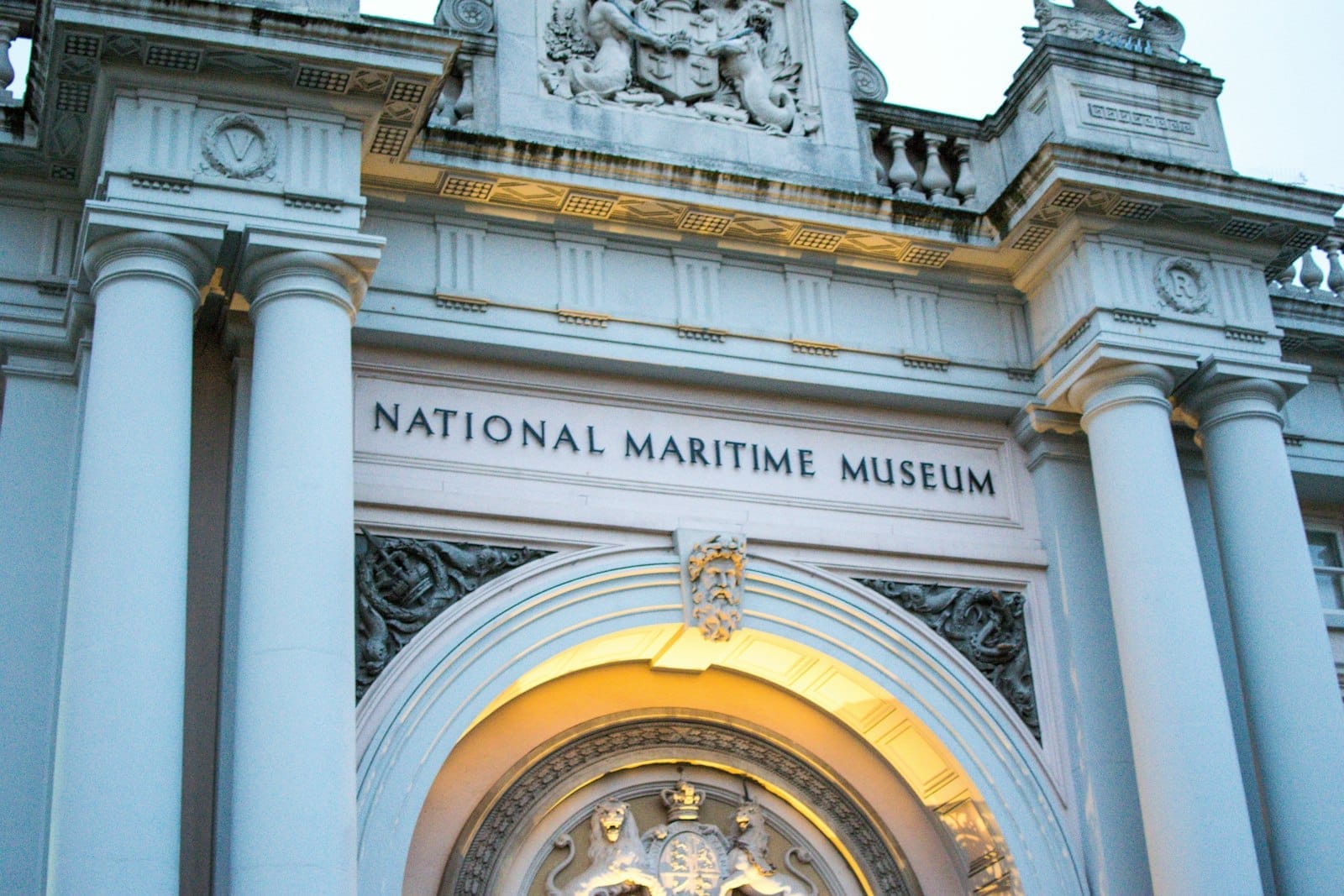
What the National Maritime Museum Actually Is
The National Maritime Museum is the largest museum of its kind in the world, and that scale becomes immediately apparent the moment you step into its central glass-roofed courtyard. This is not a dusty regional maritime collection with a few ship anchors and watercolour prints. The museum holds over two million objects spanning some 500 years of seafaring history: oil paintings the size of dining room walls, navigational instruments of extraordinary precision, gilded royal barges, deep-sea diving helmets, and maps that charted oceans no European had ever crossed.
The museum was formally established by Act of Parliament in 1934 and opened to the public on 27 April 1937. It sits within the Royal Museums Greenwich complex, which also includes the Royal Observatory and the Queen's House. Together, these sites form part of the UNESCO World Heritage Site known as Maritime Greenwich — a designation that reflects Greenwich's central role in shaping global navigation, empire, and science.
💡 Local tip
Entry is completely free and no advance booking is required. However, booking a free ticket online in advance guarantees entry during busy periods and signs you up for visit updates from Royal Museums Greenwich.
The Building and Its Setting
The museum stands immediately north of the Queen's House and its flanking colonnaded wings, a complex designed in part by Inigo Jones in the early 17th century. The Queen's House was England's first fully classical building, commissioned in 1616 for Anne of Denmark, consort of James I, and completed in 1635. Standing in front of it and looking south toward Greenwich Park's wooded hill, with the Royal Observatory perched at the summit, gives a sense of how carefully this whole landscape was conceived as a unified statement of British maritime power.
The modern addition is the Neptune Court — a vast glazed atrium that connects the wings and now serves as the museum's main internal gathering space. It is temperature-controlled and comfortable, which matters on a grey London afternoon. Ship figureheads are mounted along the upper levels of the courtyard, a detail that catches visitors off-guard: enormous carved faces staring down from the walls, some menacing, some almost comic.
The museum is part of the broader Greenwich cultural cluster. Nearby, the Cutty Sark clipper ship is docked a short walk away, while the Old Royal Naval College and the Royal Observatory Greenwich are within easy walking distance — making this an entire half-day or full-day destination in itself.
Tickets & tours
Hand-picked options from our booking partner. Prices are indicative; availability and final rates are confirmed when you complete your booking.
Soho Instagram a self-guided walking tour to top photo spots
From 6 €Instant confirmationFree cancellationTootbus London by Night: Bus tour
From 32 €Instant confirmationFree cancellationIFS Cloud Cable Car Ride and Uber Boat Hop-on Hop-off 1 Day Ticket
From 38 €Instant confirmationFree cancellationThe Making of Harry Potter Guided Tour of London Warner Bros. Studio
From 201 €Instant confirmationFree cancellation
What You Will See: The Collection Highlights
The collection is organized thematically across multiple floors and galleries. The standout object for most visitors is Nelson's uniform coat — the one he was wearing when he was shot by a French sniper at the Battle of Trafalgar in 1805. The bullet hole is visible. The bloodstains are visible. The gold epaulettes are still bright. It is a affecting artifact, and the gallery around it contextualizes the battle and Nelson's life with enough depth to satisfy curious adults without overwhelming younger visitors.
Beyond Nelson, the galleries cover the Atlantic slave trade with unusual honesty and care — a section of the collection that has been significantly developed in recent years. There are also galleries on polar exploration, the Royal Navy, merchant shipping, passenger liners, and the history of maritime cartography. The map collection alone is remarkable: charts drawn on vellum showing the coastlines of continents still partially imagined rather than known.
The ship model collection is one of the finest in existence. Models were built to scale as design tools before construction of the actual ships — some date back to the 17th century — and they offer an almost impossible level of detail: tiny gun ports, rope ladders thinner than a finger, fully fitted cabins rendered in miniature.
ℹ️ Good to know
The museum opens daily from 10:00 to 17:00 (10am-5pm). Last entry is before closing, so plan your arrival no later than 14:30 if you want adequate time to see the main galleries without rushing.
How the Experience Changes by Time of Day
Arriving between 10:00 and 11:00 on a weekday, the museum is calm and largely quiet. School groups are the main source of noise, and they tend to move through specific galleries on a circuit — so you can often dodge them by going to whichever section they have just left. The light through the Neptune Court's glass ceiling is at its clearest in the morning on bright days, making this the best time to take photographs of the atrium's figureheads.
By early afternoon on weekends or during school holidays, visitor density increases noticeably. The galleries around Nelson's coat and the Traders gallery on the Atlantic trade become particularly busy. If you visit with children, the afternoon tends to work fine since the museum keeps young visitors engaged throughout — there are plenty of hands-on elements, touch screens, and scale models children can examine closely. If you are visiting for the art collection or the map galleries and want to concentrate, a weekday morning is considerably better.
Late afternoon, in the final hour before closing, the crowd thins again. The light shifts in the Neptune Court as the sun moves, and the shadows from the figureheads change character. It is worth spending a few minutes simply sitting in the courtyard near closing time if the crowds earlier frustrated you.
Getting There: Practical Navigation
Greenwich is in southeast London and requires some transit planning from central London. The most straightforward route is the Docklands Light Railway (DLR) to Cutty Sark station, which places you directly in front of the Cutty Sark ship and a five-minute walk from the museum's main entrance. The DLR connects to the London Underground and Elizabeth line at Bank/Monument, making it accessible from most parts of London.
National Rail services from London Bridge and Charing Cross reach Greenwich Station and Maze Hill Station respectively — both are walkable to the museum in under ten minutes. Greenwich Pier is served by Uber Boat by Thames Clippers river services from central London piers, which is a scenic approach: arriving by boat along the Thames with the Old Royal Naval College's twin domes visible from the river is one of the better arrivals in London.
Greenwich makes a natural full day out combined with other sites in the area. See the Greenwich Park and Greenwich Market for a well-rounded visit to the neighbourhood. The Greenwich area guide covers transit options and the full range of things to do nearby.
Accessibility and Practical Notes
The museum's main galleries are accessible by lift and are wheelchair-friendly across most of the site. The Neptune Court floor is level and wide. The Queen's House interior has some areas requiring stairs, though the museum provides access routes for visitors with mobility needs — it is worth checking the official Royal Museums Greenwich site before visiting if this matters to your planning.
The museum has a café and a shop inside. The café is adequate for a coffee and a light lunch but not remarkable. Better food options are five minutes away in the direction of Greenwich Market, which operates on weekends and select weekdays with a good range of street food stalls. Photography without flash is generally permitted throughout the permanent galleries.
⚠️ What to skip
The museum can feel cold in winter, particularly in the Neptune Court where the glass ceiling means the space retains less heat. A light layer is advisable from October through March even though the galleries themselves are climate-controlled.
An Worth Knowing: Is It Worth Your Time?
The National Maritime Museum is one of London's most underrated free attractions, and that is partly because Greenwich requires more transit effort than South Bank or the West End museums. That effort is the main reason visitor numbers here tend to be lower than at the British Museum or the Natural History Museum — which is, paradoxically, one of the museum's strengths. You can stand in front of Nelson's coat without a crowd pressing around you on most weekday mornings.
Visitors who come expecting a quick walk-through of seafaring paraphernalia sometimes underestimate how emotionally engaged the collection becomes. The Atlantic slavery galleries in particular are handled with a seriousness that other major museums have not always matched. The polar exploration section touches something primal about endurance and ambition. And the art collection — maritime paintings by Turner, van de Velde, and Loutherbourg among others — holds its own against more celebrated London galleries.
That said, this is not the right attraction for visitors who have no interest in history, navigation, or the sea, or for those who find large museum collections overwhelming. Two hours is a realistic minimum to see the highlights; treating it as a quick 45-minute stop would leave most visitors feeling they had only scratched the surface and missed what makes the collection interesting.
If you are building a broader London itinerary, this works well as part of a dedicated Greenwich day. For budgeting purposes, the fact that entry is free makes it one of the best free things to do in London, especially when combined with the free entry to Greenwich Park and the walk up to the Royal Observatory.
Insider Tips
- The Queen's House interior, part of the wider Royal Museums Greenwich complex, contains the Tulip Staircase — the first geometric self-supporting spiral stair in Britain. It is often overlooked by visitors focused on the main galleries, but it is architecturally extraordinary and rarely crowded.
- The museum's upper-floor gallery windows facing north offer one of the better low-level views of the Old Royal Naval College's baroque twin domes — no ticket or climb required.
- Weekday mornings between 10:00 and 11:30 are consistently the quietest visiting window. School groups tend to arrive in the late morning slot. If you want the Nelson galleries to yourself, arrive right at opening.
- The spiral staircases inside the Queen's House wings are lined with portraits from the collection — easily missed if you take the lift, and worth slowing down for.
- If you plan to visit the Royal Observatory Greenwich on the same day, wear comfortable shoes and allow at least 20 minutes to walk up through Greenwich Park. The hill is steeper than it appears from the museum entrance.
Who Is National Maritime Museum For?
- History enthusiasts with an interest in naval, colonial, and exploration history
- Families with school-age children — strong interactive elements and enough visual drama to hold attention
- Art lovers interested in maritime painting from the Dutch Golden Age through Turner
- Budget-conscious travellers looking for a serious cultural experience at no cost
- Visitors combining a full Greenwich day with the Royal Observatory and Cutty Sark
Nearby Attractions
Other things to see while in Greenwich:
- Cutty Sark
Dry-docked in Greenwich since the 1950s, the Cutty Sark is the only surviving tea clipper in the world. Built in 1869 and once among the fastest sailing ships afloat, she now offers visitors a rare chance to walk her decks, stand beneath her hull, and understand what made her legendary. This guide covers everything you need to plan a rewarding visit.
- Greenwich Market
Greenwich Market is the only covered market in London located within a UNESCO World Heritage Site. Open most days with free entry, it blends handmade crafts, global street food, antiques, and independent art under a 19th-century roof, two minutes from Cutty Sark DLR station.
- Greenwich Meridian Line
The Meridian Line at Greenwich marks 0° longitude, the reference point from which all the world's time zones are measured. Set in the courtyard of the Royal Observatory on a hill in Greenwich Park, it's a brief but memorable stop with serious historical weight behind a deceptively simple act: placing one foot in each hemisphere.
- Greenwich Park
Sprawling across 74 hectares of hilltop southeast London, Greenwich Park combines one of the city's finest skyline panoramas with serious historical weight. It's home to the Royal Observatory, the Prime Meridian, a resident deer herd, and centuries of royal history — all free to enter.