Cutty Sark: Inside the World's Last Tea Clipper
Dry-docked in Greenwich since the 1950s, the Cutty Sark is the only surviving tea clipper in the world. Built in 1869 and once among the fastest sailing ships afloat, she now offers visitors a rare chance to walk her decks, stand beneath her hull, and understand what made her legendary. This guide covers everything you need to plan a rewarding visit.
Quick Facts
- Location
- King William Walk, London SE10 9HT
- Getting There
- DLR: Cutty Sark station (2-min walk); Rail: Greenwich station; River: Greenwich Pier
- Time Needed
- 1.5 to 2.5 hours
- Cost
- Adults £22, children £11, concessions from £16.50 (student), infants free — verify at rmg.co.uk before visiting
- Best for
- History lovers, families, maritime enthusiasts, architecture fans
- Official website
- www.rmg.co.uk/cutty-sark
What the Cutty Sark Actually Is
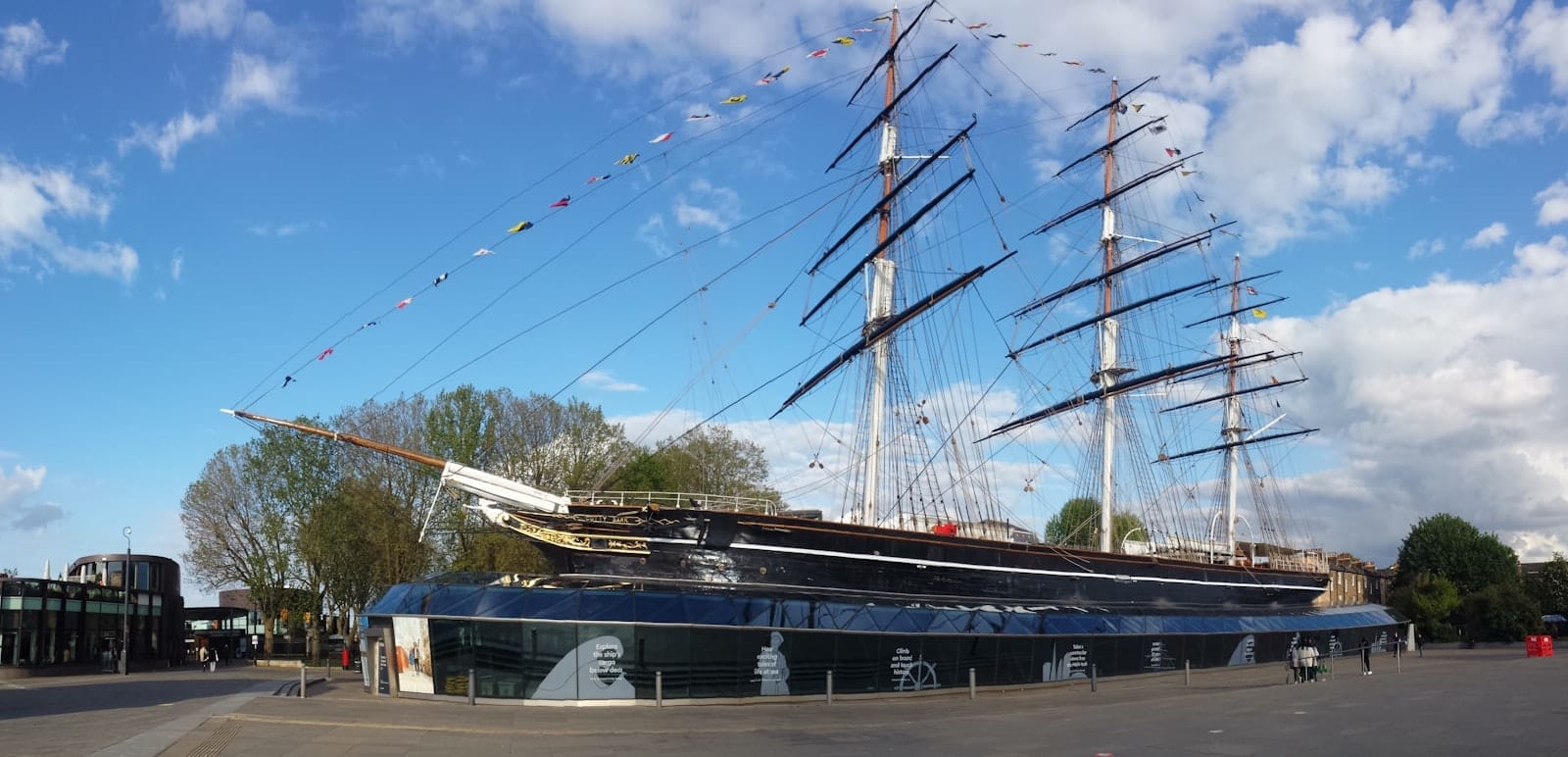
The Cutty Sark is a composite clipper ship, meaning her frame is iron but her planking is timber, built in 1869 at Dumbarton, Scotland, to the designs of naval architect Hercules Linton. She was commissioned for the tea trade between London and China at the precise moment that trade was becoming obsolete. The Suez Canal opened the same year she launched, giving steam-powered vessels a shorter route east. The Cutty Sark spent only eight return voyages carrying tea before the economics shifted against sail.
She found a second life in the wool trade between Australia and England, where the long open-ocean passages suited her speed. On that run she proved herself fast, recording passages that still earn respect among maritime historians. When sail finally gave way entirely to steam, she was bought for preservation in 1922, and has been in her current Greenwich dry dock since the 1950s. She opened as an exhibition ship in 1957, survived a serious fire during restoration works in 2007, and reopened comprehensively restored in 2012.
What makes her significant beyond nostalgia is this: she is described as the world's only surviving tea clipper, and over 90% of her hull is said to be original fabric. That is an extraordinary survival rate for a working vessel now more than 150 years old. You are not looking at a replica or a reconstruction with a few original fittings. You are looking at the actual ship.
The Experience: What You Will See and Feel
The Cutty Sark sits in a specially constructed dry dock on King William Walk, raised slightly above ground level so that visitors can walk beneath her hull. This is the detail that catches most people off guard. You descend into the enclosed space under the ship and look up at the copper-sheathed bottom of a 19th-century ocean-going vessel from directly below. The hull curves above you with surprising elegance, the lines narrow toward the bow in a way that explains her speed without needing any further description. The smell down here is faintly woody and metallic, the lighting is controlled, and the effect is quietly dramatic.
The lower deck holds the main interpretive exhibition, where displays explain the tea and wool trades, the lives of the crew, and the competitive culture of clipper racing. There are original figureheads from other ships in the collection, displayed in a semicircle around the hull space. Each figure is large, worn by salt water, and oddly moving at close range.
Above deck, the teak planking is worn smooth and the proportions of the ship become real in a way photographs do not convey. The masts are tall. The rigging is extensive. Standing on deck with the Thames and the skyline of the Old Royal Naval College visible beyond the dock, it becomes easier to imagine the working life of this vessel than it does in almost any maritime museum. The wind off the river, the slight creak of timber, the scale of the spars overhead: the ship communicates something that wall-mounted displays cannot.
💡 Local tip
Book tickets online in advance at rmg.co.uk. Walk-up tickets are available but online booking is recommended, and it avoids queuing at the entrance kiosk.
Tickets & tours
Hand-picked options from our booking partner. Prices are indicative; availability and final rates are confirmed when you complete your booking.
Entrance at the Cutty Sark with afternoon tea
From 54 €Instant confirmationCutty Sark rig climbing experience
From 71 €Instant confirmationFree cancellationCutty Sark entrance tickets
From 25 €Instant confirmationFree cancellationSoho Instagram a self-guided walking tour to top photo spots
From 6 €Instant confirmationFree cancellation
How the Visit Changes by Time of Day
Weekday mornings, especially before 11:00, are noticeably quieter than weekend afternoons. The under-hull gallery fills with school groups from mid-morning on, which changes the atmosphere considerably: the space is enclosed and the acoustics are sharp, so a single energetic class can make it feel congested. If you arrive at opening time (10:00), you can move through the lower deck before groups arrive, then go up to the main deck and spend time there at your own pace.
In summer (late June through August), opening hours extend to 18:00 with last entry at 17:15. The late afternoon light in summer is worth factoring in: the deck photographs well with the sun lower in the sky, and the crowds thin noticeably after 16:00 as families with young children leave.
Winter visits have their own quality. The under-hull space is sheltered and warm, and with fewer visitors the scale and silence of it makes more of an impression. On a cold grey day in November or February, the ship feels more like the working vessel it once was than it does surrounded by summer crowds.
ℹ️ Good to know
Standard opening hours are 10:00–17:00 daily (last entry 16:15). Summer hours (27 June–31 August 2026) are 10:00–18:00, last entry 17:15. Closed 24–26 December.
Practical Walkthrough: Getting There and Getting Around
The easiest approach is the DLR to Cutty Sark station, which deposits you almost directly in front of the ship in under two minutes on foot. From central London (Bank or Monument), the journey takes around 15 minutes. Alternatively, arriving by river is worth considering: Thames Clipper services stop at Greenwich Pier, a short walk from the ship. Traveling on the water to visit a ship has an obvious logic to it, and the Thames approach gives you a view of Greenwich from the same angle that sailors would have seen it. For more on river travel options, the London River Thames guide covers routes and fares.
Once inside, the ship operates across three levels: the under-hull gallery (reached by descending from the entrance), the lower 'tween deck with the main exhibition, and the upper main deck open to the sky. There is also a small café. The layout is compact and self-guiding, with clear signage throughout. Royal Museums Greenwich indicates the attraction is accessible; visitors with specific mobility requirements should check directly with the museum before visiting, as the historic nature of the ship places practical limits on what can be modified.
Photography on deck is straightforward and unrestricted. The under-hull space is darker, so a phone camera in portrait mode may struggle; switching to a wider aperture setting or using the dedicated night mode will produce cleaner results. The best exterior shot of the whole ship is from the riverside path slightly to the east, where you can frame the hull against the sky without the dock walls cutting into the frame.
The Cutty Sark sits at the western edge of the broader Greenwich UNESCO World Heritage Site. The Old Royal Naval College is directly adjacent, and the National Maritime Museum is a ten-minute walk. Both are free to enter. Combining all three into a single day is realistic and makes the most of the journey to southeast London.
Historical Context: Why the Clippers Mattered
The tea clipper era lasted roughly from the late 1840s to the early 1870s: a window of around twenty-five years when the premium placed on fresh tea from China created intense commercial pressure to sail faster. The first ship to deliver the new season's tea commanded higher prices. Races between clippers from Chinese ports to the Thames were followed in the press with the same attention given to horse racing. The Cutty Sark was built explicitly to compete in this environment.
Her name comes from Robert Burns's 1791 poem Tam o' Shanter, in which a witch wears a short linen garment described as a 'cutty sark'. The figurehead at the ship's bow depicts that witch, Nannie, her arm outstretched holding a horse's tail. It is a specific, literary, slightly eccentric choice for a ship, and it gives the vessel an identity that sets her apart from more generic maritime naming conventions.
Her career overlapped almost exactly with the transition from sail to steam, which makes her historically legible in a way that an earlier or later ship would not be. She represents the peak of one technology at the precise moment it was being displaced by another. That is part of what makes her worth preserving and worth visiting.
Worth Knowing: Is It Worth the Ticket Price?
At £22 for an adult, the Cutty Sark is not cheap. The visit runs between 90 minutes and two and a half hours for most people. The experience is distinctive, particularly the under-hull space, which is unlike anything else in London. But visitors who have already seen the National Maritime Museum (free entry) will find some thematic overlap, and the interpretive panels on the lower deck can feel dense if maritime history is not a particular interest.
For families with children, the combination of an actual ship you can board, close-up figurehead sculptures, and a clear visual story makes it a strong choice. It is included on the Go City London Pass, so if you are planning several paid attractions over multiple days, that may affect the calculus. For a broader view of whether combination passes represent value, the London Pass guide is worth reading before you book.
Visitors primarily interested in the Greenwich experience as a whole, rather than maritime history specifically, may find the free National Maritime Museum and the walk up to the Royal Observatory equally rewarding without the admission cost. But if you have any interest in ships, naval history, or the mechanics of 19th-century trade, the Cutty Sark earns its ticket price.
⚠️ What to skip
The ship is an outdoor attraction at deck level and weather matters. A day of heavy rain makes the main deck less pleasant to linger on, though the under-hull gallery and lower exhibition spaces are fully covered. Bring a layer regardless of season: the wind off the Thames is reliable.
Combining the Cutty Sark with the Rest of Greenwich
Greenwich rewards a full day. After the Cutty Sark, the National Maritime Museum is the logical next stop, free and directly connected to the Queen's House. From there, Greenwich Park leads uphill to the Royal Observatory and the Prime Meridian line. The walk up through the park takes around fifteen minutes and the views across the Thames from the Observatory terrace are among the best in southeast London.
For lunch or browsing, Greenwich Market operates daily and sits a short walk inland from the ship. It is a covered market with a mix of street food, craft stalls, and antiques. The quality varies but the setting is good and the food options are solid.
Insider Tips
- Arrive within the first 30 minutes of opening on a weekday to have the under-hull gallery almost entirely to yourself. The scale and silence of that space make a considerably stronger impression without a school group in it.
- The figurehead collection displayed in the under-hull gallery is one of the less-publicized highlights. These are large, painterly carvings from various ships, and they reward close attention. Allow time to walk around the full semicircle.
- If you are traveling by DLR, the elevated section between Island Gardens and Cutty Sark stations passes through the Greenwich Foot Tunnel under the Thames. For a faster scenic alternative, consider walking through the foot tunnel from Island Gardens on the north bank: the approach on foot gives you the full riverside view of the ship as you emerge on the Greenwich side.
- Combination tickets covering the Cutty Sark and the Royal Observatory are available and represent better value if you plan to visit both on the same day. Check the Royal Museums Greenwich website for current joint-ticket pricing.
- The ship's figurehead, Nannie, is visible at the bow from street level without purchasing a ticket. If you are curious about the ship and short on time or budget, the exterior and this detail can be appreciated from the public walkway around the dock.
Who Is Cutty Sark For?
- Maritime and naval history enthusiasts who want to see an original working vessel rather than a static exhibit
- Families with children aged 6 and above who respond well to immersive, walk-through experiences
- Architecture and engineering visitors interested in 19th-century composite ship construction
- Travelers spending a full day in Greenwich who want to make use of the UNESCO World Heritage Site corridor
- Anyone interested in the intersection of industrial technology and commercial history in the Victorian period
Nearby Attractions
Other things to see while in Greenwich:
- Greenwich Market
Greenwich Market is the only covered market in London located within a UNESCO World Heritage Site. Open most days with free entry, it blends handmade crafts, global street food, antiques, and independent art under a 19th-century roof, two minutes from Cutty Sark DLR station.
- Greenwich Meridian Line
The Meridian Line at Greenwich marks 0° longitude, the reference point from which all the world's time zones are measured. Set in the courtyard of the Royal Observatory on a hill in Greenwich Park, it's a brief but memorable stop with serious historical weight behind a deceptively simple act: placing one foot in each hemisphere.
- Greenwich Park
Sprawling across 74 hectares of hilltop southeast London, Greenwich Park combines one of the city's finest skyline panoramas with serious historical weight. It's home to the Royal Observatory, the Prime Meridian, a resident deer herd, and centuries of royal history — all free to enter.
- National Maritime Museum
The National Maritime Museum in Greenwich is the largest maritime museum in the world, housing a vast collection of ship models, navigational instruments, sea charts, and Nelson's bullet-pierced uniform. Entry is free, and the building itself — part of the UNESCO-listed Maritime Greenwich World Heritage Site — is worth the journey from central London alone.