The Meridian Line, Greenwich: Standing at the Centre of the World's Clocks
The Meridian Line at Greenwich marks 0° longitude, the reference point from which all the world's time zones are measured. Set in the courtyard of the Royal Observatory on a hill in Greenwich Park, it's a brief but memorable stop with serious historical weight behind a deceptively simple act: placing one foot in each hemisphere.
Quick Facts
- Location
- Royal Observatory, Greenwich Park, London SE10
- Getting There
- Cutty Sark DLR (15-min walk up the hill) or Greenwich rail station; also reachable by Thames Clipper to Greenwich Pier
- Time Needed
- 15–30 minutes for the Meridian Line itself; 2–3 hours if combining with the Royal Observatory and Greenwich Park
- Cost
- Access to the line within Greenwich Park is free; the Observatory courtyard where the brass line is located may require an Observatory ticket — verify current access arrangements at rmg.co.uk before visiting
- Best for
- History enthusiasts, families, geography lovers, and anyone wanting a interesting photo that isn't just a skyline
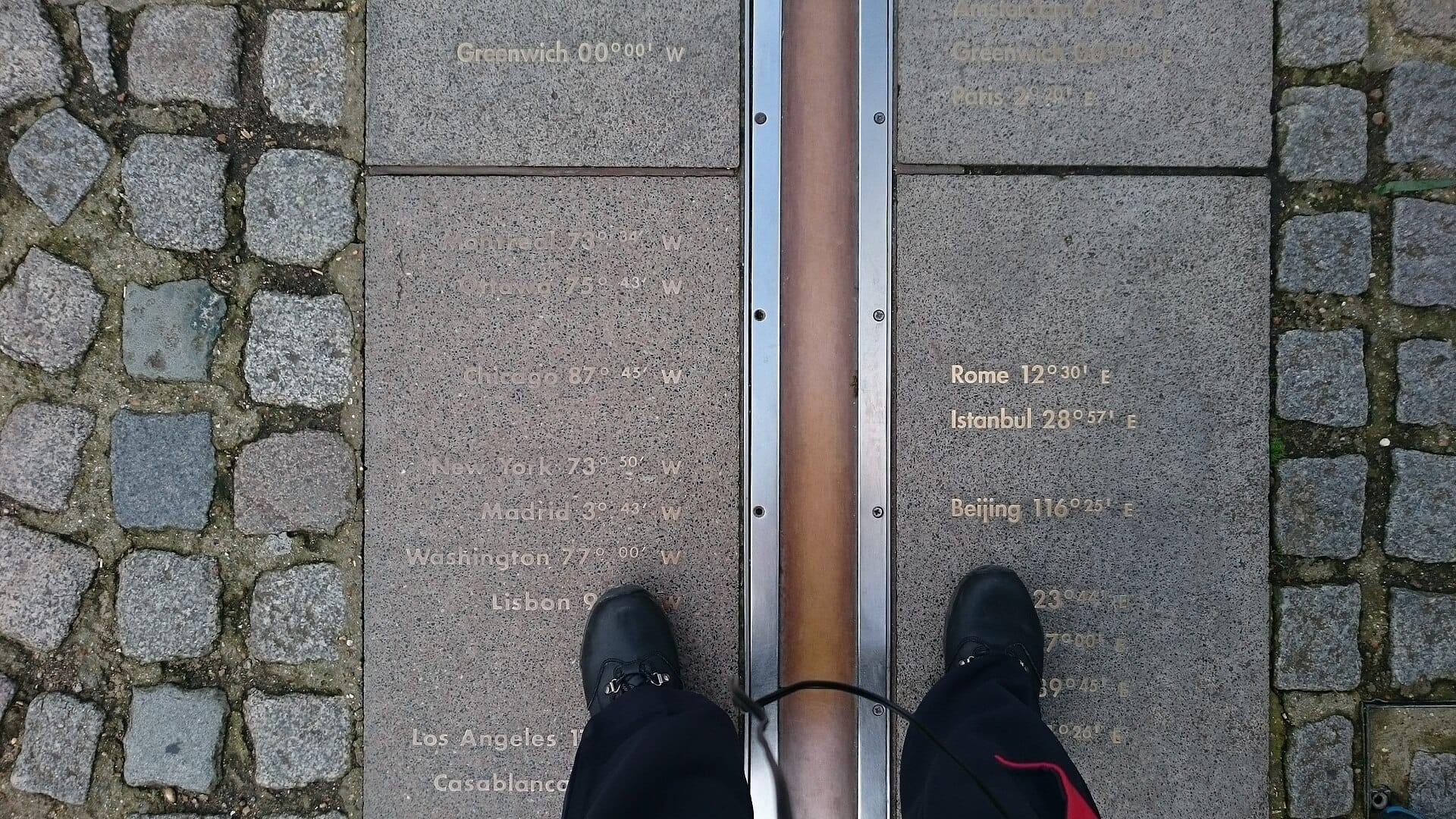
What the Meridian Line Actually Is
The Meridian Line at Greenwich is not a monument in any traditional sense. There is no arch, no statue, no grand entrance. What you find is a thin brass strip set into the stone paving of the Royal Observatory's courtyard, marking 0° longitude — the Prime Meridian of the World. Stand on it, and you have one foot in the Eastern Hemisphere and one in the Western. The planet is divided by the line you're standing on.
The Royal Observatory was built in 1675 by order of King Charles II, with the original purpose of producing better astronomical data to help sailors calculate their longitude at sea. For more than two centuries it served as one of the most important scientific sites in the world. It was at the International Meridian Conference in Washington D.C. in 1884 that Greenwich was formally adopted by 22 of 25 voting nations as the universal reference for longitude and the basis of Greenwich Mean Time (GMT). The line itself runs roughly 20,000 km from the North Pole to the South Pole, bisecting the globe.
ℹ️ Good to know
Access to the brass Meridian Line in the Observatory courtyard may form part of a ticketed area. The line visible from the path outside the courtyard wall is free to view at any time. Always check current arrangements at rmg.co.uk before visiting, as access policies can change.
The Experience: What You See and Feel
The walk to the Meridian Line is part of the experience. Greenwich Park climbs steadily from the town below, and by the time you reach the Observatory at the crest of the hill, you've earned the view. On a clear day the skyline of Canary Wharf and the City of London spreads across the northern horizon — all of it oriented, in a sense, by the line beneath your feet.
The courtyard itself is compact and often crowded with people taking the obligatory photograph: arms extended sideways, one foot on each side of the brass strip, grinning at the camera. It sounds gimmicky. It is, slightly. But there is something quietly compelling about the fact that this modest line in the stone was the reference point from which the entire modern system of global time was calculated. Every time zone, every international flight schedule, every satellite orbit references a prime meridian defined in relation to this historical line.
At night, a green laser projects the Meridian northward from the Observatory across the London skyline. If you are in Greenwich after dark, or across the river at Island Gardens on the Isle of Dogs, you can see it cutting through the sky. It is one of the more atmospheric things London does quietly, without much fanfare.
The immediate surroundings also include the Flamsteed House and the Octagon Room within the Observatory complex. If you're planning a full visit, the Royal Observatory Greenwich is worth spending proper time in, particularly for the exhibits on how longitude was eventually solved and the story of John Harrison's marine chronometers.
Tickets & tours
Hand-picked options from our booking partner. Prices are indicative; availability and final rates are confirmed when you complete your booking.
London Rock Music - self-guided offline audio tour
From 5 €Instant confirmationMamma Mia! skip-the-line tickets at London Theatre
From 84 €Instant confirmationPhantom of the Opera skip-the-line tickets at London Theatre
From 127 €Instant confirmationWicked skip-the-line tickets at London Theatre
From 43 €Instant confirmation
Best and Worst Times to Visit
The Meridian Line is visited year-round, but the experience differs considerably depending on when you go. On summer weekend afternoons, particularly between July and August, the queue to stand on the line for a photo can stretch a dozen people deep. The courtyard is small, and the wait can feel disproportionate to the activity. The sight itself takes thirty seconds once you reach it.
The most rewarding time to visit is on a weekday morning, shortly after the park opens. In autumn and winter this often means arriving under grey skies and cool, damp air — but the courtyard will be nearly empty, and you can stand on the line for as long as you like, absorbing the context rather than rushing through for the photo. The hill has a different quality at that hour too: quieter, slightly misted, with the sound of distant trains and the Thames below.
💡 Local tip
If you want the iconic photograph without the crowd, arrive before 10am on a weekday. The park is open early, and the Observatory typically opens at 10am — arriving just at opening gives you a clear run at the courtyard.
Weather matters more than at most London attractions, simply because the walk up through Greenwich Park is largely exposed. In heavy rain, the hilltop becomes unpleasant and the views disappear. A clear, cool day is the ideal condition. Check the forecast. This is one attraction where a short delay to wait for better weather pays off.
Getting There: Routes and Transit
Greenwich is well connected from central London. The DLR runs to Cutty Sark station, which deposits you at the riverfront roughly a 15-minute uphill walk from the Observatory — passing through Greenwich town centre, which has its own reasons to linger. National Rail services from London Bridge and Cannon Street reach Greenwich station in around 15-20 minutes, and the walk from the station through the park is pleasant. Trains from London Bridge also serve the nearby Maze Hill station, which is closer to the Observatory's eastern gate.
The Thames Clipper river service (Uber Boat by Thames Clippers) is the most scenic approach. From central piers it takes 40–55 minutes to Greenwich Pier, but the journey down the river past Tower Bridgeand the Docklands is worth the extra time. It is also a useful way to understand Greenwich's historic relationship with the river.
Historical and Scientific Context Worth Knowing
Understanding why Greenwich was chosen makes the Meridian Line considerably more interesting than it appears at first glance. By the late 17th century, England had a powerful maritime empire and an urgent practical problem: ships at sea could calculate latitude reasonably well by measuring the angle of the sun above the horizon, but longitude required knowing the exact time difference between the ship's position and a known reference point. An accurate clock that could survive a sea voyage, combined with a fixed reference location, was the answer.
The Royal Observatory was built specifically to address this problem. Astronomers here mapped star positions and developed tables that sailors could use to calculate time and thus longitude. The work took over two centuries to fully resolve — John Harrison's H4 marine chronometer, completed in 1759, was the eventual breakthrough — but throughout that period Greenwich was the scientific center of global navigation.
By 1884, when the International Meridian Conference met in Washington D.C., about 72% of the world's shipping was already using Greenwich-based charts. The delegates voted 22 to 1 (with 2 abstentions) to adopt Greenwich as the universal prime meridian. The longitude of every place on Earth is still measured from a prime meridian that is defined relative to this historical courtyard line. That is the weight behind the brass strip in the stone.
Combining the Meridian Line with the Wider Greenwich Visit
The Meridian Line on its own takes perhaps 20 minutes. Most visitors make it part of a broader Greenwich itinerary, which is easy to do given the density of things within walking distance. The National Maritime Museum at the foot of the hill is free to enter and has some of the best naval history collections in the world. The Old Royal Naval College with its painted hall is also free and architecturally extraordinary.
Greenwich Park itself is one of the oldest Royal Parks in London, and the hilltop view northward toward the City skyline is one of the better views in London — properly framed by the colonnades of the Naval College below. If you have time, the Cutty Sark tea clipper at Greenwich Pier is a ten-minute walk downhill and rounds out the maritime theme of the area.
Greenwich makes an excellent addition to a wider London trip. It works well as a day out from central London, and for those on a longer visit, the full area can justify a half-day easily. See our guide to day trips from London if you are combining Greenwich with other outer-London destinations.
Photography at the Meridian Line
The classic shot is straightforward: stand on the line, arms out, camera at mid-height. But the more interesting photograph is the wider one — the brass strip disappearing into the paving with the London skyline visible to the north, or the green laser beam cutting across the evening sky from the Observatory. For the latter, you need darkness and a clear night, and you need to be positioned somewhere north of the Observatory, ideally across the river at Island Gardens DLR station.
The courtyard is stone-walled and north-facing, which means it stays in shade for much of the day. Overcast light is actually flattering here. Harsh midday sun creates awkward shadows. Early morning and late afternoon give the warmest tones if the sun is low enough to reach into the space.
💡 Local tip
For a photo without strangers in the background, try arriving at opening time or in the final 30 minutes before the Observatory closes for the day. The light is often better too.
Insider Tips
- Your GPS phone will not show exactly 0.0000° longitude when you stand on the brass line — it will likely read a few metres west. This is because GPS references the WGS84 datum used by modern satellite systems, which places the true geometric meridian about 102 metres east of the historical Airy Transit Circle that defines the Meridian Line. The discrepancy is real and has a fascinating explanation covered inside the Observatory itself.
- The green Meridian laser is visible from across the Thames on clear nights. Take the DLR to Island Gardens and look south — you'll see it projected northward from the hilltop. It's one of London's better free night-time experiences.
- Maze Hill station (National Rail from London Bridge) is a less crowded entry point to Greenwich Park and puts you closer to the Observatory's eastern gate. Worth knowing if you want to avoid the main tourist flow from the river.
- The Royal Observatory's last entry is typically before closing time. Check the Royal Museums Greenwich website for the current last-entry time, especially in winter when days are short.
- If the courtyard queue is long, the time passes more quickly if you read the interpretive panels around the perimeter — they cover the history of the longitude problem and Harrison's chronometers, which is the context that makes the line worth standing on in the first place.
Who Is Greenwich Meridian Line For?
- History and science enthusiasts who want context for one of the most consequential scientific problems in maritime history
- Families with children who are old enough to find the hemisphere-straddling concept interesting rather than baffling
- Photographers looking for a compositionally interesting shot that most visitors fumble — the wider context frames a better image than the arms-out selfie
- Travellers combining Greenwich's broader UNESCO World Heritage site into a half-day itinerary
- Anyone visiting London in winter who wants an outdoor attraction that works in low light and misty conditions
Nearby Attractions
Other things to see while in Greenwich:
- Cutty Sark
Dry-docked in Greenwich since the 1950s, the Cutty Sark is the only surviving tea clipper in the world. Built in 1869 and once among the fastest sailing ships afloat, she now offers visitors a rare chance to walk her decks, stand beneath her hull, and understand what made her legendary. This guide covers everything you need to plan a rewarding visit.
- Greenwich Market
Greenwich Market is the only covered market in London located within a UNESCO World Heritage Site. Open most days with free entry, it blends handmade crafts, global street food, antiques, and independent art under a 19th-century roof, two minutes from Cutty Sark DLR station.
- Greenwich Park
Sprawling across 74 hectares of hilltop southeast London, Greenwich Park combines one of the city's finest skyline panoramas with serious historical weight. It's home to the Royal Observatory, the Prime Meridian, a resident deer herd, and centuries of royal history — all free to enter.
- National Maritime Museum
The National Maritime Museum in Greenwich is the largest maritime museum in the world, housing a vast collection of ship models, navigational instruments, sea charts, and Nelson's bullet-pierced uniform. Entry is free, and the building itself — part of the UNESCO-listed Maritime Greenwich World Heritage Site — is worth the journey from central London alone.