Sharp Centre for Design: Toronto's Building That Defies Gravity
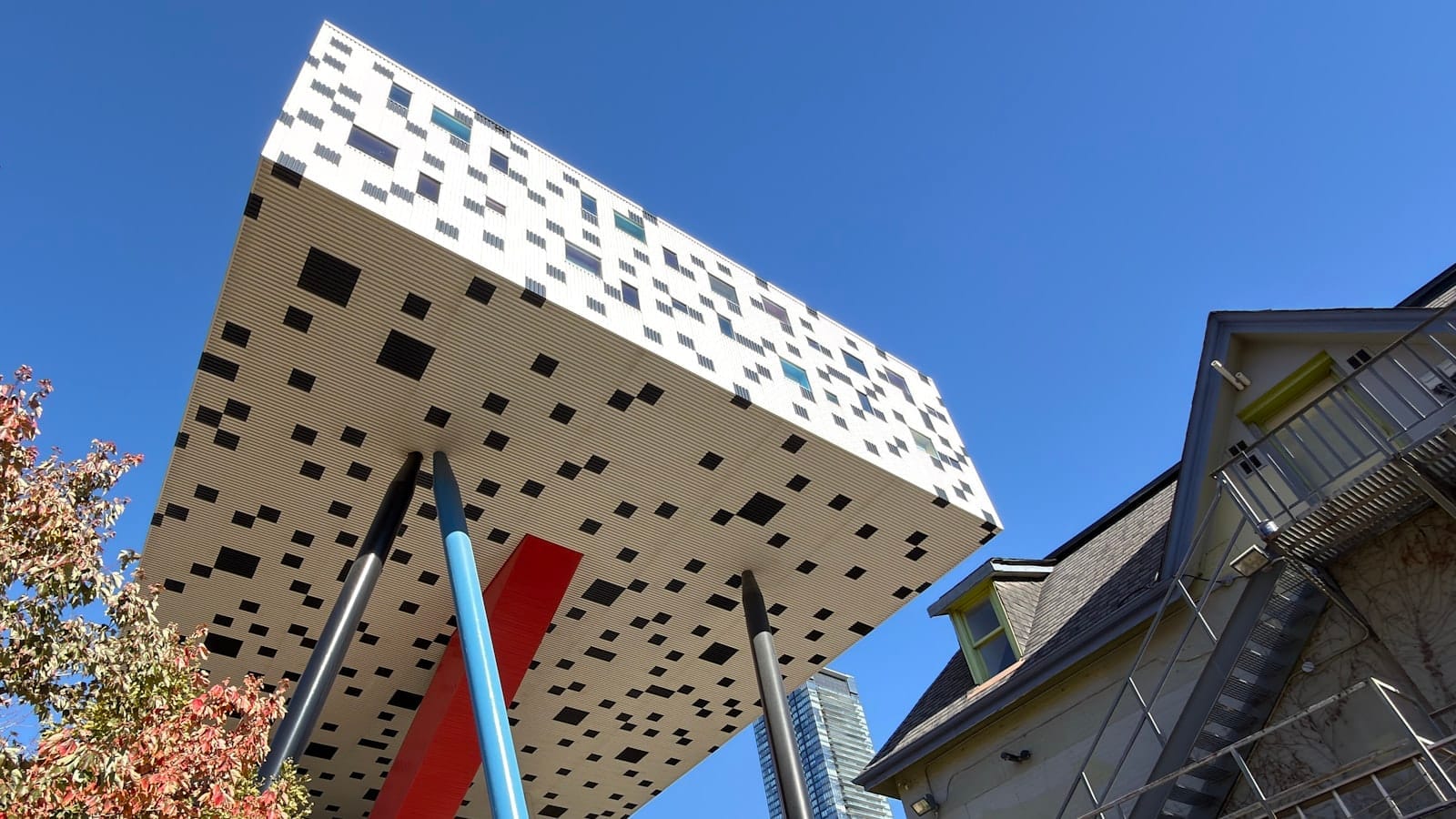
The Rosalie Sharp Centre for Design at OCAD University is one of the most visually striking buildings in Canada. A black-and-white pixelated box elevated on 12 angled coloured legs, it hovers above downtown Toronto like a giant tabletop art installation. The exterior is free to see, takes under an hour to appreciate properly, and rewards anyone who cares about architecture, design, or finding a genuinely unusual photograph.
Quick Facts
- Location
- 100 McCaul Street, Downtown Toronto, next to Grange Park and the Art Gallery of Ontario
- Getting There
- TTC streetcar on Queen Street West (501); short walk from St. Patrick or Osgoode subway stations (Line 1)
- Time Needed
- 20–45 minutes for exterior exploration; longer if combining with AGO or Grange Park
- Cost
- Free to view the exterior from public streets and Grange Park; interior access subject to OCAD University policies
- Best for
- Architecture enthusiasts, photographers, design students, and anyone building a Toronto skyline perspective
- Official website
- www.ocadu.ca/about-ocad-u/our-campus
What the Sharp Centre Actually Looks Like Up Close
No photograph fully prepares you for the experience of standing beneath the Rosalie Sharp Centre for Design. The building is a massive rectangular volume, clad in a bold black-and-white pixelated pattern, elevated roughly four storeys above street level on 12 angled steel legs painted in colours including red, orange, yellow, and green. The legs do not sit neatly vertical. They splay outward at varying angles, which makes the whole structure feel simultaneously precarious and intentional, like an enormous piece of furniture designed by someone who genuinely did not care about convention.
Completed in 2004 as part of a CAD $42.5-million campus redevelopment, the Sharp Centre was designed by British architect Will Alsop, working in partnership with Toronto firm Robbie/Young + Wright Architects (now part of NORR). The following year, in 2005, it received the Royal Institute of British Architects (RIBA) Worldwide Award, an honour that recognised the building as an outstanding contribution to architecture on the international stage. The distinction was notable precisely because the project is a relatively modest academic addition to an urban campus, not a grand civic monument.
Walk around the full perimeter. The building reads very differently from McCaul Street to the south, from Grange Park to the west, and from the lane behind it to the north. The pixelated cladding shifts in texture and depth depending on light angle, and the relationship between the hovering box and the Victorian streetscape below it creates a visual tension that is worth experiencing from multiple positions.
💡 Local tip
The view from Grange Park, looking northeast toward the building with trees in the foreground, is the most photogenic angle and changes dramatically with the seasons. In autumn, the warm tones of the park contrast sharply with the black-and-white cladding above.
Historical and Architectural Context
OCAD University, formerly the Ontario College of Art and Design, has occupied this block of McCaul Street since the early 20th century. The 1921 McCaul Street building, a fairly conventional institutional structure, had become severely overcrowded by the 1990s. The challenge facing the university was real: the campus sat on a small urban plot with no room to expand horizontally, adjacent to Grange Park on one side and the Art Gallery of Ontario on the other. Alsop's solution was to go vertical in the most theatrical way possible: build the new studio and classroom space in the air above the existing structure, supported on legs, leaving the ground plane beneath largely open.
The approach was not purely aesthetic provocation. Functionally, the Sharp Centre added substantial new studio, laboratory, and classroom space to a campus that had outgrown its footprint. The elevated form preserved pedestrian flow and park sightlines at street level while stacking usable floor area above. That combination of structural pragmatism and visual audacity is precisely what made the building polarising when it opened, and what continues to make it interesting two decades later.
The building sits in a stretch of downtown Toronto that has long been associated with arts and creative institutions. The Art Gallery of Ontario is directly adjacent, making this corner of McCaul and Dundas one of the densest concentrations of design, architecture, and visual arts in the city. For anyone following Toronto's architectural evolution, this block tells a layered story from 19th-century civic classicism to 21st-century structural experimentation.
Tickets & tours
Live prices and dates from our booking partner. If you book, we may earn a commission at no extra cost to you.
LEGOLAND Discovery Centre Toronto tickets
From 16 €Instant confirmationFree cancellationToronto Old Town: Dark Side Exploration Game and Tour
From 12 €Instant confirmationFree cancellationToronto 'Little Canada' entrance tickets
From 27 €Instant confirmationFree cancellationNiagara Falls evening tour with boat, dinner and Illumination Tower
From 77 €Instant confirmationFree cancellation
How the Experience Changes by Time of Day
The Sharp Centre is an outdoor architectural experience, which means light governs everything. In the morning, particularly on sunny days, the eastern and southern faces of the building catch direct light, making the pixelated black-and-white panels highly contrasted and graphic. The coloured legs pick up warmth from early sun and cast long angular shadows across the pavement below. There are usually few people around before 9 a.m., which makes for uncluttered photography and a more contemplative experience.
Midday in summer produces harder overhead light that flattens the facade somewhat. The area fills with students, park users, and gallery visitors, which gives the space an energetic quality but makes wide-angle photography of the building harder. Late afternoon, roughly between 4 and 6 p.m., is arguably the most rewarding time to visit: the light rakes across the western face of the building from Grange Park, the coloured legs glow, and the contrast between the darkening sky and the white panels of the cladding increases sharply.
After dark, the building is artificially lit and presents a completely different visual character. The pixelated facade becomes flatter and more monolithic at night, but the legs take on a vivid, almost theatrical quality under street and campus lighting. The surrounding streets are quiet on weekday evenings, which can make the illuminated structure feel strangely theatrical against the residential-scale buildings of the surrounding blocks.
ℹ️ Good to know
The Sharp Centre is an academic building. Weekday mornings and afternoons during the academic year (roughly September to April) are when you are most likely to see the campus operating normally. Weekends and summer months are quieter. Interior access is not available to the general public as a standalone attraction; confirm directly with OCAD University if you have a specific reason to visit inside.
Practical Walkthrough: Getting There and Getting the Most from the Visit
The building is at 100 McCaul Street, on the western edge of downtown Toronto. From Queen Street West, walk north on McCaul Street for about three minutes. The building becomes visible almost immediately once you turn off Queen. From the east, it is a short walk from St. Patrick subway station on Line 1, or a slightly longer walk from Osgoode station. The 501 Queen streetcar stops on Queen Street West within a few minutes walk.
The most rewarding approach is to combine this with the surrounding block. Spend time in Grange Park, which is immediately west of the building and free to access, then walk around to McCaul Street to see the building from the south and east. If you are combining with a visit to the Art Gallery of Ontario next door, plan to see the Sharp Centre first: the exterior takes 20 to 30 minutes, and the AGO can easily absorb a half day or more.
There is no admission fee for the exterior, which is visible from public streets and Grange Park at all times. What you are doing here is viewing architecture in its urban context, not entering an institution. Budget 30 to 45 minutes if you want to walk the full perimeter, sit in the park for a wider view, and take photographs without rushing.
The surrounding neighbourhood rewards extension. Kensington Market is about a 10-minute walk to the northwest, and Queen Street West runs immediately to the south with cafes, independent shops, and galleries. This entire area makes for a coherent half-day itinerary.
Photography Notes and Practical Considerations
The Sharp Centre is genuinely one of the most photographable buildings in Toronto, but it rewards patience and positioning more than quick snaps. A wide-angle lens or smartphone in ultra-wide mode works well for capturing the full structure and legs together. Getting low, near ground level beneath the building on the McCaul Street side, produces a striking perspective that emphasises the scale of the legs and the floating volume above.
For wider contextual shots that include Grange Park in the foreground, a standard or slightly telephoto focal length compresses the distance and makes the relationship between the parkland and the elevated building more legible. Overcast days produce even, diffused light that handles the high-contrast black-and-white facade without blowing out highlights, while direct sun creates drama at the cost of some detail in shadow areas.
⚠️ What to skip
The building is on an active university campus. Respect campus protocols, particularly during examination and graduation periods. Do not attempt to enter without a reason consistent with university access policies.
Honest Assessment: Who This Is For, and Who Should Skip It
The Sharp Centre is not a conventional tourist attraction. There is no ticket to buy, no exhibition to enter, and no guided interpretation on-site. What exists is a piece of architecture that either strikes you as extraordinary or leaves you indifferent. If you approach buildings as objects worth reading carefully, this one has a great deal to say about structure, urban constraint, and the willingness to make something unfamiliar in a city that generally plays it safe architecturally.
If architecture holds no particular interest for you, the 30 minutes here might feel like a detour rather than a destination. In that case, focus your time on the nearby attractions that offer a fuller programme: the AGO has permanent and rotating collections that can occupy several hours, and Toronto's broader architecture scene includes a number of other buildings that reward dedicated attention.
Weather has genuine impact here. Rain or snow does not diminish the building itself, but the experience of walking around it and sitting in Grange Park for a wider view is considerably less pleasant in a downpour. The exterior is fully exposed, so cold winter days mean a shorter visit unless you are dressed appropriately for extended outdoor time. In summer, the park provides shade and the visit is comfortable at most times of day outside of peak heat hours.
Insider Tips
- The southeast corner of Grange Park, nearest to the building, gives you the clearest unobstructed view of all 12 legs simultaneously. Most visitors photograph from street level on McCaul and miss this angle entirely.
- If you are visiting during OCAD University's open studio days or graduation exhibitions (typically in spring), interior access to parts of the campus may be open to the public. Check the university's events calendar before your visit.
- The alley on the north side of the building, accessible from Beverley Street, offers a perspective rarely seen in standard images: you can look back south toward the building against the downtown skyline, which puts its scale in an entirely different context.
- The building's pixelated black-and-white cladding is not paint; it is a system of coloured panels. In certain lighting conditions, particularly on grey days, subtle colour variation in the panels becomes visible that photographs at a distance do not capture.
- Combining this visit with a walk through Kensington Market to the northwest and a stop at one of the cafes on Dundas Street West creates a natural two-hour circuit that covers three distinct registers of Toronto's urban character in quick succession.
Who Is OCAD University Sharp Centre for Design For?
- Architecture and design enthusiasts seeking one of Canada's most awarded contemporary buildings
- Photographers looking for a structurally unusual subject that rewards multiple angles and lighting conditions
- Students and academics with an interest in adaptive campus design and postmodern structural engineering
- Travellers combining a half-day itinerary around the AGO, Grange Park, and Queen Street West
- Visitors following Toronto's design and creative-industries scene who want spatial context for the city's arts institutions
Nearby Attractions
Other things to see while in Downtown Toronto:
- Allan Gardens Conservatory
Allan Gardens Conservatory is a free, year-round botanical conservatory at 160 Gerrard Street East in downtown Toronto. Housed in six glass display houses anchored by a 1910 Edwardian Palm House, it holds about 1,500 m² of tropical palms, cacti, orchids, and seasonal blooms. One of the oldest parks in Toronto, it remains one of the city's most underrated green spaces.
- Art Gallery of Ontario
The Art Gallery of Ontario is one of North America's largest art museums, housing over 90,000 works inside a landmark Frank Gehry-renovated building in downtown Toronto. From Indigenous Canadian art to European masters and contemporary photography, the AGO rewards focused visitors and casual explorers alike.
- Brookfield Place (Allen Lambert Galleria)
The Allen Lambert Galleria inside Brookfield Place is a free, publicly accessible arcade designed by architect Santiago Calatrava between 1987 and 1992. Its arching steel-and-glass canopy, rising between two of downtown Toronto's tallest towers, is one of the most impressive interior spaces in Canada.
- Campbell House Museum
Built in 1822 for Upper Canada's Chief Justice, Campbell House Museum is the oldest surviving residence from the original Town of York. Moved to its current downtown corner in 1972 and opened as a museum in 1974, it offers an intimate, unhurried window into early colonial Toronto — a sharp contrast to the glass towers surrounding it.
Planning a trip? Discover personalized activities with the Nomado app.