Neues Rathaus & Glockenspiel: Munich's Gothic Centrepiece Explained
The Neues Rathaus dominates Marienplatz with 85 metres of Neo-Gothic stonework and one of Europe's most-watched clock performances. Here is everything you need to know before you go, including when crowds are thinnest and what the Glockenspiel actually shows.
Quick Facts
- Location
- Marienplatz 8, 80331 Munich (Altstadt)
- Getting There
- U-Bahn / S-Bahn: Marienplatz (U3, U6, S1–S8)
- Time Needed
- 20–30 min for Glockenspiel; 2 hrs for a guided tour
- Cost
- Free to view exterior and Glockenspiel; Neues Rathaus guided tour €18 per person
- Best for
- First-time visitors, architecture lovers, families with older children
- Official website
- www.muenchen.de/en/sights/attractions/new-town-hall
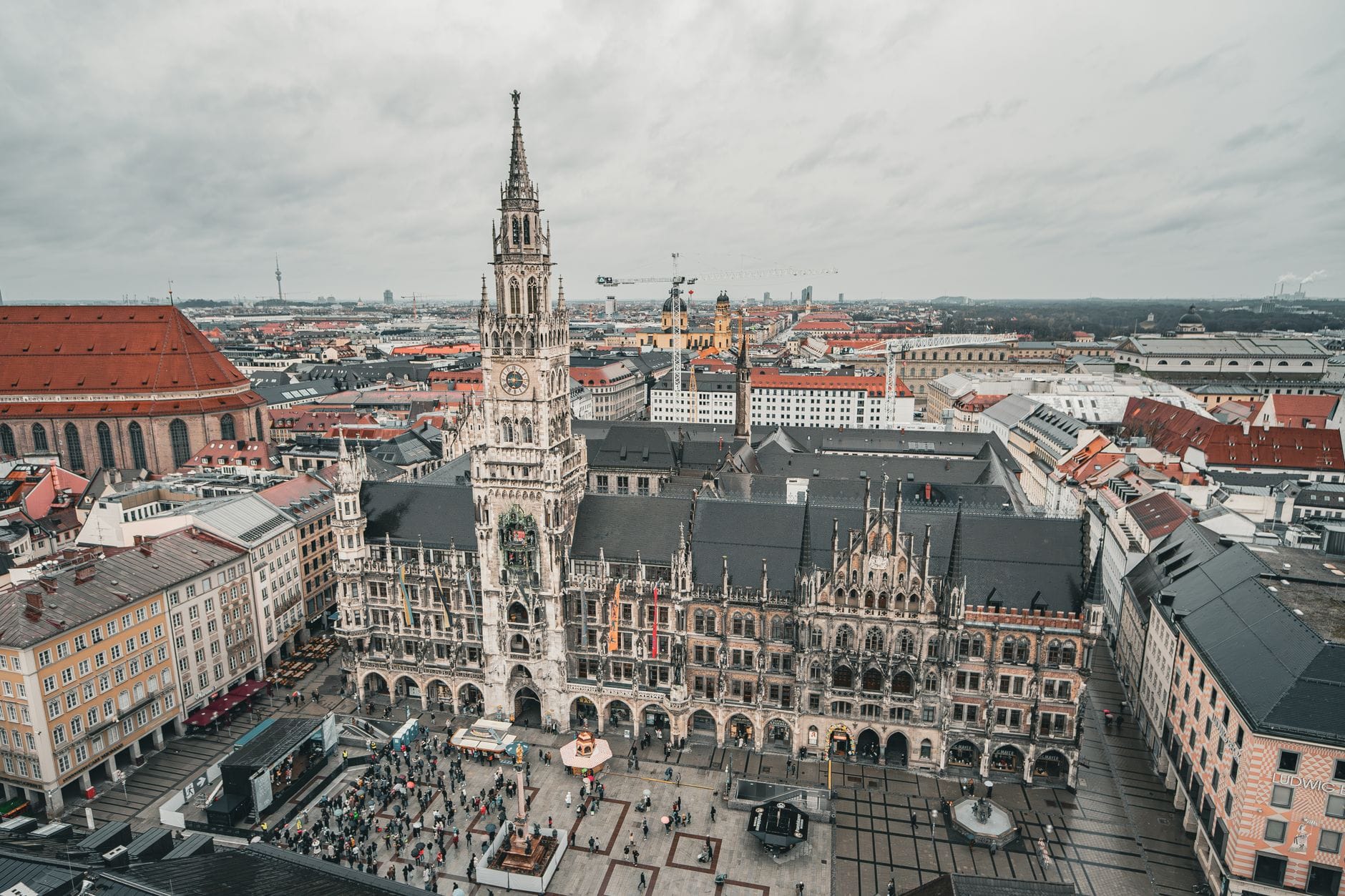
What You Are Looking At
The Neues Rathaus, or New Town Hall, is the seat of Munich's Lord Mayor and City Council, occupying the entire north side of Marienplatz. Its facade stretches roughly 100 metres wide and climbs 85 metres at the central tower. From the square below, the effect is one of compressed mass: tier after tier of pointed gables, gargoyles, tracery windows, and stone pinnacles stacked upward in dark Franconian limestone.
Despite the medieval appearance, this building is not old by European standards. Construction began in 1867 and was not completed until 1909, meaning it is a product of the Wilhelmine era, designed by Bavarian architect Georg von Hauberrisser in deliberate imitation of northern Gothic town halls. The city outgrew several earlier buildings on the same square; this was the fourth attempt to build a Rathaus worthy of a growing Bavarian capital. That context matters for understanding what you see: this is civic ambition expressed in stone, not ancient heritage.
ℹ️ Good to know
The Glockenspiel performs daily at 11:00 and 12:00 year-round, with an additional performance at 17:00 from March through October (and a brief night-time chime most evenings). Arrive a few minutes early to secure a clear sightline on the square.
The Glockenspiel: What Actually Happens
The Glockenspiel sits in the tower at roughly the third-floor level, visible from most positions on Marienplatz. At show time, 43 bells chime and 32 life-sized figures rotate through two stories drawn from Munich's history. The upper tier re-enacts a jousting tournament held in 1568 to celebrate the wedding of Duke Wilhelm V and Renata of Lorraine. The lower tier depicts the Schäfflertanz, the coopers' dance said to have lifted civic spirits during a 16th-century plague outbreak.
The full performance lasts roughly 12 minutes. The figures move on a mechanical track rather than dancing freely, and the scale from street level is smaller than most first-time visitors anticipate. What is genuinely impressive is the precision of the carillon: the bells are tuned across two octaves, and on a calm morning the sound carries clearly across the square. If you have heard church carillons in Belgium or the Netherlands, this is a comparable experience, though more focused on visual spectacle.
⚠️ What to skip
The Glockenspiel draws large, stationary crowds that form quickly before the performance. Visitors with pushchairs or mobility aids should position themselves early on the broader western side of Marienplatz, where there is more room to manoeuvre.
Tickets & tours
Live prices and dates from our booking partner. If you book, we may earn a commission at no extra cost to you.
Luggage Storage in Munich
From 6 €Instant confirmationFree cancellationOne hour city sightseeing bus tour in Munich
From 21 €Instant confirmationFree cancellationMunich Third Reich walking tour
From 32 €Instant confirmationFree cancellationRomantic Road Day Trip to Rothenburg and Harburg
From 74 €Instant confirmationFree cancellation
How the Experience Changes by Time of Day
The 11:00 performance on weekdays draws the densest crowds. Tour groups arriving by coach tend to cluster here, and the square fills with raised cameras well before the hour. The 12:00 show brings a slightly different crowd, more office workers and independent travellers, with marginally more space. If you are visiting between March and October, the 17:00 performance is considerably quieter: the tour groups have moved on, the light is warmer, and you can often stand within ten metres of the tower base without being jostled.
Early morning, before 09:00, is the best time to study the building itself without distraction. The stone takes on a cooler, greyer tone in flat morning light, and the Gothic detailing becomes more legible without midday glare washing out the shallow carvings. Street cleaners are still finishing their rounds, and the smell of fresh bread drifts up from the bakeries tucked into the arcade on the building's ground floor. By 10:30, the rhythm shifts completely: coffee cups appear on terrace tables, the first tour leaders raise their umbrellas, and Marienplatz becomes the operational centre of the Munich tourist day.
In winter, particularly around the Christmas market season, the square is transformed. Market stalls ring the Mariensäule column and approach the Rathaus facade, and the building is lit from below in the evenings, which emphasises the tower silhouette more dramatically than any summer daytime visit. The cold also keeps some crowds away from the 11:00 show, making December a reasonable time to watch the Glockenspiel without being hemmed in.
For a broader picture of seasonal timing across the city, the best time to visit Munich guide covers monthly trade-offs in detail.
Architecture Worth Your Attention
Hauberrisser's design draws on Flemish and French Gothic precedents while incorporating Bavarian heraldic motifs throughout. Look for the crests of Bavarian noble families carved into the facade panels at mid-height, and the figure of the Münchner Kindl (the city's symbol, a monk-child in a black robe) appearing repeatedly in stone and in the bronze of the main entrance doors. The central oriel window above the main portal is particularly detailed, with a canopy of micro-architecture that rewards a zoom lens or binoculars.
The tower itself contains a viewing platform accessible by lift (check the city's current access schedule, as this varies seasonally). From the top, the view south towards the twin-towered Frauenkirche and north over the roofline of Schwabing is among the more useful orientation views in the city because it puts the street grid and the scale of the Altstadt into clear perspective.
The Frauenkirche visible from the tower is Munich's cathedral and arguably the more architecturally significant of the two landmarks. The juxtaposition between the late-Gothic brick cathedral (completed 1488) and the neo-Gothic sandstone Rathaus (completed 1909) captures four centuries of the city's self-image.
Guided Tours: What They Cover
Guided tours of the Neues Rathaus in English currently run on Saturdays at 13:30 and Sundays at 10:30, with occasional extra tours on public holidays. The tour ticket costs €18 per person. Tours include access to the council chambers, the ceremonial halls used for official receptions, and spaces not open to the general public. The interior is substantially richer than the exterior suggests: high-vaulted ceilings with painted heraldic programmes, dark oak panelling, and stained glass that fills the halls with coloured light on sunny mornings.
For visitors with a specific interest in Bavarian civic history or Gothic Revival interiors, the tour justifies the price. For travellers primarily interested in ticking off the Glockenspiel and moving on, the exterior experience is free and complete in itself. The tour meeting point is at the Tourist Information office located in front of the Rathaus on Marienplatz.
💡 Local tip
Book tour tickets in advance through the official Munich city website, especially for Saturday morning slots, which fill quickly during peak season.
Getting There and Getting Around
Marienplatz is one of Munich's central transport hubs. U-Bahn lines U3 and U6 and all S-Bahn lines (S1 through S8) stop directly at Marienplatz station, making the Neues Rathaus reachable from any part of the city in under 20 minutes. From Hofbräuhaus, it is a four-minute walk east through Tal and across the square. From the Englischer Garten, tram line 16 drops you at Nationalmuseum/Prinzregentenstraße and it is a 15-minute walk southwest.
The surrounding Altstadt is a pedestrian zone, so there is no driving into this area. Cycling is permitted on some surrounding streets but not on Marienplatz itself during busy hours. If you are navigating with a map, note that Marienplatz functions as kilometre zero for Munich's street network.
Photography Advice
Getting a full-facade shot from Marienplatz is geometrically difficult because the square is not wide enough for a standard lens to capture the building from base to tower tip. A wide-angle lens (16–24mm equivalent on full frame) is necessary for a complete shot. Alternatively, the upper floor of the Kaufingerstrasse shops on the south side of the square occasionally offers elevated angles, though access depends on the individual retailer.
For the Glockenspiel specifically, a zoom of at least 200mm equivalent is useful to capture individual figures during the performance. The figures are backlit in the afternoon on sunny days, making morning performances better for detail shots. Overcast days remove the harsh shadow problem but flatten the texture of the stone facade.
💡 Local tip
Climb to the tower platform for a downward perspective on Marienplatz at show time. Photographing the crowd itself from above, with the Mariensäule column as a focal point, produces a more original image than any facade shot from street level.
Who Should Consider Skipping This
If you have spent time in Bruges, Brussels, or Cologne and are deeply familiar with genuine medieval or Gothic Revival civic architecture, the Neues Rathaus may feel formulaic. It is technically accomplished but not pioneering, and Hauberrisser was working within a well-established 19th-century template. Similarly, visitors who prioritise Munich's post-war modernist architecture or its museum district will find more reward a few kilometres north in Maxvorstadt.
The Glockenspiel, specifically, is genuinely overhyped relative to its actual spectacle. The performance is brief, the figures are small at street level, and the mechanical motion is simple. Visitors who have watched the astronomical clock in Prague or the Zytglogge in Bern will find this less impressive. That said, as a free experience embedded in the natural flow of a Marienplatz visit, there is no real cost to watching it. It only disappoints those who travel specifically for it. If Munich's history is your focus, the NS-Dokumentationszentrum a short walk away offers far deeper engagement with the city's past.
Insider Tips
- The 17:00 Glockenspiel performance (March to October) draws a fraction of the midday crowd. If you are in Munich for multiple days, save this slot rather than battling the 11:00 or 12:00 rush.
- The ground-floor arcade beneath the Rathaus contains a small flower and produce presence and several bakeries. On weekday mornings, locals collect bread orders here, giving you a brief window into ordinary Munich life before the tourist day begins.
- Binoculars or a phone zoom make a genuine difference for watching the Glockenspiel figures. Bring them or use your camera's zoom before the performance starts so you are already framed when the figures begin moving.
- The tower lift access and viewing platform hours vary seasonally and may close for official events. Check the city's website the morning of your visit rather than assuming it is open.
- The Rathaus interior courtyard is sometimes accessible during business hours and hosts open-air events in summer. It gives you a sense of the building's scale without paying for the guided tour.
Who Is Neues Rathaus & Glockenspiel For?
- First-time visitors to Munich getting their bearings in the Altstadt
- Architecture enthusiasts interested in 19th-century Gothic Revival civic buildings
- Families wanting a free, time-specific spectacle that works as a natural anchor point for a morning itinerary
- Photographers looking for a photogenic landmark with complex detail and changeable lighting conditions
- Travellers combining a Marienplatz visit with the nearby Viktualienmarkt or St Peter's Church
Nearby Attractions
Other things to see while in Altstadt (Old Town):
- Asamkirche
Squeezed into a narrow slot on Sendlinger Strasse, the Asamkirche is a privately built late Baroque church that packs more ornamental intensity into 22 metres than most cathedrals manage in a hundred. Built by the Asam brothers between 1733 and 1746, it is free to enter and sits in the heart of Munich's pedestrian zone.
- Cuvilliés Theatre
Hidden within the Munich Residenz complex, the Cuvilliés Theatre is an 18th-century Rococo opera house of extraordinary refinement. Its gilded tiers, crimson velvet boxes, and carved ivory ornaments make it one of the most visually concentrated rooms in all of Germany.
- Deutsches Museum
The Deutsches Museum sits on its own island in the Isar river and claims a place among the largest science and technology museums on earth. With 125,000 exhibited objects spanning aviation, mining, chemistry, musical instruments, and far more, it rewards careful planning rather than a casual stroll.
- Feldherrnhalle
Standing at the southern end of Odeonsplatz, the Feldherrnhalle is one of Munich's most architecturally striking and historically loaded monuments. Built between 1841 and 1844, it witnessed the gunfire that ended Hitler's failed coup and remains freely accessible at any hour. Few structures in the city compress so much of Bavaria's and Germany's history into a single loggia.
Planning a trip? Discover personalized activities with the Nomado app.