Deutsches Museum Munich: The Complete Visitor Guide
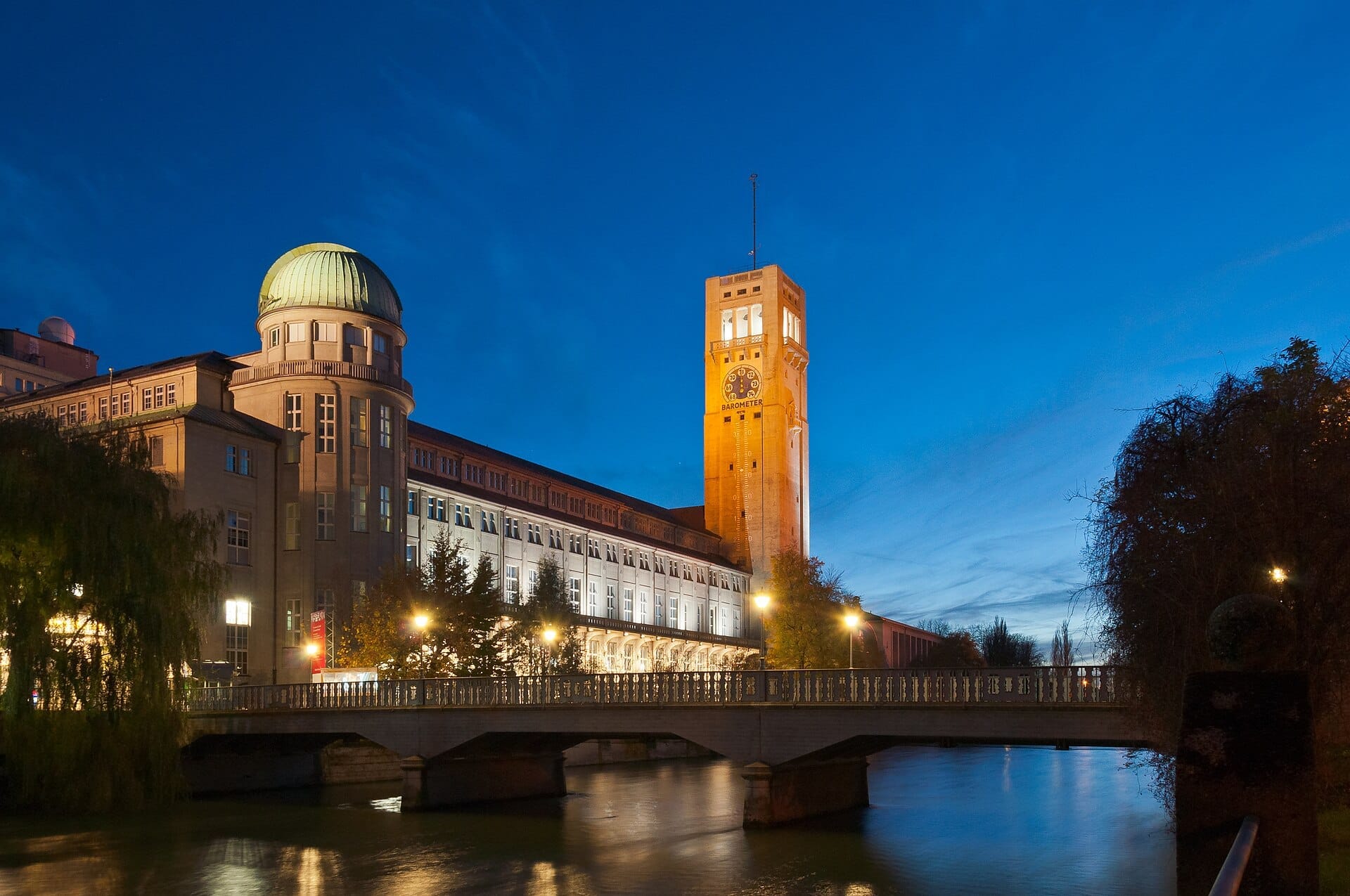
The Deutsches Museum sits on its own island in the Isar river and claims a place among the largest science and technology museums on earth. With 125,000 exhibited objects spanning aviation, mining, chemistry, musical instruments, and far more, it rewards careful planning rather than a casual stroll.
Quick Facts
- Location
- Museumsinsel 1, 80538 Munich — on Museum Island in the Isar river, Altstadt
- Getting There
- Tram 16 or S-Bahn to Isartor; U1/U2 or Tram 18 to Fraunhoferstraße; Bus 132 to Boschbrücke
- Time Needed
- 3–6 hours minimum; a full day for serious visitors
- Cost
- Adults €15 / Ages 6–17 €8 / Family ticket €31 (verify on official site before visiting; prices subject to change)
- Best for
- Science enthusiasts, families with school-age children, rainy-day seekers, engineering fans
- Official website
- www.deutsches-museum.de/en
What the Deutsches Museum Actually Is
The Deutsches Museum — formally the Deutsches Museum von Meisterwerken der Naturwissenschaft und Technik, or German Museum of Masterpieces of Science and Technology — is not a normal museum you walk through in ninety minutes. It occupies its own island, the Museumsinsel, in the middle of the Isar river in Munich's Altstadt-Lehel district. The building covers an enormous footprint, and its permanent collection runs to roughly 125,000 exhibited objects across approximately 50 fields of science and technology. Visitor numbers are in the million-plus range per year, making it one of the most visited museums in Germany.
The scope is the first thing that disarms new visitors. Aviation halls display full-scale aircraft hanging from the ceiling. A reconstructed salt mine runs beneath the building. Original submarine U1 sits in a dedicated naval hall. There are working demonstrations of high-voltage electrical experiments, a planetarium, and entire floors dedicated to fields as different as musical instruments, ceramics, and offshore oil platforms. The museum is not attempting to curate a selective highlight reel — it is trying to document the full breadth of human technical achievement, which is both its great strength and the main reason visitors should arrive with a plan.
💡 Local tip
Download the museum's floor plan before you arrive or grab one at the entrance. The building has multiple floors and dozens of departments; without orientation, it is easy to spend an hour in one wing and run out of time for what you actually wanted to see.
A Brief History and Why It Matters
The museum was founded in 1903 by engineer and industrialist Oskar von Miller, with the backing of several prominent German scientists and industrialists of the era. The ambition from the start was to make science and technology comprehensible to a general public, not just specialists. The current main building on the Museumsinsel opened in stages beginning in 1925, and the island location was deliberate — it gave the institution room to expand and kept it physically distinct from the rest of the city, reinforcing its identity as a destination in itself.
The collection survived World War II in fragmentary form — the building sustained significant bomb damage — and the postwar reconstruction effort shaped much of the layout visitors experience today. An ongoing renovation programme, scheduled to continue until 2028, means certain wings or departments may be closed or reorganised during your visit. This is worth checking on the official site before you go, since the renovation has periodically affected access to some of the museum's headline exhibits.
Tickets & tours
Live prices and dates from our booking partner. If you book, we may earn a commission at no extra cost to you.
What You Will Actually See: The Major Departments
The aviation and aerospace halls are typically the most photogenic, with aircraft suspended overhead at angles that suggest actual flight. The mining section, which includes a walk-through reconstruction of underground mine tunnels, is particularly striking — the temperature drops noticeably as you descend, and the tight passages give a visceral sense of what pre-mechanised mining involved. These two areas alone justify a half-day for visitors with a particular interest in either subject.
The energy, chemistry, and pharmaceuticals departments cater more to those with a technical background, though many exhibits include interactive demonstrations that work across ages. The marine navigation hall and the power machinery section — featuring enormous historic engines — attract a different kind of attention: the sheer physical scale of the objects, some the size of small houses, makes them impressive even with no prior knowledge of how they work.
Families with younger children tend to gravitate toward the interactive science demonstrations and the model railway exhibits. For context on how the museum fits within Munich's broader cultural landscape, Munich's top museums compared — the Deutsches Museum occupies a very different register from the art-focused institutions of Maxvorstadt, but it draws comparable crowds.
How the Visit Changes by Time of Day
The museum opens at 09:00 daily and closes at 17:00. The first hour after opening is consistently the quietest period. School groups, which form a substantial portion of weekday visitors, typically arrive between 10:00 and 11:00, and the entrance area and most popular halls fill noticeably by mid-morning. If you arrive at 09:00, you can move through the aviation hall or the mine section with considerable calm before the groups arrive.
Midday, especially on weekends and during German school holidays, is the most congested period. The cafeteria and the areas around scheduled demonstration shows fill up quickly. If you plan to attend any of the live science demonstrations — check the daily programme at the entrance — arrive ten minutes early, as standing-room capacity is limited. The late afternoon, roughly from 15:30 onward, sees crowds thinning again, though some visitors find energy flagging by then given the physical scale of the museum.
ℹ️ Good to know
The museum is open Monday through Sunday, 09:00–17:00, with a few closure days each year. Hours and department availability may vary during the ongoing renovation (expected through 2028). Always confirm current access on the official site at deutsches-museum.de before planning around specific exhibits.
Getting There and Practical Navigation
The most straightforward approach by public transport is Tram 16 or the S-Bahn to Isartor, followed by a short walk across the bridge to the island. Note that Isartor S-Bahn station does not have a lift — only escalators — so wheelchair users and visitors with prams should instead use Rosenheimer Platz, which has lift access, though the route from there involves a steep incline along Rosenheimer Straße. Bus 132 stops at Boschbrücke, which puts you directly adjacent to the museum entrance; buses 52 and 62 serve the Baaderstraße stop if you are coming from the south.
The museum is walkable from Marienplatz in about fifteen minutes along the Isar embankment, which makes it an easy addition to a day centred on the Altstadt. If you are visiting multiple paid attractions, check whether the Munich City Pass offers value on your particular itinerary — admission to the Deutsches Museum is included in some pass versions.
The ongoing renovation means that some internal routes through the building may be altered. Signage inside is generally clear in both German and English, but the scale of the building means it is worth noting your entry floor and orientation as you move between departments. The main stairwells can feel confusing when sections are temporarily closed and routed around.
Photography, Accessibility, and What to Bring
Photography is permitted throughout most of the museum without flash, and the aviation hall and mining section produce the most dramatic shots. The suspended aircraft photograph well in the morning when the halls are less crowded and natural light from the upper windows is at its clearest. Tripods are generally not permitted in busy public areas.
Comfortable shoes are essential — the building covers an enormous area and there is no practical shortcut between distant departments other than walking. A light layer is useful for the mining section, which is cooler than the rest of the museum. The museum has a cafeteria and a café, so you can break up a long visit without leaving the building, though the food is straightforward canteen fare rather than a culinary destination.
Accessibility inside the building is better than most older Munich institutions, with lifts connecting floors in the main sections, though the renovation has affected some routes. Visitors with specific accessibility requirements should consult the official museum site before arrival. For broader guidance on moving around the city, the Munich transport guide covers all transit options in detail.
Is It Worth Your Time?
The Deutsches Museum rewards visitors who arrive with genuine curiosity about at least one of its subject areas. If you have a strong interest in aviation, naval history, mining, early computing, or industrial machinery, the depth on offer here is extraordinary and largely unmatched in Germany. The collection is dense with original objects, not reproductions, and the explanatory materials are available in English throughout the main departments.
Visitors who find themselves lukewarm on science and technology as a category may struggle to sustain enthusiasm across a full visit. The museum is not designed as a casual cultural experience — there is little art, no panoramic views, and the atmosphere is functional rather than atmospheric. If your priority is Munich's historical or architectural character, the time might be better spent elsewhere.
The museum is particularly well suited to families with school-age children, and it appears frequently in guides to visiting Munich with children. The combination of hands-on exhibits, dramatic full-scale objects, and live demonstrations keeps younger visitors engaged in ways that art museums rarely manage. For adults travelling without children who have limited time in Munich, it is worth being selective: the aviation hall, the mine, and one or two additional departments of personal interest is a more satisfying approach than trying to cover everything.
⚠️ What to skip
Ongoing renovation work is expected to continue until 2028. Some departments or sections may be temporarily closed during your visit. Check the official website for current exhibition availability before planning your trip around a specific exhibit.
Insider Tips
- The mine section operates at a cooler temperature than the rest of the building — bring a light jacket even in summer if you are sensitive to cold.
- Live demonstration schedules are posted at the main entrance each morning. The high-voltage electricity demonstrations are among the most popular; arrive at least ten minutes early or you may not get a spot inside.
- The museum's upper floors tend to be significantly less crowded than the ground and first floors, regardless of time of day. If the main halls feel overwhelming, heading upstairs often provides immediate relief.
- Tuesday through Thursday mornings in non-holiday periods are the quietest days overall. Weekend afternoons, particularly in summer and during Bavarian school holidays, see the heaviest visitor volumes.
- The Isar embankment between the museum and Isartor is a pleasant ten-minute walk that lets you decompress after a long visit — and connects you naturally to the rest of the Altstadt without needing a tram.
Who Is Deutsches Museum For?
- Science and engineering enthusiasts of any age who want genuine depth rather than a surface-level overview
- Families with school-age children looking for a full-day activity with interactive elements and live demonstrations
- Visitors caught in rainy weather who need a substantial indoor option in central Munich
- History of technology researchers and those with professional backgrounds in aviation, mining, or industrial engineering
- Travellers on a longer Munich stay who have already covered the main Altstadt sights and want something substantively different
Nearby Attractions
Other things to see while in Altstadt (Old Town):
- Asamkirche
Squeezed into a narrow slot on Sendlinger Strasse, the Asamkirche is a privately built late Baroque church that packs more ornamental intensity into 22 metres than most cathedrals manage in a hundred. Built by the Asam brothers between 1733 and 1746, it is free to enter and sits in the heart of Munich's pedestrian zone.
- Cuvilliés Theatre
Hidden within the Munich Residenz complex, the Cuvilliés Theatre is an 18th-century Rococo opera house of extraordinary refinement. Its gilded tiers, crimson velvet boxes, and carved ivory ornaments make it one of the most visually concentrated rooms in all of Germany.
- Feldherrnhalle
Standing at the southern end of Odeonsplatz, the Feldherrnhalle is one of Munich's most architecturally striking and historically loaded monuments. Built between 1841 and 1844, it witnessed the gunfire that ended Hitler's failed coup and remains freely accessible at any hour. Few structures in the city compress so much of Bavaria's and Germany's history into a single loggia.
- Frauenkirche (Cathedral of Our Lady)
The Frauenkirche, officially the Dom zu Unserer Lieben Frau, is Munich's most recognizable landmark. Its twin onion-domed towers have defined the city's skyline since the 15th century, and the cathedral remains an active seat of the Archbishop of Munich and Freising. Here is everything you need to visit with confidence.
Planning a trip? Discover personalized activities with the Nomado app.