Marienplatz: Munich's Historic Heart Explained
Marienplatz has anchored Munich's public life since 1158, serving first as a grain market and today as the city's ceremonial centre. The square is free to enter at any hour, and its landmarks — the Neues Rathaus Glockenspiel, the golden Mariensäule, and the surrounding pedestrian zone — reward visitors who time their arrival well.
Quick Facts
- Location
- Marienplatz 1, 80331 München — Altstadt (Old Town)
- Getting There
- Marienplatz station: U3, U6 (U-Bahn); S1, S2, S3, S4, S6, S7, S8 (S-Bahn); Bus 52 nearby
- Time Needed
- 30–60 minutes for the square itself; allow 2–3 hours if visiting surrounding churches and the market
- Cost
- Free — the square is a public space with no admission fee
- Best for
- First-time visitors, architecture enthusiasts, market-lovers, and anyone orienting themselves in central Munich
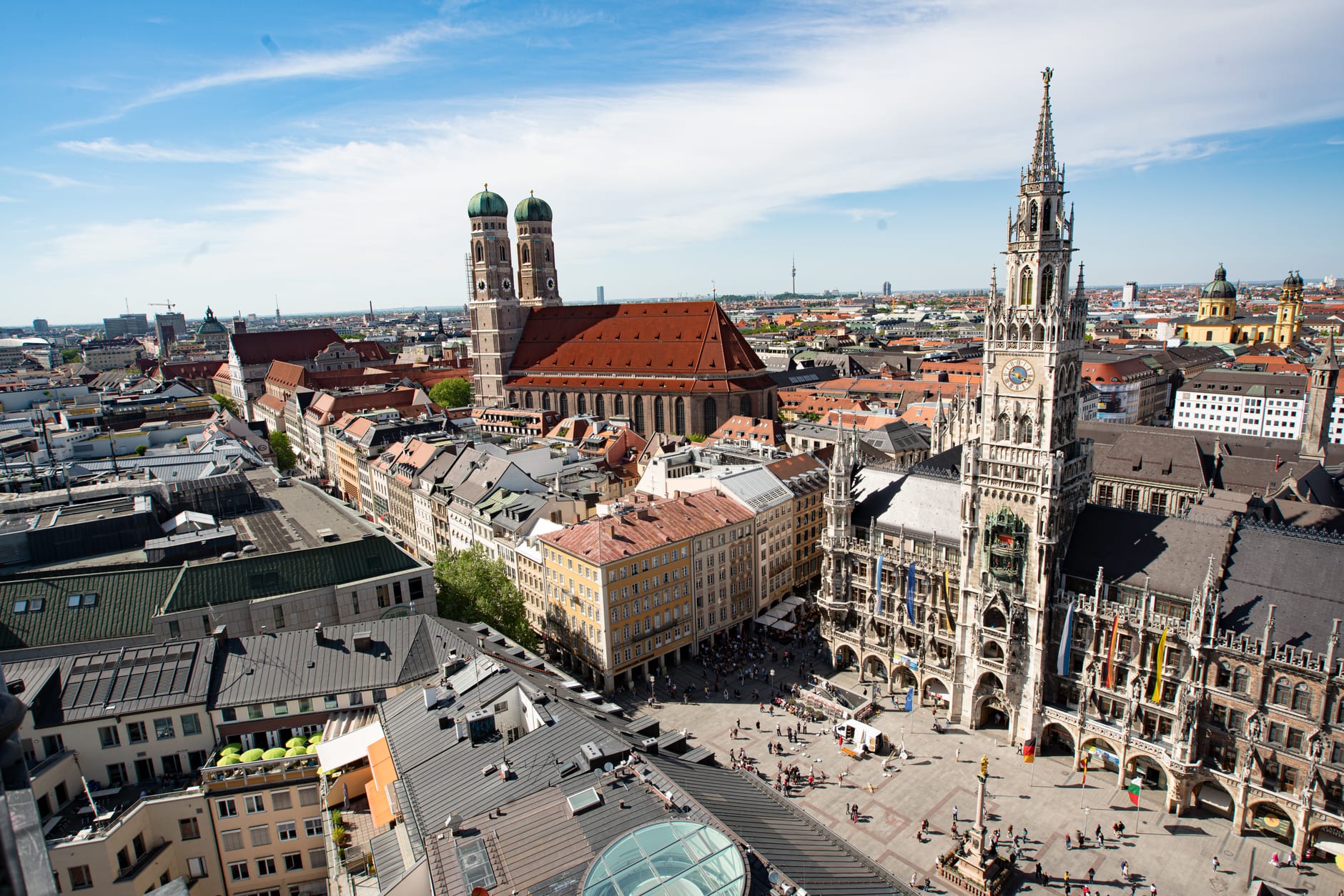
What Marienplatz Actually Is
Marienplatz — literally 'Mary's Square' — is the geographical and civic centre of Munich's Altstadt. It has functioned as the city's primary public square since Munich's founding in 1158, originally serving as a trading point and later a grain market known locally as the Schranne. Today it is a pedestrianised space ringed by the Neues Rathaus (New Town Hall) to the north, the Altes Rathaus (Old Town Hall) to the east, and a web of shopping streets extending in every direction.
The square is not a quiet contemplative space. At most daylight hours it is occupied by a steady flow of commuters cutting through from the transit hub below, tourists photographing the Glockenspiel, street musicians, and locals picking up lunch from the nearby Viktualienmarkt. Understanding that dynamic helps set realistic expectations: Marienplatz is a living city centre, not a museum courtyard.
ℹ️ Good to know
Marienplatz station sits directly below the square and is one of Munich's most important transit interchanges — seven S-Bahn lines (S1, S2, S3, S4, S6, S7, S8) and two U-Bahn lines stop here. The station has elevators and escalators, making it one of the more accessible entry points into the Altstadt for visitors with mobility needs.
The Landmarks on the Square
Mariensäule (Marian Column)
The gilded statue of the Virgin Mary atop a tall column at the centre of the square is called the Mariensäule. It was erected in 1638 to mark the end of Swedish occupation during the Thirty Years' War and to give thanks for Munich being spared from the plague. The column's base features four bronze cherubs vanquishing symbolic enemies: a lion (war), a basilisk (plague), a serpent (famine), and a dragon (heresy). These details are easy to miss from a distance — it is worth walking right up to the base to read the iconography properly.
The square was officially renamed Marienplatz on 9 October 1854, taking its name from this column. Before that date, 'Marienplatz' was just a colloquial name for the space.
Neues Rathaus and the Glockenspiel
The Neues Rathaus dominates the north side of the square with its neo-Gothic facade stretching 100 metres across. Construction took place in stages between 1867 and 1909. The building still functions as Munich's active city hall, so the interior is not a tourist attraction in its own right — but the tower observation platform offers one of the better elevated views over the Altstadt roofline.
The Glockenspiel, set into the tower at 43 metres height, is the square's biggest crowd-drawer. Its 43 bells and 32 life-sized figures re-enact two stories from Munich's 16th century: a jousting tournament celebrating the 1568 wedding of Duke Wilhelm V, and the Schäfflertanz, a dance performed by coopers to lift the city's spirits during a plague outbreak. Performances run at 11:00 and 12:00 daily, with an additional 17:00 performance from March through October. The show lasts about 15 minutes. For more context on the architecture and neo-Gothic detail throughout the Altstadt, see our dedicated Glockenspiel guide.
💡 Local tip
Arrive at least 10 minutes before a Glockenspiel performance if you want a clear sightline. The crowd forms fast, and latecomers often end up watching from behind shoulders. The 11:00 showing typically draws the largest crowd; the 17:00 showing in summer is noticeably quieter.
Altes Rathaus (Old Town Hall)
The building closing off the eastern end of the square is the Altes Rathaus, which dates to the 15th century, though it was rebuilt in neo-Gothic style after wartime damage. The tower now houses the Spielzeugmuseum, a toy museum. The building's ground-floor archway is one of the main pedestrian passages leading toward the Isar side of the Altstadt.
Tickets & tours
Live prices and dates from our booking partner. If you book, we may earn a commission at no extra cost to you.
One hour city sightseeing bus tour in Munich
From 21 €Instant confirmationFree cancellation24-hour grand hop-on hop-off bus tour of Munich
From 29 €Instant confirmationFree cancellationMunich Old Town guided walking tour
From 20 €Instant confirmationFree cancellationMunich Hop-On Hop-Off Bus Tour 24 Hour Ticket
From 25 €Instant confirmationFree cancellation
How the Square Changes Through the Day
Before 08:00, Marienplatz is genuinely quiet. The stone paving is clean, the Mariensäule catches the early light, and the scale of the Neues Rathaus facade is easier to appreciate without a crowd in front of it. Commuters begin arriving shortly after, and by 09:00 the square has a purposeful weekday rhythm — shoppers, office workers, and delivery cyclists sharing the pedestrian zone.
Midday, particularly between 11:30 and 13:30, is the peak period. Tour groups assemble below the Glockenspiel tower, lunch-break crowds spill out of the surrounding streets, and the noise level rises considerably. The smell of pretzels from nearby bakery stalls and roasted nuts from street carts mixes with the general city-centre air. This is the most photographed window of the day, but also the least comfortable for lingering.
Late afternoon, from around 16:00, the character shifts again. Day-trippers begin filtering out, the light becomes more flattering for photography, and the square takes on a more local feel. After dark, the Neues Rathaus facade is illuminated and the square stays active well into the evening, particularly in summer. In winter the Christmas market transforms the space entirely from late November through 24 December, filling it with wooden stalls, mulled wine, and the smell of cinnamon.
For a broader picture of when Munich rewards visitors most, see our guide on the best time to visit Munich, which weighs up the trade-offs between peak summer crowds and the quieter shoulder months.
Getting There and Getting Around
Marienplatz station is one of the most connected points in the entire Munich transit network. Seven S-Bahn lines (S1, S2, S3, S4, S6, S7, S8) and two U-Bahn lines (U3, U6) stop directly below the square. From Munich Hauptbahnhof, it is two stops on the S-Bahn — under five minutes. From Munich Airport (MUC), the S1 and S8 connect directly to Marienplatz in roughly 35–45 minutes.
The square itself sits within Munich's pedestrian zone, so private vehicles cannot access it directly. Cycling is allowed on routes around the Altstadt perimeter but not through the pedestrianised core. Arriving by transit is straightforwardly the most practical option.
If you plan to use public transit extensively during your stay, the guide to getting around Munich covers day tickets, the CityTourCard, and which zones you need for different destinations.
💡 Local tip
Accessibility: the Marienplatz U-Bahn and S-Bahn station has elevators connecting to street level. The square's paving is smooth and generally flat, making it manageable for wheelchair users and pushchairs, though the crowds at peak hours can make navigation slow.
What Surrounds the Square
Marienplatz functions as a hub. Within a five-minute walk you can reach the Frauenkirche (Munich's twin-towered cathedral, southwest), the Viktualienmarkt (a daily open-air food market, southeast), the Asamkirche (a spectacularly ornate Baroque church, southwest along Sendlinger Strasse), and the Peterskirche, whose tower offers arguably the best street-level view back over the square and the Frauenkirche dome.
The Viktualienmarkt in particular deserves time. It has operated continuously since 1807 and is one of the oldest and largest daily food markets in Bavaria — a reliable spot for fresh produce, Bavarian sausages, local cheeses, and prepared foods from market stalls. It is covered in our Viktualienmarkt guide, which also explains how to navigate it efficiently.
For a longer walk through the Altstadt that connects Marienplatz to Odeonsplatz, the Feldherrnhalle, and Theatinerkirche to the north, see the neighbourhood overview of Altstadt Munich. The walk is mostly flat, entirely pedestrianised, and takes under 15 minutes at a relaxed pace.
Photography Notes
The standard postcard shot — Neues Rathaus facade with the Mariensäule in the foreground — works best in morning light when the sun hits the building's Gothic stonework from the east. By midday the facade falls into flat overhead light and the crowds become unavoidable compositional obstacles.
For an elevated perspective, the observation platform of the Neues Rathaus tower (accessible by lift during opening hours, separate ticket required) gives you the rooftop view with the Frauenkirche towers visible in the background. St. Peter's Church tower to the southeast offers a slightly different angle and is worth comparing before you commit to climbing both.
⚠️ What to skip
During major events — including Oktoberfest opening weekends, large demonstrations, and the Christmas market — Marienplatz can become extremely congested. Photography becomes difficult, and moving through the square takes significantly longer than normal. Check Munich's public events calendar before planning a photography-focused visit.
Is It Worth Your Time?
Marienplatz is not an attraction you visit for a single dramatic experience. There is no ticket, no guided interior, and no single object that justifies a journey on its own. Its value is structural: it is the clearest orientation point in Munich, the place where the city's architectural and civic history is most legible at a glance, and the natural starting point for exploring the Altstadt on foot.
First-time visitors should pass through at a minimum, but the square rewards those who pair it with the surrounding streets rather than treating it as a destination in isolation. If you are in Munich for only one day, spending 20–30 minutes at Marienplatz and then moving to the Viktualienmarkt, the Frauenkirche interior, and Odeonsplatz is a more satisfying use of time than lingering in the square itself.
Those who prefer to plan a fuller day in the Altstadt and beyond can use our 3-day Munich itinerary as a framework, which sequences Marienplatz alongside the city's other central sights in a logical order.
Travelers who are sensitive to crowds may find the square genuinely unpleasant between 11:00 and 14:00 on weekdays and most of Saturday. If that describes you, an early morning visit followed by a quick return in the evening light is the most practical approach.
Insider Tips
- The Glockenspiel's 17:00 performance (March through October) draws notably smaller crowds than the 11:00 and 12:00 showings — if you are flexible, that is the version to catch.
- The ground-floor arcade of the Neues Rathaus on the north side of the square is publicly accessible and provides a closer look at the neo-Gothic decorative detail — carved stone figures, vaulted ceilings, and historical coats of arms — without requiring a ticket.
- The bronze figures at the base of the Mariensäule are frequently overlooked. Each of the four cherubs represents a different threat — war, plague, famine, heresy — and the craftsmanship is considerably finer than it appears from a distance. Walk up close.
- If you want to photograph the square without people, the cleanest window is between 06:30 and 07:30 on a weekday morning. The light is useful from late spring through early autumn, and sanitation crews typically finish by 06:00.
- The narrow streets immediately south of the square — particularly Sendlinger Strasse leading to the Asamkirche — are noticeably less crowded than the main tourist corridor running north toward Odeonsplatz, and architecturally just as interesting.
Who Is Marienplatz For?
- First-time visitors to Munich who need a clear starting point for the Altstadt
- Architecture and urban history enthusiasts interested in neo-Gothic civic buildings
- Travelers building a walking route through central Munich who want a logical anchor point
- Anyone visiting during the Christmas market season (late November to 24 December)
- Photographers working on early-morning city shots before the crowds arrive
Nearby Attractions
Other things to see while in Altstadt (Old Town):
- Asamkirche
Squeezed into a narrow slot on Sendlinger Strasse, the Asamkirche is a privately built late Baroque church that packs more ornamental intensity into 22 metres than most cathedrals manage in a hundred. Built by the Asam brothers between 1733 and 1746, it is free to enter and sits in the heart of Munich's pedestrian zone.
- Cuvilliés Theatre
Hidden within the Munich Residenz complex, the Cuvilliés Theatre is an 18th-century Rococo opera house of extraordinary refinement. Its gilded tiers, crimson velvet boxes, and carved ivory ornaments make it one of the most visually concentrated rooms in all of Germany.
- Deutsches Museum
The Deutsches Museum sits on its own island in the Isar river and claims a place among the largest science and technology museums on earth. With 125,000 exhibited objects spanning aviation, mining, chemistry, musical instruments, and far more, it rewards careful planning rather than a casual stroll.
- Feldherrnhalle
Standing at the southern end of Odeonsplatz, the Feldherrnhalle is one of Munich's most architecturally striking and historically loaded monuments. Built between 1841 and 1844, it witnessed the gunfire that ended Hitler's failed coup and remains freely accessible at any hour. Few structures in the city compress so much of Bavaria's and Germany's history into a single loggia.
Planning a trip? Discover personalized activities with the Nomado app.