Asamkirche Munich: Inside One of Bavaria's Most Extraordinary Baroque Churches
Squeezed into a narrow slot on Sendlinger Strasse, the Asamkirche is a privately built late Baroque church that packs more ornamental intensity into 22 metres than most cathedrals manage in a hundred. Built by the Asam brothers between 1733 and 1746, it is free to enter and sits in the heart of Munich's pedestrian zone.
Quick Facts
- Location
- Sendlinger Str. 32, 80331 München (Altstadt)
- Getting There
- Sendlinger Tor (U1/U2/U3/U6/U7) or Marienplatz (U3/U6); Tram 16/17/18/27/28 to Sendlinger Tor
- Time Needed
- 20–40 minutes inside; allow extra time if the interior is busy
- Cost
- Free; donations appreciated
- Best for
- Architecture lovers, art historians, photography, quiet reflection mid-week
- Official website
- alterpeter.de/nebenkirchen
What Is the Asamkirche?
The Asamkirche, formally named St. Johann Nepomuk, is a late Baroque church on Sendlinger Strasse in Munich's historic city centre, Altstadt-Lehel. It was built between 1733 and 1746 by two brothers who were also among the era's most accomplished artists: Cosmas Damian Asam, a painter, and Egid Quirin Asam, a sculptor and stucco worker. They financed and built the church as a private chapel attached to their own residence, meaning it was never intended as a parish church open to the public. The city's burghers eventually pressured them to allow general access, and it has been open to visitors ever since.
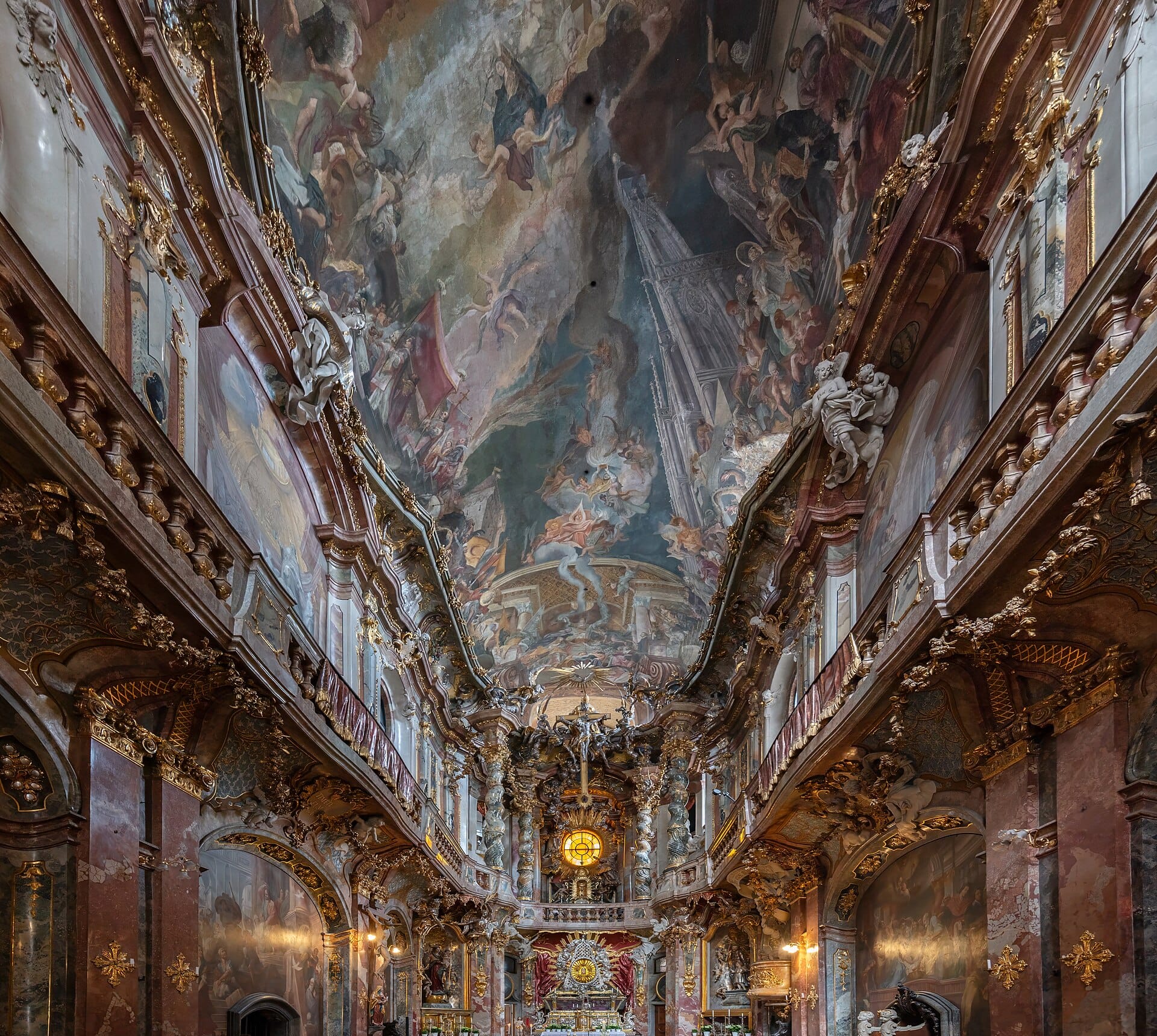
At roughly 22 metres deep, the church is extraordinarily narrow by the standards of any significant religious building. That compression is not incidental: it forces every surface to carry maximum decorative weight, producing an interior that feels almost overwhelming at first glance. Gold leaf, marble, stucco, fresco, and carved wood compete for attention from floor to ceiling. Critics in the 18th century called it excessive. Today it is considered one of the finest examples of late Baroque architecture in southern Germany.
ℹ️ Good to know
Opening hours differ by season. April–October: Monday–Thursday and Saturday–Sunday 09:00–19:00, Friday 13:00–19:00. November–March: Monday–Thursday and Saturday–Sunday 09:00–18:00, Friday 13:00–18:00. Always verify current hours via the parish website before visiting.
The Architecture: A Crash Course in What You're Looking At
The facade is the first surprise. From across Sendlinger Strasse, you see a rock-encrusted base at street level, rough and unpolished, as if the earth itself is being pushed aside. Above it, two storeys of increasingly ornate stonework rise to a curved pediment. The contrast between the raw lower zone and the refined upper zone is deliberate: it signals the transition from earthly to divine, a visual metaphor typical of Baroque religious architecture.
Step inside and your eyes need a moment to adjust, not to darkness, but to density. The nave is a single aisle, barely wide enough for two rows of pews, with a shallow gallery running overhead. The ceiling frescoes by Cosmas Damian Asam depict scenes from the life of St. John of Nepomuk, the Bohemian martyr who became patron saint of bridges and of those falsely accused. The painted figures lean out of their frames in trompe l'oeil fashion, dissolving the boundary between architecture and painting. Egid Quirin Asam's stucco work on the pilasters and cornices is equally sophisticated: garlands, cherubs, and abstract ornament rendered in cream and gold, crisp even after nearly three centuries.
The high altar and the church's dense wall of Baroque ornament dominate the sanctuary end. Note that the famous reliquary of St. Munditia — a Roman martyr whose glass-cased skeletal effigy is often described in older guidebooks as being in the Asamkirche — is in fact housed in St. Peter's Church, a few blocks away.
Tickets & tours
Live prices and dates from our booking partner. If you book, we may earn a commission at no extra cost to you.
Luggage Storage in Munich
From 6 €Instant confirmationFree cancellationOne hour city sightseeing bus tour in Munich
From 21 €Instant confirmationFree cancellationMunich Third Reich walking tour
From 32 €Instant confirmationFree cancellationRomantic Road Day Trip to Rothenburg and Harburg
From 74 €Instant confirmationFree cancellation
How the Experience Changes by Time of Day
Morning visits, particularly on weekdays, offer the most composed experience. The light entering through the upper windows is cool and directional, picking out the gilded stucco reliefs in sharp relief. The church is quiet enough that you can hear the faint creak of the wooden pews and, occasionally, organ practice drifting from the loft above. The smell of cold stone and faint candlewax is present throughout, a reminder that this is a functioning religious space, not a museum.
Midday on weekends is the most crowded window. Sendlinger Strasse is part of Munich's main pedestrian shopping circuit, and visitors flowing between Marienplatz and Sendlinger Tor often duck inside on impulse. The nave fills quickly, and the intimate scale of the church means that a group of fifteen people constitutes a crowd. Photography becomes difficult because there is no way to isolate a frame without another visitor in it.
Late afternoon, roughly 16:00–18:00 in summer, brings warmer, lower light through the west-facing windows. The gold leaf responds differently at this hour, appearing richer and more saturated. If you are visiting primarily to photograph the interior, this is the window to aim for. Arrive on a Tuesday or Wednesday for the fewest interruptions.
💡 Local tip
Photography tip: The Asamkirche permits non-flash photography. Use a wide-angle lens and shoot upward to capture the ceiling frescoes. A small travel tripod is helpful for the low-light nave, though check with staff before setting one up.
Getting There and Finding It
The church sits on Sendlinger Strasse between Marienplatz and Sendlinger Tor. On foot from Marienplatz, it is a six-minute walk south through the pedestrian zone. From Sendlinger Tor U-Bahn station (lines U1, U2, U3, U6, U7), it is a three-minute walk north. Trams 16, 17, 18, and 27 also stop at Sendlinger Tor, and buses 52 and 152 serve the same stop. There is no parking directly outside; the pedestrian zone prohibits cars, so public transport or walking is the only practical approach.
The entrance door is easy to miss from a distance because the building's width is so narrow relative to its neighbours. Look for the rock-encrusted base at street level and the small stone steps leading to the main portal. There is no queue management or timed entry; you simply walk in, which keeps the experience informal and unhurried on quieter days.
Practical Walkthrough: What to Expect Inside
You enter directly into the nave with no antechamber or lobby. The interior is compact enough that you see the high altar almost immediately. A box for donations sits near the entrance. The church is actively used for religious services; if a service is in progress when you arrive, wait for it to conclude before entering, or enter quietly and stay near the back.
Move slowly through the nave and look at the three zones of decoration in sequence: the floor-level marble detailing, the mid-height stucco pilasters and figures, and the upper-level ceiling frescoes. Each zone rewards individual attention. The pulpit on the left side of the nave is an exceptional piece of carved woodwork, often overlooked by visitors who walk straight to the altar.
The gallery above the entrance is accessible only during special events and is not open to general visitors. The sacristy and any connecting rooms are closed to the public. Plan for 20 to 40 minutes depending on how closely you want to study the individual elements. Carrying a small pair of binoculars is a genuine advantage here: the ceiling frescoes are some 10 metres overhead, and the detail in the painted faces and drapery is considerable.
⚠️ What to skip
Accessibility: The church fronts directly onto a level pedestrian street, which is easy to navigate. However, the interior has no published information about wheelchair access, step configurations, or adapted facilities. Visitors with reduced mobility should contact the parish office of St. Peter directly at St-Peter.Muenchen@ebmuc.de before visiting.
Is It Worth Your Time?
The Asamkirche is one of Munich's most architecturally concentrated sights. For visitors with any interest in Baroque art, religious architecture, or 18th-century craftsmanship, it is genuinely rewarding, and the free admission makes the cost-to-experience ratio exceptional. It fits naturally into a walk that also includes Viktualienmarkt and the surrounding Altstadt, and adds perhaps 30 minutes to a half-day route without requiring any additional transport.
That said, the Asamkirche is not for everyone. Visitors who find ornate religious decoration oppressive or overwhelming may feel the interior is too intense for comfort. Those with limited time who are choosing between this and Munich's larger churches, such as the Frauenkirche or Theatinerkirche, should know that the Asamkirche offers artistic density over spatial grandeur. It is small, focused, and intense rather than sweeping. Visitors seeking a quiet sanctuary for reflection during busy midday hours on weekends will also be frustrated by the foot traffic.
The Asamkirche is administered as a subsidiary church of Stadtpfarrei St. Peter. If you want to understand it in the broader context of Munich's sacred buildings and Altstadt layout, a broader Munich sightseeing plan will help you sequence your visit efficiently.
Insider Tips
- Friday mornings before 13:00 are effectively off-limits due to restricted opening hours, so plan your visit for any other morning of the week to get the quietest conditions.
- The Asam brothers' former residence is the building directly adjacent to the church on the right. The connection between private home and private chapel is physically visible in the shared wall, a detail almost no guidebook bothers to mention.
- Bring binoculars. The ceiling frescoes by Cosmas Damian Asam are approximately 10 metres overhead and contain detail, expressive faces, trompe l'oeil architectural elements, that you simply cannot appreciate from the floor with the naked eye.
- The heavily gilded altarpiece and dramatic wax effigies typical of South German Baroque are worth pausing over. Note that the well-known reliquary of St. Munditia is not in the Asamkirche — it is displayed in nearby St. Peter's Church, a common mix-up in older guidebooks.
- If you find the interior too crowded, step outside and study the facade in detail instead. The progression from rough rock base to refined stonework to the carved pediment is a complete argument in Baroque visual language and is best read slowly from the opposite pavement.
Who Is Asamkirche For?
- Architecture enthusiasts and students of Baroque and Rococo art
- Photographers looking for one of Munich's most complex and rewarding interiors
- Visitors on a tight budget who want world-class art without an admission fee
- Travellers building a self-guided Altstadt walking route through Munich's historic core
- Anyone with 30 spare minutes between Marienplatz and Sendlinger Tor who wants something more than shopping
Nearby Attractions
Other things to see while in Altstadt (Old Town):
- Cuvilliés Theatre
Hidden within the Munich Residenz complex, the Cuvilliés Theatre is an 18th-century Rococo opera house of extraordinary refinement. Its gilded tiers, crimson velvet boxes, and carved ivory ornaments make it one of the most visually concentrated rooms in all of Germany.
- Deutsches Museum
The Deutsches Museum sits on its own island in the Isar river and claims a place among the largest science and technology museums on earth. With 125,000 exhibited objects spanning aviation, mining, chemistry, musical instruments, and far more, it rewards careful planning rather than a casual stroll.
- Feldherrnhalle
Standing at the southern end of Odeonsplatz, the Feldherrnhalle is one of Munich's most architecturally striking and historically loaded monuments. Built between 1841 and 1844, it witnessed the gunfire that ended Hitler's failed coup and remains freely accessible at any hour. Few structures in the city compress so much of Bavaria's and Germany's history into a single loggia.
- Frauenkirche (Cathedral of Our Lady)
The Frauenkirche, officially the Dom zu Unserer Lieben Frau, is Munich's most recognizable landmark. Its twin onion-domed towers have defined the city's skyline since the 15th century, and the cathedral remains an active seat of the Archbishop of Munich and Freising. Here is everything you need to visit with confidence.
Planning a trip? Discover personalized activities with the Nomado app.