Frauenkirche Munich: What to Know Before You Visit the Cathedral of Our Lady
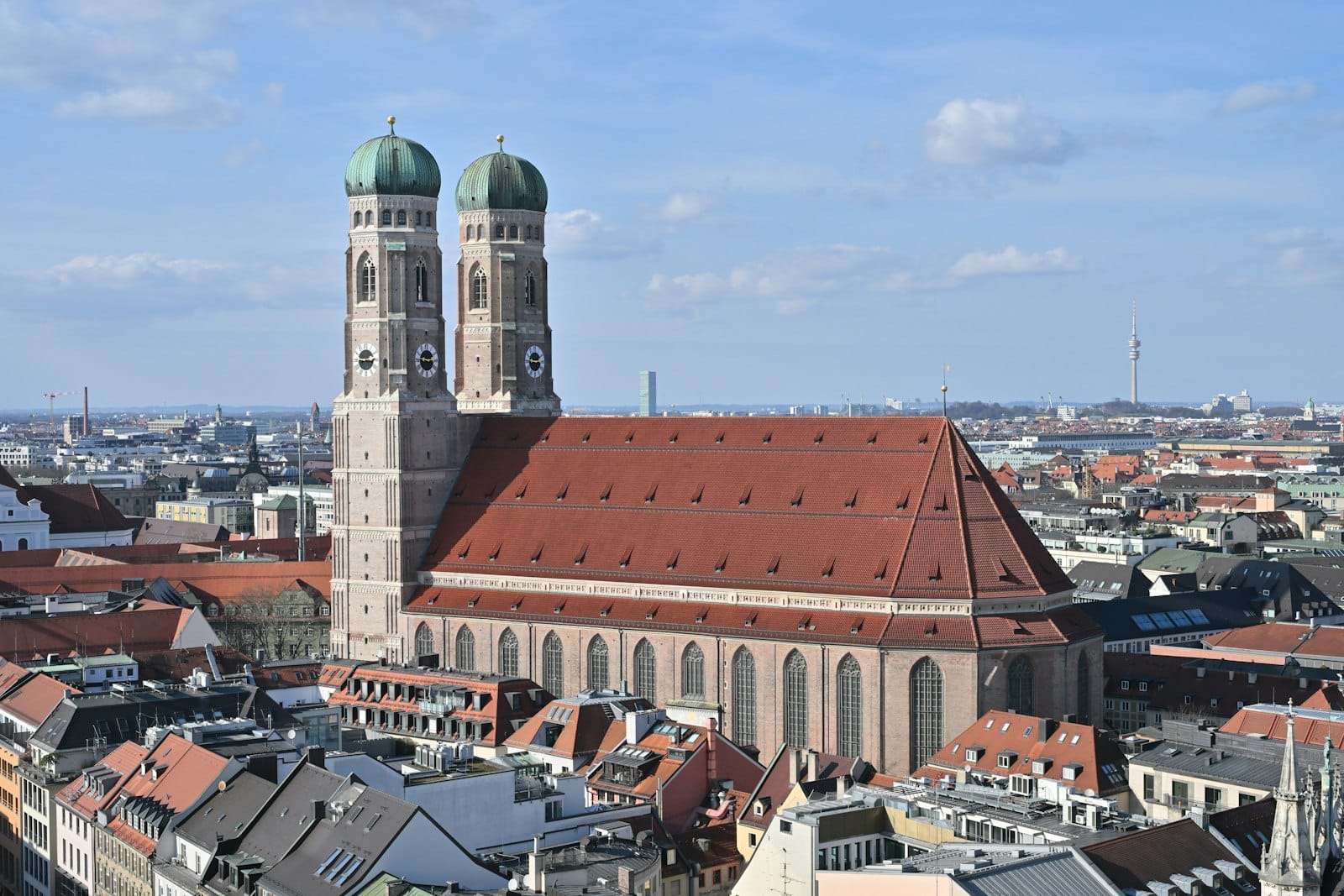
The Frauenkirche, officially the Dom zu Unserer Lieben Frau, is Munich's most recognizable landmark. Its twin onion-domed towers have defined the city's skyline since the 15th century, and the cathedral remains an active seat of the Archbishop of Munich and Freising. Here is everything you need to visit with confidence.
Quick Facts
- Location
- Frauenplatz 1, 80331 München (Altstadt)
- Getting There
- Marienplatz (U3, U6, all S-Bahn lines) — 3-5 min walk
- Time Needed
- 30–60 min for interior; add 60 min if visiting the south tower
- Cost
- Interior free. Tower: €7.50 adults, €5.50 children (7+), under 7 free
- Best for
- Architecture lovers, history seekers, city views (tower), first-time visitors to Munich
- Official website
- www.muenchner-dom.de
What Is the Frauenkirche?
The Frauenkirche, formally the Dom zu Unserer Lieben Frau (Cathedral of Our Dear Lady), is Munich's cathedral church and one of the largest Gothic hall churches in southern Germany. Its two towers, each rising to just under 99 metres and capped with distinctive copper onion domes, are the defining feature of the Munich skyline. A city ordinance long protected the view of those domes by restricting new buildings from exceeding their height in the historic core, making the Frauenkirche not just a religious building but a legal anchor of the city's visual identity. You can learn more about the surrounding old town in our guide to Altstadt Munich.
Standing at Frauenplatz 1, the cathedral is an active diocesan seat — the seat of the Archbishop of Munich and Freising — so it functions simultaneously as a major tourist attraction and a working place of Catholic worship. Visitors enter freely during opening hours outside of services, but the atmosphere shifts noticeably when a mass is underway: the nave fills with chant, incense drifts toward the ceiling vaults, and casual sightseeing gives way to something quieter.
History and Architecture: Five Centuries of Brick Gothic
Construction began in 1468 under the master builder Jörg von Halspach, and the cathedral was consecrated on 14 April 1494 — a remarkably fast build for a structure of this scale. The building is constructed almost entirely from fired brick, a hallmark of the southern German and Bavarian late Gothic tradition. The interior spans roughly 103 metres in length and accommodates up to 20,000 people, though everyday visitor numbers are far more modest.
The two towers were completed structurally during construction, but the iconic domed caps were not added until around 1525. These onion-shaped crowns were inspired by the domed rooflines seen in Italian Renaissance architecture and were unusual additions to a Gothic church. The result is a building that carries two distinct stylistic impulses: the vertical severity of German Gothic brick construction below, and the rounded warmth of Renaissance-influenced caps above. The combination is what makes the silhouette so immediately recognizable.
The cathedral suffered serious bomb damage during World War II and was carefully restored through the 1950s and 1960s. Some medieval furnishings were lost, but the overall structure survived, and several important artworks — including the tomb of Emperor Ludwig IV (Louis IV) — remain inside. The tomb, located in the nave, dates from the 17th century and marks the resting place of the Holy Roman Emperor who died in 1347.
ℹ️ Good to know
The Frauenkirche is an active cathedral. Masses are held regularly, particularly on weekday mornings and Sunday. The nave may be closed or restricted to worshippers during services. Check the official schedule at muenchner-dom.de before you go if timing matters.
Tickets & tours
Live prices and dates from our booking partner. If you book, we may earn a commission at no extra cost to you.
Luggage Storage in Munich
From 6 €Instant confirmationFree cancellationOne hour city sightseeing bus tour in Munich
From 21 €Instant confirmationFree cancellationMunich Third Reich walking tour
From 32 €Instant confirmationFree cancellationRomantic Road Day Trip to Rothenburg and Harburg
From 74 €Instant confirmationFree cancellation
Inside the Cathedral: What You Will Actually See
The interior is striking for its scale and its relative austerity. Twenty-two octagonal pillars divide the nave into three aisles, and when you stand at the main entrance and look toward the choir, the pillars align in a way that briefly obscures the side windows — a spatial effect that gives the impression of a solid, almost windowless wall. Step a few metres further in and the light returns: tall windows along the choir and chapels flood the eastern end with diffuse grey-white light on overcast days and warm southern light in the afternoons.
The stained glass in the choir dates largely from the 14th and early 15th centuries and survived the war relatively intact. The colours are deep reds and blues typical of late medieval German glasswork. The overall palette of the interior tends toward cool stone and dark wood, with the glass providing the only real warmth. On a bright summer afternoon, the contrast between the shadowed nave and the glowing choir windows is genuinely impressive.
Near the entrance, visitors sometimes seek out the so-called Devil's Footprint (Teufelstritt), a dark mark on the stone floor near the west door. Local legend holds that the devil stamped his foot there after being tricked during the cathedral's construction. The mark itself is an ordinary dark smudge in the flagstone, unremarkable without context, but it attracts steady curiosity and is marked on most interior maps.
💡 Local tip
Photography inside is generally tolerated during non-service hours, but flash and tripods are typically not permitted. The choir end is the most photogenic section — arrive before midday for the best light on the medieval glass.
The South Tower: Munich's Most Accessible Viewpoint
The south tower is open to visitors most of the year, Monday to Saturday, 10:00 to 17:00 and Sundays/public holidays 11:30 to 17:00. Admission is €7.50 for adults and €5.50 for children aged 7 and over; children under 7 enter free. Tickets are sold in the cathedral shop. The tower is not step-free: reaching the viewing platform involves a combination of stairs and a lift for part of the ascent, but the final section requires climbing. Visitors with significant mobility limitations should confirm current access arrangements before visiting.
From the top, on a clear day, the panorama extends south toward the Alps, including the mountain ridge that frames Munich's southern horizon. The view over the old town roofline is excellent, and the perspective down onto Marienplatz and the surrounding medieval street grid is difficult to replicate anywhere else in the city centre. On hazy summer days, the Alps disappear entirely, so clear autumn mornings or winter days with overnight snowfall tend to produce the sharpest views.
If you want a broader set of viewpoint options across the city, the Munich viewpoints guide covers the tower alongside other high points including the Monopteros in the English Garden (the Olympiaturm, another well-known viewpoint, is closed for renovation until late 2027).
When to Visit and How the Experience Changes by Time of Day
The cathedral opens daily; current hours on the official site are 8:00 to 20:00, though practical visiting times for sightseeing are often listed by the city as 10:00 to 17:00 (Sundays and holidays from 11:30), which likely refers to organised visitor access rather than the building being entirely closed outside those times. As hours shift seasonally and around services, checking the official site before your visit is worth the two minutes it takes.
Early morning, around 8:00 to 9:00, is when the cathedral is quietest. The low light through the nave creates a contemplative atmosphere, and the tourist crowds that arrive from mid-morning have not yet gathered. The space smells of cold stone and faint incense from morning mass, and the acoustics are particularly noticeable when the building is nearly empty. By 10:30 to 11:00, school groups and tour parties begin arriving, and the nave becomes markedly noisier.
Midday to mid-afternoon is peak time. The area around Frauenplatz fills with visitors, street photographers, and people crossing between Marienplatz and the shopping streets to the north. The interior is busy but rarely uncomfortably crowded. Late afternoon, from around 15:30 onward, sees the crowds thin out and the western light begin to angle through the entrance, casting long shadows down the nave. This is a good window for photography inside, though tower access ends at 17:00.
💡 Local tip
Weekday mornings in spring and autumn offer the best combination of good light, calm interior, and manageable crowds. Avoid visiting on Sunday mornings during service hours, when the nave is reserved for worshippers.
Getting There and Nearby
The Frauenkirche is a 3 to 5 minute walk from Marienplatz, Munich's central transport hub. All S-Bahn lines (S1, S2, S3, S4, S6, S7, S8, and others) stop at Marienplatz, as do U-Bahn lines U3 and U6. Bus line 52 also serves the area. From Marienplatz, walk west along Kaufingerstrasse and turn left onto Frauenplatz. The twin towers are visible from the main square. The Neues Rathaus Glockenspiel on Marienplatz is only steps away and worth combining into the same visit.
The surrounding Altstadt is compact and walkable. The Viktualienmarkt is about a 5-minute walk southeast, and the Asamkirche — a dramatically decorated Baroque church that makes for an instructive architectural contrast to the Frauenkirche's austerity — is roughly 8 minutes on foot to the southwest along Sendlinger Strasse. Combining all three into a single morning walk is realistic without feeling rushed.
For visitors planning a broader Munich itinerary, the 3 days in Munich guide places the Frauenkirche within a logical sequence of Altstadt sights that avoids unnecessary backtracking.
Who This Attraction Suits — and Who Might Skip It
The Frauenkirche is worth seeing for almost any visitor to Munich, if only because its towers are the visual anchor of the city and the exterior is genuinely impressive up close. The interior, however, is more interesting to visitors with some appetite for architectural or religious history. It is not a heavily ornamented cathedral in the manner of Cologne or Vienna's Stephansdom: it is Gothic in its restraint, and visitors expecting elaborate gilded altarpieces or densely frescoed ceilings may find the nave underwhelming.
Families with young children will find the open floor plan easy to navigate, and the Devil's Footprint legend tends to engage kids who might otherwise lose interest quickly. The tower climb, if the children are old enough and physically capable, adds a concrete goal to the visit. Travelers who are indifferent to religious architecture and primarily interested in museums, food, or outdoor activities can reasonably spend 15 minutes at the exterior and move on without regret.
Insider Tips
- The north tower is not open to visitors — only the south tower has a viewing platform. If you arrive and find the entrance unclear, look for the cathedral shop near the main entrance; tower tickets are sold there.
- The Devil's Footprint (Teufelstritt) near the west door is easy to walk past without noticing. Look for a small dark impression in the stone floor roughly in line with the central nave, near the entrance area. A floor marker or nearby visitors usually give away the location.
- The cathedral's exterior reads very differently at night when the towers are lit. If you are in the Altstadt after dark, walk to Frauenplatz for the view — there is no entry fee for the square, and the illuminated domes above the roofline are worth the detour.
- Tower visits are generally available year-round, with current hours usually Monday through Saturday 10:00–17:00 and Sundays/public holidays 11:30–17:00. If you are visiting in winter or on a particularly bad-weather day and the tower is a priority, check the latest schedule — note that the Olympiaturm in the Olympic Park is closed for renovation until late 2027, so Alter Peter is the most reliable alternative city panorama in the meantime.
- The interior can be noticeably cold even in summer due to the thick brick walls. A light layer is worth carrying if you plan to spend more than 20 minutes inside.
Who Is Frauenkirche (Cathedral of Our Lady) For?
- First-time visitors to Munich wanting to understand the city's architectural identity
- Architecture and medieval history enthusiasts interested in late Gothic brick construction
- Travelers combining a morning walk through the Altstadt with multiple nearby sights
- Photographers seeking the classic Munich skyline from the south tower viewing platform
- Families looking for a free, centrally located attraction with an accessible story (the Devil's Footprint legend)
Nearby Attractions
Other things to see while in Altstadt (Old Town):
- Asamkirche
Squeezed into a narrow slot on Sendlinger Strasse, the Asamkirche is a privately built late Baroque church that packs more ornamental intensity into 22 metres than most cathedrals manage in a hundred. Built by the Asam brothers between 1733 and 1746, it is free to enter and sits in the heart of Munich's pedestrian zone.
- Cuvilliés Theatre
Hidden within the Munich Residenz complex, the Cuvilliés Theatre is an 18th-century Rococo opera house of extraordinary refinement. Its gilded tiers, crimson velvet boxes, and carved ivory ornaments make it one of the most visually concentrated rooms in all of Germany.
- Deutsches Museum
The Deutsches Museum sits on its own island in the Isar river and claims a place among the largest science and technology museums on earth. With 125,000 exhibited objects spanning aviation, mining, chemistry, musical instruments, and far more, it rewards careful planning rather than a casual stroll.
- Feldherrnhalle
Standing at the southern end of Odeonsplatz, the Feldherrnhalle is one of Munich's most architecturally striking and historically loaded monuments. Built between 1841 and 1844, it witnessed the gunfire that ended Hitler's failed coup and remains freely accessible at any hour. Few structures in the city compress so much of Bavaria's and Germany's history into a single loggia.
Planning a trip? Discover personalized activities with the Nomado app.