Viktualienmarkt Munich: What to Expect at the City's Daily Food Market
Running since 1807, the Viktualienmarkt is Munich's most storied open-air food market: around 140 stalls across 22,000 square metres of the Altstadt, selling everything from Bavarian cheeses to tropical fruit. Entry is free, the beer garden at its centre is genuinely local, and the market is open Monday through Saturday year-round (weather-dependent for the beer garden on some days).
Quick Facts
- Location
- Viktualienmarkt 3, 80331 München (Altstadt, a few minutes' walk from Marienplatz)
- Getting There
- U3/U6 or S-Bahn to Marienplatz, then a short walk south. Bus 52/132/152 stop 'Viktualienmarkt'.
- Time Needed
- 45–90 minutes to browse; longer if you linger at the beer garden
- Cost
- Free to enter. Purchases priced per vendor in euros.
- Best for
- Food lovers, morning walkers, Bavarian culture, casual weekday visits
- Official website
- www.viktualienmarkt-muenchen.de/en/home
What Viktualienmarkt Actually Is
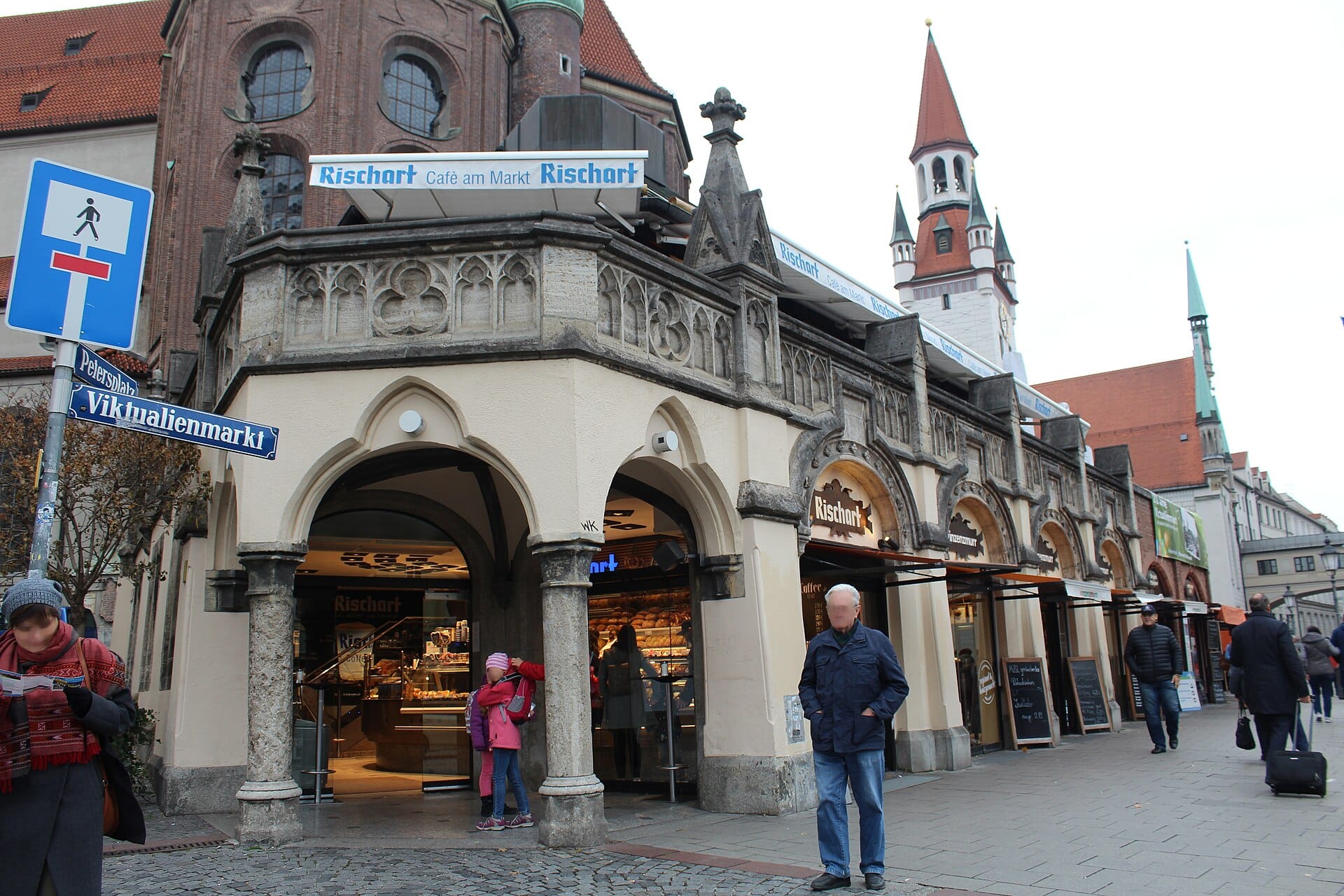
The Viktualienmarkt is Munich's primary open-air food market, a 22,000-square-metre square in the Altstadt that has operated on working days since 1807. It started as an overflow from the farmers' market at Marienplatz, relocated and formalised at the start of the 19th century, and has barely stopped since. Today it hosts around 140 permanent stalls and shops selling fresh produce, meats, cheese, bread, flowers, spices, and specialty foods from around the world.
It occupies the space between the Neues Rathaus and Marienplatz to the north and the Gärtnerplatz quarter to the south, sitting squarely in Munich's historic core. The surrounding streets are dense with traditional Bavarian architecture and small independent businesses. Unlike most European food markets that have been converted into tourist-facing halls, the Viktualienmarkt still serves Munich residents as a genuine place to buy groceries.
ℹ️ Good to know
The market area is a public square and is always accessible, but stalls operate Monday through Saturday only, generally from 08:00 to 20:00. Many individual vendors close earlier, particularly in winter — expect the bulk of activity to wind down by 18:00. The first booth can open as early as 05:30.
How the Market Changes Through the Day
Early morning, before 09:00, is the most atmospheric time to visit. The square smells of cut flowers, damp stone, and fresh bread. Vendors arrange their stalls, crates of produce get stacked, and a thin mist sometimes sits around the market's central maypole. The dominant sounds are crates being shifted, Bavarian dialect spoken quickly between traders, and the occasional blast of a delivery van.
By mid-morning, the market reaches full density. Local shoppers mix with tourists, and queues form at the most popular cheese and charcuterie counters. This is when you can best observe the range: stalls selling Bavarian Weisswurst alongside others offering Southeast Asian spices, Italian truffle products, or organic herbs. The variety reflects Munich's position as an international city with strong regional food traditions.
Lunchtime brings a different crowd. The beer garden at the centre of the market fills quickly with a mix of office workers, tourists, and retirees. By early afternoon, some smaller stalls begin packing down, particularly on weekdays in winter. Saturday is the busiest day of the week: expect full stalls through late afternoon and genuine difficulty moving through the central paths between noon and 15:00.
💡 Local tip
If you want to shop seriously, go on a Tuesday or Wednesday morning before 10:00. Saturday afternoons are the most crowded time of the week, and some stalls sell out of premium products by midday.
Tickets & tours
Live prices and dates from our booking partner. If you book, we may earn a commission at no extra cost to you.
Self-guided Discovery Walk in Munich's Old Town
From 26 €Instant confirmationFree cancellationMunich Old Town Culinary Tour
From 44 €Instant confirmationFree cancellationMunich private walking tour
From 152 €Instant confirmationFree cancellationE-Rickshaw guided tour to the highlights of Munich
From 63 €Instant confirmationFree cancellation
The Beer Garden at the Centre
A circular beer garden sits at the heart of the market, shaded by large chestnut trees and surrounded by the market stalls. It operates on a rotating system: a different Munich brewery supplies the beer over time, a tradition that ensures no single brewery monopolises the space. It is one of the few beer gardens in central Munich where you can buy food from the surrounding stalls and bring it to your table without issue.
The atmosphere is notably more relaxed than the famous Hofbräuhaus a few streets over. Tables fill with market workers, pensioners reading newspapers, and the occasional tourist who has discovered that this, not the tourist-facing beer halls, is where Munich locals actually sit on a Tuesday afternoon. Prices are in line with standard Munich beer garden rates. The garden is open Monday through Saturday all year, with opening and closing times depending on the weather.
If you are comparing Munich's drinking culture across venues, the contrast with the Hofbräuhaus is instructive. The Hofbräuhaus is louder, more theatrical, and staffed for high tourist volume. The Viktualienmarkt beer garden is quieter, smaller, and considerably less directed at out-of-towners. Neither is better; they serve different purposes.
Historical and Cultural Context
Before 1807, Munich's main market was held directly on Marienplatz. As the city grew under King Maximilian I Joseph, the market was relocated south to its current site, then outside the immediate urban core. The name comes from the Latin word 'victualia,' meaning provisions or foodstuffs, reflecting the market's original function as a supply point for the city's households.
The decorated maypole on the square is a recognisable feature, with figures representing various guilds and trades historically associated with the market, such as butchers, bakers, fishermen, hunters, and farmers. It is repainted and re-raised in a traditional ceremony, which continues today. Around Fasching (the Bavarian carnival period before Lent), market vendors hold a costumed dance on the market square, a tradition dating back over a century.
The market sits at the southern edge of Munich's Altstadt, a district layered with medieval, Baroque, and Neoclassical structures. Exploring the area around the Viktualienmarkt alongside the Asamkirche and St. Peter's Church gives a much fuller sense of the old town's spatial logic than any single attraction does alone.
What to Buy and What to Watch Out For
The market's strengths are fresh regional produce, charcuterie, and cheese. Several stalls specialise in Bavarian and southern German varieties: Obatzda (a spiced cream cheese preparation), Weisswurst, smoked sausages, and a range of cured meats. There are dedicated spice merchants, a fishmonger, flower sellers, and vendors with organic fruit and vegetables. Quality is generally high, and regular customers know their preferred vendors by name.
Some stalls on the market's perimeter have shifted toward ready-to-eat food targeted at tourists: pretzels, bratwurst in bread rolls, and similar items priced at a premium. These are fine for a quick bite but are not representative of what makes the market worth visiting. Focus instead on the inner stalls and permanent shops for the more authentic selection.
⚠️ What to skip
Bring cash. Several smaller vendors do not accept cards, and the ones that do may have minimum transaction amounts. There are ATMs near Marienplatz, about two minutes' walk north.
Getting There, Practical Notes, and Accessibility
The most direct route from central Munich is a short walk south from Marienplatz, which is served by U3, U6, and multiple S-Bahn lines. Bus lines 52, 132 and 152 stop directly at 'Viktualienmarkt.'
The market is a level, open square with paved surfaces, accessible for prams and wheelchairs in general terms. During peak hours on Saturdays, the central paths become crowded enough that navigation with mobility aids requires patience. Specific accessibility facilities are not listed on the official market site; for details on nearby accessible restrooms and transport options, the MVV accessibility services page is the best reference.
The Viktualienmarkt is a logical starting point for a broader walk through Munich's old town. The full Munich itinerary pairs it naturally with Marienplatz, the Glockenspiel, and the Isartor gate within a single walkable morning.
Who Will Not Enjoy This
Visitors looking for a large-scale covered market with consistent year-round conditions may find the Viktualienmarkt underwhelming in rain or cold. In winter, the square can feel sparse, with fewer stalls operating and the beer garden’s opening hours more dependent on the weather. On Sundays and public holidays the stalls are completely shut, leaving only the empty square, which holds little interest on its own. Travellers who dislike crowds will want to avoid Saturday afternoons entirely.
If your main interest is buying unique regional crafts or design objects, this is not the right market. The Viktualienmarkt is primarily food-focused. For a broader range of goods and a more curated shopping experience, Munich's other retail districts serve that purpose better.
Insider Tips
- The best single purchase for a picnic is from the Obatzda stall: ask for a portion to go with a pretzel from the adjacent baker, then take it to the beer garden tables.
- Several stalls open before 08:00. If you are an early riser, arriving at 07:00 on a weekday gives you the market nearly to yourself and the chance to watch the daily setup in real time.
- The rotating brewery system in the beer garden means the beer on tap changes seasonally. Locals track which brewery is pouring and time their visits accordingly. Ask the server which brewery is currently serving.
- The Schrannenhalle, a 19th-century market hall immediately adjacent to the Viktualienmarkt's western edge, was rebuilt and reopened as a modern food hall and now houses additional food vendors and a bakery. It is worth walking through and is considerably less crowded than the main square.
- Photography is generally tolerated but take care around vendors: some object to having their stalls photographed without permission, particularly at the charcuterie and cheese counters. A brief 'Darf ich fotografieren?' (May I photograph?) goes a long way.
Who Is Viktualienmarkt For?
- Food lovers wanting to understand Bavarian produce and regional specialities at source
- Weekday morning visitors looking for an authentic, non-tourist local experience
- Travellers building a half-day walking route through Munich's Altstadt
- Couples looking for a relaxed outdoor lunch in a genuinely local beer garden setting
- Self-catering visitors or those assembling a picnic for the Isar riverbanks or English Garden
Nearby Attractions
Other things to see while in Altstadt (Old Town):
- Asamkirche
Squeezed into a narrow slot on Sendlinger Strasse, the Asamkirche is a privately built late Baroque church that packs more ornamental intensity into 22 metres than most cathedrals manage in a hundred. Built by the Asam brothers between 1733 and 1746, it is free to enter and sits in the heart of Munich's pedestrian zone.
- Cuvilliés Theatre
Hidden within the Munich Residenz complex, the Cuvilliés Theatre is an 18th-century Rococo opera house of extraordinary refinement. Its gilded tiers, crimson velvet boxes, and carved ivory ornaments make it one of the most visually concentrated rooms in all of Germany.
- Deutsches Museum
The Deutsches Museum sits on its own island in the Isar river and claims a place among the largest science and technology museums on earth. With 125,000 exhibited objects spanning aviation, mining, chemistry, musical instruments, and far more, it rewards careful planning rather than a casual stroll.
- Feldherrnhalle
Standing at the southern end of Odeonsplatz, the Feldherrnhalle is one of Munich's most architecturally striking and historically loaded monuments. Built between 1841 and 1844, it witnessed the gunfire that ended Hitler's failed coup and remains freely accessible at any hour. Few structures in the city compress so much of Bavaria's and Germany's history into a single loggia.
Planning a trip? Discover personalized activities with the Nomado app.