Feldherrnhalle: Munich's Monument Between Glory and Infamy
Standing at the southern end of Odeonsplatz, the Feldherrnhalle is one of Munich's most architecturally striking and historically loaded monuments. Built between 1841 and 1844, it witnessed the gunfire that ended Hitler's failed coup and remains freely accessible at any hour. Few structures in the city compress so much of Bavaria's and Germany's history into a single loggia.
Quick Facts
- Location
- Residenzstraße 1, Odeonsplatz, Altstadt-Lehel, Munich
- Getting There
- U3/U4/U5/U6 Odeonsplatz; Tram 19 Nationaltheater; Bus 100 Odeonsplatz
- Time Needed
- 20–40 minutes; longer if exploring surrounding square
- Cost
- Free — no ticket required, open around the clock
- Best for
- History enthusiasts, architecture lovers, central Munich walkers
- Official website
- www.schloesser.bayern.de/deutsch/schloss/objekte/mu_feldh.htm
What Is the Feldherrnhalle?
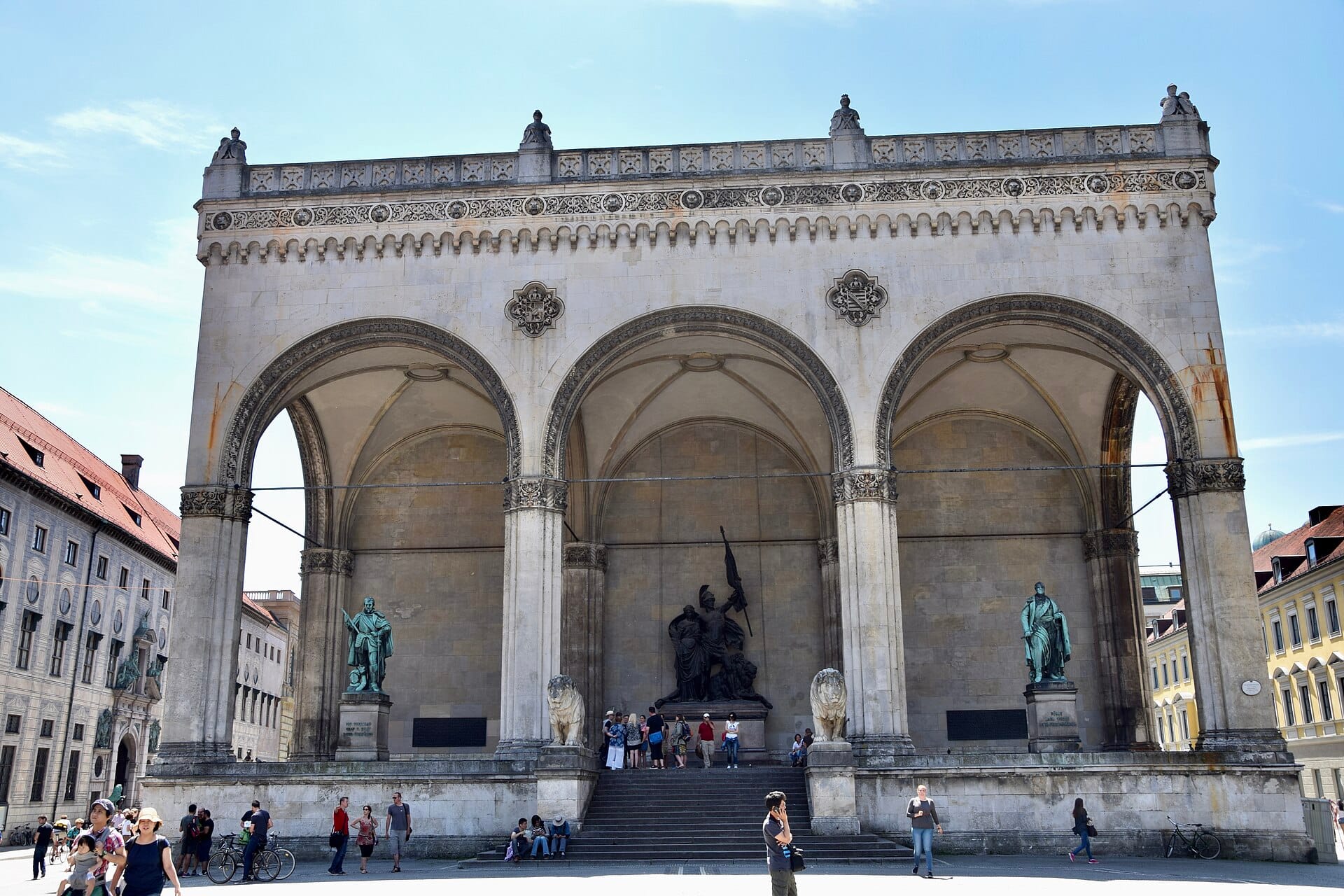
The Feldherrnhalle — literally the 'Field Marshals' Hall' in English — is a monumental open loggia standing at the southern boundary of Odeonsplatz in Munich's historic city centre. Commissioned by King Ludwig I of Bavaria and designed by architect Friedrich von Gärtner, it was built between 1841 and 1844 as an explicit homage to the Loggia dei Lanzi in Florence. The intention was to give Bavaria a civic monument of comparable Renaissance grandeur, celebrating the military commanders of Bavarian history.
The structure is built from pale sandstone with three large arched bays facing the square. Inside the loggia stand imposing bronze statues of two key Bavarian field marshals: Count Johann Tserclaes von Tilly and Prince Karl Philipp von Wrede, both positioned on high plinths that force the viewer to look upward. A third monument at the rear commemorates the Franco-Prussian War of 1870–71. The scale is deliberate — the building was designed to impress, and it still does.
💡 Local tip
The Feldherrnhalle is open 24 hours and costs nothing to enter. Early morning visits — before 8am — offer nearly empty conditions and soft northern light that brings out the texture of the stone facades. It is one of the few grand monuments in central Munich where you can stand in genuine quiet.
The View From the Steps: What You Actually See
Approaching from Marienplatz along Residenzstraße, the Feldherrnhalle appears gradually, framed by the narrowing street until it opens onto the full width of Odeonsplatz. The loggia fills the southern end of the square like a theatre backdrop. On the left as you face it, the baroque yellow facade of the Theatinerkirche rises above the roofline, and to the right the Residenz palace complex extends northward along the square.
The Odeonsplatz itself is a large formal square, part of the grand neoclassical urban plan that Ludwig I pursued throughout Munich's Altstadt during the first half of the 19th century. Standing beneath the arches of the loggia and looking back south, you get one of Munich's most photographed views: Residenzstraße stretching directly toward the twin towers of the Frauenkirche, lining up almost perfectly with the monument's central arch. This is not accidental — the urban axis was planned.
The two bronze lions flanking the base of the steps are a detail easy to overlook. Local lore holds that the lions face the Residenz because they would be embarrassed to look toward the church, a bit of irreverent Munich humor that has circulated for generations. The lions are smooth-nosed from years of visitors reaching down to touch them.
Tickets & tours
Live prices and dates from our booking partner. If you book, we may earn a commission at no extra cost to you.
Luggage Storage in Munich
From 6 €Instant confirmationFree cancellationOne hour city sightseeing bus tour in Munich
From 21 €Instant confirmationFree cancellationMunich Third Reich walking tour
From 32 €Instant confirmationFree cancellationRomantic Road Day Trip to Rothenburg and Harburg
From 74 €Instant confirmationFree cancellation
Time of Day: How the Experience Changes
At midday and through the afternoon, the Feldherrnhalle sits at the intersection of two major pedestrian flows: tourists moving between Marienplatz and Odeonsplatz, and locals using the square as a transit shortcut. The steps and the loggia interior fill with people resting, photographing, and eating lunch. The ambient noise is considerable — street musicians sometimes set up on the square, and traffic from Ludwigstraße carries across the open space.
In the early morning, the atmosphere changes entirely. The stone is cool, the square is largely empty, and pigeons occupy the steps. The low-angle light from the east catches the relief carvings on the upper portions of the loggia and the facial details of the bronze statues in a way that midday flatness obliterates. If you are seriously interested in the architecture or the historical weight of the place, come before the tour groups arrive.
On warm evenings, Odeonsplatz becomes a social space for Munich residents. Groups gather on the steps, the surrounding cafes extend their terraces, and the monument recedes into the background of city life rather than dominating it. This is worth experiencing as a contrast to the formal daytime encounter.
The History You Cannot See: 9 November 1923
No visit to the Feldherrnhalle is complete without understanding what happened here on the morning of 9 November 1923. Adolf Hitler, then leader of the National Socialist German Workers' Party, had attempted to seize power in Bavaria as the first step toward overthrowing the Weimar Republic. The coup began the previous evening at the Bürgerbräukeller beer hall, with Hitler and General Erich Ludendorff leading a column of around 2,000 supporters toward the city centre.
When the column reached the Feldherrnhalle, it was blocked by a cordon of Bavarian state police. Gunfire broke out, though who fired first remains disputed by historians. Sixteen Nazi marchers and four police officers died in the confrontation. Hitler fled the scene and was arrested the following day. He was subsequently convicted of treason but served only a short sentence, during which he dictated much of Mein Kampf. For a broader account of this pivotal moment in Munich's history, the Munich Beer Hall Putsch history guide covers the full sequence of events and its aftermath.
After Hitler came to power in 1933, the Feldherrnhalle was appropriated as a National Socialist shrine. A commemorative plaque was installed for the 'fallen martyrs' of the putsch, and an SS honor guard was posted there permanently. Munich residents who did not wish to perform the required Nazi salute when passing the monument learned to detour through the small lane on the east side of the Feldherrnhalle, known informally as 'Drückebergergasse' — the 'shirkers' alley'. The alley still exists today.
ℹ️ Good to know
The 'Drückebergergasse' — the narrow passage running behind the Feldherrnhalle on the east — is where Munich residents avoided Nazi salutes by bypassing the Feldherrnhalle entirely during the Third Reich. Walking it today is a small, quiet act of historical imagination.
Architectural Context and the Loggia dei Lanzi Connection
Friedrich von Gärtner modeled the Feldherrnhalle closely on the 14th-century Loggia dei Lanzi in Florence, itself one of the great open-air architectural spaces of Italy. The choice was deliberate and politically charged: Ludwig I saw himself as a patron-king in the Renaissance mold, transforming Munich into a German Athens. The Feldherrnhalle was part of the same program that produced Königsplatz, the Glyptothek, and the Ludwigstraße — a coherent urban vision executed over decades.
The Feldherrnhalle closes Residenzstraße at its northern end and opens onto Ludwigstraße, which stretches north as a grand neoclassical boulevard toward Schwabing. This axis, about two kilometres long, was conceived as a ceremonial route and remains one of Munich's most coherent 19th-century streetscapes. Walking it from the Odeonsplatz northward through the Siegestor arch gives a clear sense of Ludwig I's ambitions for the city.
The loggia's three arched bays are carried on coupled columns with Composite capitals, and the entablature above bears decorative friezes. The material is Kelheim limestone, a cream-colored stone that darkens over time and accumulates a patina of urban weather. Up close, the surface texture is visibly granular and worn at points that receive the most visitor contact.
Getting There and Practical Logistics
The most direct public transport option is the U3, U4, U5 or U6 to Odeonsplatz, which deposits you on the square within a 30-second walk of the monument. Tram 19 stops at Nationaltheater, one block to the east, and Bus 100 also serves Odeonsplatz directly. From Marienplatz, the walk north along Residenzstraße takes around five minutes on foot, passing the Residenz complex on the right.
The Feldherrnhalle is free and open at all times, making it easy to build into any itinerary without scheduling constraints. It pairs naturally with the nearby Theatinerkirche and the Munich Residenz, both within two minutes' walk. Plan 20 to 40 minutes at the monument itself, more if you want to sit on the square and absorb the broader urban space.
Accessibility note: the interior of the loggia is reached only via steps, and there is no step-free access into the raised hall. The Bavarian Palace Department, which administers the site, confirms that no ramps or lifts are available. The surrounding Odeonsplatz is flat public urban space with standard paving and is wheelchair-accessible at street level.
⚠️ What to skip
Photography on the steps and square is unrestricted. However, the monument is a functioning public space and occasional events, political demonstrations, or film shoots temporarily close sections of Odeonsplatz. Check local event listings if your visit falls on a weekend or public holiday.
Who Should Skip This, and What to Combine It With
Travelers focused exclusively on contemporary Munich — food, nightlife, or modern culture — may find the Feldherrnhalle underwhelming as a standalone destination. It is a monument, not an experience-led attraction. Without knowing the historical context, it can read as an impressive but inert piece of 19th-century civic architecture, which is accurate but incomplete.
For visitors with a serious interest in German history, the Feldherrnhalle works well in combination with the NS-Dokumentationszentrum, Munich's documentation centre for the history of National Socialism, located about 15 minutes on foot to the west. Together, the two sites form a coherent historical itinerary that covers both the physical site of the putsch and the broader political context. For those planning a wider Munich historical and architectural tour, the things to do in Munich guide provides a structured overview.
Insider Tips
- Walk the Drückebergergasse, the narrow lane on the east side of the Feldherrnhalle that Munich residents used to avoid the mandatory Nazi salute at the Feldherrnhalle during the 1930s and early 1940s. It takes 45 seconds and adds a layer of lived history to the visit.
- Stand under the central arch of the loggia and look south down Residenzstraße: on a clear day the twin towers of the Frauenkirche align almost exactly with the arch opening, confirming that this urban axis was deliberately planned.
- Visit just after sunrise on a weekday for the best photographic conditions and near-total solitude. The monument faces northeast and receives warm raking light in the early morning hours.
- Touch the bronze lions' noses — they are noticeably worn smooth compared to the rest of the casting, revealing how many generations of visitors have reached down as they pass.
- The small cafe terrace on the southeast corner of Odeonsplatz offers an elevated perspective of the full square and loggia facade without requiring you to stand in the flow of pedestrian traffic.
Who Is Feldherrnhalle For?
- History travelers who want to stand at an actual site connected to the 1923 Beer Hall Putsch
- Architecture enthusiasts interested in 19th-century neoclassical urban design and the Loggia dei Lanzi connection
- Photographers seeking the famous Residenzstraße-to-Frauenkirche axial shot
- Budget travelers building a free walking itinerary through central Munich
- First-time Munich visitors completing the Marienplatz-to-Odeonsplatz pedestrian route
Nearby Attractions
Other things to see while in Altstadt (Old Town):
- Asamkirche
Squeezed into a narrow slot on Sendlinger Strasse, the Asamkirche is a privately built late Baroque church that packs more ornamental intensity into 22 metres than most cathedrals manage in a hundred. Built by the Asam brothers between 1733 and 1746, it is free to enter and sits in the heart of Munich's pedestrian zone.
- Cuvilliés Theatre
Hidden within the Munich Residenz complex, the Cuvilliés Theatre is an 18th-century Rococo opera house of extraordinary refinement. Its gilded tiers, crimson velvet boxes, and carved ivory ornaments make it one of the most visually concentrated rooms in all of Germany.
- Deutsches Museum
The Deutsches Museum sits on its own island in the Isar river and claims a place among the largest science and technology museums on earth. With 125,000 exhibited objects spanning aviation, mining, chemistry, musical instruments, and far more, it rewards careful planning rather than a casual stroll.
- Frauenkirche (Cathedral of Our Lady)
The Frauenkirche, officially the Dom zu Unserer Lieben Frau, is Munich's most recognizable landmark. Its twin onion-domed towers have defined the city's skyline since the 15th century, and the cathedral remains an active seat of the Archbishop of Munich and Freising. Here is everything you need to visit with confidence.
Planning a trip? Discover personalized activities with the Nomado app.