Odeonsplatz: Munich's Most Architecturally Ambitious Square
Odeonsplatz sits at the northern edge of Munich's Altstadt, framed by a Baroque church, royal arcades, and a loggia built to celebrate Bavarian military victories. It is free to visit at any hour, serves as a major transit hub, and rewards those who slow down long enough to read the layers of history written into its stonework.
Quick Facts
- Location
- Odeonsplatz, 80539 München, Germany (northern Altstadt, border with Maxvorstadt)
- Getting There
- U-Bahn: Odeonsplatz (U3, U4, U5, U6); Bus 100
- Time Needed
- 30–60 minutes for the square; longer if entering Theatinerkirche or Hofgarten
- Cost
- Free (public square, open 24 hours)
- Best for
- Architecture lovers, history walkers, photography, orientation walks
- Official website
- www.muenchen.de/en/sights/odeonsplatz
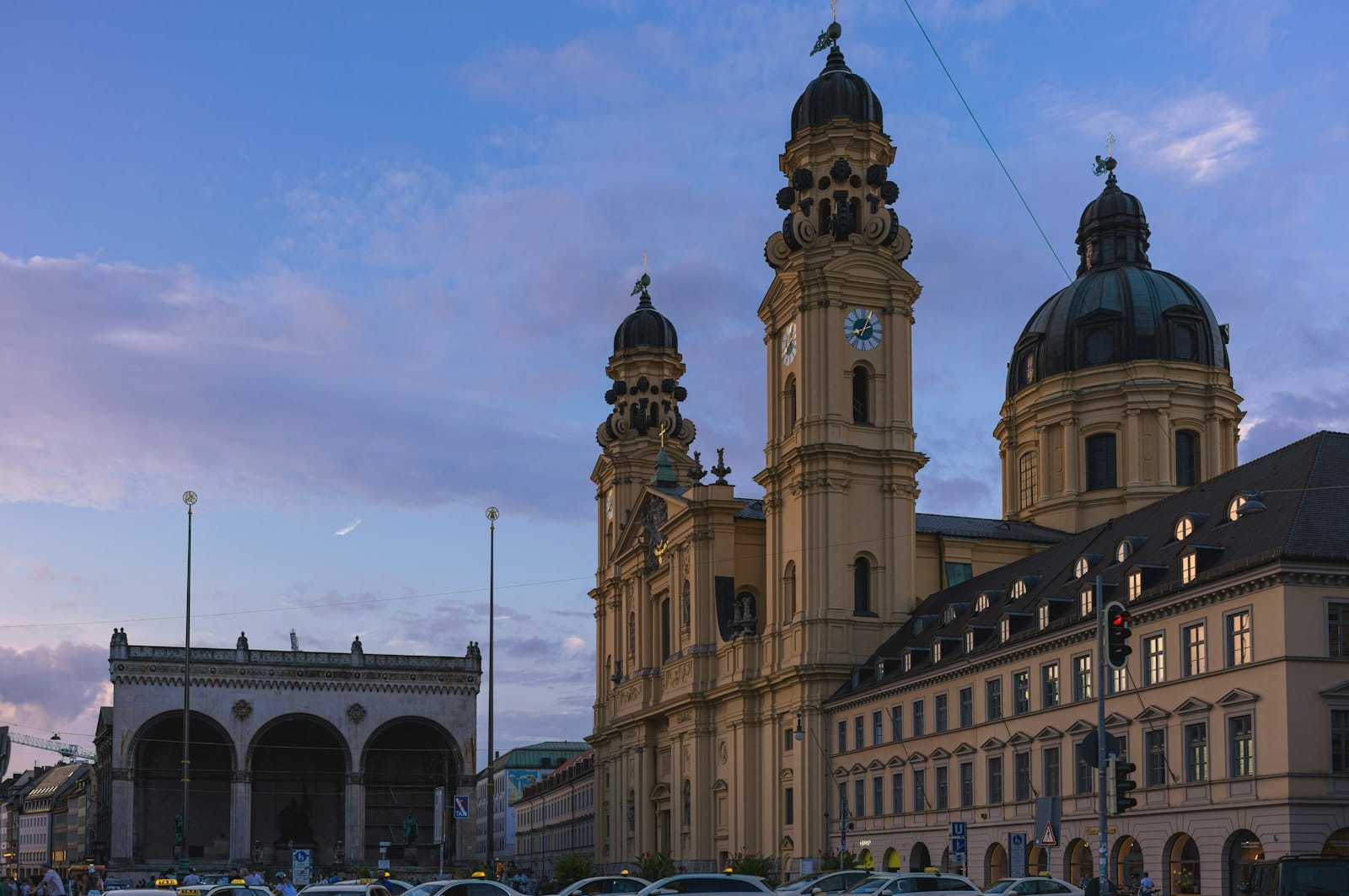
What Odeonsplatz Actually Is
Odeonsplatz is a large public square at the southern end of Ludwigstraße, sitting precisely on the boundary between Munich's historic Altstadt and the planned district of Maxvorstadt. It is not a market square, not a park, and not a pedestrian shopping zone. It is a ceremonial urban space, designed in the early 19th century to project the ambitions of the Bavarian monarchy onto the city's geography.
The square is open at all times with no admission. It functions simultaneously as one of Munich's busiest U-Bahn interchanges, a gathering point for locals cutting between neighborhoods, and one of the densest concentrations of significant architecture in the city. Most visitors pass through it without stopping. That is their loss.
💡 Local tip
The U-Bahn station beneath the square (lines U3, U4, U5, U6) makes Odeonsplatz one of the easiest starting points for a walking tour of central Munich. Arrive here first, orient yourself, then walk south to Marienplatz or north along Ludwigstraße toward the university district.
The Architecture: A Deliberate Statement in Stone
The square was designed by the Bavarian court architect Leo von Klenze and developed between roughly 1816 and 1827. Klenze was the same architect responsible for shaping much of what is now the Kunstareal museum district in Maxvorstadt, and his hand at Odeonsplatz is equally systematic. The ensemble was conceived as a monumental gateway: arriving from the south through the Feldherrnhalle loggia, or descending Ludwigstraße from the north through the Siegestor arch, a traveler would experience Munich as a city of order, ambition, and historical weight.
The square takes its name from the Odeon concert hall, built on its southwestern side for King Ludwig I of Bavaria, which gave the space its official name in 1827. The Odeon building no longer functions as a concert hall but the name endured. On the western edge of the square stands the Theatinerkirche, a Baroque church whose yellow facade and twin towers are among the most photographed surfaces in Munich. The church was begun in 1663 and its exterior, completed much later, was directly inspired by Sant'Andrea della Valle in Rome. Standing in the square and looking up at those towers gives a clear sense of how Bavarian royal patronage imported Italian Baroque into northern Europe.
On the southeastern edge of the square, the Feldherrnhalle closes the southern opening of Odeonsplatz with a shallow loggia modeled on the Loggia dei Lanzi in Florence. Built between 1841 and 1844 under Ludwig I, it was designed to honor the Bavarian army. The two large bronze lion sculptures flanking the steps are a standard photo stop, but the interior of the loggia itself, with its bronze statues of Field Marshals Tilly and Wrede and a central monument to the Franco-Prussian War, repays a closer look.
Behind the Theatinerkirche, accessible through an arch from the northern side of the square, lies the Hofgarten: a formal Italian Renaissance garden laid out in the 17th century. Its grid of paths, central domed temple, and rows of clipped trees provide a sharp contrast to the traffic and movement of the square outside. Entry is free.
Tickets & tours
Live prices and dates from our booking partner. If you book, we may earn a commission at no extra cost to you.
Luggage Storage in Munich
From 6 €Instant confirmationFree cancellationOne hour city sightseeing bus tour in Munich
From 21 €Instant confirmationFree cancellationMunich Third Reich walking tour
From 32 €Instant confirmationFree cancellationRomantic Road Day Trip to Rothenburg and Harburg
From 74 €Instant confirmationFree cancellation
How the Square Changes Through the Day
Early mornings at Odeonsplatz are remarkably quiet given its central position. Before 8am, the square smells of damp paving stones and, occasionally, the faint exhaust of overnight delivery vehicles on Residenzstraße nearby. The yellow facade of the Theatinerkirche catches the morning light from the east in a way that makes it look almost golden, and the square is largely clear of pedestrians. This is the best hour for photography: no crowds blocking sightlines, clean light, and the geometry of the space reads clearly.
By mid-morning, the square fills with the commuter overflow from the U-Bahn station below. Workers in suits cut across the paving at pace. Tour groups begin to cluster near the Feldherrnhalle. By midday in summer, the stone paving radiates heat and there is little shade on the square itself, aside from the shallow overhang of the Feldherrnhalle loggia. If visiting in July or August, plan to move through the square and into the Hofgarten, which is shaded and considerably cooler.
Late afternoons and early evenings produce the most pleasant conditions. The crowd thins to a mix of locals and tourists, the light softens, and street musicians sometimes perform near the Theatinerkirche steps. The square does not have outdoor cafes or kiosks of its own, but the surrounding streets offer plenty of options within a two-minute walk.
⚠️ What to skip
In summer, the open square offers almost no shade. Wear sunscreen and consider planning your visit for before 10am or after 5pm if temperatures are high.
The Historical Weight: What Happened Here
Odeonsplatz carries a specific historical significance that goes beyond its architectural ensemble. On November 9, 1923, the Feldherrnhalle at the southern end of the square was the site where the Beer Hall Putsch march, led by Adolf Hitler and Erich Ludendorff, was stopped by Bavarian state police. The confrontation left sixteen Nazi marchers and four police officers dead. The failure of the putsch led to Hitler's imprisonment and, during that time, the writing of Mein Kampf.
After the Nazis came to power in 1933, the Feldherrnhalle was transformed into a memorial to the putsch dead, and passersby were required to give the Nazi salute as they walked past it. A side street, Viscardigasse, became known as the 'Shirkers' Alley' because Münchners used it to bypass the square and avoid the mandatory salute. The cobblestones of Viscardigasse are still slightly different in color and texture today, a subtle physical trace of that period. The NS-Dokumentationszentrum nearby covers this history in depth and is worth visiting alongside the square.
Practical Walkthrough: How to Approach the Square
The most logical approach is from the U-Bahn station directly beneath the square. Exit toward Ludwigstraße and you emerge at the northern end of the square facing the Hofgarten wall and the rear of the Theatinerkirche. Turn to face south and you have the full spatial sequence in front of you: the broad open paving, the Feldherrnhalle closing the far end, and the yellow towers of the Theatinerkirche to your right.
Give yourself at least 15 minutes just standing and looking before you move. Then walk south toward the Feldherrnhalle and enter the loggia to examine the statues. Step around to Viscardigasse on the eastern side of the Feldherrnhalle. Then double back to the Theatinerkirche, whose interior (open daily from approximately 06:30 to 19:30, with no admission charge) is genuinely impressive: a white and gold Baroque nave that feels far larger than the exterior suggests. From there, pass through the arch north of the Theatinerkirche into the Hofgarten. The walk from one end of this sequence to the other, including brief stops, takes about 45 minutes. For a broader circuit of the surrounding area, the Munich Residenz is a five-minute walk to the south.
ℹ️ Good to know
The Hofgarten, directly behind the Theatinerkirche, is a formal garden with free entry and shaded paths. It connects to the northern wing of the Residenz complex and offers a calm counterpoint to the open square.
Getting There and Getting Around
Odeonsplatz is one of Munich's most central and best-connected locations. The U-Bahn station Odeonsplatz is served by four lines: U3, U4, U5, and U6. From Marienplatz it is one stop north on the U3, U4, U5, or U6. Bus line 100, the museum route, also stops here. The square is level, paved, and step-free from street level, making it accessible for wheelchairs and strollers. The U-Bahn station has elevators; check MVV or MVG for current step-free access details on specific exits.
The square sits at the northern end of the pedestrianized old town axis. Walking south from Odeonsplatz along Residenzstraße takes you to Marienplatz in about eight minutes on foot. Walking north along Ludwigstraße takes you into Maxvorstadt and toward the university and museum district. This makes Odeonsplatz a natural pivot point for any walking itinerary covering central Munich.
Photography Notes
The best photography conditions at Odeonsplatz are in the first two hours after sunrise (golden hour light hits the Theatinerkirche facade from the east) and in the hour before sunset (warm light across the Feldherrnhalle and long shadows across the paving). Midday in summer produces harsh overhead light and heavy crowds, which makes wide compositions difficult.
For a wide shot that captures both the Theatinerkirche towers and the Feldherrnhalle in the same frame, stand near the center of the square and use a moderately wide lens. The towers are tall and the loggia is low and horizontal, so getting both in sharp focus requires stepping back further than most people instinctively do. The cobblestone foreground adds texture and leads the eye into the composition.
Viscardigasse, the narrow alley to the east of the Feldherrnhalle, offers a different kind of shot: compressed perspective, layered stone, and almost no tourists in frame even on busy days.
Insider Tips
- Walk through Viscardigasse, the narrow alley on the eastern side of the Feldherrnhalle. The slightly different-colored cobblestones mark the route Münchners used to avoid saluting the Nazi memorial during the Third Reich. It is one of the most tangible small-scale historical traces in the city.
- Enter the Theatinerkirche even if you have limited time. The exterior is what most people photograph, but the interior is the real achievement: a full Baroque nave in white and gold stucco that feels unexpectedly spacious. Entry is free.
- The Hofgarten, reached through an archway on the north side of the square, has a small rotunda at its center where musicians sometimes perform on summer afternoons. The acoustics under the dome are striking.
- If you want an elevated view looking south down Ludwigstraße from above the Odeonsplatz level, the upper terraces of the Theatinerkirche are occasionally accessible during special events or church-organized tours. Check the church notice board on arrival.
- Odeonsplatz is directly on the route of several major Munich events including marathon races and political demonstrations. Check local event listings before visiting if crowds are a concern, as the square can become completely impassable on certain dates.
Who Is Odeonsplatz For?
- Architecture and urban history enthusiasts who want to understand how 19th-century royal patronage shaped Munich's street plan
- First-time visitors using it as an orientation point before walking into the Altstadt or north into Maxvorstadt
- Photographers working in early morning or late afternoon light
- Travelers with an interest in 20th-century German history, particularly the Nazi period and the Beer Hall Putsch
- Anyone combining a visit to the Munich Residenz, the Theatinerkirche, and the Hofgarten in a single half-day loop
Nearby Attractions
Other things to see while in Altstadt (Old Town):
- Asamkirche
Squeezed into a narrow slot on Sendlinger Strasse, the Asamkirche is a privately built late Baroque church that packs more ornamental intensity into 22 metres than most cathedrals manage in a hundred. Built by the Asam brothers between 1733 and 1746, it is free to enter and sits in the heart of Munich's pedestrian zone.
- Cuvilliés Theatre
Hidden within the Munich Residenz complex, the Cuvilliés Theatre is an 18th-century Rococo opera house of extraordinary refinement. Its gilded tiers, crimson velvet boxes, and carved ivory ornaments make it one of the most visually concentrated rooms in all of Germany.
- Deutsches Museum
The Deutsches Museum sits on its own island in the Isar river and claims a place among the largest science and technology museums on earth. With 125,000 exhibited objects spanning aviation, mining, chemistry, musical instruments, and far more, it rewards careful planning rather than a casual stroll.
- Feldherrnhalle
Standing at the southern end of Odeonsplatz, the Feldherrnhalle is one of Munich's most architecturally striking and historically loaded monuments. Built between 1841 and 1844, it witnessed the gunfire that ended Hitler's failed coup and remains freely accessible at any hour. Few structures in the city compress so much of Bavaria's and Germany's history into a single loggia.
Planning a trip? Discover personalized activities with the Nomado app.